Showing posts with label Angus McBride. Show all posts

Sunday, September 7, 2014

Character Classes in Man, Myth & Magic (part IV)

Art by Angus McBride

Some of the character Classes in Man, Myth & Magic have 'negative abilities' in an attempt to balance (I suppose) the powers and talents that the Classes supply.  We have seen a few examples in prior posts; a Hebrew Warrior may “feel compelled to offer food to an opponent” and Leprechauns can disappear from play for a segment at a time.  Here are a few other examples:
  • Visigoth Barbarian:  Once per segment, if given any order by friend or foe, there is an 11% chance the character will obey it “without question.”
  • Philistine Warrior:  “Will attack immediately if his family or heritage is insulted.”
  • Oriental Shaman:  There is a 6% chance per segment that the Shaman will be “unable to fight or use magic or any special ability for two segments” as a result of “mushroom poisoning.”
  • Egyptian Physician:  May never start combat and “will always be hit in the first round of a Combat.”
  • Egyptian Priest:  Once per week, must engage in self-laceration (at least 25 Life Points worth of damage) and fasting.
  • Egyptian Sorcerer:  Upon entering a tomb, there is a 2% chance that the character will refuse to leave voluntarily.

For the Alchemist classes, the prime ability is “Science.”  Alchemists don't believe in magic, so they can't use magic; I suppose, however, they can be affected by magic.  An Egyptian Alchemist can do the same things as an Egyptian Apothecary, except at three times the POWER cost.  This is interesting because the Egyptian Apothecary can craft amulets, charms, talismans, and artifacts – all of which have magical effects.  The description of the Egyptian Alchemist class acknowledges that the character's creations may be magical, but the character may not use them.  Items that an Egyptian Apothecary (and Alchemist) may create include:
  • Seal of Solomon:  The user can command any one demon for the remainder of the segment.  (Yes, Egyptians create the Seal of Solomon.)
  • Rope:  “Is uncuttable and unbreakable.”
  • Hammer:  “Will drive in or pull out nails without an operator.”
  • Box:  A six inch cube that can nonetheless contain a volume of six cubic feet.
  • Negative Sand:  Damage from “magical injury” is reduced by ten points per use.

Egyptian Alchemists can also analyze potions and can attempt to “transmute” one pound of metal to one ounce of another metal (because that's science).  By contrast, Babylonian Alchemists have a 50% chance of identifying compounds and can spend two months to add one point to either SKILL or INTELLIGENCE.  Regardless of nationality, Alchemist characters can do the following things.
  • Identify Non-Magical Machines/Artifacts:  An Alchemist can also “determine how to operate” such devices.
  • Make Corrosive Acid:  Each “dose” costs five points of POWER and consists of water, mercury, and ten Life Points of the Alchemist's blood.
  • Make Fire Bombs:  These bombs consist of “oil, sulphur and salt.”  They “burn with three times the intensity and effect of burning oil” but must be used within six hours of being made.
  • Intensify Poison:  Distilling a batch of poison doubles its effectiveness and increases the duration of its potency by three times.
  • Repair Metal:  An Alchemist can attempt to repair a metal item “using a combination of iron, sulphur, and 10 Life Points of his own blood.”

In the 1375 BC Man, Myth & Magic setting, Charioteer is a 'Special Class' that may be selected in conjunction with a character's 'normal' class.  If the Prime Ability of the 'normal' class is Combat, then it may be assumed that the character is already trained.  For non-combat classes, there is a training cost of 500 - 5,000 Gold Pieces (the 1375 BC setting uses pieces/ounces instead of libra).  However, trained non-combat characters have less ability than combat class Charioteers.

Man, Myth & Magic offers two “special categories,” which are Class “aspects” associated more with the player than the character.  The Sage category is for “know it all” players – the MM&M equivalent of “rules lawyers.”  The Orator is for players who are comfortable making extemporaneous speeches.

With regard to Sages, we are told by Book II:
[T]he Sage is obliged to sell information to to fellow players.  Note that this is an obligation.  Information may no longer be volunteered by a Sage, but only offered for sale...
The cost of information is 25 gold libra per item; however, if the Sage provides the wrong answer, he or she must pay 50 gold libra to the player(s) who asked.
Good Sages are very valuable to a party.  Know-all Sages are a pain.  Either way, the MM&M Sage system keeps them under control.
Lore Masters do not determine who is a Sage; a player must decide if and when to become a Sage.  So, “under control” may not be entirely accurate.  The description of the Sage category implies that they provide answers to rule-based questions.  As a player, I would not be inclined to pay gold for information the Lore Master should provide.  I would be more amenable to the notion of the Sage supplying in-game knowledge to which the players had been exposed previously.  Even then, I think that non-gold POWER would be a more appropriate currency.

By delivering “a spoken two-minute (real time) speech on the prevailing situation,” an Orator “...will so fascinate any number of opponents that the Orator's colleagues may always attack first, irrespective of First Strike Capabilities.”  The result of 1d100 determines the “number of opponents affected.”  (I would have imposed a cost of one POWER per incapacitated opponent.)  The Lore Master must be given “advance notice” of any of such an oration.  To become an Orator, a player must pass an examination in which he or she must “speak fluently, amusingly and without a break for three minutes (real time)” on a topic of the Lore Master's choice.

Sunday, August 24, 2014

Character Classes in Man, Myth & Magic (part III)

Art by Angus McBride

The only Priest class available in the 'original' Man, Myth & Magic setting is Hebrew.  Once per segment, a Hebrew Priest has a 41% chance to “commune with his Deity” thereby obtaining a truthful yes-or-no answer to a question.  Once per adventure, a Hebrew Priest has a chance (based on the character's SKILL) to “work” a miracle.  For purposes of MM&M, a miracle must be expressed as a written statement of no more than twenty-five words and is subject to literal interpretation by the Lore Master.  With a POWER expenditure of only 150 points, a miracle costs less than a Leprechaun's wish.  The class description for the Hebrew Priest explicitly states, “Magical Abilities:  None.”  Regardless, several Hebrew Priest 'spells' are described in the back of MM&M Book II.  The spells are appropriately thematic:  Part Waters, Water from Rock, Manna from Heaven, Fiery Hail, Angel of Death, Pillar of Fire, and Lazarus Lives.  (For the sake of comparison, here are the spells specific to Hebrew Sorcerers:  The Ear of Baalam, Joshua's Tongue, The Eyes of Elija, Walk on Water, The Jug of Gideon, Conjure Cherub, Seeker, Conjure Demon, Sanctuary, and Bridge over Gehenna.)

'Lazarus Lives' is an interesting spell for a game where reincarnation is a primary feature.  At a cost of 30 POWER, the Priest has a 20% chance of restoring life to a character who died that same segment.  If successful, “the Priest loses an amount of POWER Points equal to the restored character's total Life Points.”

In The Egyptian Trilogy 'setting' for MM&M, several other Priest classes are introduced.  (Original MM&M takes place circa AD 41 while The Egyptian Trilogy transpires 1,400 years earlier.)  Specifically, the additional Priest classes are:  Babylonian, Egyptian, Minoan, Philistine, and Sumerian.  With regard to 'magical abilities', the description for Babylonian Priest states, “May not use Spells listed in Grimoire, only Special Character spells for this class.”  Seemingly, this is true of every 'nationality' of Priest, including Hebrew.  The Grimoire consists of thirteen spells “common to all Character Classes having magic as one of their abilities.”  Priests are evidently excluded, as are Apothecaries; some 'magic' classes – like Druid or Harper – don't cast spells per se and others – such as Soothsayer or Astrologer – are 'psychic' rather than magical.  Thus, the classes that have access to the Grimoire are:  Witch-Doctor (African), Leprechaun (Hibernian), Sorcerer (Hebrew and Egyptian), as well as Shaman and Zen Lama (both Oriental).  (It seems that the Zen Lama class has access to the psychic talents as well as the Grimoire spells.)

Only Hebrew Priests are entitled to miracles.  Maybe if the other gods were less stingy with their miracles, their respective religions would have persisted.  Each variety of Priest has its own selection of spells, but instead of invoking miracles, non-Hebrew Priests can craft magic-like items; specifically...
Babylonian:  Can create charms that offset Basic Failure Rate (10 uses)
Egyptian:  Can create a 'Focus' that magic-class characters can use to reduce Basic Failure Rate (10 uses)
Minoan:  With a two week preparation, can enchant a weapon (+1 damage per 25 POWER spent)
Philistine:  Can create an ointment that allows the user to fly
Sumerian:  Can create a personal focus that reduces Basic Failure Rate  (permanent, but costs 50 POWER and takes two weeks)

Instead of being able to commune with their various deities, non-Hebrew Priests have an aptitude with divination – an aptitude shared by Hittite Seers and Sumerian Astrologers.  There are many, many forms of divination; however, MM&M limits itself to nine methods.  In listing the divination types, sometimes the rules use the high falutin' term (e.g., 'hepatoscopy') and sometimes a common descriptor (e.g., 'smoke').  The methods are:  Rhabdomancy (use of divination rods), Incubation (sleeping overnight in a temple), Tarot (a.k.a. Taromancy), Augury (“The study of birds in flight”), Smoke (a.k.a. Capnomancy; +10% chance of success if smoke is narcotic), Dog Howlings (a.k.a. Ololygmancy), Casting Lots (a.k.a. Sortilege), Hepatoscopy (“The study of the liver of an unblemished sacrifice”), and Horoscope.

Aside from Rhabdomancy, which is used “to locate water, oil or a particular type of ore,” and Smoke, which gives “a clue to a future event,” the various divination methods provide a yes/no answer to a question.  For most methods, the question must pertain to the future; however, Incubation allows for “any one question” while with Dog Howlings, the question must regard “another individual.”  Hepatoscopy actually answers six questions and Horoscope, three questions.

The 'Divination Table' shows which classes are capable of performing a given type of divination as well as the POWER cost and Basic Failure Rate modifier.  POWER cost is usually 10 or 15 points, but there are two instances of a 5 point cost and one instance of a 20 point cost.  Modifiers are more often detrimental than beneficial; however, the modifier for Hepatoscopy is beneficial for all classes that can perform it.  An unblemished sacrifice really is the most economical means of gaining knowledge about future events.  The only class that can engage in all forms of divination is the Sumerian Priest.

Sunday, August 10, 2014

Character Classes in Man, Myth & Magic (part II)

Art by Angus McBride

Doubtless, the cats pictured above are leopards.  The Man, Myth & Magic livestock table does not list leopards – an unfortunate oversight – but it does list trained cheetahs, the minimum price of which is 300 gold libra.  Although MM&M provides no bestiary, we gain some insight into the capabilities of leopards via the Witch-Doctor spell 'Leopard Man'.  A leopard (or a Witch-Doctor who has turned into a leopard) gets five attacks per turn and causes damage equivalent to a dagger wielded by a human being.  Some other Witch-Doctor spells include:  Pointing Bone (“kill any single mortal enemy” at a cost of 100 POWER), M'Gumbo Sickener (causes 1-100 opponents “to become too ill to fight”), Voodoo Doll, and Zombie.  The special ability of Witch-Doctors is healing; at no POWER cost, a Witch-Doctor has a 31% of restoring 25 Life Points and a 4% chance of re-attaching severed limbs.  According to the class description, “the Witch-doctor is something of an Apothecary” and “Any poison or death magic compounded...is exceptionally potent.”  However, there are no other details in the rules about this.  Similarly, the description states that the Witch-Doctor “is something of a Warrior,” but there is nothing that elaborates upon this.

Aside from the Witch-doctor, the other class exclusive to the African 'nationality' is the Wisewoman.  Like the Sibyl, only a female character can be a Wisewoman.  The prime ability for Wisewomen is 'healing'.  They can form a healing compound with only “the flower of any plant” and “the root of any other plant.”  The compound takes five minutes to prepare and it must be applied immediately afterwards.  One Life Point is restored for each point of POWER the Wisewoman invests.  Due to “the very ancient Feminine Tradition of Prophetic Lore,” a Wisewoman has an 11% chance of issuing an accurate prophecy “only in [a] segment following consumption of the yarrow herb.”  Also, Wisewomen can craft charms like the Apothecary classes, including a charm exclusive to Wisewomen – a Love Token.

In MM&M, the primary ability of the Druid is something called “The Four Strange Arts.”  According to Herbie Brennan, “No-one is quite sure whether the Four Strange Arts are strictly speaking magical, or purely scientific.”  The Four Strange Arts are:
Stone Lore – “This enables the Druid to set fire to stone which will then burn fiercely until all immediately available stone is consumed” or until the Druid wants it to stop.
Tree Lore – For ten POWER points the Druid can receive a truthful 'yes or no' answer to a question put forth to a tree (which must be at least six feet tall).  This assumes, of course, that the answer is “within the tree's knowledge.”  If the tree is an oak (and the Druid spends a total of 25 POWER points), a response not in excess of twelve words is possible.
Stellar Lore – “A form of astrology” which allows the Druid to obtain a 'yes or no' answer about the future.  This costs fifteen points of POWER per question.
Mekhenesis – Apparently, this “is the old term for hypnosis.”
Regardless of their magical or scientific nature, Druids lose “all abilities in the Four Arts for three segments following a solar eclipse.”

The prime ability of the Philosopher class is 'information retrieval'.  At a cost of fifteen points of POWER, a Philosopher “can attempt to gain information on the essential nature of an artifact, strategy, environment, situation, etc.”  I guess the information comes from the Philosopher's own mind, specifically a combination of memory and deduction.  Yet what does “essential nature” mean?  Of course – since this is philosophy – we may as well ask what does anything mean?  But what does it mean in terms of in-game knowledge?  What – beyond the obvious – does a Lore Master tell a Philosopher's player once the player makes a successful roll to gain information?  I fear this class may not be well-suited for adventuring.

Slightly less useless than the Philosopher are the Scribe classes.  While scribes were an important part of the ancient world, their potential for thrilling RPG action is rather limited.  The Egyptian Scribe has “a 40% chance of getting the basic gist of any written language.”  The rules specify “one try only.”  Is this one try per language or per writing sample?  The Babylonian Scribe has a chance of memorizing conversations verbatim.  Otherwise, over a period of months, either type of Scribe can attempt to learn to read and write or speak any foreign language.  If you are easily excited or have a heart condition, this may be the perfect class for you.

The primary ability of the Roman Senator class is 'bribery'.  At a cost of five points of POWER, “a Senator is entitled to offer a bribe to any Character.”  The amount of the bribe is determined randomly:  one thousand gold libra times 1d100.  If you don't have the money do you still spend the POWER?  Even with the money, the Senator must succeed with a roll; if failed, the unsuccessfully bribed “Character will immediately attack the Senator.”  Senators also have a 71% chance of obtaining “any reasonable item required by the party.”  The item appears in the segment following the segment in which the roll was made.  Finally, for 25 POWER points, “a Senator may take charge of a friendly party and lead them in a given direction whether they wish to go there or not.”

The Hibernian Harper class has 'music' as its prime ability.  A Harper has four special abilities, all of which require the Harper to have a working harp in his or her possession.  First, once per segment, a Harper has a 36% chance of sending a message of no more than twelve words to any other Harper.  Second, once per segment and at a cost of twenty points of POWER, a Harper may attempt to send a message of no more than six words to any character regardless of distance.  Third, at a cost of twenty-five points of POWER, a Harper may attempt to transport any character “physically to another dimension of reality” until the end of the segment.  Although not stated, I suppose the target character must initially be in the Harper's presence.  Fourth, a Harper can play a “LOVE SONG.”  Each character within fifty feet has a 45% of being well-disposed towards the Harper “and will not attack him [or her] under any circumstances.”  However, there is a 45% chance that “any affected Characters...will fall in love” with the Harper.  Such are the perils of being a musician.

Perhaps the oddest class in MM&M is the Leprechaun.  According to the rules, “There is still considerable controversy about whether or not this Character Class is actually human.”  Their prime ability is 'magic', so they have access to spells common to all spell-casters but they also have access to their own exclusive set of spells:
Fairy Path – The Leprechaun instantly travels in a straight line up to a distance of one mile, “passing through any obstacles, without harm enroute.”
Grant Wish – At a cost of 201 POWER and subject to the approval of the Lore Master, the Leprechaun can grant the wish of another character.
Magic Milk – The Leprechaun can create a “fluid” that can provide combat bonuses to three characters for an undisclosed period of time.
Rainbow Gold – The Leprechaun creates 100 x 1d100 gold pieces that turn into “dried leaves at the end of the segment.”
See in Dark – Self explanatory.
Tinker's Dam – The Leprechaun can block any portal of no greater than ten feet in radius with a metal disk (including a coin).
Luck of the Irish – “Allows the Leprechaun to win any nonphysical wager.”
Shamrock Sleep – The Leprechaun can “turn willing subjects into Shamrocks until the end of the segment.”
O'Brian's Key – The Leprechaun can open any non-magical lock.
The Wee People – The Leprechaun can shrink “any willing person to one-tenth their normal size.”
Abilities that technically are not categorized as 'magical' include the power to sense gold or danger and the Gift of Gab, which gives the Leprechaun a 21% chance to convince a character “to believe any single proposition, however fantastic, for the space of one segment.”  Unfortunately for their players, Leprechauns can disappear from the game for one segment at a time.  At the beginning of a segment, there is an 11% chance that the Leprechaun will disappear.  The Leprechaun will return at the beginning of the next segment and will not have a chance of disappearing again until the following segment.

Sunday, August 3, 2014

Character Classes in Man, Myth & Magic (part I)

Art by Angus McBride

For random determination of characteristics, many role-playing games use a method that reflects normal distribution; Man, Myth & Magic does not.  As said previously, characteristic scores are determined by rolling percentile dice.  All results are equally common; there is no tendency for a value to be near the middle of a range.  Thus, a player character has the same chance to have an unfortunately low score as an ostensibly 'average' score.  (Even in Rolemaster players:  assign scores as wanted, re-roll anything under 20, and can adjust prime requisites.)  According to Book III, a Tyrannosaurus rex has a 25 Intelligence.  This isn't relative Intelligence, this is Intelligence “on a human scale.”  This means that when generating characters according to the rules, one-out-of-four characters will be no smarter than a dinosaur.

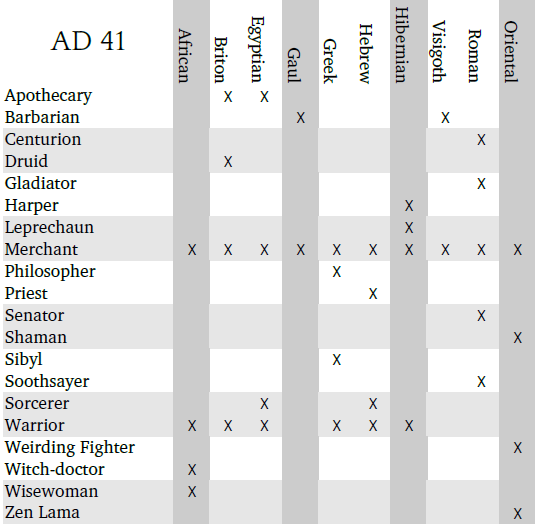
The ten nationalities available for AD 41 era MM&M characters are:  African, Briton, Egyptian, Gaul, Greek, Hebrew, Hibernian, Visigoth, Roman, and Oriental.  For 1375 BC era characters, only the African, Egyptian, and Hebrew nationalities are retained, but the following are added:  Babylonian, Hittite, Minoan, Philistine, and Sumerian.  Each nationality is associated with at least two classes.  As I mentioned before, determination of nationality and class is random.  Nationality may be rerolled only when a previous incarnation of the character was of the rolled nationality.  Class can be rerolled, but the second roll is final.

Here are charts showing the various classes for each nationality.


Each class has a “prime ability” which indicates the use to which the character's SKILL may be applied.  For instance, the Anakim, Barbarian, Centurion, Gladiator, Warrior, Weapon Master, and Weirding Fighter classes all have 'combat' as their prime ability.

All nationalities have a Merchant class (“the most broadly based of all character classes”), the prime ability for which is 'wealth increase'.  This means that the value of the character's treasure is modified based on Skill and Intelligence.  For every twenty points (or fraction thereof) of Skill over fifty, value is increased by 10% (or 15% for Hebrew Merchants); however, for every twenty points (or fraction thereof) of Skill under fifty, value is decreased by 5% (except Hebrew Merchants do not suffer this penalty).  For every twenty points (or fraction thereof) of Intelligence over fifty, value is increased by 5%.  In game terms, the only differences among the Merchant classes of the different nationalities (other than Hebrew) are their permitted weapons and armor.

Most nationalities have a Warrior class.  In addition to their permitted weapons and armor, each nation's Warrior class is made distinctive by special abilities.
African:  In tropical environments, +5 to hit and +10 damage; however, in Arctic conditions, the modifiers are -5 to hit and -10 damage.
Babylonian:  When fighting in a city, +5 to hit.  (technically, -5 THN)
Briton:  “Gains a +5 on damage if body and face are stained blue with woad.”
Egyptian:  In desert environments, +6 to hit and damage.  When using a bow, +5 to hit and damage.
Greek:  Via deception, has a 31% chance of gaining first strike in combat regardless of First Strike Capacity.
Hebrew:  When fighting alongside a Hebrew Priest, +5 to hit and +10 damage.  “On a roll of 85 or better...will feel compelled to offer food to an opponent.”  This means the Hebrew Warrior will not have first strike, regardless of First Strike Capacity.
Hibernian:  When fighting in the rain, +5 to hit and +10 damage; there are no negative modifiers for “fighting in fog or mist.”  Once per segment, Hibernian Warriors can heal their own wounds.  For every one POWER spent, three Life Points are regained.  When taunted, there is a 50% chance that a Hibernian Warrior will attack.
Hittite and Sumerian:  Can fight from a chariot without penalty.
Minoan:  When “fighting at sea or on board a boat,” +5 to hit.  (technically, -5 THN)

Of course, combat classes that aren't Warriors also have distinctions.  Gallic Barbarians receive +10 Courage (not to exceed 100).  Visigoth Barbarians get +10 Courage and Strength; additionally, when at least three are fighting together, they have +5 to hit and +10 damage. Philistine Anakim use a special table for determining hight and weight.  Opponents must succeed with a Courage roll to gain first strike, regardless of First Strike Capacity; however, Anakim may not use magical artifacts.  “Roman Centurions are entitled to hire and lead up to 100 mercenaries.”  A Centurion in combat may spend 10 POWER to make a percentile roll.  With a result of 26 - 60, allies receive +5 to hit and damage for the remainder of the combat; if the result is over 60, the modifier is +10.  Roman Gladiators get +5 to Courage, Skill, Speed, and Strength characteristics.  They never suffer combat penalties but they must fight (at least) once in the Arena between adventures.  The THN of a Hittite Weapon Master can never exceed 45.  Weapon Masters can train other characters how to use weapons they would not normally be allowed to use.  Finally, Oriental Weirding Fighters receive +10 to Speed and Endurance.  Bare hand damage is at +15, “while kicks with his feet strike at +25 damage.”  At a cost of 10 POWER, a Weirding Fighter can paralyze an opponent long enough to attack him twice; this is accomplished by ch'i energy.

The Astrologer, Seer, Soothsayer, Sybil, and Zen Lama classes all have “psychic” as their prime ability.  This means that – by spending POWER – they have access to the following eleven psychic talents.
Body Blow:  Automatically inflict damage on any one human within ten feet of the character; damage equals POWER spent.
Glimpse:  The character gains vague information about a distant or future event.
Hunch:  The character can “determine if a given course of action will prove dangerous or beneficial.”
Illusions:  By means of “mass hypnosis,” 1 - 100 humans see something that doesn't actually exist.  Someone not subject to the illusion can convince someone who is subject that the illusion is not real; however, the subject character must have at least 50 Intelligence.
Mind Reading:  The character can determine the main concern of any one person within twenty feet.
Tulpa Creation:  The character can “create an illusionary human or animal” that will act independently for one segment.  (rabbit hole)
Teleport:  The character can “mentally transport any inanimate object through any non-magical barrier.”
Telepathy:  The character can transmit information (in the form of words) “to any willing subject over any distance.”
Demoralize:  Once per turn, any one character within twenty feet must succeed with a 'courage check' or else flee.
Mirror Image:  The character can create a number of illusionary duplicates.
Empathy:  By handling an object, the character can determine what its owner was feeling when last in contact with the object.

Astrologers have a chance of identifying “the use of any artifact.”  On a clear night, they can study the stars to “predict whether a given course of action will prove harmful or beneficial.”  This is like the 'hunch' talent (above), only without the POWER cost.  Of course, Astrologers can devise horoscopes to obtain the answers to three yes/no questions “regarding the future of certain propositions.”

Hittite Seers must dance until exhausted (losing 20 Life Points) once per week.  They can commune with birds.  Perhaps more importantly, the Seer can engage in “Healing Empathy.”  Essentially, this allows the Seer to restore an injured character's Life Points by transferring his or her own Life Points.

The Soothsayer class has the ability of prophecy.  If used, the Lore Master must provide “a short, obscure rhyming prophecy pertaining to dangerous or unpleasant aspects of the current situation or...the next danger or unpleasantness the party is likely to encounter.”  However, when this ability is used, there is a 6% chance that the character “will lose the prophetic ability for three segments.”  Another ability of this class is a 31% chance of repelling “any chosen character” to a distance of fifty feet.

The Sybil is one of two MM&M classes that require the character to be female.  Each segment, there is a 2% chance that a Sybil will fall into a trance for an unknown length of time.  The Sybil has a 'prophecy' ability like the Soothsayer; however, unlike the Soothsayer, the Sybil's 'prophecy' must be about the current situation.  Also, a Sybil can 'infatuate' any one male at a chance of 41% (or 6% against Leprechauns).

A Zen Lama has +50 Endurance (not to exceed 100) by virtue of lung-gom-pa and has +10 to hit and damage in freezing conditions as a result of “tumo.”  The special ability of this class is “The Glance of Death.”  Once per segment, the character has a 6% chance of causing the instant death of any one opponent by scrambling his/her/its brain waves.