Showing posts with label Man Myth & Magic. Show all posts

Sunday, October 5, 2014

The Player Character in Timeship

Signed by “C. A. Millan”

Timeship is one of those role-playing games where players are expected to portray themselves.  Since players are not adopting roles, it is more of a 'hypothetical situation' game than a 'role-playing' game.  However, 'role-playing' has fewer syllables and the Timelord certainly adopts roles during the course of the game.

Defining famous real or fictional people in terms of a specific game system can be entertaining if not instructive.  Yet famous people tend to be famous for a reason, usually due to one or several accomplishments.  Such accomplishments are typically the basis for translating a person into a set of game statistics.  Most players, however, are not famous and their accomplishments are of a more modest nature.  More to the point, many players (your humble host included) are not well-suited to a life of adventure.  After all, escapism is a major reason players turn to role-playing games.  Players are more-or-less “average individuals” most of the time and “average” is that which they seek to escape.  In a player-as-character game, the escapism takes the form of the extra-ordinary circumstances of the adventures in which the player characters partake.

I am not opposed to the notion of players portraying themselves.  (I once ran a campaign where some of the players played themselves as described in Hero System terms.)  The conceit can be entertaining in ways playing a different persona cannot.  I merely opine that quantifying players as characters can be difficult; especially so in achieving an objective, 'realistic' representation.  Depending on the game system, there may be few means to distinguish 'average' characters from one another.  On the other hand, depending upon gamemastering style, codification of players-as-characters may be of little importance; interaction may supercede game mechanics.

Nowadays, we have tools that can help define our game-selves; in the old school era, we were left to our own devices.  In Villains & Vigilantes, players are encouraged to play themselves.  This requires the gamemaster to assign scores on a 3 - 18 scale to Strength, Endurance, Agility, Intelligence, and Charisma.  “Smaller people tend to be more agile than larger ones” and “accept high grades in school as evidence [of Intelligence], but not as proof” are examples of the meager guidelines provided to assist with this task.

It's possible to learn something about a role-playing game through an examination of its character sheets.  Of course, in Timeship, players are represented by themselves – not 'characters'.  Therefore, Timeship has 'Personal Data Sheets' instead of character sheets.  For the reader's edification, an official Timeship Personal Data Sheet is presented below.


There is no name field.  It's easy enough to scrawl a name at the top of the sheet but a virtue of playing one's self is that one is intimately familiar with one's name.  However, the most prominent portion of the sheet is the 'To Hit Numbers By Weapon Type' section.  (Readers may recall that Man, Myth & Magic also uses 'To Hit Numbers' and they function similarly in Timeship.)  All Weapon Types have a default THN of 60; meaning that the result of a percentile dice roll must equal or exceed 60 in order to hit an opponent.  Players can reduce the THN for specific Weapon Types by distributing (at most) forty points.  No THN may be reduced by more than fifteen points; however, players may allocate up to thirty more points among Weapon Types (including Weapon Types that had previously reduced by the fifteen point maximum).  There is a cost for the (up to) thirty point allocation; every reduction point for a given Weapon Type requires a point be added to another Weapon Type's THN (thereby decreasing the player's chances to hit).  With the (up to) thirty point allocation, no THN may be raised or lowered in excess of ten points and “[n]o less than 3 points may be added to a single category so long as 3 or more points remain to be allocated.”

The next section of the sheet deals with tracking “energy” and the third – and largest – section is reserved for an inventory of “Weapons and Equipment.”  The position of “Physical Abilities” on the sheet is marginal (literally).  Perhaps they were an afterthought.  The instructions for filling out the Personal Data Sheet are presented in their entirety on the back cover of the Timeship book.  The section about Physical Abilities consists of a single paragraph.  The 'Speed' Physical Ability (sometimes called 'Speed Factor') is discussed in the parts of the rules having to do with movement and combat.  However, none of the other Physical Abilities are even listed in the rules, much less described.

So, the Personal Data Sheet identifies the Physical Abilities as:  Speed, Endurance, Intelligence, Strength, Dexterity, and Agility.  Intelligence is not typically grouped with 'physical' characteristics and – in a players-as-characters game – player intelligence would be manifest; it need not be expressed in game terms.  Anyway, each Physical Ability starts at a value of fifty.  Unlike THN, rolls that regard Physical Abilities succeed when the result is less than or equal to the ability value.  Players have up to fifty points to allocate among the Physical Abilities without restriction (beyond “an honest and sincere evaluation”).  The sheet also lists 'Running Ability' and 'Jumping Ability' in the same area as the Physical Abilities but they are derived attributes according to the “Time Lord Screen.”  (Timelord is usually treated as one word.)  Running Ability is the average of Speed and Endurance while Jumping Ability is the average of Speed, Strength, and Agility.

Sunday, September 28, 2014

Man, Myth & Magic versus Timeship

Art by Clyde Caldwell

The contents of Dragon #80 (December 1983) offer a glimpse into the state of gaming as it was three decades ago.  The “Dungeon Master's Familiar” article provides the entire code for a program intended to facilitate AD&D combat.
This program was written to run on a Radio Shack TRS-80, but it can be used easily in any computer that uses a variation of Microsoft BASIC.  To use the automated combat segment, you need a disk drive...
In his introduction to the issue, Kim Mohan presents submission guidelines for computer programs.  He explains that programs should not be extensive...
...even if they're good, because most people couldn't cram them into their 16K or 32K systems.  We'll look at programs for 48K or 64K systems, but they'll only be accepted if they need to be that long.
What a difference 31 years makes.

The “How many coins in a coffer?” article goes into profound detail about numismatic dimensions, metallic impurities, specific gravities, and – for some reason – the speed of light.  Regardless, the author concedes that – for the sake of playability – “all coins are the same size (diameter and thickness) and weigh a tenth of a pound each.”  This is acceptable because AD&D™represents fantasy, not reality.  Good to know:  “...the figure for a loose coin is 110% of the effective volume of a stacked coin...”

One article, “Five keys to DMing success,” has the sub-title, “Reducing the work, increasing the fun.”  Huh?  Less work?  More fun?  How baffling!  Must be old school.

In any event, the purpose of this post is not to analyze old issues of gaming magazines; your humble host surrenders that task to bloggers greater than himself.  This post compares and contrasts the games Timeship and Man, Myth & Magic.  It just so happens that Dragon #80 contains reviews for both games.  It just so happens that both reviews were written by the same person – Ken Rolston.  (The same issue has another review by Rolston as well as an article he wrote on how to write game reviews.)  Here is an opportunity to see how a (professional) reviewer perceived both games at a time when those games were still in print.  In short, Rolston's verdict was:  MM&M, thumbs down; Timeship, thumbs up.  These are similar games from the same creator, yet the assessments were contradictory.  Why?

Rolston did not consider Timeship to be without flaws.  He recommended the game “[d]espite its weaknesses in game design” and notwithstanding his contentions that “the organization of the rules is confusing and the style is occasionally unpalatable.”  Rolston expressed similar misgivings for MM&M but was unable to overlook them when establishing his opinion of that game.

With regard to rules, Rolston wrote:
The term used locally to describe the level of sophistication of the mechanics of Timeship is “goofyworld,” a generally positive term suggesting wild and crazy action, with fast-and-loose judgements left pretty much in the hands of the referee, under the assumption that there is little competitive pressure and that the referee is basically out to show the players a good time.
Herbie Brennan expressed similar sentiments in the advice section of Man, Myth & Magic.  While Rolston commented that Brennan's advice was “practical and intelligent,” he did not believe it was “successfully translated” for MM&M.  Still, Rolston stated with regard to MM&M, “In fairness, I suspect a skilled gamesmaster could make the rule system and scenarios work...”

Rolston felt that the time-travel premise of Timeship reflected “the stuff of thousands of daydreams and fantasy adventure stories.”  Man, Myth & Magic, on the other hand, did not conform to any “literary adventure genre models” nor was it an “historical simulation game [although] it makes no claim to be.”

Was premise the deciding factor in Rolston's opinion?  He wrote:
Whatever reservations I might have had originally about Timeship were dispelled when I playtested the game with our local weekly gaming circle.  I don't believe I've seen FRP gamers have so much fun in years.  Everyone was quite enthusiastic about the concept of the game, and the players were quite willing to overlook any faults in the rules...As a gamesmaster, I was surprised at how smoothly the session ran, despite my original impression...
Regarding Man, Myth & Magic, however, Rolston “never felt tempted to playtest the game...”

Ultimately, Rolston praised Timeship for simple mechanics, accessibility to non-gamers, and the “marvelously fertile” genre of time travel.  He faults MM&M for poor execution (“not up to industry standards”) and a lack of innovation.  Perhaps if Rolston had the experience of playing MM&M – especially with a skilled gamesmaster – he might have been more inclined to forgive its flaws as he did with Timeship.  Perhaps not.  If a game lacks sufficient appeal even to want to play it, then it has failed on a fundamental level of engagement.  Evidently, a game with “historically implausible party composition” did not appeal to Rolston, nor did it particularly appeal to RPG consumers of the time.  As Rolston queried, “[W]hat would a Hebrew priest, a British apothecary, and an Egyptian warrior be doing together in the first place?”

Well, they could try walking into a bar.

Sunday, September 21, 2014

The Man, Myth & Magic Grimoire


“Sorcery is not a bowl of cherries,” remarks the Man, Myth & Magic rules.  The successful casting of a spell is dependent upon overcoming the Fundamental Failure Rate.  For “every activity,” (Advanced) MM&M characters have a Fundamental Failure Rate.  By default, this rate is 50%; meaning “you will have to throw 50 or better on the percentile dice to score a hit [or otherwise succeed].”  (I know, that's a 49% chance for failure.  What difference does a single percentage point make?  A great deal actually; read on.)  Circumstances can modify the Fundamental Failure Rate.  For example, a warrior's SKILL characteristic affects his or her Fundamental Failure Rate for striking a foe in combat.  According to page 12 of Book II:
For every 10 SKILL points above 50, subtract 1 from your basic 50 needed to hit.  For every 10 SKILL points below 50, add 1 to the score you need to hit.
So, a warrior with a SKILL value of 40 would succeed in a combat strike by throwing 51 or better.  The rules would have been better served by having a Fundamental Success Rate instead of a Fundamental Failure Rate.  High SKILL values increasing success rate with low values decreasing success rate is a more intuitive concept.

The rules explaining the Fundamental Failure Rate and how it is affected by SKILL are provided in the (Advanced) Combat section.  Evidently, these rules are meant to be extrapolated to 'Prime Abilities' other than combat.  Each class has a Primary Ability; for warrior-type classes, it is combat.  The African Witch-Doctor, Egyptian Sorcerer, Hebrew Sorcerer, Oriental Shaman, and Hibernian Leprechaun all have 'magic' as their Primary Ability.  As such, they are capable of casting all of the spells in the Grimoire.  Each of these classes also has a set of spells exclusive to that class.  Other classes (e.g., Sibyl, Priest) have “spells,” but these are considered to be psychic or divine powers and such classes do not have access to the Grimoire spells.  There are 37 distinct character class/nationality combinations in the standard (AD 41) MM&M setting, so only about one character in six will have Grimoire spells.  The ratio is even less in the ancient (1375 BC) setting, with 43 distinct character combinations and only three of which have a 'magic' Primary Ability.  (The Shaman and Leprechaun classes are not available.)

For (Grimoire) spells users, the Fundamental Failure Rate can be altered by both SKILL and INTELLIGENCE.  Assuming ±1 per ten points above/below a value of fifty, there is – at most – a mere 19% difference in the Fundamental Failure Rate between the smartest, most competent spell caster and the dumbest, least competent spell caster.  Thus, a single percentage point becomes significant.

Each spell has a 'casting cost' in POWER points; the points are spent whether or not the casting roll is successful.  Of course characters (not just spell casters) can increase their chances of success (for one roll) by 1% per ten POWER points spent.  Additionally, for 250 (permanent) POWER points, a character may increase a characteristic value by one point.  Given that reincarnation costs 200 POWER and that characteristic values will be redetermined as part of reincarnation, this may not be a wise investment.

According to the rules, “if you are using a spell which takes effect at a distance, there is no immediate way of discovering whether or not it was effective.”  This suggests that the Lore Master makes all spell casting rolls.  However, for all but two of the Grimoire spells, the maximum distance at which a spell can take effect is fifty feet.

Any gold pieces within fifty yards of the caster will mumble “Here I am” upon the successful casting of Gold Sniffer (10 POWER).  The same thing happens with Treasure Finder (15 POWER) except gems speak, not gold pieces.  With Lie Detector (10 POWER), the caster may “detect falsehood in any one given statement.”  Does “statement” mean one item of information?  One sentence?  How does one target a “statement”?  Is it retro-active?

Any “mortal human or beast” must succeed with a COURAGE roll in order to travel through a Circle of Fear (10 POWER per 20' radius).  Web (25 POWER) causes “a 10 ft. diameter vertical web” to come into being.  Assuming the the web is placed over an opening of less that ten feet in diameter, “mortal humans and animals” will not be able to pass (until the next segment).  Pathfinder (15 POWER) allows the caster “to retrace steps in any terrain.”  With Freeze (30 POWER), the caster paralyzes a target for the remainder of the segment.

Poltergeist (30 POWER) causes “an invisible imp” to come into being.  It “can throw small objects and set fire to easily burned materials.”  On any given turn, there is a 50% chance that the imp “will obey the caster's wishes.”  I suppose that means “obey the caster's wishes” to the extent the imp is able.  I also suppose that the caster must vocally command the imp, but I could be wrong.  Speaking of invisibility, the caster may cause “any object he may hold in his hands” to become invisible with a successful casting of Invisible Object (40 POWER).  A caster “may make himself invisible” with Invisibility (85 POWER), the most expensive of the Grimoire spells in terms of base POWER cost.  Note that the caster's clothing and accoutrements are not rendered invisible with this spell.

A Zone of Purity (40 POWER) is a 20' diameter circle in which “no spells may be cast until the end of the segment.”  Of course, spells already in effect remain unabated.  To stop an existing spell, the caster must successfully cast Terminate within twenty-five feet of where the effects of the target spell manifest.  The POWER cost is equal to the target spell's POWER cost, but in no instance may it be less than 10 POWER.

A successful Curse spell “causes magical weapons and artifacts to lose their magical properties” permanently.  The POWER cost of the Curse spell is equal to the POWER cost of the target object's enchantment (which, of course, the caster may not necessarily know).  If the caster does not have enough POWER to cover the cost, “the balance is taken from him in Life Points at a ratio of 3 Life Points for each POWER Point.”  For reference purposes, a harp that plays by itself costs an Egyptian Apothecary 25 POWER Points to create while a 'Blessed Bow' (-10 THN) costs an Oriental Shaman 100 POWER Points to create.

Sunday, September 14, 2014

Adventures and Random Encounters in Man, Myth & Magic (Spoilers)


Book III of the Man, Myth & Magic set is The Adventures Book, containing a 'basic' adventure, an 'advanced' adventure, advice on being a Lore Master, and some random encounter tables.

The basic adventure is a simple 'infiltrate and destroy' mission.  The advanced adventure does not have a title per se, but consists of four 'linked' episodes.  Each episode is divided into game-time periods called segments.  Surviving a segment allows a character a POWER roll and at least some damage recovery. 

To be blunt, the advanced adventure is a railroad; in fact, the Lore Master's advice (four pages under the modest heading 'How to Become the All-Time Greatest Lore Master of the Known Universe') includes a section titled 'Getting Players Back on the Rails'.  In fairness, Brennan states that players – not the Lore Master – should “control the action” and that Lore Masters should not “break their necks to try and make sure players follow a particular pre-determined sequence.”  In other words, players should be allowed to leave the “rails” but the Lore Master should “get his players back on the real track of the adventure without their suspecting anything is amiss; and without their getting restless or bored.”  To assist the Lore Master with accommodating the players' impromptu peregrinations, the book provides a few “standard” maps.  (At the end of this post I provide scans of the “standard cave complex” map and the “standard underground complex” map.)

The first episode (less than two-and-a-half pages of text) is called The Dragon Loose in Rome.  Essentially, players must develop a strategy to defeat a “dragon” that is practically invulnerable to weapons.  In the second episode, Apollo's Temple, Emperor Caligula summons the player characters to his presence.  Because of their success defeating the “dragon,” he assigns the characters a “special task.”  Caligula wants the characters to learn the secret of Apollo's Temple (i.e., Stonehenge).  The reward is great; however, if they fail, the Legions of Rome will seek them out and bring them back to Rome for an “extremely painful” fate.

The party goes to Britain and, en route to Stonehenge, there are three 'Road Encounters'.  Two of these encounters can provide clues regarding the episode's climax.  At Stonehenge, the party confronts a group of evil druids about to engage in human sacrifice.  Once the druids are defeated and the clues deciphered, the party can perform a ceremony that 'activates' some of the stones.  Different stones – distinguishable by color – generate distinct effects when touched.  Some effects are beneficial, such as healing or “granting the single item each [party] member desires most at that present moment.”  Some effects are bad, such as being disintegrated or sent to hell.  One stone summons a “Ban Sheed.”  What is a Ban Sheed?
This fearsome creature appears in the form of a very tall, white robed and dark haired woman, but is, in fact, the sexless representative of an alien race of beings who once inhabited the Celtic Islands during an era of almost unimaginable antiquity.
It is revealed that the Ban Sheed is the basis of the banshee legend.  Anyway, the party can only progress to the next episode by being sent to hell.  The adventure was designed for six characters; since there are five stones, it is reasonable to expect that someone will touch the 'hell' stone.  However, there are psychic abilities that can provide characters with information about possible future events.  Also, the Ban Sheed can tell the party the effects of a given stone.  Alternately, the Ban Sheed can also destroy Caligula, thereby dispensing with the party's motivation.

Assuming the party goes to hell, they are given a scroll by some old guy in robes and informed that “the fate of your planet now rests squarely in your hands!”  The party returns to Stonehenge after being subject to a poem of fifty-six lines.  The old guy's scroll indicates that the party should go to Hibernia and the next episode, The Witches of Lolag Shlige, assumes that they do so.  It just so happens that, in Hibernia, there is a “prediction” that “a party of strangers” will find and rescue the infant nephew of the king.  The party is supposed to discover that the infant was kidnapped by the titular witches and then go to the House of Lolag Shlige to effect a rescue.  The 'house' is presented in the style of a dungeon; there are two levels and a description of the various rooms.  One of the denizens is a “Pollyrotten” which is “a peculiar breed of paranoid parrot...indigenous to Hibernia in prehistoric times.”  The episode ends in a confrontation with the aforementioned witches.  If the party loses, I guess they die.  If the party wins, the witches cast a spell that transports the party to “an eerie, moonlit shore.”  The only way to leave the location is via a boat piloted by a “robed and hooded boatman.”

In the boat, the characters lose consciousness; when they wake, they find themselves in Egypt and thus begins the fourth episode, The Great Pyramid Revealed.  The party finds a scroll that leads them to a fishmonger who informs them that Caligula “has issued a Death Warrant for members of the party.”  (Given that the characters can reincarnate, this doesn't seem like much of a threat.)  The fishmonger also lets the party know that they must go to the Great Pyramid of Giza because of a dream he had.  The interior of the pyramid (for purposes of the adventure) is displayed in the graphic at the beginning of the post.  Compared to the real thing, it is only slightly embellished.  In Location 10, there is “a rare subterranean plant...that feeds directly on energy.”  The plant will cause a character to become “a shattered, unconscious husk of 6 Life Points.”  The plant can be avoided by edging along the sides of the chamber; however, contact with the side walls “leads to a total sex change by the current segment.”  At the end of the episode, the characters find themselves in Hibernia, but ten years have passed since the second episode.  There are actually five more episodes to this adventure, but they were sold separately.

Random encounter tables are provided only for the regions where the adventures take place:  Roman Britain, Roman Italy, Egypt, and Hibernia.  It would have been nice to have tables for other regions, like Greece or Gaul, but I suppose one can't have everything.  For each region, there is a table for the following terrains:  Open Road, Wilderness, Forest, Village, Town/City, and Underground.  (There is no Forest table for Egypt.)  Using a table requires a percentile roll. The Lore Master has a choice of using the indicated encounter or any of the preceding encounters on the table.  For the sake of example, here is the 'Open Road' table for Italy:


With a roll of '44', a party may encounter a foreign traveller, a merchant, a peasant farmer, or a formation of Legion soldiers.  Note that the first encounter requires a minimum roll of '20'; anything less than that means “the Fates have decided your party encounters nothing at that time.”  The table above is rather tame compared to many of the other tables.  Most tables have a '100' listing with a suitably rare encounter.  For instance, the 'Wilderness' table for Italy allows for a 1% chance of encountering “the god Jupiter.”  Brennan uses this result in an example of how to 'present' encounters to players.
You might present him sitting on a rock throne hurling thunderbolts to wipe out the party, but this, surely, lacks a certain subtlety.  He might equally well be presented as a naked youth with amazing powers, who may even aid the party if they are nice to him...
Other '100' results include a talking bulldog, a giant weasel, Caligula in fancy dress, and “Pharaoh's cousin (so he claims).”  Other, more common, encounters include a funeral procession, up to one-hundred village idiots, a bear, a brass golem, bugs, and a sandstorm.  However, Brennan saves the most colorful encounters for his native Hibernia.  Eight Hibernian encounters are explicitly described as “drunk” and only one encounter is listed as “sober.”  Some examples of Hibernian encounters include:  beautiful colleen (with mother hidden in trees), intelligent shamrock, fake Leprechaun, vampire pig farmer*, two-headed calf, and “Drunk Hibernian Lore Master who fell into his own scenario and couldn't find his way out.”


We are left to ponder which is vampiric – the farmer or the pigs?  Or both?


Sunday, September 7, 2014

Character Classes in Man, Myth & Magic (part IV)

Art by Angus McBride

Some of the character Classes in Man, Myth & Magic have 'negative abilities' in an attempt to balance (I suppose) the powers and talents that the Classes supply.  We have seen a few examples in prior posts; a Hebrew Warrior may “feel compelled to offer food to an opponent” and Leprechauns can disappear from play for a segment at a time.  Here are a few other examples:
  • Visigoth Barbarian:  Once per segment, if given any order by friend or foe, there is an 11% chance the character will obey it “without question.”
  • Philistine Warrior:  “Will attack immediately if his family or heritage is insulted.”
  • Oriental Shaman:  There is a 6% chance per segment that the Shaman will be “unable to fight or use magic or any special ability for two segments” as a result of “mushroom poisoning.”
  • Egyptian Physician:  May never start combat and “will always be hit in the first round of a Combat.”
  • Egyptian Priest:  Once per week, must engage in self-laceration (at least 25 Life Points worth of damage) and fasting.
  • Egyptian Sorcerer:  Upon entering a tomb, there is a 2% chance that the character will refuse to leave voluntarily.

For the Alchemist classes, the prime ability is “Science.”  Alchemists don't believe in magic, so they can't use magic; I suppose, however, they can be affected by magic.  An Egyptian Alchemist can do the same things as an Egyptian Apothecary, except at three times the POWER cost.  This is interesting because the Egyptian Apothecary can craft amulets, charms, talismans, and artifacts – all of which have magical effects.  The description of the Egyptian Alchemist class acknowledges that the character's creations may be magical, but the character may not use them.  Items that an Egyptian Apothecary (and Alchemist) may create include:
  • Seal of Solomon:  The user can command any one demon for the remainder of the segment.  (Yes, Egyptians create the Seal of Solomon.)
  • Rope:  “Is uncuttable and unbreakable.”
  • Hammer:  “Will drive in or pull out nails without an operator.”
  • Box:  A six inch cube that can nonetheless contain a volume of six cubic feet.
  • Negative Sand:  Damage from “magical injury” is reduced by ten points per use.

Egyptian Alchemists can also analyze potions and can attempt to “transmute” one pound of metal to one ounce of another metal (because that's science).  By contrast, Babylonian Alchemists have a 50% chance of identifying compounds and can spend two months to add one point to either SKILL or INTELLIGENCE.  Regardless of nationality, Alchemist characters can do the following things.
  • Identify Non-Magical Machines/Artifacts:  An Alchemist can also “determine how to operate” such devices.
  • Make Corrosive Acid:  Each “dose” costs five points of POWER and consists of water, mercury, and ten Life Points of the Alchemist's blood.
  • Make Fire Bombs:  These bombs consist of “oil, sulphur and salt.”  They “burn with three times the intensity and effect of burning oil” but must be used within six hours of being made.
  • Intensify Poison:  Distilling a batch of poison doubles its effectiveness and increases the duration of its potency by three times.
  • Repair Metal:  An Alchemist can attempt to repair a metal item “using a combination of iron, sulphur, and 10 Life Points of his own blood.”

In the 1375 BC Man, Myth & Magic setting, Charioteer is a 'Special Class' that may be selected in conjunction with a character's 'normal' class.  If the Prime Ability of the 'normal' class is Combat, then it may be assumed that the character is already trained.  For non-combat classes, there is a training cost of 500 - 5,000 Gold Pieces (the 1375 BC setting uses pieces/ounces instead of libra).  However, trained non-combat characters have less ability than combat class Charioteers.

Man, Myth & Magic offers two “special categories,” which are Class “aspects” associated more with the player than the character.  The Sage category is for “know it all” players – the MM&M equivalent of “rules lawyers.”  The Orator is for players who are comfortable making extemporaneous speeches.

With regard to Sages, we are told by Book II:
[T]he Sage is obliged to sell information to to fellow players.  Note that this is an obligation.  Information may no longer be volunteered by a Sage, but only offered for sale...
The cost of information is 25 gold libra per item; however, if the Sage provides the wrong answer, he or she must pay 50 gold libra to the player(s) who asked.
Good Sages are very valuable to a party.  Know-all Sages are a pain.  Either way, the MM&M Sage system keeps them under control.
Lore Masters do not determine who is a Sage; a player must decide if and when to become a Sage.  So, “under control” may not be entirely accurate.  The description of the Sage category implies that they provide answers to rule-based questions.  As a player, I would not be inclined to pay gold for information the Lore Master should provide.  I would be more amenable to the notion of the Sage supplying in-game knowledge to which the players had been exposed previously.  Even then, I think that non-gold POWER would be a more appropriate currency.

By delivering “a spoken two-minute (real time) speech on the prevailing situation,” an Orator “...will so fascinate any number of opponents that the Orator's colleagues may always attack first, irrespective of First Strike Capabilities.”  The result of 1d100 determines the “number of opponents affected.”  (I would have imposed a cost of one POWER per incapacitated opponent.)  The Lore Master must be given “advance notice” of any of such an oration.  To become an Orator, a player must pass an examination in which he or she must “speak fluently, amusingly and without a break for three minutes (real time)” on a topic of the Lore Master's choice.

Sunday, August 31, 2014

Optional Characteristics in Man, Myth & Magic


As discussed previously, characters in Man, Myth & Magic have six basic characteristics:  Courage, Endurance, Intelligence, Skill, Speed, and Strength.  The sum of their values equals the amount of 'Life Points' that a character possesses – the amount of physical harm the character can sustain.  So, everything else being equal, smarter people are more durable than dumb people.  As a game mechanic, I don't have a problem with this.  Someone who has bought into the concept of Leprechauns, gladiators, Zen mystics, and Egyptian sorcerers reincarnating into one another cannot decry a lack of realism.  Regardless, determining Life Points by adding together all of the basic characteristics is a simple and convenient notion.  Also, beginning characters will tend to have similar Life Point totals; each added characteristic means a closer approximation to the “average.”  So, using all of the basic characteristics for Life Points helps to balance characters.

The rules do not explicitly define most of these basic characteristics, but they are largely self-explanatory – especially for people versed in RPG terminology.  'Skill' is an exception; it means something different for each character type.  For warriors, 'Skill' is combat training.  For sorcerers, it is magic proficiency; for merchants, it is salesmanship.  Let's take two hypothetical characters who have the same basic characteristic values as each other.  One is a warrior and the other is a merchant.  To the same extent, their 'Skill' contributes to their respective Life Point totals.  Some of the warrior's Life Points are due to combat training.  Fair enough, but the merchant has the same number of Life Points because he can get a good deal on a rug.  Perhaps instead of considering the effect of the Skill, we should interpret the talent and/or determination inherent in the Skill to be a metaphysical 'source' of Life Points.  If you don't buy that argument, just tell yourself, “Leprechauns.”

Book II of Man, Myth & Magic contains a section detailing various 'optional characteristics' that may be used “to increase the depth of your characters.”  The are typically expressed as percentile scores.  (Incidentally, the MM&M notation for percentile dice is “2d20%.”  This is a testament to the old-school nature of the game.  Back in the day, we didn't have ten-sided dice; we had twenty-sided dice numbered 0 - 9 twice – and we were grateful.)  The optional characteristics do not influence Life Points; however, as mentioned before, some optional characteristics – most notably Agility, Dexterity, Sight, and Throwing – provide modifiers when using certain weapon types.

The Luck optional characteristic is not represented as a percentage.  Instead, a die is rolled generating a result from 1 to 10. Modifiers are applied and the total is divided by three.  This is the number of times per adventure that the player may re-roll a result (or cause a roll made against the character to be re-rolled).  “Luck may not be used to offset death caused by a natural dice roll of 100...”

Height determination is a flat distribution.  'Normal' humans can be anywhere from 4' to 6'6" at intervals of 2" except that 4'4", 4'10", and 5'2" are skipped without explanation.  Leprechauns can be either 3'6" or 4' and Anakim have their own table ranging from 6'6" to 7'3".  The roll for Weight is determined by indexing a percentile die roll on a Height chart.

Many of the optional characteristics are shown in the “LM'S LIST OF CHECKING DICE ROLLS” graphic above.  This list is found on the back of the “ADVANCED CHARACTER STATISTICS SHEET” for ease of reference.  A successful roll means rolling high in some cases and rolling low in others and the distinction is not intuitive (or else there wouldn't be a need for such a list).  For Hearing, a successful roll is higher than the value but, for Sight, a successful roll is lower than the value.  Is consistency too much to ask for?  Incidentally, the only other 'sensory' characteristic is Senses which “represents a players [sic] ability to sense danger or trouble.”

Characters (in the AD 41 setting) “are assumed to speak their native language and Latin...Roman characters are assumed to speak Latin and Greek.”  The Language optional characteristic determines the chance a character can speak a third (and possibly a fourth) language.  The Read & Write optional characteristic determines if a character is literate (must have a score of at least 70) and – if so – with how many languages.

The “Player Characteristics Modifiers Table” takes up a complete page and provides basic and optional characteristic modifiers for each of the classes/nationalities.  (The Egyptian Trilogy provides an equivalent table for the 1375 BC setting.)  Fewer than half of the classes/nationalities have basic characteristic modifiers less than –5 or greater than +5.  Gaulish Merchants have no modifiers for basic characteristics so I assume they represent the 'average' of humanity.  Optional characteristics are more likely to have modifiers in the range of ±10, ±15, or even ±20.  Spellcasters tend to have a positive modifier for Luck and no class has a negative modifier for Luck.  An Egyptian Merchant has a +15 modifier for Woods Knowledge (bad) while a British Druid has a –15 modifier (good).  In contrast, the same Merchant has a –10 modifier for Desert Knowledge (good) and the Druid, a +10 modifier (bad).

Sunday, August 24, 2014

Character Classes in Man, Myth & Magic (part III)

Art by Angus McBride

The only Priest class available in the 'original' Man, Myth & Magic setting is Hebrew.  Once per segment, a Hebrew Priest has a 41% chance to “commune with his Deity” thereby obtaining a truthful yes-or-no answer to a question.  Once per adventure, a Hebrew Priest has a chance (based on the character's SKILL) to “work” a miracle.  For purposes of MM&M, a miracle must be expressed as a written statement of no more than twenty-five words and is subject to literal interpretation by the Lore Master.  With a POWER expenditure of only 150 points, a miracle costs less than a Leprechaun's wish.  The class description for the Hebrew Priest explicitly states, “Magical Abilities:  None.”  Regardless, several Hebrew Priest 'spells' are described in the back of MM&M Book II.  The spells are appropriately thematic:  Part Waters, Water from Rock, Manna from Heaven, Fiery Hail, Angel of Death, Pillar of Fire, and Lazarus Lives.  (For the sake of comparison, here are the spells specific to Hebrew Sorcerers:  The Ear of Baalam, Joshua's Tongue, The Eyes of Elija, Walk on Water, The Jug of Gideon, Conjure Cherub, Seeker, Conjure Demon, Sanctuary, and Bridge over Gehenna.)

'Lazarus Lives' is an interesting spell for a game where reincarnation is a primary feature.  At a cost of 30 POWER, the Priest has a 20% chance of restoring life to a character who died that same segment.  If successful, “the Priest loses an amount of POWER Points equal to the restored character's total Life Points.”

In The Egyptian Trilogy 'setting' for MM&M, several other Priest classes are introduced.  (Original MM&M takes place circa AD 41 while The Egyptian Trilogy transpires 1,400 years earlier.)  Specifically, the additional Priest classes are:  Babylonian, Egyptian, Minoan, Philistine, and Sumerian.  With regard to 'magical abilities', the description for Babylonian Priest states, “May not use Spells listed in Grimoire, only Special Character spells for this class.”  Seemingly, this is true of every 'nationality' of Priest, including Hebrew.  The Grimoire consists of thirteen spells “common to all Character Classes having magic as one of their abilities.”  Priests are evidently excluded, as are Apothecaries; some 'magic' classes – like Druid or Harper – don't cast spells per se and others – such as Soothsayer or Astrologer – are 'psychic' rather than magical.  Thus, the classes that have access to the Grimoire are:  Witch-Doctor (African), Leprechaun (Hibernian), Sorcerer (Hebrew and Egyptian), as well as Shaman and Zen Lama (both Oriental).  (It seems that the Zen Lama class has access to the psychic talents as well as the Grimoire spells.)

Only Hebrew Priests are entitled to miracles.  Maybe if the other gods were less stingy with their miracles, their respective religions would have persisted.  Each variety of Priest has its own selection of spells, but instead of invoking miracles, non-Hebrew Priests can craft magic-like items; specifically...
Babylonian:  Can create charms that offset Basic Failure Rate (10 uses)
Egyptian:  Can create a 'Focus' that magic-class characters can use to reduce Basic Failure Rate (10 uses)
Minoan:  With a two week preparation, can enchant a weapon (+1 damage per 25 POWER spent)
Philistine:  Can create an ointment that allows the user to fly
Sumerian:  Can create a personal focus that reduces Basic Failure Rate  (permanent, but costs 50 POWER and takes two weeks)

Instead of being able to commune with their various deities, non-Hebrew Priests have an aptitude with divination – an aptitude shared by Hittite Seers and Sumerian Astrologers.  There are many, many forms of divination; however, MM&M limits itself to nine methods.  In listing the divination types, sometimes the rules use the high falutin' term (e.g., 'hepatoscopy') and sometimes a common descriptor (e.g., 'smoke').  The methods are:  Rhabdomancy (use of divination rods), Incubation (sleeping overnight in a temple), Tarot (a.k.a. Taromancy), Augury (“The study of birds in flight”), Smoke (a.k.a. Capnomancy; +10% chance of success if smoke is narcotic), Dog Howlings (a.k.a. Ololygmancy), Casting Lots (a.k.a. Sortilege), Hepatoscopy (“The study of the liver of an unblemished sacrifice”), and Horoscope.

Aside from Rhabdomancy, which is used “to locate water, oil or a particular type of ore,” and Smoke, which gives “a clue to a future event,” the various divination methods provide a yes/no answer to a question.  For most methods, the question must pertain to the future; however, Incubation allows for “any one question” while with Dog Howlings, the question must regard “another individual.”  Hepatoscopy actually answers six questions and Horoscope, three questions.

The 'Divination Table' shows which classes are capable of performing a given type of divination as well as the POWER cost and Basic Failure Rate modifier.  POWER cost is usually 10 or 15 points, but there are two instances of a 5 point cost and one instance of a 20 point cost.  Modifiers are more often detrimental than beneficial; however, the modifier for Hepatoscopy is beneficial for all classes that can perform it.  An unblemished sacrifice really is the most economical means of gaining knowledge about future events.  The only class that can engage in all forms of divination is the Sumerian Priest.

Sunday, August 10, 2014

Character Classes in Man, Myth & Magic (part II)

Art by Angus McBride

Doubtless, the cats pictured above are leopards.  The Man, Myth & Magic livestock table does not list leopards – an unfortunate oversight – but it does list trained cheetahs, the minimum price of which is 300 gold libra.  Although MM&M provides no bestiary, we gain some insight into the capabilities of leopards via the Witch-Doctor spell 'Leopard Man'.  A leopard (or a Witch-Doctor who has turned into a leopard) gets five attacks per turn and causes damage equivalent to a dagger wielded by a human being.  Some other Witch-Doctor spells include:  Pointing Bone (“kill any single mortal enemy” at a cost of 100 POWER), M'Gumbo Sickener (causes 1-100 opponents “to become too ill to fight”), Voodoo Doll, and Zombie.  The special ability of Witch-Doctors is healing; at no POWER cost, a Witch-Doctor has a 31% of restoring 25 Life Points and a 4% chance of re-attaching severed limbs.  According to the class description, “the Witch-doctor is something of an Apothecary” and “Any poison or death magic compounded...is exceptionally potent.”  However, there are no other details in the rules about this.  Similarly, the description states that the Witch-Doctor “is something of a Warrior,” but there is nothing that elaborates upon this.

Aside from the Witch-doctor, the other class exclusive to the African 'nationality' is the Wisewoman.  Like the Sibyl, only a female character can be a Wisewoman.  The prime ability for Wisewomen is 'healing'.  They can form a healing compound with only “the flower of any plant” and “the root of any other plant.”  The compound takes five minutes to prepare and it must be applied immediately afterwards.  One Life Point is restored for each point of POWER the Wisewoman invests.  Due to “the very ancient Feminine Tradition of Prophetic Lore,” a Wisewoman has an 11% chance of issuing an accurate prophecy “only in [a] segment following consumption of the yarrow herb.”  Also, Wisewomen can craft charms like the Apothecary classes, including a charm exclusive to Wisewomen – a Love Token.

In MM&M, the primary ability of the Druid is something called “The Four Strange Arts.”  According to Herbie Brennan, “No-one is quite sure whether the Four Strange Arts are strictly speaking magical, or purely scientific.”  The Four Strange Arts are:
Stone Lore – “This enables the Druid to set fire to stone which will then burn fiercely until all immediately available stone is consumed” or until the Druid wants it to stop.
Tree Lore – For ten POWER points the Druid can receive a truthful 'yes or no' answer to a question put forth to a tree (which must be at least six feet tall).  This assumes, of course, that the answer is “within the tree's knowledge.”  If the tree is an oak (and the Druid spends a total of 25 POWER points), a response not in excess of twelve words is possible.
Stellar Lore – “A form of astrology” which allows the Druid to obtain a 'yes or no' answer about the future.  This costs fifteen points of POWER per question.
Mekhenesis – Apparently, this “is the old term for hypnosis.”
Regardless of their magical or scientific nature, Druids lose “all abilities in the Four Arts for three segments following a solar eclipse.”

The prime ability of the Philosopher class is 'information retrieval'.  At a cost of fifteen points of POWER, a Philosopher “can attempt to gain information on the essential nature of an artifact, strategy, environment, situation, etc.”  I guess the information comes from the Philosopher's own mind, specifically a combination of memory and deduction.  Yet what does “essential nature” mean?  Of course – since this is philosophy – we may as well ask what does anything mean?  But what does it mean in terms of in-game knowledge?  What – beyond the obvious – does a Lore Master tell a Philosopher's player once the player makes a successful roll to gain information?  I fear this class may not be well-suited for adventuring.

Slightly less useless than the Philosopher are the Scribe classes.  While scribes were an important part of the ancient world, their potential for thrilling RPG action is rather limited.  The Egyptian Scribe has “a 40% chance of getting the basic gist of any written language.”  The rules specify “one try only.”  Is this one try per language or per writing sample?  The Babylonian Scribe has a chance of memorizing conversations verbatim.  Otherwise, over a period of months, either type of Scribe can attempt to learn to read and write or speak any foreign language.  If you are easily excited or have a heart condition, this may be the perfect class for you.

The primary ability of the Roman Senator class is 'bribery'.  At a cost of five points of POWER, “a Senator is entitled to offer a bribe to any Character.”  The amount of the bribe is determined randomly:  one thousand gold libra times 1d100.  If you don't have the money do you still spend the POWER?  Even with the money, the Senator must succeed with a roll; if failed, the unsuccessfully bribed “Character will immediately attack the Senator.”  Senators also have a 71% chance of obtaining “any reasonable item required by the party.”  The item appears in the segment following the segment in which the roll was made.  Finally, for 25 POWER points, “a Senator may take charge of a friendly party and lead them in a given direction whether they wish to go there or not.”

The Hibernian Harper class has 'music' as its prime ability.  A Harper has four special abilities, all of which require the Harper to have a working harp in his or her possession.  First, once per segment, a Harper has a 36% chance of sending a message of no more than twelve words to any other Harper.  Second, once per segment and at a cost of twenty points of POWER, a Harper may attempt to send a message of no more than six words to any character regardless of distance.  Third, at a cost of twenty-five points of POWER, a Harper may attempt to transport any character “physically to another dimension of reality” until the end of the segment.  Although not stated, I suppose the target character must initially be in the Harper's presence.  Fourth, a Harper can play a “LOVE SONG.”  Each character within fifty feet has a 45% of being well-disposed towards the Harper “and will not attack him [or her] under any circumstances.”  However, there is a 45% chance that “any affected Characters...will fall in love” with the Harper.  Such are the perils of being a musician.

Perhaps the oddest class in MM&M is the Leprechaun.  According to the rules, “There is still considerable controversy about whether or not this Character Class is actually human.”  Their prime ability is 'magic', so they have access to spells common to all spell-casters but they also have access to their own exclusive set of spells:
Fairy Path – The Leprechaun instantly travels in a straight line up to a distance of one mile, “passing through any obstacles, without harm enroute.”
Grant Wish – At a cost of 201 POWER and subject to the approval of the Lore Master, the Leprechaun can grant the wish of another character.
Magic Milk – The Leprechaun can create a “fluid” that can provide combat bonuses to three characters for an undisclosed period of time.
Rainbow Gold – The Leprechaun creates 100 x 1d100 gold pieces that turn into “dried leaves at the end of the segment.”
See in Dark – Self explanatory.
Tinker's Dam – The Leprechaun can block any portal of no greater than ten feet in radius with a metal disk (including a coin).
Luck of the Irish – “Allows the Leprechaun to win any nonphysical wager.”
Shamrock Sleep – The Leprechaun can “turn willing subjects into Shamrocks until the end of the segment.”
O'Brian's Key – The Leprechaun can open any non-magical lock.
The Wee People – The Leprechaun can shrink “any willing person to one-tenth their normal size.”
Abilities that technically are not categorized as 'magical' include the power to sense gold or danger and the Gift of Gab, which gives the Leprechaun a 21% chance to convince a character “to believe any single proposition, however fantastic, for the space of one segment.”  Unfortunately for their players, Leprechauns can disappear from the game for one segment at a time.  At the beginning of a segment, there is an 11% chance that the Leprechaun will disappear.  The Leprechaun will return at the beginning of the next segment and will not have a chance of disappearing again until the following segment.

Sunday, August 3, 2014

Character Classes in Man, Myth & Magic (part I)

Art by Angus McBride

For random determination of characteristics, many role-playing games use a method that reflects normal distribution; Man, Myth & Magic does not.  As said previously, characteristic scores are determined by rolling percentile dice.  All results are equally common; there is no tendency for a value to be near the middle of a range.  Thus, a player character has the same chance to have an unfortunately low score as an ostensibly 'average' score.  (Even in Rolemaster players:  assign scores as wanted, re-roll anything under 20, and can adjust prime requisites.)  According to Book III, a Tyrannosaurus rex has a 25 Intelligence.  This isn't relative Intelligence, this is Intelligence “on a human scale.”  This means that when generating characters according to the rules, one-out-of-four characters will be no smarter than a dinosaur.

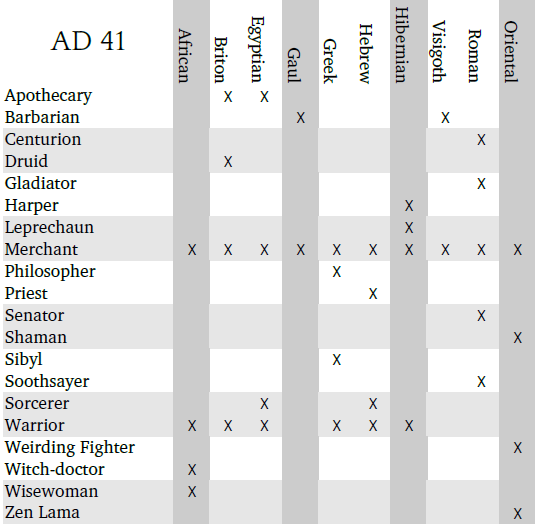
The ten nationalities available for AD 41 era MM&M characters are:  African, Briton, Egyptian, Gaul, Greek, Hebrew, Hibernian, Visigoth, Roman, and Oriental.  For 1375 BC era characters, only the African, Egyptian, and Hebrew nationalities are retained, but the following are added:  Babylonian, Hittite, Minoan, Philistine, and Sumerian.  Each nationality is associated with at least two classes.  As I mentioned before, determination of nationality and class is random.  Nationality may be rerolled only when a previous incarnation of the character was of the rolled nationality.  Class can be rerolled, but the second roll is final.

Here are charts showing the various classes for each nationality.


Each class has a “prime ability” which indicates the use to which the character's SKILL may be applied.  For instance, the Anakim, Barbarian, Centurion, Gladiator, Warrior, Weapon Master, and Weirding Fighter classes all have 'combat' as their prime ability.

All nationalities have a Merchant class (“the most broadly based of all character classes”), the prime ability for which is 'wealth increase'.  This means that the value of the character's treasure is modified based on Skill and Intelligence.  For every twenty points (or fraction thereof) of Skill over fifty, value is increased by 10% (or 15% for Hebrew Merchants); however, for every twenty points (or fraction thereof) of Skill under fifty, value is decreased by 5% (except Hebrew Merchants do not suffer this penalty).  For every twenty points (or fraction thereof) of Intelligence over fifty, value is increased by 5%.  In game terms, the only differences among the Merchant classes of the different nationalities (other than Hebrew) are their permitted weapons and armor.

Most nationalities have a Warrior class.  In addition to their permitted weapons and armor, each nation's Warrior class is made distinctive by special abilities.
African:  In tropical environments, +5 to hit and +10 damage; however, in Arctic conditions, the modifiers are -5 to hit and -10 damage.
Babylonian:  When fighting in a city, +5 to hit.  (technically, -5 THN)
Briton:  “Gains a +5 on damage if body and face are stained blue with woad.”
Egyptian:  In desert environments, +6 to hit and damage.  When using a bow, +5 to hit and damage.
Greek:  Via deception, has a 31% chance of gaining first strike in combat regardless of First Strike Capacity.
Hebrew:  When fighting alongside a Hebrew Priest, +5 to hit and +10 damage.  “On a roll of 85 or better...will feel compelled to offer food to an opponent.”  This means the Hebrew Warrior will not have first strike, regardless of First Strike Capacity.
Hibernian:  When fighting in the rain, +5 to hit and +10 damage; there are no negative modifiers for “fighting in fog or mist.”  Once per segment, Hibernian Warriors can heal their own wounds.  For every one POWER spent, three Life Points are regained.  When taunted, there is a 50% chance that a Hibernian Warrior will attack.
Hittite and Sumerian:  Can fight from a chariot without penalty.
Minoan:  When “fighting at sea or on board a boat,” +5 to hit.  (technically, -5 THN)

Of course, combat classes that aren't Warriors also have distinctions.  Gallic Barbarians receive +10 Courage (not to exceed 100).  Visigoth Barbarians get +10 Courage and Strength; additionally, when at least three are fighting together, they have +5 to hit and +10 damage. Philistine Anakim use a special table for determining hight and weight.  Opponents must succeed with a Courage roll to gain first strike, regardless of First Strike Capacity; however, Anakim may not use magical artifacts.  “Roman Centurions are entitled to hire and lead up to 100 mercenaries.”  A Centurion in combat may spend 10 POWER to make a percentile roll.  With a result of 26 - 60, allies receive +5 to hit and damage for the remainder of the combat; if the result is over 60, the modifier is +10.  Roman Gladiators get +5 to Courage, Skill, Speed, and Strength characteristics.  They never suffer combat penalties but they must fight (at least) once in the Arena between adventures.  The THN of a Hittite Weapon Master can never exceed 45.  Weapon Masters can train other characters how to use weapons they would not normally be allowed to use.  Finally, Oriental Weirding Fighters receive +10 to Speed and Endurance.  Bare hand damage is at +15, “while kicks with his feet strike at +25 damage.”  At a cost of 10 POWER, a Weirding Fighter can paralyze an opponent long enough to attack him twice; this is accomplished by ch'i energy.

The Astrologer, Seer, Soothsayer, Sybil, and Zen Lama classes all have “psychic” as their prime ability.  This means that – by spending POWER – they have access to the following eleven psychic talents.
Body Blow:  Automatically inflict damage on any one human within ten feet of the character; damage equals POWER spent.
Glimpse:  The character gains vague information about a distant or future event.
Hunch:  The character can “determine if a given course of action will prove dangerous or beneficial.”
Illusions:  By means of “mass hypnosis,” 1 - 100 humans see something that doesn't actually exist.  Someone not subject to the illusion can convince someone who is subject that the illusion is not real; however, the subject character must have at least 50 Intelligence.
Mind Reading:  The character can determine the main concern of any one person within twenty feet.
Tulpa Creation:  The character can “create an illusionary human or animal” that will act independently for one segment.  (rabbit hole)
Teleport:  The character can “mentally transport any inanimate object through any non-magical barrier.”
Telepathy:  The character can transmit information (in the form of words) “to any willing subject over any distance.”
Demoralize:  Once per turn, any one character within twenty feet must succeed with a 'courage check' or else flee.
Mirror Image:  The character can create a number of illusionary duplicates.
Empathy:  By handling an object, the character can determine what its owner was feeling when last in contact with the object.

Astrologers have a chance of identifying “the use of any artifact.”  On a clear night, they can study the stars to “predict whether a given course of action will prove harmful or beneficial.”  This is like the 'hunch' talent (above), only without the POWER cost.  Of course, Astrologers can devise horoscopes to obtain the answers to three yes/no questions “regarding the future of certain propositions.”

Hittite Seers must dance until exhausted (losing 20 Life Points) once per week.  They can commune with birds.  Perhaps more importantly, the Seer can engage in “Healing Empathy.”  Essentially, this allows the Seer to restore an injured character's Life Points by transferring his or her own Life Points.

The Soothsayer class has the ability of prophecy.  If used, the Lore Master must provide “a short, obscure rhyming prophecy pertaining to dangerous or unpleasant aspects of the current situation or...the next danger or unpleasantness the party is likely to encounter.”  However, when this ability is used, there is a 6% chance that the character “will lose the prophetic ability for three segments.”  Another ability of this class is a 31% chance of repelling “any chosen character” to a distance of fifty feet.

The Sybil is one of two MM&M classes that require the character to be female.  Each segment, there is a 2% chance that a Sybil will fall into a trance for an unknown length of time.  The Sybil has a 'prophecy' ability like the Soothsayer; however, unlike the Soothsayer, the Sybil's 'prophecy' must be about the current situation.  Also, a Sybil can 'infatuate' any one male at a chance of 41% (or 6% against Leprechauns).

A Zen Lama has +50 Endurance (not to exceed 100) by virtue of lung-gom-pa and has +10 to hit and damage in freezing conditions as a result of “tumo.”  The special ability of this class is “The Glance of Death.”  Once per segment, the character has a 6% chance of causing the instant death of any one opponent by scrambling his/her/its brain waves.

Sunday, July 27, 2014

Poisons in Man, Myth & Magic


Nearly two pages of the forty-page 'Advanced Rules' of Man, Myth, & Magic are devoted to the topic of poisons; more poisons are described in The Egyptian Trilogy.  Page 29 tells us that “while anyone may buy available poisons only the Wisewoman and Apothecary classes may concoct them.”  The rules go on to say that...
While only Apothecary Classes may concoct, or make poisons, not every Apothecary Class may concoct every type of poison.  To determine which Character Class may make which kind of poison see the specific Character Classes.
However, the character class descriptions fail to include this information.  Instead, these details are to be found in the grimoire in the back of Book II.

In MM&M, poisons have either a full effect or a half effect depending on the poison's potency and the victim's Strength, Endurance, and Courage.

For purposes of this post, there are three ways that poisons may reach a victim:  ingested, topical, and weapon.  In order for poisons applied to weapons to be effective against victims, the roll to hit must exceed the minimum to hit by 30% “and the damage number rolled must be at least 25% higher than that needed to penetrate the victim's armor.”  If these conditions are met, the poison will be 85% effective.  How this correlates to the full effect/half effect model is not explained.

Here are the various poisons described in MM&M.  Thoul's Paradise does not attest to the accuracy of this information; it is presented for purposes of entertainment only.

Curare  (topical/weapon)
Strychnos toxifera is the Western Hemisphere plant from which curare is derived.  For purposes of MM&M (which does not address the New World at all), this poison is made from the vine of the “African” Strychnos toxifera mixed with goat's milk.
Full Effect:  “Causes total paralysis in a matter of seconds with death following in a few moments.”
Half Effect:  Causes partial paralysis within a few minutes that lasts a day.  Also causes “violent illness” which lasts for three days.

Hari Zaranya (ingested)
Better known as arsenic, hari zaranya cannot be concocted by any MM&M class.  A single dose large enough to be lethal is not practical.  So, “For purposes of the game, three doses can be lethal.”
Full Effect:  “Victim begins to perspire and then passes out never to awaken.”
Half Effect:  Victim passes out for up to 48 hours; illness persists for days.

Hemlock (ingested)
Roots of the Conium maculatum are “dried and pulverized into power.”  The powder is mixed with a liquid, then imbibed.
Full Effect:  “Causes victim to become drowsy and dizzy followed in a few moments by a sleep from which he will never awaken.”
Half Effect:  Victim wakes “after 12 to 36 hours with upset stomach, headache, and mild fever.”

Henbane (ingested/weapon)
Portions of the Hyoscyamus niger are made “into a salve like, brownish, foul smelling substance.”  The substance may be applied to a weapon or burned in a fire.  Breathing the smoke will not cause more harm than the listed half-effect.
Full Effect:  “Victim immediately begins to feel drowsy, followed in seconds by a feeling of unreality and timelessness.”  Moments later, the victim will fall into a coma from which he has a 75% chance of surviving.
Half Effect:  The coma-like sleep “will last between 12 and 16 hours” with no chance of fatality.

Jimson Weed (ingested)
Datura stramonium is another Western Hemisphere plant that would not have been available in the MM&M setting.  As such, leaves of the “Mediterranean” Jimson plant are ground into powder and mixed with liquid.
Full Effect:  “Causes victim to have heart attack with 90% chance of being fatal.”
Half Effect:  “Causes victim to have minor heart attack with 35% chance of being fatal.”

Mandrake (ingested)
Extract is derived from the Mandrake plant, producing a clear fluid with a bitter taste.  As such, “it usually must be administered in a heavily flavored drink.”
Full Effect:  A quarter of an hour after exposure, the victim starts to hallucinate.  “This is followed by a high fever and severe stomach cramps” and then death.
Half Effect:  “Causes victim to hallucinate, followed by mild convulsions and vomitting [sic] and high fever.”  Illness can last from one to three days.

Monkshood (ingested)
White or purple flowers from the Aconitum family are used to create a clear, almost tasteless fluid.
Full Effect:  Victim suffers breathing difficulties and a “pounding heart” before entering a coma then dying within an hour. 
Half Effect:  As above, but the victim will pass out with only a 10% chance of entering a coma; victim will wake within eight hours and recover completely within forty-eight hours.

Naja Haje (weapon)
Venom from the Egyptian Cobra is “mixed with a previously prepared ointment made from locust excrement and fish liver oil.”  Strangely, 'Apep Ointment' is listed as a separate poison although it would seem to be the same.
Full Effect:  “Causes victim to perspire blood, with Liver, Kidney and Stomach failure.”  Victim suffers convulsions and death typically ensues within ten minutes.
Half Effect:  “Victim...becomes ill to varying degrees...[and] will remain ill for many weeks.”  There is an unknown “percentage chance of dying in the first two weeks.”

Nightshade (ingested/weapon)
Ripened berries from Nightshade plants are processed into “a slightly pinkish, almost clear fluid.”
Full Effect:  Death within thirty minutes preceded by “dry throat...itching, anger, [and] drowsiness.”
Half Effect:  As above, but instead of death, “a coma that will last a random amount of time and often is accompanied by permanent blindness.”

Nux Vomica (topical/weapon)
Seeds from the Strychnos Nux-vomica must be pulverized then “mixed with pulverized earth worms and water to form a smelly, jelly-like substance.”
Full Effect:  Localized muscle spasms will occur within five minutes, spreading until all muscle control is lost; “finally blindness occurs just prior to death.  The whole process is accompanied by intense pain and skin irritation usually causing loud screaming.”
Half Effect:  Not applicable.  It “is either always fatal” or there is a 5% chance of a victim having “natural immunity.”

Scorpion Venom (weapon)
Venom from scorpions “must be mixed with palm tree oil and simmered until thick.”
Full Effect:  “Victim will have severe irritation and itching around the spot of application.”  Within five minutes, the pain will be so intense that “the victim will cease normal function.”  Death occurs within forty minutes of application, preceded by facial swelling.
Half Effect:  If the victim does not receive treatment within an hour of exposure, victim experiences 'full effect' symptoms.  Even with treatment, there is a 40% chance that the infected area or limb must be removed or amputated to prevent death within a day.

Thornapple  (ingested)
This poison is derived “from the pollen of the Thornapple flower which can only be obtained from bees which have collected pollen from the plants.”  One dose apparently requires about two dozen bees.
Full Effect:  “Victim will become irritable within seconds...followed by insanity, coma and death within minutes.”
Half Effect:  As above, but victim “will recover from coma in two to three days with a 30% chance of being permanently insane.”  The percentage chance of the victim subsequently becoming an RPG blogger is not given.

Sunday, July 20, 2014

Combat in Man, Myth & Magic


It is a basic principle of ADVANCED MM&M that every activity, from fighting to soothsaying, has a fundamental failure rate.
– Book II

The fundamental failure rate means that – by default – the player will need “to throw 50 or better on the percentile dice” for the character to succeed at an activity such as striking an opponent in combat.  Of course, this number is subject to modifiers.  The actual number needed to hit is appropriately referred to as the “to hit number” or THN.  The amount that a result succeeds in excess of the THN is the amount of damage subtracted from the target's Life Points.  We are told in Book I that, “Any throw of 100% (00) is scored a kill, however unlikely the circumstances.”  This rule is not rescinded in Book II, so it evidently applies to the basic and advanced versions of the game.

If a character belongs to a Class having combat as its “Prime Ability,” the character's 'Skill' characteristic may affect the THN.  For every ten points of Skill in excess of fifty, the THN is reduced by one (meaning an increased chance of success).  For every ten points of Skill less than fifty, the THN is increased by one.  This means a 'fighter' character with a Skill of 40 (or less) fights less effectively than a 'non-fighter' character regardless of the non-fighter's Skill (or lack of Skill).  How much does that suck?  Also, all else being equal, between a 'fighter' with a Skill of 100 and a 'fighter' with a Skill of 01, the difference in the THN is merely 9%.

Advanced MM&M has several, optional characteristics.  If these characteristics are in use, then they may affect a character's THN.  Different 'types' of weapons are affected by different characteristics.  For instance, a character's 'thrown weapon' THN is modified by “Sight, Strength, Skill, and Throwing.”  For the value of each of these characteristics, deviation from 50 is determined.  Every ten points difference from fifty indicates a THN modifier of one; a negative modifier when the value is greater than fifty and a positive modifier when the value is less than fifty.  (Presumably, modifiers from Skill are only applied if 'combat' is the Prime Ability of the character's class.)  For some weapon types, there are Characteristics that influence THN at different rates.  For instance, the Characteristics of Agility, Speed, and Strength can modify the 'bludgeon weapon' THN.  Each five points of Agility over fifty decreases THN by one, but each ten points of Agility less than fifty increases THN by one.  Additionally,  it is curious that 'Skill' is not one of the modifying Characteristics for bludgeons.

Each Class has certain 'allowed' weapons.  For example, the allowed weapons for a Hebrew sorcerer are dagger, sword, and trident; for an Egyptian Apothecary, the allowed weapons are dagger and dart.  A THN for a weapon not allowed by a class is not modified by any Characteristic (not even 'Skill' for a 'fighter'), instead, a fixed +25 modifier is applied.

A character may expend POWER points to reduce his or her THN.  For every 10 POWER spent, THN is reduced by one for a single attack.  I assume that POWER used in this fashion is 'recoverable' just as POWER used for magic (i.e., regained at a rate of 10 points per segment).  The intent to spend POWER in this way must be stated prior to making the roll.

“In ADVANCED combat, you must specify, in advance of rolling, which part of your opponent's body you are attacking.”  Aiming for a hand increases THN by 15; Aiming for a particular thumb, finger, or toe increases THN by 20.  Aiming for the torso or back does not modify THN.  Non-player characters, however, do not aim for hit location.  The Lore Master randomly determines hit location after a target has been hit.  Percentile dice are rolled and a table consulted.  A roll of 89 indicates “Left Foot Toe”; a roll of 98 indicates “Right Thumb.”

As might be expected, weapons increase the amount of damage a character inflicts.  A knife does +8 damage, a dagger does +10, and a sword, +30.  Armor reduces damage with regard to protected hit locations.  A loinguard (leather) protects “Abdoman [sic], loins, and thighs” with –15 damage.  If a character lacks armor, the damage sustained for each successful attack is increased by ten.

The amount of damage may be modified as a result of the attacker's Strength characteristic.  For every ten points of Strength over fifty, +1 is applied to damage; likewise, for every ten points of Strength under fifty, –1 is applied to damage.  Strength modifiers to damage do not apply when using weapons like bows or blowpipes.

Regardless of a character's total Life Points, different hit locations “cease to function” after suffering specific amounts of damage.  For instance, each finger or toe can sustain a maximum of 25 points of damage; a thumb can sustain 30.

In combat, a character can attempt a limited number of attacks before he or she must rest for two turns.  For every ten points of Endurance (or fraction thereof), a character may make one attack.  A character may make an additional attack for every twenty full points of Courage.  For every twenty-five points of Speed a character has in excess of fifty, he or she may make an additional attack per turn.  These attacks are not counted against the Endurance/Courage limit for purposes of rest.

In a turn, characters attack in order of descending 'First Strike Capacity' (i.e., Speed + Courage).  A character may try “Avoiding the Blow” of an opponent; this must be announced prior to the opponent's attack roll.  Each attempt at avoiding a blow counts as an attack with regard to the Endurance/Courage limit.  If a character attempts to avoid a blow, that character's 'Combined Modifier Figure' is added to the opponent's THN for that attack.  The rules helpfully inform us that the Combined Modifier Figure (or “CMF for short”) is the sum of the character's Skill and Strength modifiers.  Alas, the rules neglect to inform us what is meant by “Skill and Strength modifiers.”  Does that mean a modifier of +1 for every ten points (of Skill or Strength) more than fifty and –1 for every ten points (of Skill or Strength) less than fifty?  If so, an attempt at “Avoiding the Blow” could actually make it easier for an opponent to hit.  Given that some of the other rules do not seem well thought out, I fear that my surmise is correct.  Also, 'Skill' is applicable to combat only for 'fighters'.  Does this mean that only 'fighters' can attempt to avoid blows?

Sunday, July 6, 2014

MacGuffins, Plot Devices & Bric-a-brac

Plate 10 from The Book of Talismans, Amulets and Zodiacal Gems

When 'incarnated', an Advanced Man, Myth & Magic character receives an inheritance.  I suppose only the first incarnation receives an inheritance given that equipment is retained when a character is reincarnated.  However, there is no rule that addresses this and a new inheritance that somehow shows up with each incarnation is no stranger than the MM&M 'reincarnation' process itself.  By rolling percentile dice, the inheritance table “will tell you which of your ancestors remembered you and how much you receive.”

There is a 4% chance that your grandfather has bequeathed to you a:
7 pound piece of fallen star (meteorite); [worth] 300 Lbr.)[sic](If piece is melted into sword it will have a plus 15 to damage).
Whether or not this grandfather is maternal or paternal is not stated.  However, the table lists another grandfather who provides (also at a 4% chance) a silver helmet complete with horns (worth 100 libra) and a ruby (worth 500 libra).  It seems both the maternal and paternal branches are included, but not specified.  One of your aunts might give you “Seven vials of rare spices (150 libra each).”  Your other aunt – perhaps the crazy one – might leave you 200 libra and a leopard skin.  If your father really loves you (1% chance) you will get “10,000 Libra and the Emperor's Seal.”  Otherwise, there's a 4% chance he will give you a suit of legionnaire armor (complete) and 200 libra or (another 4% chance) 500 libra, a broadsword, a dagger, and a Greek helmet.

The 'ancestors' on the inheritance table are related to the character (Older Sister, God Mother, etc.) with the exception of Livia the Poisoner, a non-player character from a couple of the adventures.  (I guess she could be a relative, but the familial tie is not given.)  There is a 4% chance that Livia will leave you:  500 libra, a blowpipe, one hundred darts, and – true to her epithet – a bottle of cobra venom.

Yaquinto's The Egyptian Trilogy was marketed as “A TRIPLE Adventure Module for use with Man, Myth & Magic.”  It is also a 'system expansion' or sourcebook.  The setting of the MM&M rules is AD 41 (or thereabouts), but The Egyptian Trilogy module takes place in 1375 BC.  As such, the book provides nationalities, classes, rules, etc. appropriate for that era, including an inheritance table.  The 'ancestors' include the relatives from the original table (other than godparents), but also includes 'ancestors' such as Ex-Lover, Childhood Friend, Tribal Hetman, Priest, and Hunter.  Your uncle might give you sixty ounces of silver, a bow, a quiver of thirty arrows, and a vial of five applications of curare.  Your other uncle might give you a copper poleaxe, an iron-tipped spear, and a bronze helmet.  There is a 4% possibility that your ex-lover will leave you a leather kilt and a lethal dose of hemlock.  (I wonder if that's supposed to send some kind of message.)

The MM&M inheritance table provides characters with starting equipment and/or money.  The items can also be plot hooks.  What was your uncle doing with an “African Ju-Ju Bone”?  A spool of golden thread is worth 500 libra, but first you need to find someone who will buy it.  Why would “the Hunter” leave you his magical bow and magical charm?  What's the story behind the silver chalice your cousin left you?

In the recently released D&D Basic Rules we see a similar 'plot hook generator' with the 'Trinkets table' (which I find reminiscent of 1E Gamma World's 'Treasure List').  The table takes up two pages, with more than half of the second page blank.  Surely, the Trinkets table is not necessary for the Basic Rules; they could have used those pages for a couple of additional backgrounds or a detailed example of play or an index or more passages from that literary genius R. A. Salvatore.  While not necessary, the Trinkets table does something important – it connects (however faintly) the character with the setting in a unique way.  It shouldn't be the only connection, but it may be the first.  Anything that spurs the imagination is worthwhile.

The Trinkets table “can help stock a room in a dungeon or fill a creature's pockets.”  The problem with this is that some trinkets are more appropriate as contents for a monster's pocket than as possessions of a player character.  Why would a player character walk around with a “rope necklace from which dangles four mummified elf fingers” (Trinket #9) or a “glass jar containing a weird bit of flesh floating in pickling fluid” (Trinket #20)?  Why would you keep a “small idol...that gives you unsettling dreams when you sleep near it” (Trinket #8)?  Some things useful for dungeon room/monster pocket stocking should be in a Dungeon Curios table and not a 'player character possession' Trinket table.

Most of the Trinket table items are unusual, but some are not.  Trinket #41 is a “scrap of cloth from an old banner.”  That's an example of a trophy from the Soldier background; it shouldn't be a “trinket.”  On the other hand, perhaps there should be a separate Trinket table for each background.  (I'm ambivalent about Trinket #29, “A pair of old socks.”)

I notice possible product placement with trinket #46, “A dead sprite inside a clear glass bottle.”  (Get it?  A bottle of Sprite!  Haha!)

Trinket #99 is “A wooden box with a ceramic bottom that holds a living worm with a head on each end of its body.”  I wonder if this is an allusion to one of Sherlock Holmes' “unsolved” cases; namely, “that of Isadora Persano, the well-known journalist and duellist, who was found stark staring mad with a match box in front of him which contained a remarkable worm said to be unknown to science.”  (“The Problem of Thor Bridge”)