Showing posts with label trinkets. Show all posts

Sunday, May 19, 2019

The (A)D&D Adventure That Michael Moorcock Wrote (Spoilers)

Map by Paul Ruiz

Published from 1983 to 1985, Imagine was TSR's official organ in the UK.  Issue #22 was a Michael Moorcock Special Feature including:  an interview with him, a short story by him (“1st UK magazine publication”), an AD&D adventure by him, and a three page publication history of the Eternal Champion by someone other than him.  In the interview, Moorcock tells us what he thinks about people who partake in role-playing games:
...I know a lot of people who are actively involved.  It's certainly very popular.  If you look back to the 20s and 30s, the people then were enjoying the popular magazines, they contained the same types of fantasies but they weren't so formalized.  It's also linked to the times we live in.  Large numbers of people feel disenfranchised, and if people haven't got any effect, or feel that they haven't got any effect in the real world, they go into religion – or perhaps role-playing games.  Both are substitutes for the person who feels that he has no effect on anything.
Perhaps writing Sword & Sorcery stories about an albino also counts as a substitute.

Anyway, the eight page adventure is written by Michael Moorcock and Michael Brunton.  So, it's a collaboration.  How much did Moorcock contribute?  In the interview, when Moorcock is asked if he will write for role-playing games, he replies, “I'll write the odd scenario, such as the outline I did for IMAGINE.”  So, Moorcock's contribution was limited to an outline.  The credits at the end of the adventure attribute “Inspiration” to Moorcock and “Perspiration” to Brunton.  Using the Edison criteria, I suppose Moorcock was responsible for ten percent of the adventure.

In the Table of Contents, the “mini-module” is called “The Iron Galleon.”  When the adventure is presented on page 25, it has the title “Earl Aubec and The Iron Galleon.”  The scenario turns out to be a “one-on-one adventure” where the player assumes the role of a Moorcock creation, Earl Aubec of Malador, previously appearing in a 1964 short story.  In AD&D terms, Aubec is a twelfth level fighter with a +3 two-handed sword.  Actually, there is provision for a second player character – Jhary-a-Conel, an incarnation of the Eternal Sidekick.  Jhary is a seventh level fighter who “can use magic items and scrolls as though a magic-user.”  He also has a flying cat, Whiskers, that “should be treated as a magic user's familiar.”  In the absence of a second player, Jhary can be used as a non-player character.

A half-page section, The World of the Young Kingdoms, is intended to be read by both the DM and player.  While the section briefly describes Moorcock's setting, mostly it reveals Aubec's history.  We learn:
At Kaneloon he fought and defeated creatures from his own imagination.  In rising above the darkness of his own mind Aubec won the right to go beyond the world's boundary and carve new lands from the Chaos-stuff that existed beyond.  Here too, he first encounters Myshella, the Dark Lady, and refuses the 'rights' that she offers him....
This is an impressive accomplishment for someone with a Wisdom of 9.  There is also a section of Dungeon Master's Notes.  The section begins with six paragraphs of background information.  There is also a sub-section about alignment in Moorcock's setting; mainly, “the classifications of 'Good' and 'Evil' have no real relevance.”  (Perhaps the adventure should have been presented in terms of BECMI rules instead of AD&D.)  Also, some Dungeon Master advice is presented regarding one-on-one play:
In a one player module it is always possible to 'kill off' the one and only character with ease.  The DM must resist the temptation to see the adventure as a personal confrontation, and his or her duty in that confrontation as 'getting' the player.  This doesn't mean that the player character should be given an easy ride, but the DM should remember that the character is supposed to be a hero and win through.... most of the time.
The adventure presents a couple of house rules:

Yielding to tradition, the scenario begins in a tavern.  While enjoying a repast, time seems to stand still except for Aubec and his cat.  “From the shadows” appears Myshella, the Sorceress of Kaneloon.  Aubec's nameless cats purrs, so we know the sorceress intends no harm towards Aubec.  (“Aubec's cat is not a familiar, but it is sensitive to danger.  The DM should make a point of mentioning (subtly) what the cat's reaction is to the various characters and situations in this module.”)  She reveals the premise of the adventure.  There's an Iron Galleon which “sails not only the seas of the Young Kingdoms, but the waters of other worlds as well.”  Somewhere, the Captain of the Iron Galleon acquired the Horn of Fate, “a treasure of incomparable power” capable of “bringing about the ruin of everything.”  Myshella wants Aubec to obtain the Horn and deliver it to her so she can send it “out of Aubec's world...”  Myshella provides some money so that Aubec can hire a ship to travel to a given location.  If Aubec does so, “Within five days [he] will meet the Iron Galleon.”  Myshella departs and time resumes.

“If Aubec decides not to obey Myshella's instructions” within two days, he is attacked by hirelings of an old enemy.  Such attacks will continue daily until Aubec (literally and figuratively) gets on board.  Before encountering the Iron Galleon, “The DM should use at least one” preceding encounter.  One such encounter is attack upon the ship by an ildriss (air grue).  The other possible encounter is an attack by “a Pan Tang slave raider looking for fresh victims.”  Regardless of which preceding encounters are employed, eventually the Iron Galleon collides with the ship Aubec is on and destroys it.  Aubec is supposed “to grab the anchor chain of the Iron Galleon as it passes, and climb up it to 'safety'.”

The captain of the Iron Galleon is Dyvim Ka'aand, “a Melnibonéan outcast, doomed to wander the seas between the worlds...”  In true Melnibonéan fashion,  “He maintains a pretense of bored, tolerant amusement towards the world, beneath which he is haughty, noble, sophisticated, and amoral.”  Dyvim Ka'aand is not given a character class; however...
Dyvim is the equivalent of a 12th level spell caster when casting his memorised spells.  Unlike normal magic users or illusionists, Dyvim does not have to 'memorise' other spells.  His spell grimoires and tomes contain details of spells that are functionally identical to all the magic user and illusionist spells of 6th level and below.  After studying these spells for a period of (4d4 ⨯ spell level) minutes, Dyvim Ka'aand is able to cast them.  There is also a 17% chance that Dyvim Ka'aand will be able to cast any spell from memory.  In this case, there is a 5% chance he will do so incorrectly and the casting will prove to be a waste of time.  However, there is a limit to Dyvim Ka'aand's spell casting capability.  He cannot cast more than 35 levels of spell in a single day – for example he can cast up to 2 ⨯ 1st, 1 ⨯ 2nd, 4 ⨯ 4th, and 3 ⨯ 5th levels.
The Iron Galleon is mapped out and each numbered location is described like a proper dungeon.  One location is the hold, containing “the Iron Galleon's collection of trinkets” from a plethora of worlds.  Such trinkets include:  “lengths of ship's timbers; oil barrels (for the lamps); mold-covered grain sacks; chests full of tea, raw cotton, white marble, pottery, and black powder (which is so damp as to be useless); wine amphorae; five life preservers marked HMS Graf Spee and perched on top of one heap is a what appears to be a giant, misshapen arrow – a Phoenix AIM 54A air-to-air missile, which is armed and ready for firing.”  (Elsewhere on the vessel is “the ejector seat from a Mig-31 Foxhound.”)  There are a few locations with 'monsters' (e.g., stirges and rust rats) but, mainly, the Iron Galleon serves as a venue for interacting with non-player characters.  Aside from Dyvim, other intelligent denizens of the ship include:

          Jeroaz :  A Dwarven jester with a +1 slapstick that causes extra damage because it “is tainted with unclean Chaos-stuff.”  (6th level assassin)
          Master Smiles :  “He is simply a dissolute sybarite who actively enjoys the life of contemplative cruelty and barbarity that he indulges in aboard the Iron Galleon.”  (5th level fighter)
          Kateriona van Hjeok :  Last survivor of a group of pirates who assaulted the Iron Galleon.  She has an “eye patch and steel prosthetic hand.”  (7th level fighter)
          Miriame :  A refugee from a slave galley, “Dyvim has amused himself by feeding her a powerful hallucinogenic drug which makes her totally compliant to his will – the withdrawal symptoms are extremely painful.” (non-classed)
          Windlos of Heuliss :  A “flying man” trapped on board the Iron Galleon.  (non-classed, but 7+1 Hit Dice)

The Horn of Fate – appearing to be a drinking horn – is in Dyvim's study.  Dyvim knows the Horn is special, but evidently does not realize its true nature.  What Aubec does to get the Horn is up to the player.  Aubec can attempt to recruit non-player characters as allies against Dyvim.  “Aubec need only obtain a positive reaction (DMG p63) to apparently enlist the aid of any of the NPCs.”  Aubec's cat is useful in determining which non-player characters are trustworthy.  Aubec and his allies can make use of “a small wooden sailing boat” on the Iron Galleon.  There is also a way to destroy to Iron Galleon.  If Aubec gets away without killing Dyvim, the Melnibonéan will send an invisible stalker against Aubec.  If Aubec does not repair to Kaneloon with alacrity, the DM may have Aubec attacked by his old enemy's hirelings “as an extra incentive to Kaneloon and safety with minimal delay.”


Sunday, June 25, 2017

Port o' Call

Art by Liz Danforth

Over a period of fifteen years (1982 - 1997), Flying Buffalo published seven installments of its CityBook line of system-neutral game supplements (or “a GM aid for ALL role-playing systems” as the books themselves state).  All of the books provide details about various urban establishments, including descriptions, maps, non-player characters, and scenario suggestions.  Each book after the first was presented as a themed collection.  For instance, CityBook II – published in 1984 – carries the subtitle Port o' Call and “focuses on places an adventurer is likely to find in the worlds' crossroads: port cities.”  The editors for this second volume were Liz Danforth and Michael Stackpole (or “Liz Dansforth and Micheal Stackpole” as they are credited for “Typoes”).

As demonstrated in a cover graphic (shown below), one of the selling points of the second CityBook is a conrtibution by Dave Arneson.  This is interesting in that the entry – “The Longtooth Lounge” – does not especially conform to the seaside theme the book proclaims.  However, the introduction to the 'Lodging and Entertainment' section jokingly states that “a number of horizon-expanding experiences are available” at the Lounge.


The Lounge offers “liquid refreshment as well as female companionship for its gentlemen clientele.”  Of course, port cities have such establishments, but there is nothing to indicate that the Longtooth Lounge isn't in a landlocked locale.  As the depiction above shows, there is “a large pair of sunken double doors” next to “a three-story tall tower.”  This is more subtle than a train entering a tunnel, but not by much.

As one might expect, the Longtooth Lounge is no ordinary brothel.  There are various aspects that make the Lounge an interesting adventure location – or a sit-com premise.  Foremost among these is Jeanie, “the most popular girl” in the establishment.  She “commands the highest prices and leaves even the most obnoxious customer satisfied.”  We learn, “This is because Jeanie gives the customer exactly what he wants, magically...”  You see, Jeanie is a genie.  Jeanie entered the world's oldest profession when the madame that owns the Longtooth Lounge made an off-hand comment while holding the locket that contains the genie.  Not realizing that the locket was associated with a genie, the madame said, “I wish that the Lounge had someone to help the girls with the guests...”  Nothing about the wish suggests that Jeanie assume the role herself, but assume it she did.  So, the brothel has a working girl who is a genie, but no one realizes she's a genie.  (The Lounge's bouncer may know the truth, but this is not made clear in the description.)  Jeanie, “like all genies, [is] likely to take any requests literally, [and] her power is often wielded rashly...”

Jeanie is also “Somewhat hard of hearing...” and “is surprised 5% of the time.”  Sometimes, Jeanie is 'surprised' by a customer and there is “a 75% probability that the assailant will be turned into something harmless and immobile – generally a plant.”  However, “the plants retain many of their human mental faculties.”  According to page 19, “The trouble with this automatic defense is that it seems to be permanent, and there is no way to restore any of the plants to their complete human form using normal magic.”  Jeanie places these plants in the Lounge's garden where they exist “with a nearly human awareness.”  Among the 'normal' plants in the garden, “there are domesticated triffids and Martian sand traps.”

Although there is nothing to suggest that the Lounge is in a port city, there are a few easy ways such a connection could have been established.  For instance, the tower could have been a former lighthouse or one of the working girls could have been a mermaid.  Due to the disappearance of Jeanie's 'victims', “The local authorities...seem to believe the [Lounge] is some kind of front for a slaving operation.”  The book's Introduction defines some nautical terms, including crimp:  “...someone who drugs and kidnaps lubbers to sell them to a captain who will attempt to turn them into sailors.”  The Longtooth Lounge could easily have had an actual 'crimping' sideline.

Among the other establishments listed in CityBook II, the good ship Golden Princess is described.  It is a contribution from Stephan Peregrine.  Within the seven pages devoted to the ship is the following gem:
     Kyztprr.  Thing.  Ht: variable.  Wt: 20 lbs.  Age: adult.  Fighting prowess: fair with what he uses in place of teeth.
     Unknown to virtually everyone aboard the Princess is Kyztprr.  During a violent storm off the accursed Isle of F'Tudd, Kyztprr was wave-tossed onto the ship and washed through a hatchway torn open by the typhoon.  Kyztprr made his way to the bilge where he hid safely, somewhat resembling a ballast stone.  For the most part, he is content to stay there, eating bilge worms and rats.  The diet is affecting his mind, driving him mad.  On nights when the evil stars rise, he has crawled forth in search of something besides rats to sate his hunger . . . .
Also included in the second CityBook is a 'notes' page, reproduced below for your non-commercial edification.  With the artwork and the large CITYBOOK™ NOTES title, not much space is reserved for actual notes. C'est la vie.  Your guess is as good as mine with regard to what that sign is supposed to show.

Art by Liz Danforth

Sunday, December 4, 2016

Role Playing Adventure in Ancient Egypt


Two-and-a-half years ago, your humble host briefly addressed Palladium Books' The Valley of the Pharaohs.  Now it is time for a more detailed analysis.  Published in 1983, the rulebook – accompanying several maps and a template character sheet in a boxed set – consists of 48 pages (numbered 3 - 50).

Player Characters in The Valley of the Pharaohs (hereinafter TVotP) have five attributes.  Although the glossary mentions “Will, Intelligence, and Dexterity,” the actual attributes are Strength (“physical power and endurance”), Speed (“fleetness...coordination and nimbleness”), Intellect (“intelligence and mental capacity”), Power (“will and mental strength”), and Persona (“personality, appearance, and charisma”).  Values are determined, in the old school tradition, by rolling 3d6 per attribute.  I never understood why game designers would use a 'normal distribution' paradigm for determining player character attributes.  Just as there are no stories about Conan the Mediocre, I do not indulge in escapism to assume the role of an average person.  I think I would have players add together the attribute values of a character and subtract the total from 100.  This would result in a number of points (perhaps called ka points) which could be allocated for various purposes; for instance, increasing attributes (perhaps 3 points for +1 value, up to a value of 10, and 6 points for +1 thereafter, up to a value of 18).

Each character has a number of hit points equal to Strength × 2.  Should the hit points of character be reduced to zero, “that character collapses and goes into shock; if he/she does not receive care within ten minutes he/she dies.”  When “a character is reduced to negative hit points...he/she dies.”

Anyway, before dice are rolled for attributes, a character's caste is determined by rolling percentile dice.  The are four castes, each of which provides a +1 bonus to a particular attribute:  Nobility (Persona), Clergy (Power), Bureaucracy (Intellect), and Commons (Strength).  In my alternate character generation method, Commons would be a character's default caste, a different caste could be purchased with ka points.  Rather than providing an attribute bonus, a caste's attribute could be purchased up to a value of 19.

TVotP is a skill based system. Each character receives a number of 'caste' skills from a list of ten:  Agriculture, Archery, Combat, Cooking, Gaming, Hunting, Reading, Swimming, Throwing, and Writing.  'Reading' is a mandatory skill for every caste except Commons.  Nobility receive 4 - 6 skills with Archery mandatory, Clergy receive 3 - 6 skills with Writing mandatory, characters of the Bureaucracy caste also receive 3 - 6 skills, and Commons receive 2 - 6 skills with Agriculture mandatory.

There are five possible classes (called occupations in TVotP ).  Choice of occupation is limited by caste.  Nobility can be either Soldiers or Priests, Clergy can be either Priests or Scholars, the Bureaucracy caste is limited to Merchants, Scholars, and Thieves, and characters of the Commons caste have a choice among Soldiers, Merchants, and Thieves.  The only difference among occupations is that each has a list of ten skills distinct from the 'caste' skills. However, some 'occupation' skills apply to more than one occupation.  For instance, Merchants and Thieves both have access to Barter and Evaluation; Priests and Scholars both have access to History, Magick, Music, and Oration.  Each character receives four 'occupation' skills.

The initial score for any skill is based on attribute values.  For example, the initial score for Scouting is Intellect + ½ Speed; the initial score for Chariot Use is Strength + ([Intellect + Speed] / 3).  Perhaps ka points could be used to purchase additional skills and/or increase initial scores.

Character improvement comes in the form of increasing skill scores and acquiring new skills.  If, during a scenario, a character uses a skill (successfully or not), the character can attempt to improve that skill after the scenario concludes.  Percentile dice are rolled and if the skill's current score is exceeded, then the score is increased by 1d6.  Characters can also be trained “by a teacher who has at least a 60 in the skill taught.”  After two game weeks, “one...increase check is allowed.”

In combat, a d20 is rolled to see if an attack is successful.  If the result exceeds the Resistance Factor of the target, then damage is applied.  Armor provides a Resistance Factor.  Scale armor has a Resistance Factor of 14; an unarmored character has a Resistance Factor of 5.  A roll of less than 5 misses the target.  A roll equal to or less than a target's Resistance Factor (but still at least 5) damage is applied to the target's armor.  Combat rolls may be modified depending upon the Speed attribute as well as the scores of “Martial Skills.”  For example, with a Combat skill score of 21, a character has two attacks per round; at 31, +1 to hit; at 41, +1 to parry, etc.  Characters can use 'attacks' to dodge or parry.

Twenty Magick Spells are described and each is assigned a level.  The least powerful spell is Illumination (level 10) and the most powerful is Speak with Gods (level 90).  A character can only learn a spell if his (or her) Magick skill score equals or exceeds the spell's level.  A spell may be learned from a teacher, a tablet, or a scroll.  Regardless, “it takes 1 - 4 weeks of study to commit a spell to memory.”  To successfully cast  a spell, a character must roll (on percentile dice) less than or equal to his (or her) Magick score or the spell's Difficulty, whichever is less.  A spell's Difficulty is roughly inverse to its level; the Difficulty for Illumination is 85 (easy to cast) and for Speak with Gods is 25 (hard to cast).  Spell-casting characters have a number of Magick Points equal to the initial score for the Magick skill (i.e., Power + Intellect).  Each spell has a cost between 1 (e.g., Speak with Animals) and 6 (e.g., Ressurection [sic] ).  An unsuccessful casting still costs 1 Magick Point.

The rulebook spends about a page describing magical amulets.  We are told, “Gamemasters should limit the total number of charms and amulets which may be worn or divided (sic) each each individual charm's power by the total number worn...”  Here are a selection of amulets detailed in TVotP :
Menat:  “If worn or held it will restore 1d6 of hit points lost due to disease or poison and will eliminate all pain.”
Scarab:  “If this amulet is worn, the character receives +5% on any skill proficiency as well as an additional 1d6 of hit points.”
Shen:  “This amulet represents the sun's orbit and eternity...If worn it will give the character an additional five years of life.”  (I assume this refers to natural lifespan, it's not as though a character can be disemboweled and expect to live another five years.)
Tet:  “The wearer of this amulet will receive a 10% bonus against all magic cast on or within a three meter radius of him.”
Utchat:  “This amulet, which was by far the most numerous, represents the eye of Horus...If worn, this amulet has a 20% chance of neutralizing any poison and can restore 1d6 of hit points once per day.”

Sunday, March 29, 2015

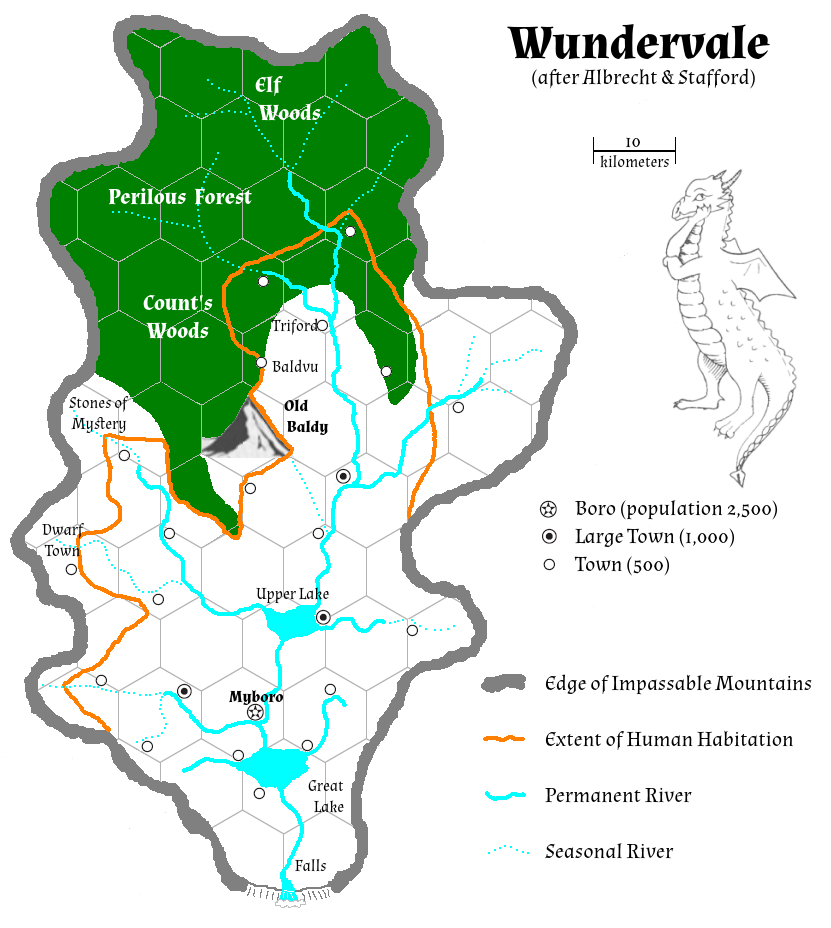
Wundervale


Along with a set of rules, The Adventurer's Handbook offers a setting called Wundervale.  The map provided in the book is rather unsightly, so I was compelled to create a less unsightly map that I present above.  (The map in the book shows “Elf Wood's.”)

The first human settlers arrived in Wundervale “less than a century ago” and began the process of deforestation.  According to the book:
          About 50,000 people live in the populated regions.
          Myboro is the largest settlement, numbering about 2,500 souls inside its walls.  It is the county capital as well, and handsome staunch towers gird the wall to protect it.  Its docks house a fleet of small, swift fishing boats.  Is markets are the meeting places for the foreign merchants from beyond the valley and the local farmers and artisans.  It is famous for its seven green-dyed cloths which cannot be duplicated outside this valley, and for the tiny carved wooden charms that bring luck in games of chance.
          Three large towns serve as seasonal marketplaces for the smaller towns that surround Myboro.  They are also centers of tax collection, grain storage, and so on.  Wares not locally made in the towns can generally be found here, including imported cloth and specialized goods such as alchemist's equipment and astrologer's instruments.
          Towns are the places where weekly peddlers' markets are held.  A town will generally have a parish priest, a smith, a carpenter, a thatcher, and a leather worker.  Noblemen of knight status will generally live in a town, or the town will have grown up around his manor.  The average size is 600 residents.
          Towns are surrounded by villages that are arranged to be about an hour's walk apart, dotting the countryside.  These are small settlements of a few families, clustered about their barns and agricultural tools.  Most people live in these settlements, about three-fifths of the total population.  Town dwellers should also be counted as rural dwellers, which raises the total to about 85% rural population.  Furthermore, most of the people within the larger settlements are also farmers in the fields about their their cities, so that almost 90% of the population is engaged in agricultural practices, or performs labor to support the farmers.
          About 2% of the population is engaged in full-time religious work, so there are about 1,000 clerics or their equivalent in the valley.  About 5% of the region is generally supported as a standing army, so this region provides about 2,500 soldiers and knights.  Finally, the rest (3%) are aristocrats of varying ranks, totaling about 1,500 men, women, and children of noble birth.
Nonhuman races also inhabit the valley, including elves, trolls, dwarves, and goblins.  The book allows player characters of the races although some sections of the book suggest that human - nonhuman relations are strained or even violent.

In Myboro, there is the Taverna Athena, “a large, warm, comfortable, and entertaining place, populated by city folk, adventurers, scholars, magicians, and even members of the nonhuman races of Wundervale:  dwarves, elves, and trolls.”  At this tavern, “these ancient enemies of each other put aside their animosity and treat each other with respect and civility, if not friendship.”  Evidently, goblins aren't welcome, perhaps because – for armor – goblins “favor Cuirboilli, especially that made from laminated layers of human skin.”  If dwarves, trolls, and elves are tolerated in the Taverna Athena, then they must be tolerated in Myboro and, if they are tolerated in Myboro, they must be tolerated as they travel from their enclaves through human inhabited areas while en route to Myboro.  Of course, there has to be a reason for them to travel to Myboro and associate with humans.

Dwarf Town is found on the western side of the valley.  I suppose Dwarf Town is a colony of dwarves and not a human town with miniature buildings.  Since the human habitation zone borders upon Dwarf Town, one supposes there is an understanding between the dwarves and humans in that area.

On the eastern side of the valley, there is a town outside of the human habitation zone.  Is this a population center for nonhumans?  Perhaps the original map erroneously excluded it from the human zone.

Since the valley is entirely surrounded by impassible mountains “save through the southern gap,” the 'foreign merchants' must travel through that gap.  How they manage to traverse the waterfall or cliffs is not detailed.

Anyway, the book continues to describe Taverna Athena:
Taverna Athena is a special place, the center of information and activity in Myboro.  It is part of a large complex that includes an inn, stables, and assorted shops...In a future book, or possibly in a magazine such as Different Worlds, we will tell the story of Taverna Athena, and the the mysterious noble, Kulmar, who...[description ends]
The character Joleen spends time at Taverna Athena and describes it as “a place of philosophers and entertainers, and those who are neither but like to be with both.”  Another feature of Myboro is a weapon shop “owned by and attended to be Rehsu, who gives good quality, fair prices, and loves to talk about past glories.”

Sunday, July 6, 2014

MacGuffins, Plot Devices & Bric-a-brac

Plate 10 from The Book of Talismans, Amulets and Zodiacal Gems

When 'incarnated', an Advanced Man, Myth & Magic character receives an inheritance.  I suppose only the first incarnation receives an inheritance given that equipment is retained when a character is reincarnated.  However, there is no rule that addresses this and a new inheritance that somehow shows up with each incarnation is no stranger than the MM&M 'reincarnation' process itself.  By rolling percentile dice, the inheritance table “will tell you which of your ancestors remembered you and how much you receive.”

There is a 4% chance that your grandfather has bequeathed to you a:
7 pound piece of fallen star (meteorite); [worth] 300 Lbr.)[sic](If piece is melted into sword it will have a plus 15 to damage).
Whether or not this grandfather is maternal or paternal is not stated.  However, the table lists another grandfather who provides (also at a 4% chance) a silver helmet complete with horns (worth 100 libra) and a ruby (worth 500 libra).  It seems both the maternal and paternal branches are included, but not specified.  One of your aunts might give you “Seven vials of rare spices (150 libra each).”  Your other aunt – perhaps the crazy one – might leave you 200 libra and a leopard skin.  If your father really loves you (1% chance) you will get “10,000 Libra and the Emperor's Seal.”  Otherwise, there's a 4% chance he will give you a suit of legionnaire armor (complete) and 200 libra or (another 4% chance) 500 libra, a broadsword, a dagger, and a Greek helmet.

The 'ancestors' on the inheritance table are related to the character (Older Sister, God Mother, etc.) with the exception of Livia the Poisoner, a non-player character from a couple of the adventures.  (I guess she could be a relative, but the familial tie is not given.)  There is a 4% chance that Livia will leave you:  500 libra, a blowpipe, one hundred darts, and – true to her epithet – a bottle of cobra venom.

Yaquinto's The Egyptian Trilogy was marketed as “A TRIPLE Adventure Module for use with Man, Myth & Magic.”  It is also a 'system expansion' or sourcebook.  The setting of the MM&M rules is AD 41 (or thereabouts), but The Egyptian Trilogy module takes place in 1375 BC.  As such, the book provides nationalities, classes, rules, etc. appropriate for that era, including an inheritance table.  The 'ancestors' include the relatives from the original table (other than godparents), but also includes 'ancestors' such as Ex-Lover, Childhood Friend, Tribal Hetman, Priest, and Hunter.  Your uncle might give you sixty ounces of silver, a bow, a quiver of thirty arrows, and a vial of five applications of curare.  Your other uncle might give you a copper poleaxe, an iron-tipped spear, and a bronze helmet.  There is a 4% possibility that your ex-lover will leave you a leather kilt and a lethal dose of hemlock.  (I wonder if that's supposed to send some kind of message.)

The MM&M inheritance table provides characters with starting equipment and/or money.  The items can also be plot hooks.  What was your uncle doing with an “African Ju-Ju Bone”?  A spool of golden thread is worth 500 libra, but first you need to find someone who will buy it.  Why would “the Hunter” leave you his magical bow and magical charm?  What's the story behind the silver chalice your cousin left you?

In the recently released D&D Basic Rules we see a similar 'plot hook generator' with the 'Trinkets table' (which I find reminiscent of 1E Gamma World's 'Treasure List').  The table takes up two pages, with more than half of the second page blank.  Surely, the Trinkets table is not necessary for the Basic Rules; they could have used those pages for a couple of additional backgrounds or a detailed example of play or an index or more passages from that literary genius R. A. Salvatore.  While not necessary, the Trinkets table does something important – it connects (however faintly) the character with the setting in a unique way.  It shouldn't be the only connection, but it may be the first.  Anything that spurs the imagination is worthwhile.

The Trinkets table “can help stock a room in a dungeon or fill a creature's pockets.”  The problem with this is that some trinkets are more appropriate as contents for a monster's pocket than as possessions of a player character.  Why would a player character walk around with a “rope necklace from which dangles four mummified elf fingers” (Trinket #9) or a “glass jar containing a weird bit of flesh floating in pickling fluid” (Trinket #20)?  Why would you keep a “small idol...that gives you unsettling dreams when you sleep near it” (Trinket #8)?  Some things useful for dungeon room/monster pocket stocking should be in a Dungeon Curios table and not a 'player character possession' Trinket table.

Most of the Trinket table items are unusual, but some are not.  Trinket #41 is a “scrap of cloth from an old banner.”  That's an example of a trophy from the Soldier background; it shouldn't be a “trinket.”  On the other hand, perhaps there should be a separate Trinket table for each background.  (I'm ambivalent about Trinket #29, “A pair of old socks.”)

I notice possible product placement with trinket #46, “A dead sprite inside a clear glass bottle.”  (Get it?  A bottle of Sprite!  Haha!)

Trinket #99 is “A wooden box with a ceramic bottom that holds a living worm with a head on each end of its body.”  I wonder if this is an allusion to one of Sherlock Holmes' “unsolved” cases; namely, “that of Isadora Persano, the well-known journalist and duellist, who was found stark staring mad with a match box in front of him which contained a remarkable worm said to be unknown to science.”  (“The Problem of Thor Bridge”)

Wednesday, May 28, 2014

Do your characters have appropriate talismans?


In a setting where magic is more-or-less commonplace, superstition becomes pragmatic.  Charms and amulets become less frivolous and – perhaps – gain some degree of efficacy.  Presented here is a plate from The Book of Talismans, Amulets and Zodiacal Gems along with notes from that tome.  What game effects – if any – would these items have?  What would it take to 'activate' one of these things?  Would the owner need to wear it for a year and a day?  Perhaps 'invest' a hit point?


104:  Harpokrates – “...god of eternal youth and fecundity...”
105:  Caduceus – “...the wand of Mercury...worn to render its possessor wise and persuasive, to attract Health and Youthfulness, as well as to protect from the Evil Eye.”
106:  Horn – “...worn to protect from harm, danger, and...evil influences...and also a charm to attract good fortune and success.”
107:  Anubis – “...the Guardian of Souls in the under-world.”
108:  Bull's Head – “...worn...for success in love and friendship and...was also worn by men for Strength and Long Life.”
109:  Hand – “...a Talisman against fascination...”
110:  Key – “...the joint symbol of...Apollo...and...Diana...and was worn for Prudence, and for Remembrance of things past, and foresight of things to come...”
111:  Hand of the Lady Fatima – “...a sacred symbol representing Generosity, Hospitality, Power, and Divine Providence...”
112:  Salus Ring – “...worn for Health and Success in all undertakings, as well as for general Good Fortune.”
113:  Crescent – “...worn by Roman women upon their shoes as a safeguard against witchcraft and to prevent the evil spirits of the moon from afflicting them with delusions, hysteria, or lunacy...”
114:  (Zufur Tukiah) letters making the name Nasiree – “...the Preserver, one of the names of God...”
115:  (Zufur Tukiah) letters making the name Gadiri – “...the Powerful, also one of the names of God...”
116:   (Zufur Tukiah) letters making the name Mohammed
117:  Pine Cone – “...the symbol of Cybele the goddess of abundant benefits...”
118:  Cornucopia – “...the symbol of Abundance, Fruitfulness, and Prosperity...”
119:  Frog – “...worn for fertility and abundance.”

Thursday, February 2, 2012

The Magic of Atlantasia


Continuing the glorious creation of Johann Nederland – Cosmic Spy Mage

In our post last week, Johann purchased a set of clothes; however, I forgot to have him buy footwear. Let us correct this oversight at once. In Atlantasia, one can buy short boots or high boots and there are three options for each type: soft leather, hard leather, and “hard with trinkets.” For high boots, the costs are 1 gold chip, 15 gold chips, and 30 gold chips respectively. Johann buys high boots made of soft leather for one gold chip and – what the heck – let's splurge for a hard-with-trinkets wide belt for three gold chips. (Wide belts are the only kind available.) For those of you keeping track at home, Johann has 97 gold chips left.

On Atlantasia, careers have talents which are like specializations; priests, however, for reasons known only to John Holland, do not have specialized talents. Talents are determined by random rolls. Johann's spy talent is “spider (+30% to climb walls).” His mage talent is “scroll writer (+40% to scroll writing rolls).”

At first level, Johann's spy abilities are:

     Locate Traps 1%

     Locate Secret Doors 1%

    “Extra Hearing” 10% (Extra Hearing is not explained.)

     Climb Walls 35% (this includes the spider talent; normally, it would be 5%)

     Hide in Shadows 5%

     Use Disguise 10%

As a mage, Johann has a 20% chance of detecting magic within an item. At first level, he knows the first three spells of his school (cosmic). These spells are: Sun Shield (+5% to defense for 5 semi-segments, magic cost 2), Falling Star (1 star doing 1d4 damage, magic cost 3), and Free Breath (“This spell allows the mage to breathe when there is no air available for a period of time,” magic cost 7).*

So how does spell combat work in Atlantasia? Well, it can involve several rolls of the dice, especially during the Season of Chaos. “The first roll of the % dice will determine if the spell is successfully casted [sic].”** There is a 15% chance that the spell will backfire and a 20% chance that the spell with otherwise fail; this means an attack spell will be successful 65% of the time. There are no modifiers to this roll; a first level character has the same chances as a twentieth level character. “The second roll of the % dice is to determine the power behind the spell.” Thankfully, Holland tells us that we don't have to determine the power of an unsuccessful spell. Not only is that realistic, but I'm certain that it saves a lot of time! There is a 10% chance on the 'power roll' for a spell to fizzle, so even a successful spell can wind up being unsuccessful.

In the Season of Chaos, it is possible for a spell to have effects beyond what the caster intended. Depending upon the specific cycle during the season, the 'chance of altered spell' can be anywhere from 1% to 95%. If a spell is altered, another d% roll is made to determine the effect. There is a 5% chance that 1-20 “garter snakes fly out” and there is a 15% chance that “strange bird sounds erupt.” Whether or not a spell is altered, there is a chance that the spell will hit a companion; there is also a chance that the spell will backfire (presumably only if it doesn't hit a companion). For a period of seven cycles in the middle of the Season of Chaos, the chance for backfire is 100%.

If a spell successfully hits a target, a d% roll is made and the result checked on the 'Placement Chart.' (In other games, this is called a Hit Location Chart.) It's not that damage can affect different parts of the body differently; a roll is made on the 'Placement Chart' to determine which piece of armor or article of clothing (if any) is subject to damage.

Sometimes, a target will have a certain degree of resistance to certain forms of magic. For instance, Johann's resistance to cosmic spells is 32%. This resistance is not the chance Johann has of ignoring the effects of the spell; instead, this is the amount by which damage caused by the spell is reduced.

That's it for magical combat! “Wait,” you ask, “what about the spell save roll? It has a modifier derived from Psychic Defense.” Well, what about it? Oh, you think that “spell save roll” is defined somewhere in the rules? No, not a chance; it's not even mentioned anywhere other than the Psychic Defense table. In that regard, it's just like “reaction roll.” Does Holland mean for the “spell save roll” modifier to be applied to resistance? I guess it's possible, but resistance isn't rolled.

There's more to come.


*  We assume, of course, that air will become available after said period of time expires.

**  Yes, John Holland, author of The Realms of Atlantasia, uses “casted” for the past tense of “cast.” (Or is that pasted tense? Gosh, the English language can be difficult at times.)