Trogolosaurus
 |
Planet Comics #8
(Spurt Hammond feature);
1940, Fiction House, Art by Henry Kiefer |
Speaking of Spurt, the adventurer tied the depicted Troglosaurus (also called 'Troglo') to his rocket ship and flew it from its native Venus to Mars. Such a trip suggests that the creature is especially hardy and rugged; a suggestion corroborated by the fact that “the rays don't even hurt it!”
On Venus, “tamed fighting troglosauri” live in a valley. Normally docile enough to follow a person around “like a puppy,” they can become furious (perhaps as a result of being flown through outer space unprotected and being struck by rays).
◇ ◇ ◇
Blost
 |
Planet Comics #29
(Mars feature);
1944, Fiction House, Art by Joe Doolin |
Even this specimen can be riled into violent action by the forceful application of an electric whip. However, the Blost tend to have a poor opinion of those who would inflict pain upon them and may aggressively display their opinion if given the opportunity.
◇ ◇ ◇
Elipticoon
 |
Planet Comics #8
(Buzz Crandall feature);
1940, Fiction House,
Art by Gene Fawcette (?)
|
In a story more reminiscent of a fever dream than a science fiction adventure, Buzz Crandall and Sandra West fly “in the remotest recesses of space and time.” Somehow, “their space ship crashes through the walls of a crystal sphere...” Sandra enters the Hall of the Elipticoon and faces “the giant time entity.” Whatever its physiology may be, it has the “hum of a giant insect.”
The Elipticoon (at least this one) was destroyed when it attempted to consume the disembodied head of a “mad philosopher.” But can a “giant time entity” ever really be destroyed? If so, how?
◇ ◇ ◇
Mobile Fungus
 |
Planet Comics #23
(Flint Baker feature);
1943, Fiction House,
Art by Joe Doolin
|
On a “sinister little asteroid,” the mobile fungus lurks in a cave. When visitors duck into the cave in an effort to escape the prevalent flying snakes, the “horrible phosphorescent mass rolls forward over ghastly remains” of its prior victims.
An effective way of deterring this thing is not yet known; even when pelted by rocks, it advances relentlessly. Still, if you have enough time to throw rocks it, you likely have enough time to flee.
◇ ◇ ◇
Kloccial
 |
Planet Comics #13
(Crash Parker feature);
1941, Fiction House,
Art by Joe Doolin
|
The Kloccial, a “fiendish plant,” thrives in the twilight band of the planet Mercury. It is evidently subterranean and sends tendrils above ground to grapple its prey. On one occasion, Crash Parker inadvertently landed his rocket ship on top of one. Of course, with a name like Crash, any landing that doesn't result in immolation is a good landing.
Coping with a Kloccial can be troublesome. However, if you can manage to sever one of its tendrils, try blasting down the trunk of the tendril with a ray gun. Acting as a conduit, the tendril carries the destructive energies to the heart of the Kloccial.
◇ ◇ ◇
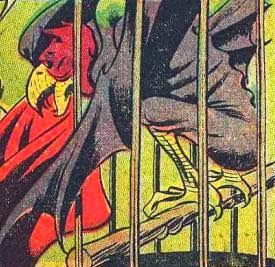
Vampire Birds
 |
Planet Comics #12
(Crash Parker feature);
1941, Fiction House, Art by P. Rice & A. Cazeneuve |
Crash Parker's adventures took him to various exotic locations, not the least of which is Uracius (or maybe Urania?), a “planet forbidden to Earth-men.” True to his name, Crash wrecked his rocket ship there. His excuse included the phrases “cosmic storm” and “vortex of the nebular maelstrom.”
In a cavern on that planet, Crash encountered the vampire birds, which possessed “heavy white fur and human-shaped talons!” Apparently, “human-shaped talons” is supposed to mean “talons formed like human hands.” Every vampire bird “has a queer crimson spot over the heart.” It is this spot “through which the fiendish transfusions [of blood] take place.”
◇ ◇ ◇
Service Animals from Planetoid R
 |
Planet Comics
#61 (Lost World feature);
1949, Fiction House,
Art by George Evans
|
These “fierce creatures” (affectionately called “hairy ones”) function as hunters and guides for “the blind mummy-men” of Planetoid R. Their ability to burrow underground tunnels makes them particularly effective.
After the Voltamen conquered the Earth, they imported these “strange monsters” in their efforts to annihilate the last vestiges of human resistance. These animals are very loyal to their mummy-men masters – a good reason not to antagonize the mummy-men.
◇ ◇ ◇
Dasta
 |
Planet Comics #23
(Star Pirate feature);
1943, Fiction House,
Art by Joe Doolin
|
Star Pirate (known informally as 'Star') encountered this beast on Zev. However, we should not assume that the Dasta is native to that planetoid. The Dasta is described as “three tons of armor-plated brute” and, as is shown, Star exclaimed, “Ten ray-guns wouldn't stop him!”
Star managed to blind the beast with a cloak and leaped atop “the bellowing bulk of a live torpedo.” Star then felled the Dasta by employing the “bulldogger's twist,” a little trick that Star somehow “learned from an Earthman castaway.”
◇ ◇ ◇
Grok
 |
Planet Comics #27
(Star Pirate feature);
1943, Fiction House, Art by George Appel |
Years before Heinlein scribed Stranger in a Strange Land, the writers of Planet Comics used the word 'Grok' to name a space creature. This is another animal that Star Pirate improbably killed without recourse to weapons.
While cruising the space-ways, Star's craft was surrounded by “a queer radiation,” precipitating a “space storm.” After being “sucked into the swirling center...[of] a twisting space-whirlwind,” Star was adrift for days when hunger prompted him to attack the “bird-beast.” How Star expected to dine through his space helmet is not explained.
◇ ◇ ◇
Dork
In another instance of a creature's name later acquiring a curious meaning, the Dork was a giant reptile from Neptune. The Toags, a race of reptilian humanoids, kept the “slavering monstrosity” in their dungeon for purposes of entertainment.
It's so huggable!
 |
Planet Comics #24
(Reef Ryan feature);
1943, Fiction House, Art by George Tuska |