Showing posts with label Xermoc. Show all posts

Sunday, September 2, 2012

Character Advancement and Spellcasting in High Fantasy


In High Fantasy, player characters gain experience points through their actions. With enough experience points, player characters advance in terms of “skill level.” Each skill level attained increases a character's effectiveness. This process is rather standard for many 'old school' role-playing games. However, beyond this point, High Fantasy begins to exhibit some differences.

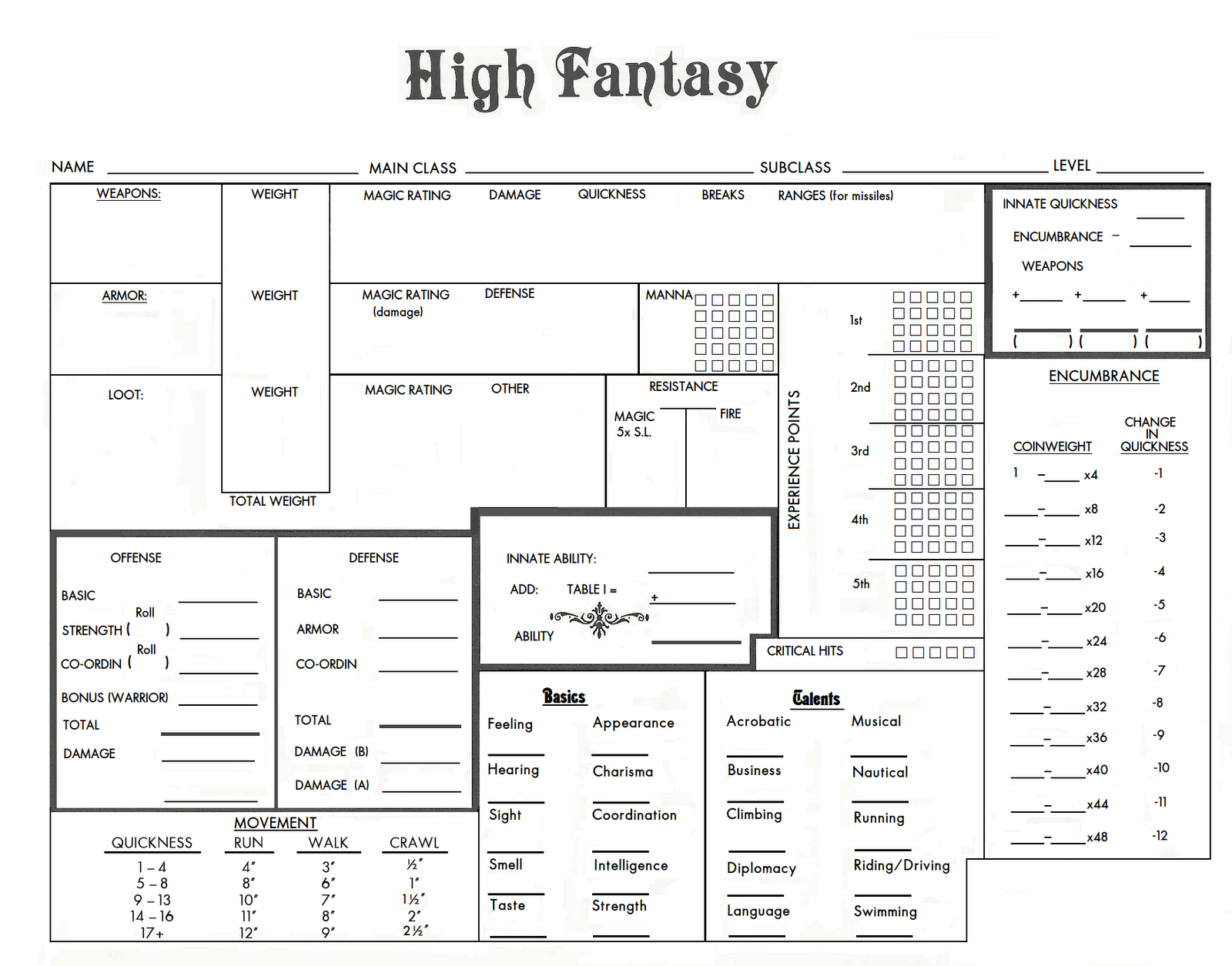
Five experience points separate one skill level from the next, regardless of character class. From first level to second level – five experience points are needed; from fourteenth level to fifteenth level – five experience points, etc. According to page 41, an experience point is earned “when a player's character's ability leads to the destruction, subdual, capture or control of an opponent with a skill level equal to or higher than that of the player [character].”* The rules go on to say that a character “need only aid in conquering an opponent” to earn an experience point; that way, all party members participating in the defeat of a suitably powerful opponent get an experience point. Because of how High Fantasy handles experience, players are spared the burden of recording thousands – or millions – of experience points as their characters advance and the amount of experience required to attain the next level is easily ascertained. In fact, experience is recorded via a group of checkboxes on the character sheet.

A key point of the experience system is that it specifies a “player's character's ability.” This does not mean 'ability' in the general sense; it refers to the function of the character's class. To earn experience points, a wizard must use spells to overcome an opponent, a warrior must use weapons, etc. It is also possible to gain an experience point when a character employs “his [or her] subclass in a very useful way.” Following up on this remark, the last sentence in the 'Advancement' section explains such an award is appropriate “when the player [sic] has a less than 5% chance and accomplishes his task.” Apparently, gaining experience via a subclass necessitates a very useful task that has a very low chance of success.
In High Fantasy, a set of four skill levels constitutes a “plane.” Page 41 explains that...
When a player [sic] advances into another plane not only does he receive the common skill level advantages but he also receives additional bonuses...For example wizards may use more spells, warriors receive another specialty weapon, alchemist [sic] get a new gun and animal masters train animals faster.
There are five 'planes' of spells. So, a wizard can cast spells from a plane equal to or less than the wizard's own plane (assuming the spell is in the wizard's book).  As might be expected, spells of a given plane are more powerful than spells from lesser planes; however, as a wizard “progresses from plane to plane [the wizard] will learn more effective uses” for known spells of lesser planes.  For example, let us examine the 'wall' spell of the first plane.  A 'first plane' wizard (1st - 4th level) casting 'wall' creates “a smokey wall to obscure vision.” Yippee.  Cast at 'second plane' (5th - 8th level), the spell generates an illusion of a wall.  At 'third plane' (9th - 12th level), the effect becomes substantial – “a stone wall 6" thick.”  At 'fourth plane' (13th - 16th level), a magic-hindering iron wall comes into being.  Finally, at 'fifth plane' (17th level and above), the wizard can create an invisible wall of “annihilation” that inflicts two boatloads of damage upon anything “entering it.”

In High Fantasy, magic is defined as the reshaping of reality.  Wizards do this via spells, which are powered by “a natural resource called aether.”  Wizards “conduct” aether in units called “manna.”  This is the basis of the spell point system in High Fantasy.  Any given spell costs a number of manna equal to the plane at which the spell is cast.  So, even though it is the 'same' spell, a 'smoke wall' would cost one manna regardless of the wizard's level, an 'annihilation wall' would cost five manna.

The amount of manna a wizard has is based solely on level.  Players are directed to consult the 'Skill Level Table' on page 116 to determine the amount of manna available to wizards of a given level.  Essentially, up through tenth level, available manna equals the wizard's level plus two.  After tenth level, manna equals level plus three.**

In order to cast a spell successfully, a wizard must (1) have hand and voice free, (2) not be involved in melee, and (3) “roll...equal to or less than his innate ability score.”  Manna is still expended when a roll is failed.  Wizards recover manna at a rate of one point per twenty-four hours.

Although aether is ubiquitous “in the environment of the game,”  there are areas of greater or lesser concentration.  Nexus points have a greater concentration of aether; because of this, wizards gain a bonus to their (spellcasting) ability rolls.  Also, the effects of a spell might spontaneously 'improve' to the next plane.  Black nexus points are areas of lesser concentration of aether; wizards suffer a penalty to their ability rolls at such places.


*  The Creature Table on pages 97-99 dutifully assigns a skill level to each creature. Xermocs, however, are not listed on the Creature Table; they are described as part of the rouge's gallery for the solitaire adventure and no skill level is listed.

**  Perhaps to avoid the number thirteen?

Sunday, August 19, 2012

Escape from Queztec'l

A Xermoc!

On our road trip to Gen Con, your humble host and his doughty companions decided to kill some time by going through the High Fantasy solitaire adventure Escape from Queztec'l. Since your humble host had been through the adventure once before, he did not participate in making decisions; he limited himself to bookkeeping and reading the 'scenes' aloud. In truth, the adventure is relatively extensive, allowing for many distinct experiences. The adventure itself (360 scenes) takes up 59 of the rule book's 196 pages and an additional 17 contain the adventure's instructions, stat blocks, background etc. Because High Fantasy uses percentile dice exclusively, we did not need to roll actual dice but were able to use the 'random' function of the scientific calculator app on your humble host's tablet. 

Warning – Beyond this point be spoilers!

In Escape from Queztec'l, the player portrays – or in this case, players portray – Xenon Swif'sord, a Swordsman/Healer. Given Xenon's depiction, it seems that a player could have Xenon be of either gender; however, Xenon is described as a swordsman and – in certain parts of the adventure – is referenced with masculine pronouns.

Xenon is a noble whose lands are not part of the Queztec'l empire but who, nonetheless, is connected with Queztec'l by virtue of “a common language, religion, and customs.” (Queztec'lan religion was described in this post.) Visiting the city of Queztec'l for a Holy Day ceremony, Xenon is staying at the Imperial Palace when the adventure begins. A military coup ensues and Xenon's life is in danger. While Z'lan* search the palace for nobles to slay, a chambermaid loyal to the nobility shows Xenon a secret staircase which leads to the catacombs beneath the palace. The only chance Xenon has of escaping Queztec'l is to travel through the catacombs to a seaside exit. The chambermaid says, “You may follow the red hands of Djacarta through the crypt and down to the sea, but that path may be dangerous. There are other routes...” While descending the stairs, Xenon thinks about Dazia, the cousin with whom Xenon traveled to Queztec'l. “You wonder if she can survive the usurpation, and you find that you really don't care. She always knew how to win favor.”

The doughty companions elect to have Xenon run down the southern hall which “is significantly wider than the other two and relatively well lit.” (Being pursued by soldiers, this is not the choice your humble host would have made.) Anyway, Xenon reaches an intersection and goes east to another intersection and a large bronze door “adorned with a left and right palm painted in an eerie shade of red.” Instead of taking the north or south corridors, the companions have Xenon open the door. (Your humble host approves, believing the palms to be “the red hands of Djacarta” about which the chambermaid spoke.)

Beyond the door is “a large well-lit circular room” with another bronze door opposite and six iron doors besides. (A diagram is provided below.)  “The six iron doors apparently lead to tombs, for the names of the emperors are still visible to them.”  Rather than go through the other bronze door, which also has the “two red palms set in relief,” the companions decide that Xenon enters the tomb of Hac Djacarta.


Inside the tomb is “a man-sized statue of Djacarta” which turns out to be “the sarcophagus of Hac Djacarta.” Xenon examines the statue and a gem it holds.  While doing so, the room seems to spin and the stone dissolves beneath Xenon's feet.  A random roll offers seven results and the result determined by the scientific calculator has Xenon wind up in a large room with a Xermoc.**  Xenon rushes for the nearest exit but is psychically assaulted by the Xermoc.  Instead of leaving, the companions opt to have Xenon attack the Xermoc.  As Xenon approaches, the Xermoc goes behind a statue of Djacarta and the statue “steps off its pedestal and moves toward” our hero.  Pursuant to the will of the companions, Xenon attacks the statue.  Alas, the statue proves to be quite formidable and when, after three rounds of combat, Xenon has the option to break away from the battle, the companions have him do so.  As Xenon exits the chamber, the Xermoc hits him with another psychic blast.  Xenon slams the door and finds himself in a north-south hall.  Before proceeding, Xenon uses his talents as a healer to recover completely from his wounds.  Still, Xenon's armor has been damaged extensively.

The companions have Xenon walk south and, after several turnings, Xenon is in a hall with two doors opposite one another.  Xenon opens the east door (which has two red palm prints) and enters the dark room beyond.  Within the room is none other than Xenon's cousin, Dazia the 5th level alchemist.  Dazia has made an agreement with the leader of the successful coup:  Dazia's life for Xenon's.  Dazia claims, “My only hope is handing you over...”  Dazia puts aside her wheel-lock pistol in order to “make the contest fair.”  In contradiction to her claim of a fair contest, Dazia drinks a Potion of Strength.

Cousin Dazia
In the ensuing fight, Xenon manages to get in some good hits against Dazia but, ultimately, Dazia prevails.  When Xenon regains consciousness, he finds that his hands have been bound.  A Z'la prods Xenon down a hall and Dazia says,“Take him to the room...”  When Xenon and the Z'la eventually stop to rest, a random roll offers three possible results.  By virtue of the scientific calculator, Xenon falls asleep.  Upon awakening, Xenon finds two Z'lan standing over him.  A Death Dealer approaches and laughs.  “Together the Z'lan and the Death Dealer carry [Xenon] back to the palace, there to await [his] fate.”  The fate is not a good one; this scene concludes the adventure.


*  A Z'la is a common Queztec'lan soldier. Z'lan would seem to be the plural.
**  A Xermoc is a “[t]elepathic lizard with a type of vague intelligence. Used by the army for tracking.”


Sunday, June 24, 2012

Solo Adventuring in High Fantasy


In the preface to High Fantasy, Jeffrey Dillow states:
This is not a book of rules. The actual rules consist of only a few pages. What this book is, is an accumulation of medieval weapons, spells, and monsters with clear explanations on how to use them in fantasy adventures.
Actually, the page distribution is as follows.


Dillow also uses the preface to point out the 'giant' solo adventure and its suitability for teaching the reader how to play.  Specifically, Dillow says in the introduction to the adventure, it “was designed...to teach beginning players how to work through combat and to give them a basic understanding of how High Fantasy works.”  The adventure, Escape from Queztec'l, was written by Craig Fisher, who also wrote another High Fantasy solitaire adventure, In the Service of Saena Sephar. With Queztec'l, Fisher not only provides a solo adventure and a streamlined version of High Fantasy combat, he also provides some setting background, including a continent map, notes on religion, and creature statistics.  The setting deserves its own post, so I will not dwell further on it here.

Dillow says, “High Fantasy is based on the sound mathematics of the percentile dice.” I don't know why the RPGGeek listing includes “Dice (Primarily d6)” as a game mechanic. Six-sided dice are not mentioned in High Fantasy (at least not in the second edition), doubtless due to their comparatively unsound mathematics.

Anyway, for purposes of playing the solo adventure, the reader controls a character named Xenon.  The picture above suggests that the character's full name is Xenon Swif's'ord and that Xenon could be of either gender based upon the preference of the reader.  For purposes of the adventure, all characters have three attributes:  quickness, offense, and defense.

Essentially, quickness determines initiative.  It also determines movement rate.  It is affected by encumbrance.  For purposes of initiative only, it is also affected by weapon type.

In order for Xenon to hit an adversary in combat, the adversary's defense is subtracted from Xenon's offense; the result is the percentile chance of success.  Assuming Xenon is successful, the combat table is consulted.  The chance of success determines which column to use and another percentile roll determines which row to use.  The combat table provides a number that is subtracted from the adversary's offense and a number that is subtracted from the adversary's defense.  Death occurs if and when defense is reduced to zero.  Combat against Xenon is handled similarly, except that defense damage is divided – as indicated by the combat table – between 'personal' defense and 'armor' defense (if any).

Depending upon the attack, more or less damage may be inflicted.  A 'plus' means moving to a column to the right of the column indicated by the chance of success (more damage) and a 'minus' means moving to the left (less damage).  For instance, a weaponless attack by a human has a -5 damage modification while a Xermoc's claw has a +6 damage modification.

Apparently, “pad[s] of character sheets” as well as percentile dice were available from Fantasy Productions Inc., the company that Dillow created originally to publish High Fantasy. The character sheet graphic in the book is, in effect, a diagram with different sections labeled with numbers associated with the steps a player follows when making a character. For my cherished readers – as well as posterity in general – I have scanned in the so-called character sheet and cleaned it up somewhat, taking out the step labels.  The result appears below.  You can use it as a reference as we continue our exploration of this fine game.