Showing posts with label 5E. Show all posts

Sunday, August 29, 2021

It's 2021 and the Dream is Dead

So reads the cover caption of Mayfair's Underground, published in 1993.  Taking place in 2021, Underground is unusual in terms of genre; perhaps “dystopian super-hero” might be the best categorization.  According to the first chapter, “the world of 2021 is clearly a cold and dreary rat trap dominated by violent men and women who shoot or foreclose first and ask questions later.”

Writer Ray Winninger has contributed a variety of table-top role-playing game products; most recently, he has an “Additional Design” credit on last year's Tasha’s Cauldron of Everything.  However, the first textual matter in the book is a poem by William S. Burroughs.  This is a clue to the reader that the game is going to a dark place.  In fact, the full page illustration on page 102 focuses on a person about to commit suicide.  Yet the game is not without (gallows) humor.  Tastee Ghoul, “a chain of fast food restaurants specializing in cannibal cuisine,” has as a motto, “Are you a people person?”  Among other topics, Underground is a commentary on consumerism.  Here is the ultimate extension of consumerism; the consumer becomes indistinguishable from the product.

How did such a strange world come to be?  In August, 1996, “a life-pod launched from an interstellar starship crash-landed in the Florida Everglades.”  The two aliens on-board died as a result.  Although the aliens were “totally unlike any creature mankind had ever imagined,” they are also described as “lobster-like.”  So, the first point of divergence from our reality is that lobsters cannot be imagined.  “The aliens' technology was found to be based entirely around the manipulation of amino acid chains” and this technology held “the clues needed to unlock the mysteries of quantum theory, unified fields, and genetics...”

Because the U.S. Government did not disclose all aspects of the alien technology to the world, a Second Cold War resulted among the “three major trading blocks:  the North American Confederation, headed by the United States; the European Common Market, headed by Neo-Deutschland... and the Far East Collective, headed by mainland China.”

Also According to the first chapter...

...technological advances derived from the pod combined with the political situation wrought by the new Cold War to dramatically reshape the world.  All across the globe, the gap between the upper and lower classes grew broader, crime and other social ills corrupted large portions of the planet, and multi-national corporations grew larger and more powerful than ever before.  Shortly after the turn of the century, warfare evolved into a business as multi-national corporations organized large, technologically sophisticated armies capable of rapid deployment to any hot spot on the planet...  Only a few years after the first corporate army took to the battlefield, all three of the major trading blocks were routinely hiring corporate soldiers to intervene in scores of Third World squabbles and conflicts in the hope of protecting and expanding their economic interests...

One of the so-called militant corporations, Allied Mayhem™ Inc., “learned to modify human genetic tissues, turning test subjects into 'super-men' capable of dominating a modern battlefield.”  However, “stabilizing the genetic enhancement process required a living subject with a seriously impaired capacity to replace lost body cells.”  Originally, AMI used brain-dead bodies that were cryogenically frozen in the twentieth century but, “Due to their artificial brains, the enhanced soldiers were easy to outsmart and frequently failed to follow all but the simplest orders.”

In 2014...

Allied Mayhem began enhancing live volunteers in limited numbers.  Although this latest generation of enhanced soldiers was very effective in battle, the new process was ultimately deemed unstable and abandoned.  During the many months that AMI scientists spent conquering the cellular regeneration problem, they failed to recognize psychological instability as an even more profound obstacle to the enhancement of live subjects.  The first such subjects who awoke to discover that they were suddenly capable of lifting cars, flying, and projecting powerful force fields all lost their grip on reality and went mad.  AMI researchers ultimately discovered that such a radical shift in world view was simply too much for a conscious human mind to handle.

The solution devised by AMI's head of the Genetic Enhancements Division was to have enhancement subjects “spend fourteen months in a sensory deprivation tank wired into” a virtual reality environment based on a super-hero comic book.  During this time, “the computer's program enables the subject to relive his or her entire life as it might have occurred in the four-color” comic book setting.  In the simulation, the subject acquires enhanced abilities while scientists confers those same enhancements to the subject's physical form.  “Once the process is complete and the subject is removed from sensory deprivation,” we learn, “AMI psychologically reconditions the subject to the real world, though a psychological acceptance of his or her newly acquired abilities lingers on within the individual's subconscious mind alongside a faint memory of his or her virtual life.”

Important highlights of the world of 2021 include:

  • The second cold war has a hidden impact on society
  • The U.S. government closely monitors its citizens
  • The demand for (military) recruits is high
  • Some forms of popular entertainment are becoming propaganda
  • Unskilled veterans returning to the U.S. often turn to crime
  • Foreign affairs are more complex than ever
  • The wars are changing the very nature of mankind

The player characters are super-powered veterans subject to “all sorts of bigotry and prejudice.”  With regard to these veterans, “most are neurotic, slightly detached from reality, and prone to extreme mood swings.”  Additionally, for some of the veterans, the virtual reality experience instills “a 'comic book' world view and begin to interpret life as a series of struggles between 'heroes' and 'villains.'”  Ultimately, “Given the growing alienation of the lower classes and the current climate of predatory corporate practices, a few such [veterans] look upon AMI and the American government as 'master villains' who have betrayed the American way.”  Such veterans formed the titular Underground activist group.


Sunday, October 20, 2019

Role-Playing Game as Marketing Gimmick


Art by Alex Lopez

Earlier this month, Wendy's – the restaurant chain – released a tabletop role-playing game, Feast of Legends (hereinafter Feast).  It is available as a free PDF.  (A hardcopy version was available at the New York Comic Con.)  Now that I've time to digest it, I provide my thoughts in this post.

First and foremost – Why?  Evidently, “There are 4.7 million RPG fans across the U.S. and 13.8 million worldwide, according to Google Analytics data cited by Wendy's.”  This fact and the extent to which RPGs have encroached upon popular culture are apparently sufficient for an ad agency (or marketing consultant or whatever they call themselves nowadays) to convince Wendy's that this demographic is important enough to solicit.  According to Ad Age, advertising agency executives playing RPGs is a thing, so it was only a matter of time until something like this saw the light of day.

At 97 pages, Feast is the product of eight months of work.  Although infused with tongue-in-cheek humor, Feast is a professionally rendered product with a workable system influenced by Fifth Edition.  (No writing credit is given and there is no concession to the Open Gaming License.)  Aside from the PDF, the Feast home page has a thirty second YouTube video, a rudimentary die roller, and the requisite DoorDash link.  What about the droves of hamburger consumers who aren't familiar with RPGs?  The Feast page also has a “New to This?” link.  However, page two of the PDF does a better job of concisely describing how role-playing games work.  Game Master advice (on page 36) includes appropriate statements like “The most important part of being a GM is to make sure the group is having fun” and “This is simply your template to create the best game possible for the players.”

Feast presents itself as both a rulebook and campaign.  The rulebook is 19 pages and the campaign, “Rise from the Deep Freeze,” has 35 pages.  The remaining pages consist of the covers, introductory material, art, a map of the setting, a character sheet, and five pre-generated characters.  The setting is Beef's Keep...
     ...where the nations have been splintered over major disagreements in how to treat the realm’s people.  Creepingvale and the United Clown Nations have led their people into a collective darkness known as The Deep Freeze.  While the world currently feels like a cold and desolate place, you reside in the one nation that remains a true beacon of hope: Freshtovia.
     Freshtovia is known for its lush fields; signature dishes; and redheaded queen, Queen Wendy.  As queen of Freshtovia, Wendy has clapped back at all attacks on her borders.  She is strong and has maintained her nation’s integrity despite the growing pressure of the other nations.
The marketing message is obvious; Wendy's serves only wholesome, fresh beef while the competitors foist ungodly, frozen beef upon their unsuspecting customers.

The basic mechanic of the system is to obtain a high result on a d20 roll.  A roll of 1 is considered “a big oops.”  A roll of 20 causes a character to enter “FEAST MODE,” the best possible outcome.  In combat, this means maximum damage and an additional roll with advantage.  Instead of short rests and long rests, there are snacks and meals.  Feast characters have “five main stats” (Strength, Intelligence, Charm, Arcana, and Grace).  For the most part, they are self-explanatory, but Strength represents both “physical and mental strength.”  To determine the score for a stat, 4d4 are rolled.  (This is supposed to reflect Wendy's “4 for $4” promotion.)  All five scores are  determined before assigning them.  Even an average roll (i.e., 10) offers a +1 bonus.  Starting Hit Points are also determined by rolling 4d4.


Instead of classes, there are 14 Orders – each based on one of Wendy's offerings (e.g., Order of the French Fries, Order of the Baconator, Order of the Asiago Ranch Chicken Club, et al.).  Orders provide:  Base Defense (like ascending Armor Class), Additional HP (if any), Other Bonuses (to stats), Skilled With (armor and weapons the character can use – characters receive a +1 on attacks with weapons with which they are skilled), and Cannot Use (prohibited armor and weapons).  Orders also provide one or more skills per level.  For example, 'Two Beef Patties' is a Level 1 skill of the Order of the Double Stack (“You can dually wield any weapons that don’t require two hands”).

Characters start with ten gold pieces.  There is no other coin denomination, which means that a nail costs 1 gold – the same as a blanket, a weaponized spoon, or ten feet of rope.  Characters “also start with a basic outfit, which can include clothing or armor that matches your character’s skills...a basic weapon or two if the Order you choose permits it...other basic tools or items that make sense for your character to carry...” and possibly a shield.  Examples of equipment that can be purchased include ukelele (7g), pigtail wig (4g), and strawberry lemonade (10g) which heals 1d12 hit points.

One important aspect of Feast is that the behavior of a player in real life can affect game mechanics that apply to his or her character.  Eating various Wendy's items will grant bonuses “for the entire duration of play for the day.”  These are called “buffs.”  As an example, eating Wendy's french fries confers “+1 to your Intelligence stat.”  By eating an item that matches the character's Order, the character will “gain advantage on all attack rolls for the day.”  This seems overpowered.  There are also “debuffs.”  A player eating food other than Wendy's during gameplay may detrimentally affect a character for the duration of the session.  A sub sandwich causes a -2 modifier to all Strength rolls (including attack rolls).  Consuming tacos inflicts a -2 modifier to all Arcana rolls.

I won't disclose spoilers for the multi-part adventure, but it includes puzzles and various activities.  We learn, “Each square on the table represents 5 feet of movement,” but no scale is provided for the maps.  Characters can encounter people with names like Chilbo Bacons and Frostina LaSpoon.  At various parts of the adventure, player characters gain a level.  Regardless of Order, each character gains 2d4 + 4 hit points upon reaching a new level. The adventure takes the characters to fifth level.  Since the Order descriptions only lists skills through fifth level, there is no means of improvement for characters once they finish the adventure.  Yet there is a larger world beyond the adventure; part six of the campaign is titled “Continued Adventuring.”  It describes additional locations and activities.  Page 83 provides a 'Karaoke Charm Rolls' table.  Characters can obtain exotic steeds at the Spicy Stables.  The listed attack for camels is 'spit' (1d6 damage).  The 3.5 SRD description of camels does not mention spitting; Feast is therefore superior in at least one aspect.  (1d6 damage might seem to be excessive, but Feast characters do not perish upon depleting their hit points, instead they “pass out from hunger.”)

Players are encouraged to describe their characters:
     Writing down a physical description of your character will help you and your party members be fully immersed in the experience.  Use your class [sic] to help inform the look and feel of the character you want to create.
     Oh, and don’t forget to give your new hero a super dope name.  People are going to be calling you that for the entire game, after all.
Yet the character sheet does not have a place to write such a description, although it has sections for Photo and Bio.

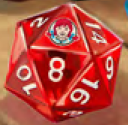
Presenting a free PDF is well and good, but if Wendy's wants me ordering their food, they need to provide premiums.  People in the YouTube comments are clamoring for figures.  I have another idea.  Page 7 has a representation of a d20 with a Wendy's cameo depicted on the '20' side.
This should be a real thing.  They can even call it a Wend20.

Sunday, May 12, 2019

Deck of Many Things

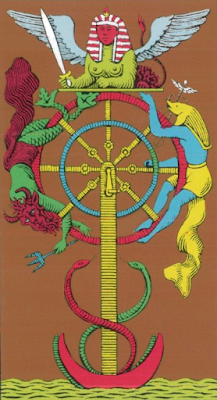
Art by Oswald Wirth

Nowadays you can just buy them but circa 1981, if you wanted a Deck of Many Things, you either had to cannibalize a standard poker deck (yawn) or make it from scratch.  One of your humble host's gaming buddies crafted an original deck, although I don't think we ever found an in-game use for it.  Still, such was the allure of this magic item, it captivated our imagination.

I never much cared for the name.  Deck of Many Things?  If Viking parliamentarians had cards similar to baseball players and you had a comprehensive set of those cards, you would have a Deck of Many Things.  Sure, I guess the full name is the Deck of Many Things Beneficial and Baneful, but no one ever uses the full name.  Why not the Deck of Benefit and Bane?  The Deck of Danger and Delight?  The Deck of Precipitous Fate?  “Many Things” implies a paucity of creativity.

The Deck of Many Things is first described in Greyhawk.  This version consists of eighteen cards, “One-half bring beneficial things, and one-half cause hurtful things.”  Actually, eight cards are beneficial and eight are hurtful, but there are also two jokers.  Each joker offers the choice of 25,000 experience points or the selection of two additional cards.  Arguably, the jokers are beneficial which would mean slightly less than half of the cards are hurtful.  Regardless, the (roughly) half-good / half-bad mix of cards is reflected in future iterations of the deck.  Aside from the jokers, the deck includes the face cards and aces of the standard suites; the red suites containing the beneficial cards and the black, hurtful.  The cards are not given fancy names like 'Comet' or 'Euryale', they are referenced only by their pedestrian poker designations.  Greyhawk informs us that a character “possessing such a deck may select cards from it four times (or more if jokers are drawn), and whatever is revealed by the card selected takes place.”  No announcement of intent is required – a card is drawn and the outcome occurs.

Once Greyhawk describes the effects of the individual cards, the book continues:
After each draw the card is returned to the pack and it is shuffled again before another draw is made. All four draws need not be made, but the moment the possessor of the deck states he has no intention of ever drawing further cards, or after the maximum number of draws in any event, it disappears.
Clearly, a deck has an individual possessor and – once the possessor concludes his draws – the deck goes away.  ('Disappear' does not mean that the deck becomes invisible.)  It seems wasteful that only one character can benefit/suffer from the deck before it leaves to wherever these decks go.  Since there is no stipulation that jokers aren't shuffled back into the deck, more and more cards can be drawn (at least until the possessor dies or is turned to stone).  Lastly, we are informed, “The referee may make up his own deck using the guidelines above.”  Said guidelines seemingly ensure a mix of beneficial and hurtful cards balanced in number and intensity.

The first edition Dungeon Masters Guide describes two varieties of decks, both of which are distinct from the Greyhawk deck.  One is a thirteen plaque economy deck (being 75% of all decks), the other is a deluxe deck (being the remaining 25% of all decks) with nine additional plaques.  Each plaque has a poker deck analog, but they also have individual names like 'Vizier' and 'Talons'.

Unlike the Greyhawk deck, for a drawn card to have an effect in the DMG versions, a character must announce beforehand the number of cards he or she intends to draw (up to a maximum of four).  Exactly how is a character supposed to know this condition?  Here's my take:  Decks are “usually...contained within a box or leather pouch.”  I would think that characters are incapable of withdrawing any plaques from their container unless and until they announce the number they intend to draw.  Instructions about this requirement can be inscribed on the container.

Instead of two jokers with an option of experience points or additional draws, there is one 'Jester' where the experience option is 10,000 points (as opposed to 25,000).  The second joker – called 'Fool' – appears in the deluxe deck; it causes a loss of ten thousand experience points and necessitates an additional draw beyond the number announced.  The Greyhawk version has a card (A♥) that grants 50,000 experience points and another (K♥) that provides a miscellaneous magic item.  In the DMG version, both effects are combined into the 'Sun' plaque.  The DMG 'Moon' gives the character 1 - 4 wishes while the Greyhawk version (Q♥) gives 1 – 3 wishes.  A Greyhawk drawer can receive a “map to richest treasure on any dungeon level” (A♦) while the DMG 'Key' offers “a treasure map plus 1 magic weapon.”  With the DMG 'Knight', a character gains “the service of a 4th level fighter” until death; the Greyhawk version (J♥) supplies a Superhero (i.e., 8th level fighter) with +3 armor, shield, and sword, but this service only lasts an hour.  A Greyhawk card (K♦) supplies a character with “5 – 30 pieces of jewelry immediately,” but the DMG 'Gem' offers a “choice of 20 jewelry or 50 gems.”  While the DMG 'Star' increases a character's “major ability” by two points, the Greyhawk card (J♦) adds one point to an ability of the character's choice.  While a Greyhawk card (K♣) takes away a character's most prized magic item, the DMG 'Talons' causes the loss of all magic items.  A Greyhawk card (Q♣) causes a character to be turned to stone (“no saving throw”), but the DMG 'Euryale' causes a “Minus 3 on all saving throws vs. petrification.”  Greyhawk cards without a direct DMG equivalent include one (Q♦) that provides a “Scroll of 7 Spells, no 1st-level spells on it” and another (J♠) where a “Monster from 5th-level Underworld Monster Table attacks by surprise.”

With regard to the staying power of the DMG decks we learn, “Upon drawing the last plaque possible, or immediately upon drawing the plaques in bold face (The Void, Donjon), the deck disappears.”  (bold and italics in original)  This is less explicit than the Greyhawk explanation.  Apparently, the same conditions apply, but there is no specific statement that only one character can use a given deck.  Dragon #148 (August 1989) includes a feature with the title “Luck of the Draw.”  In the guise of fiction, Robin Jenkins provides some information about how a Deck of Many Things works.  According to Jenkins' logic...
Once the number of cards to be drawn is announced, other characters may pull from the deck in place of the initial character, thereby assuming the number of pulls initially announced. Any character who announces his intention to pull a new number of cards from a deck “erases” any previous number announced, so long as that previous number of draws was not completed; this makes it possible for one deck to pass through many hands.
The third edition rules tend to dispel this notion. We read:
Cards must be drawn within 1 hour of each other, and a character can never again draw from this deck any more cards than she has announced. If the character does not willingly draw her allotted number (or if she is somehow prevented from doing so), the cards flip out of the deck on their own.
Yet nothing indicates that the deck “disappears” once a character finishes his or her draws.

When 'The Void' card from the DMG is drawn, “The character's body functions, and he or she speaks like an automaton, but the psyche is trapped in a prison somewhere – in an object on a far planet or plane, possibly in the possession of a demon.”  In Jenkins' paradigm, this means the victim's body can be led about to “check for pits, traps, that sort of thing!”  Third edition clarifies that the body functions “as though comatose.”  The 'Donjon' card from DMG “signifies imprisonment – either by spell or by some being/creature at your option.”  Jenkins presents an example where a character drawing 'Donjon' is imprisoned in Hades.  Whereas the DMG decks disappear upon 'Donjon' or 'The Void' being drawn, third edition includes the instruction “Draw no more cards” in the explanation for both cards

Other differences between first edition and third edition cards are as follows:
  • Euryale :   Instead of -3 on petrification saving throws, 3E inflicts -1 on all saving throws.
  • Gem :  Third edition specifies 25 items of jewelry instead of 20.  Also, each item of jewelry is worth 2,000 gp and each gem is worth 1,000 gp.
  • Idiot :  In first edition, 1d4 points of Intelligence are lost; in third edition, the loss is 1d4+1.
  • Key :  In third edition, the character gains “a major magic weapon” but no map.
  • Skull :  In first edition, “A minor Death appears.”  In third edition, “A dread wraith appears.”
  • Star :  First edition specifies the points go to the character's “major ability” (or, if such an addition would bring the score to 19, one or both points are applied to other abilities).  In third edition, any ability can be selected for the bonus.
  • Throne :  In first edition, the character gains a Charisma score of 18 and the “castle gained will be near to any stronghold already possessed.”  No Charisma is gained in third edition; the character receives “+6 bonus to Diplomacy checks.”  Additionally, “The castle gained appears in any open area she wishes.”
  • Vizier :  In third edition, the effect must be employed “within one year.” 
Also, the third edition Deck of Many Things is a minor artifact and the thirteen card economy version is not mentioned.

The number of cards in the deluxe deck suggests a correlation with the Major Arcana of the tarot; even some of the card names are the same – 'Sun', 'Moon', 'Star', and 'Fool'.  In fact, Dragon #77 (September 1983) contains an article describing a Tarot of Many Things.  Each of the seventy-eight cards has two effects, one if the card is drawn upright and another if drawn inverted.  Unlike the more prosaic Deck of Many Things, “No card can be received more than once by the same drawer.”  Also,
A person who wishes or is compelled to draw from the deck will be allowed to announce an intention of drawing one, two, three, or four cards; when the last member of the party who wishes to do so has drawn, or if one hour elapses without any draw, the deck will disappear – unless the party is on the plane of the Tarot's master deity, which is not the party's own home plane.
So, use of the Tarot is not limited to one character.  Third edition lists tarot equivalents for the twenty-two cards in the deck; however, only half of the Major Arcana are represented.  To be fair, the imagery of the Minor Arcana used is appropriate to the card effects.

The Pathfinder version of the Deck of Many Things naturally conforms to 3.5E; however, we are given information about destroying the artifact:
The item can be destroyed by losing it in a wager with a deity of law.  The deity must be unaware of the nature of the deck.
One might think that the deity would become suspicious (and thus 'aware' of the nature of the deck) after the first time this occurs.  Also, one might think a god could become quite upset if something just won in a wager ceases to exist.

In fifth edition, the Deck of Many Things is no longer an artifact, the thirteen card economy deck is reintroduced, and any correlation with the tarot is abandoned.  Card effects are generally the same as third edition, with differences indicated as follows:
  • Donjon :  It is specified that the character disappears and becomes “entombed in a state of suspended animation in an extradimensional sphere.”
  • Euryale :  A –2 penalty on saving throws is inflicted.
  • Key :  “The item is selected by the GM.”
  • Moon :  The character is “granted the ability to cast the wish spell 1d3 times.”
  • Skull :  Instead of a dread wraith, there is an Avatar of Death, which is similar to the first edition's minor Death.
  • Star :  “The score can exceed 20 but can’t exceed 24.”
  • Throne :  The character gains “proficiency in the Persuasion skill” and the proficiency bonus is doubled “on checks made with that skill.”  Also, “the keep is currently in the hands of monsters,” which must be cleared out before the character claims the keep.
  • Vizier :  In fifth edition, “the knowledge comes with the wisdom on how to apply it.”  (This is in contrast to first edition which says, “Whether the information gained can be successfully acted upon is another question entirely.”)
Another issue I have with the Deck of Many Things is how knowledge is imparted to the character in various circumstances.  For instance, with 'The Fates' card, “Reality’s fabric unravels and spins anew, allowing you to avoid or erase one event as if it never happened.” (5E)  How does the character know this?  When the character selects an event, what does he or she do to apply the effect of the card?  Instead of a deck being contained in a box or pouch, why not have it be part of a device with an animatronic fortune teller?  If you don't like an animatronic fortune teller you could have an imp, a talking magpie, or whatever suits your fancy.  The device could dispense physical objects like weapons and gems in the manner of a vending machine (or a slot machine).  Entities like fighters and death avatars can climb out of a small door in the side of the machine.  Cards that require an explanation (like 'The Fates') can be explained by the fortune teller (or whatever).

The next question is, who (or what) would bother to create a Deck of Many Things?  Jenkins postulates that “the powers of Neutrality are at the core of the deck’s power, and the enchantments of such decks come from the plane of Concordant Opposition...the gods of luck...seem likely to benefit from the dissemination of such items in this world.”  Well, if a wizard didn't do it, you might as well have gods do it.  But why would gods (of luck or otherwise) want to create and disseminate such items?  Jenkins writes, “The purpose behind the deck of many things is to encourage risk.”  I don't think the motives of gods would be known to mortals (or necessarily comprehensible by mortals).  I think that – to the gods – it's just a game.


Saturday, April 1, 2017

Friendship Is Magic!


© Hasbro Studios

Regular readers have likely noticed a reduction in the frequency of posts.  This is because your humble host has been preparing to take the blog in a bold, exciting direction.  After five years of discussing role-playing games, Thoul's Paradise will henceforth be a brony empowerment blog.  Today's post will act as a transition between these interests, looking at pony role-playing opportunities.

The official My Little Pony role-playing game, Tails of Equestria (Get it?  Tails?), will not be available until later this month.  However, the “pony sheet” offers a glimpse of what we can expect.


According to the ad copy:  “Armed with core skills and special abilities, each player ventures into the world of Equestria with their pony peers, forging deeper friendships as they help one another in the whimsical world they create through every action they take.”  It looks like the dice (sold separately, of course) are the standard assortment of polyhedrals.  Interestingly, the recommended age for this game is “3 years and up.”


Other than the forthcoming official RPG, there is the Ponyfinder Campaign Setting from Silver Games, LLC.  Originally, Ponyfinder was intended as a supplement to Paizo's Pathfinder (hence the name).  The latest incarnation – a 168 page PDF – embraces Fifth Edition; however, the Ponyfinder name has been retained.  (I would have gone with Ponyfiver, but I'm not a marketing expert.)

Each pony has a sub-race (which I assume is the same as 'tribe') and a spiritual path (“an important and specific choice that sets ponykind apart from most of the other races”).  The three common sub-races are earth-bound, pegasus, and unicorn.  The less common sub-races include ghost ponies, leather wings, sea horses, and zebras.  Among the spiritual paths, there are:  Antean, chaos hunter, clockwork, doppelganger, gem pony, and sun pony.  However, the most common spiritual path is “unique destiny,” which allows a choice of ability score increase and skill/tool specialty.  'Spiritual path' is something of a misnomer; the term suggests a conscious decision to follow a particular philosophy.  However, the described paths are really accidents of birth.  Clockwork ponies, for instance, are “comprised of gears and springs.”  Instead of 'spiritual path', perhaps 'heritage' would be a better term.  Even so, the reason why 'gem pony' should be a spiritual path while 'ghost pony' is a sub-race is beyond me.  If I'm going to pretend to be a magical pony, I need a logical framework with a rock-solid foundation.  I mean, what am I, an eight year old girl?  (Don't answer that.)

Ponies “stand about four feet tall from hooves to head, and are about four feet long from front to base of the tail.”  All ponies have a “Brand of Destiny.”  We are told, “This symbol is of high importance to the pony, signifying their destiny or talent, and driving them to excel at it.”  This brand can be removed via a 'Denial of Destiny' feat.  Doing this is a “drastic act [that] defies the gods and the natural order and declares that you mean to operate under your will alone.”  So ponies don't automatically have free will, but they can obtain it.

The back cover claims, “Many spells, class specializations, and backgrounds are also usable by non ponies or other settings.”  The accuracy of this statement depends on how few items can constitute 'many'.  Regarding spells, we are told, “Most of these spells are of specific use to ponies, with limited function for other races.”  Among the dozen new spells provided, we are treated to the likes of 'Blast of Harmony' and 'Grazing'.  Two of the five new backgrounds are 'Hybrid' and 'Unbound Hooves'.  As is, some of the class specializations – such as Artifact Tender (Rogue) and Warden of the Night (Paladin) – can be used by non-ponies and are not tied to the setting.  Other specializations are not quite so flexible.  Among these are Tribal Scholar and Mobile Cannon (“Four-legged races face unique challenges when they pursue the way of the gun”).  Two other examples of specializations are Mystic Prancer (Bard) and Vampiric (Sorcerer).  Yes, there are rules for playing vampire ponies; it's a wonderful time to be alive.

Other than ponies, there are seven other playable, quadruped races in Ponyfinder.  Two of these – Flutterponies and Steelhearts – might as well be pony sub-races.  The 'non-pony' races are:  Cloven (“intelligent goats”), Griffons, Phoenix Wolves, Purrsians (“a winged feline race”), and Sun Cats.  All of these races are of 'Medium' size and all have their own feats.

The 'world' of the Ponyfinder setting is Everglow, “nestled in delicate balance between the elemental planes...a world of magic and mystery where the fey are in control and the humanoid races are secondary.”  Ponies and all of the non-humanoid playable races are considered to be fey “for all purposes.”  The 'Places of Note' chapter consists of 24 pages (describing locations like Tramplevania) as well as a one-page map.

Of course, given intelligent ponies, there must be pony gods.  The Ponyfinder gods include:  Blaze (CE), Kara (NE), Moon Princess (LN), Princess Luminace (LG), Sheila the Author (N), Sun Queen (NG), The Night Mare (LE), and – last but not least – Unspoken (CN).  I guess Chaotic Good ponies are out of luck...or maybe they just don't give a pasture patty about gods.

A fulsome history of Everglow is provided in the book with emphasis on the pony empire.  There is a presumption that Ponyfinder games are “set after the decline of the Empire,” but information for running a 'height of the empire' campaign is also provided.  Twenty-four pages are devoted to descriptions of 39 'Notable Persons'.  There are no stat blocks, just paragraphs of information about famous ponies with names like Saxon Violins, Scarlet O'Mare, and Boogie.

Sunday, January 8, 2017

The Lantern in Combat


Domenico Angelo's The School of Fencing (1787) includes a section on how to confront an opponent who employs a “dark lanthorn” – a lantern with a panel that slides to block the light.  Evidently, footpads would equip themselves with a sword and lantern in order to commit their depredations.  According to Angelo, “there are severe punishments inflicted upon on those who are found sword in hand with a dark lanthorn...”  Reportedly, such a criminal would keep the lantern's panel closed, thereby maintaining darkness.  When the robber approached close enough to shine a beam of light into the victim's eyes, he would open the panel.  This would temporarily blind the victim, thereby facilitating the footpad's goal.

If such tactics were viable in the real world, why not apply them to dungeon delving?  Subterranean entities with sensitive eyesight might be particularly susceptible.  How would the mechanics work?  Perhaps, first of all, a successful 'attack' should be made on the part of the lantern wielder.

Starting with Moldvay's D&D and continuing with subsequent editions of 'basic', a 'Light' spell cast at a target's eyes would cause blindness for the duration of the spell (assuming the target fails a saving roll vs. Spells).  “In D&D BASIC rules,” the spell description states, “a blinded creature may not attack.”  This effect may be more severe than what a non-magical light would be expected to accomplish; yet it provides a precedent.  Edition 3.5 indicates that a “dazzled” character has an attack roll modifier (both melee and ranged) of -1.  Additionally, the Armor Class of a “blinded” character is detrimentally modified by 2 (and no Dexterity bonus is applied).  In fifth edition, attacks by a blind character “have disadvantage” while attacks against a blind character “have advantage.”  The fifth edition “condition” of blindness seems appropriate for our purpose.  But what about a saving throw?  For 'basic', like the 'Light' spell, a saving roll vs. Spells may be apt.  The 3.5E 'Sunburst' spell allows a Reflex save to avoid blindness whereas the same spell in 5E indicates a “Constitution saving throw.”  A blinded character is entitled to “another Constitution saving throw at the end of each of its turns” (to a maximum duration of 1 minute I suppose) in order to recover.  I am inclined to favor a Wisdom saving throw rather than Constitution, since Wisdom governs perception.

Depicted below is a lantern shield, a 'real world' weapon that incorporates a lantern for the purpose for blinding or dazzling an opponent.  It seems rather abundantly accessorized to be of much practical value, still they would not have been made if there was no demand for such things.  Seemingly, lantern shields were not intended for combat but rather intimidation.  Of course, in an elfgame, there is nothing to prevent a lantern shield from being a common piece of adventuring equipment.


Saturday, September 10, 2016

Pages from Spellbooks (part I)

Magic is a significant – if not essential – element of fantasy role-playing game settings.  Spellbooks are the primary means by which wizards are associated with magic.  Therefore, spellbooks, and the pages they contain, ought to enhance the color and flavor of a campaign.  In this post, we see what spellbook pages might look like in a fantasy campaign.  These examples are compiled from 'real world' materials, although some of the materials are not associated with magic in the real world.  Thoul's Paradise disclaims any responsibility for the injudicious use of magic by its readers.

Spellbook pages need not contain words exclusively.  A picture is worth a thousand words and, as such, symbols, diagrams, and images may be a more efficient means of conveying information for wizards.

Trésor du Vieillard des Pyramides Véritable Science des Talismans (collage)

Seals from The Sixth and Seventh Books of Moses

Galdrabók (and other manuscripts) (collage)

The Dragon-Book of Essex (collage)

Ars Notoria

A spellbook would be reflective the spellcaster's school or type of magic, the spellcaster's culture, and the spellcaster's individual personality.  Below we see a page appropriate for a court magician.

The Miscellany of Iskandar Sultan
Contrast the above with the page below, which is more like a page from a murderhobo's grimoire with its gruesome imagery and jagged script.

Ardā Wīrāz-nāmag
Somewhere in between:

Codex Argenteus

Page 40 of the (1st edition) Dungeon Masters Guide states:
All magic and cleric spells are similar in that the word sounds, when combined into whatever patterns are applicable, are charged with energy from the Positive or Negative Material Plane. When uttered, these sounds cause the release of this energy, which in turn triggers a set reaction. The release of the energy contained in these words is what causes the spell to be forgotten or the writing disappear from the surface upon which it is written.
Spells are “forgotten” as a check against the power of spellcasters; spellbooks are necessary so that magic-users can memorize “forgotten” spells. In the 5th edition rules de-emphasize the memory aspect of spellcasting; instead the rules focus on “energy.” According to page 78 of the (5th edition) Player's Basic Rules :
...a caster...can cast only a limited number of spells before resting. Manipulating the fabric of magic and channeling its energy into even a simple spell is physically and mentally taxing...
Instead of using spellbooks to memorize forgotten spells, 5th edition wizards use spellbooks to recoup energy. Regarding wizards, page 31 of the PBR states: “You have learned to regain some of your magical energy by studying your spellbook.”

The Earthdawn role-playing game adopts the notion of a “spell matrix.” Per page 153:
A spell matrix is an astral construct linked to the intelligence of the magician, energized by the magical energies of the astral plane. Magicians in Earthdawn use spell matrices as a conduit through which they can transfer the energy of a spell from astral space into the physical world. (Emphasis in original.)
To me, the matrix paradigm makes more sense than forgetting spells or gaining energy through study.  Let's assume that each spell requires a psychic construct that becomes spent when the spell is cast.  The construct must be reconstituted through visualization and concentration before it can be used again.  With this paradigm, a wizard must study his (or her) spellbook as part of the necessary mental effort to (re-)formulate the construct or matrix (as opposed to memorizing a spell or recovering energy).  Such a spellbook might easily contain 'perception exercises', like those below, which would allow the spellcaster to access the cognitive state needed to manipulate magic.


Sunday, July 13, 2014

The Most Phenomenal Game Ever Created


Compare with print ad: The clothing colors are
different and the girls have switched places


Not surprisingly, the recent release of the Fifth Edition Starter Set and Basic Rules has fostered an abundance of commentary in various forums and blogs, including those associated with the OSR.  In general (from what I can tell), criticism has been mild.  Wholesale acceptance, of course, is impossible and there are some who would treat 5E with contempt no matter what.  Criticism about the system tends to boil down to the fact that 5E isn't like (or isn't sufficiently like) the older editions (i.e., how the game is “supposed to be”).  With these criticisms, it is important to remember that people who already play D&D don't need the fifth edition; they can take or leave it in whole or in part.

“Dungeons & Dragons” exists as different concepts.  The Product is the trademark, intellectual property, merchandising, and everything associated with D&D that makes money for Wizards of the Coast.  The Practice is how people play D&D.  WotC has learned to its detriment that the Product does not control the Practice.  The Practice doesn't need the Product and, for some people, the two are entirely divorced.  With this latest edition, WotC is attempting to embrace the current Practice in the hope that the Practice will embrace the Product.  It is also attempting to cultivate the future Practice.  Only by thus engaging the Practice can WotC maintain (if not increase) the profitability of the Product.  I don't know if WotC will succeed, but they're certainly trying.  The true test of this latest edition is not acceptance by a legion of jaded grognards, rather it is the favorable exposure of new players to the game (and thus to the hobby).

When looking for a picture for today's post, I came across this commercial.  About five seconds in, there is a glorious pronouncement, “You're playing the most phenomenal game ever created!”  One might easily dismiss that statement as advertising hyperbole, but it's arguably true.  Thanks to the commercial, not only did I have an image for this post, but I also had a title.  (The title I originally intended – “Playing D&D with Paint Sellers” – lacked a certain gravitas.)  Anyway, I participated in a 5E game yesterday.  This is not something I would normally make the subject of a post; however, this particular session was the first tabletop role-playing experience for a majority of the players.

The most important change in 5E from previous editions is the inclusion of Personal Characteristics – Personality Traits, Ideals, Bonds, and Flaws – along with Inspiration, the tool that integrates Personal Characteristics with play.  Many experienced players might ignore these rules as they are not essential to the game.  After all, D&D has managed to exist for forty years without them.  In a post two-and-a-half years ago (!) when 5E was first announced, I said “D&D needs to leverage its differences from computer gaming.”  This is exactly what 'Personal Characteristics/Inspiration' does.  It accomplishes what graphics and algorithms cannot; it emphasizes the personal interactions inherent in tabletop role play.

Elitists might sneer at the notion of using game mechanics to promote “playing in character.”  The execution is new, but the idea isn't.  In 1E, Gygax associated 'good role playing' with adherence to class function and professed alignment.  Characters who deviated from the ideal were penalized with extended training time and costs for level advancement.  (DMG, p. 86)  5E approaches the issue differently, it immediately rewards 'good role playing' with a currency the player redeems at will.  This sort of thing isn't necessary for veteran players, but it effectively educates new players as to how tabletop role-playing is different from/better than computer role-playing.  'Player' means “theatrical performer” as well as “person who plays a game” and both senses are applicable to RPGs.  Just as a theatrical performer considers the motivation of the character he portrays, so should the role-player consider the 'Personal Characteristics' of the D&D character he plays.  Appropriately, the Personal Characteristics are written on the character sheet alongside other important pieces of information like Armor Class and Attack Bonus.

In addition to Product and Practice, there is also the Phenomenon of Dungeons & Dragons, by which I mean the effect of D&D upon popular culture and the lives of the players, as well as the reciprocal effect of culture and individuals upon D&D.  The world is a different place than what it was thirty and forty years ago when D&D was achieving its initial popularity and the new players now are a different generation from the new players then.  The Phenomenon is necessarily different and so is the Product.  What made the Product successful back then may not be the best way to make the Product successful today.  The Practice may not need it, but the Product can benefit the Practice.  Regardless, D&D remains most phenomenal game ever created.

(“Only by doing so can we hope to have a Fifth Edition that’s worthy of the Dungeons & Dragons legacy” – I actually wrote that?)


"Use your Lightning Bolt!!"

Sunday, July 6, 2014

MacGuffins, Plot Devices & Bric-a-brac

Plate 10 from The Book of Talismans, Amulets and Zodiacal Gems

When 'incarnated', an Advanced Man, Myth & Magic character receives an inheritance.  I suppose only the first incarnation receives an inheritance given that equipment is retained when a character is reincarnated.  However, there is no rule that addresses this and a new inheritance that somehow shows up with each incarnation is no stranger than the MM&M 'reincarnation' process itself.  By rolling percentile dice, the inheritance table “will tell you which of your ancestors remembered you and how much you receive.”

There is a 4% chance that your grandfather has bequeathed to you a:
7 pound piece of fallen star (meteorite); [worth] 300 Lbr.)[sic](If piece is melted into sword it will have a plus 15 to damage).
Whether or not this grandfather is maternal or paternal is not stated.  However, the table lists another grandfather who provides (also at a 4% chance) a silver helmet complete with horns (worth 100 libra) and a ruby (worth 500 libra).  It seems both the maternal and paternal branches are included, but not specified.  One of your aunts might give you “Seven vials of rare spices (150 libra each).”  Your other aunt – perhaps the crazy one – might leave you 200 libra and a leopard skin.  If your father really loves you (1% chance) you will get “10,000 Libra and the Emperor's Seal.”  Otherwise, there's a 4% chance he will give you a suit of legionnaire armor (complete) and 200 libra or (another 4% chance) 500 libra, a broadsword, a dagger, and a Greek helmet.

The 'ancestors' on the inheritance table are related to the character (Older Sister, God Mother, etc.) with the exception of Livia the Poisoner, a non-player character from a couple of the adventures.  (I guess she could be a relative, but the familial tie is not given.)  There is a 4% chance that Livia will leave you:  500 libra, a blowpipe, one hundred darts, and – true to her epithet – a bottle of cobra venom.

Yaquinto's The Egyptian Trilogy was marketed as “A TRIPLE Adventure Module for use with Man, Myth & Magic.”  It is also a 'system expansion' or sourcebook.  The setting of the MM&M rules is AD 41 (or thereabouts), but The Egyptian Trilogy module takes place in 1375 BC.  As such, the book provides nationalities, classes, rules, etc. appropriate for that era, including an inheritance table.  The 'ancestors' include the relatives from the original table (other than godparents), but also includes 'ancestors' such as Ex-Lover, Childhood Friend, Tribal Hetman, Priest, and Hunter.  Your uncle might give you sixty ounces of silver, a bow, a quiver of thirty arrows, and a vial of five applications of curare.  Your other uncle might give you a copper poleaxe, an iron-tipped spear, and a bronze helmet.  There is a 4% possibility that your ex-lover will leave you a leather kilt and a lethal dose of hemlock.  (I wonder if that's supposed to send some kind of message.)

The MM&M inheritance table provides characters with starting equipment and/or money.  The items can also be plot hooks.  What was your uncle doing with an “African Ju-Ju Bone”?  A spool of golden thread is worth 500 libra, but first you need to find someone who will buy it.  Why would “the Hunter” leave you his magical bow and magical charm?  What's the story behind the silver chalice your cousin left you?

In the recently released D&D Basic Rules we see a similar 'plot hook generator' with the 'Trinkets table' (which I find reminiscent of 1E Gamma World's 'Treasure List').  The table takes up two pages, with more than half of the second page blank.  Surely, the Trinkets table is not necessary for the Basic Rules; they could have used those pages for a couple of additional backgrounds or a detailed example of play or an index or more passages from that literary genius R. A. Salvatore.  While not necessary, the Trinkets table does something important – it connects (however faintly) the character with the setting in a unique way.  It shouldn't be the only connection, but it may be the first.  Anything that spurs the imagination is worthwhile.

The Trinkets table “can help stock a room in a dungeon or fill a creature's pockets.”  The problem with this is that some trinkets are more appropriate as contents for a monster's pocket than as possessions of a player character.  Why would a player character walk around with a “rope necklace from which dangles four mummified elf fingers” (Trinket #9) or a “glass jar containing a weird bit of flesh floating in pickling fluid” (Trinket #20)?  Why would you keep a “small idol...that gives you unsettling dreams when you sleep near it” (Trinket #8)?  Some things useful for dungeon room/monster pocket stocking should be in a Dungeon Curios table and not a 'player character possession' Trinket table.

Most of the Trinket table items are unusual, but some are not.  Trinket #41 is a “scrap of cloth from an old banner.”  That's an example of a trophy from the Soldier background; it shouldn't be a “trinket.”  On the other hand, perhaps there should be a separate Trinket table for each background.  (I'm ambivalent about Trinket #29, “A pair of old socks.”)

I notice possible product placement with trinket #46, “A dead sprite inside a clear glass bottle.”  (Get it?  A bottle of Sprite!  Haha!)

Trinket #99 is “A wooden box with a ceramic bottom that holds a living worm with a head on each end of its body.”  I wonder if this is an allusion to one of Sherlock Holmes' “unsolved” cases; namely, “that of Isadora Persano, the well-known journalist and duellist, who was found stark staring mad with a match box in front of him which contained a remarkable worm said to be unknown to science.”  (“The Problem of Thor Bridge”)

Wednesday, August 22, 2012

The D&D Next Playtest at Gen Con

I was optimistic.  Really.  Sadly, it turns out that the glass is less than half-full and, regardless, the Kool-Aid doesn't taste right.

At Gen Con, Wizards of the Coast offered a suite of activities under the rubric of the ‘D&D Experience.’  Two of these activities, ‘Sorcere’ and ‘The Clawrift,’ pertained to the D&D Next playtest and were coupled into a single 1.5 hour event.  I attended this event and was subject to conveyor belt regimentation that dampened my optimism somewhat.  A host of D&D drudges maintained a playtest bureaucracy, strictly enforcing time limits on activities as well as grouping and ungrouping participants as necessary. For the most part, these drudges were merely performing their responsibilities and I appreciate that Wizards was attempting to engage with as many of its (ostensible) consumers as possible.  Such a situation does not lend itself well to individual interaction and were that my single vexation, I would have little cause for complaint.  Alas, my experience at Gen Con with D&D Next is discouraging.

‘Sorcere’ is listed as “D&D Next Introduction/Character Creation.”  I sat at a long table with eight or ten other participants supervised by a drudge.  (To be fair, this particular drudge was personable and enthusiastic given the circumstances.)  We were given character sheets and encouraged to create characters using the playtest materials.  Copies of the relevant portions of the materials were provided (except for the 'How to Play' document, containing the rather important ability score modifiers).  In addition to the playtest materials released on Monday the 13th, two additional character classes were provided – sorcerer and warlock.  This caused some consternation among the drudges since – evidently – the decision to introduce these classes to the playtest was made at the last minute and the drudges (understandably) felt ill-prepared to discuss these late-comers.  I mean, what's the rush?  The playtest is supposedly going to last another two years.  Anyway, the drudge was available to answer questions but, for the most part, we were left to our own devices.  Of course, in order to get the 'drow-themed' d12, we had to present a complete character to the drudge.  'Sorcere' lasted half-an-hour; that was the extent of the 'introduction' and 'character creation.'

Let's take a look at character generation.  Suppose someone wants to create a thief.  Well, the appropriate class would be 'rogue.'  When creating a rogue, a player chooses a rogue scheme; two such schemes are listed in the playtest materials – thief and thug.  It would seem that, to be a thief, a character should be a rogue with a thief scheme.  Easy, right?  Oh, wait, did you want the thief to be able to do things traditionally associated with thieves?  Like, you know, open locks and disarm traps?  Well, those are skills and characters obtain skills via a background.  Although backgrounds are supposed to be optional, there does not seem to be any other means for a beginning character to obtain skills.  By the way, there is a thief background and a thug background.  These backgrounds are distinct from schemes, so it's possible to have a thief scheme with a thug background or vice versa.  That shouldn't be confusing to new players at all!  You can also choose a specialty (previously known as a theme), but that's optional too.

Here's how your humble host would handle things.  First, get rid of 'fighting styles' and 'rogue schemes'; those should be subsumed into specialties.  Then, each class should have a built-in background and specialty by default.  The possibility of switching to a different background and/or specialty would be optional.  This would make character generation more streamlined and less burdensome for inexperienced players.

'The Clawrift' is listed as “D&D Next Adventure.”  I and five other participants, with our freshly made characters, were assigned to a drudge DM.  I wasn't expecting a masterpiece of storytelling; just a simple scenario showcasing fundamental game mechanics (via railroad if necessary).  Our drudge DM didn't like the sudden addition of the sorcerer and warlock classes to the playtest.  Our drudge DM didn't like that, during the course of our character creation activity, we had not been taught the finer points of turning undead.  In the brief hour we were alloted for the adventure, we did not accomplish much (according to our drudge DM at least).  The really sad part was when our drudge DM employed (human) racial caricature when providing the voice of an orc.  Someone more principled than myself would have left the table at that point, but I stayed around to get the 'drow-themed' d20 (for a pal – not for me).  I don't think that the drudge DM acted out of malice; he was just oblivious.  Regardless, Wizards should make certain that anyone representing them has undergone rudimentary sensitivity training; after all, we're in the twenty-first century.

In closing, I think that 'Sorcere' and 'The Clawrift' should have been two distinct events.  'Sorcere' should have included an actual introduction to D&D Next and an overview of the character creation process.  After signing up on-line (computers were available for this) participants could have received a cheap booklet of the latest playtest materials (at least those materials pertaining to character generation).  Would a solitaire adventure have broken the budget?  'The Clawrift' should have used pre-generated characters with the DM allowing original characters at his discretion.

Saturday, June 16, 2012

D&DNext Rips Off Atlantasia!


Thanks to Brendan for bringing this to your humble host's attention.  

Wizards of the Coast functionary Bruce Cordell has written here and here about how 5E backgrounds are all awesome and can permit character concepts such as a wizard who is also a spy!  No mention is made of John Holland, whose The Realms of Atlantasia expertly developed that possibility previously.  Given D&DNext's tendency to emulate Holland's design, it seems Mike Mearls is worried about the threat posed by Atlantasia after all.

John Holland's attorneys were not immediately available for comment.

Saturday, May 26, 2012

Psionics in D&D Next

or 'A Tale of Two Oozes'


Your humble host feels the need to assert his geekhood.

Because many bloggers are commenting on the D&D Next playtest materials, I thought that I might insert myself into the mob. I won't gripe about downloading issues because (1) I'm not that much of a geek and (2) I didn't encounter any issues.

Since I'm currently in the process of analyzing the Psi World game, is it not appropriate that I address the topic of psionics in D&D Next?

First, let me say that I'm attempting to absorb the playtest rules from a fresh perspective – bereft of biases imposed by other editions, extrapolating exclusively from the information that the materials provide. Attempting, but not necessarily successful in doing so.

Second, apparently unlike many others, I fully appreciate that these are playtest rules and not the final output – many changes can (and likely will) take place. Still, it is interesting to see what the Wizards have included and what they have not.

So, in this frame of mind, I was perusing the bestiary and came across the entry for gray ooze. Let me phrase this appropriately – my impression upon reading the description was – sages know that gray ooze has latent psionic ability. Specifically, it has the ability to 'crush minds' (that is, according to my impression of the meaning of the words). Nothing else in the playtest materials expands upon or even acknowledges this ability; from what my impressions supply, there are no rules for implementing this ability in play.

Gray ooze was psionic in 1E, but it wasn't psionic in either Basic or the SRD.  An editorial gaffe?  Perhaps, but 'playtest' gray ooze has a Wisdom score that exceeds human average (or so my impressions relate) as opposed to the SRD version where its Wisdom is minimal.  Also, I gain the impression that gelatinous cubes are expressly immune to psychic damage but my impressions detect no such immunity for gray ooze.  Hmmm.

Other quick observations impressions:
 
– Rules for being intoxicated, but no alcoholic beverages on the equipment list.

– The marginalization of humanity: Two dwarf pre-gens but only one human.


Monday, January 9, 2012

Inclusion and the Fifth Edition

For the link deprived, here are links regarding the announcement of the Fifth Edition of the world’s most factionalized role-playing game:

Mike Mearls says, “The game is at its best when it is yours.”  In a sense, it already is ours (as I posted here), but we shouldn’t stand in the way of potential improvement.  Mearls wants our participation; he wants “to give a voice to all D&D fans and players of all previous editions of the game.”  It would be nice if all previous editions of the game were readily available – you know, like they used to be before WotC removed them from commercial distribution as electronic documents.  Reints (naturally) is all over that; he posted a nicely worded open letter on his blog requesting their availability.  We’ll see what happens.
If the Wizards truly “seek to build a foundation for the long-term health and growth of D&D” we should provide our input.  Of course, it isn’t possible to please everyone but this is an opportunity.  To take advantage of this opportunity, we need to examine and explain why we enjoy this game.  Only by doing so can we hope to have a Fifth Edition that’s worthy of the Dungeons & Dragons legacy.
What will be the fate of tabletop RPGs as we trudge through the Information Age?  I notice that the NY Times article is categorized under “video games.”  Instead of becoming more like an MMO, D&D needs to leverage its differences from computer gaming.  D&D needs to be defined in contrast to “computer games” and we should help define it.