Showing posts with label dice. Show all posts

Sunday, September 3, 2017

Combat in Cyborg Commando


When making attack rolls or skill checks, CYBORG COMMANDO players roll two ten-sided dice.  However, instead of adding the results together or interpreting one result as 'tens' and the other 'units', the results are multiplied together.  This method is called the d10x system.  The CCF Manual lists various reasons why CYBORG COMMANDO employs the d10x system:
  • “Most people can multiply two single-digit numbers easily, and often with less trouble than adding two-digit numbers.
  • “The system produces results that still span the convenient 1-100 range...but with unusual frequencies of results.”
  • Regarding combat, “a single d10x roll determines the chance to hit and, in many cases, damage as well.”
  • Regarding improvement of skill scores, “minimal gains in low scores produce great leaps in the percentage chances of success, but improvements in high scores produce only small increases.”
For skill checks and stat checks, success is determined by rolling a certain number or less.  However, for combat, the opposite is true:  “An attack is a 'clean miss' if the result of the d10x roll is a given number or less.”


Page 9 informs us:
The average result of a normal d10x roll is 30¼.  The median result is 24; that is, you are equally likely to roll either 24 or more or 24 or less.  Exactly one fourth of all the possible results are odd numbers; three fourths are even numbers.
As previously noted, a Combat Turn (CT) represents 8.6 seconds and is divided into ten phases of 0.86 seconds each.  The ten phases are split into two cycles:  phases 1 - 5 in the first cycle and phases 6 - 10 in the second cycle.  A character can perform a number of actions in a cycle equal to the “first digit of the Neural Capacity score (or 1 if NC is 9 or less).”  At the beginning of every Combat Turn, players must announce what actions (such as attacks) they intend their characters to commit for both cycles.  This establishes when in the Combat Turn any given character will act because each phase is reserved for a particular type of action (most of which are attack options):
     Phases 1 & 6:  Zap Weapons
     Phases 2 & 7:  Fast Projectiles
     Phases 3 & 8:  Slow Projectiles
     Phases 4 & 9:  Lobbed Objects & Projected Substances
     Phases 5 & 10:  Physical & Sonic Attacks, plus all Miscellaneous
Miscellaneous actions include any activity other than an attack or movement.  Phases are resolved in order.  A character always has the option to forgo an announced action.  If an action announced for the first cycle is forgone, “you may revise your intentions for the second cycle.”

Movement need not be announced at the beginning of the Combat Turn and does not count against the number of actions permitted to a character.  If a character is not otherwise committing an action in a given phase, he (or she) may move two meters (or yards).  The maximum number of yards (or meters) a character may move (under his or her own power) during a Combat Turn is ten times the character's Speed value.  (Speed equals Neural Capacity divided by ten.)  This movement allowance is reduced by terrain modifiers as well as what attacks the character attempts in the Combat Turn.  For instance, “Each laser shot has a -1 movement penalty, and each grenade, a -2.”  If a character forgoes an attack in a Combat Turn, the movement penalty imposed by that attack no longer applies.

Starting characters have a Combat Rating (CR) of 10.  If an attack roll is equal to or less than the attacker's Combat Rating, the attack misses, “not hitting anything.”  Assuming the attack is not a clean miss, any modifiers are applied to the result.  “If that total equals or exceeds the Defense Value (DV) of the target,” the rules state, “you have successfully hit it.”  Every 'target' has five Defense Values, “one for each of the five basic attack forms.”  These attack forms are represented by the acronym LITES:  Laser, Impact, Thermal, Electro-magnetic, and Sonic.

Prediction Aiming Digitizer (PAD) programs allow Cyborg Commandos to improve their attack roll results by expending additional Power Units (PU).  “The amount of the...bonus is always equal to the amount of PU expended for it.”

“The amount of physical damage the character's body can sustain” is measured in Integrity Points (IP).  The damage inflicted by an attack “is either fixed or standard.”  Hand-held weapons inflict fixed damage (1 - 20 IPs depending upon the weapon).  Standard damage is equal to the original attack roll (with a possible modifier).  Lasers – for example – inflict standard damage.

The advanced combat rules include special effects (SFX).  Special Effects come into play if the attack roll was doubles (“that is, the same number on both dice”) and otherwise successful.  For Special Effects, 1d10 is rolled and a table is consulted.  The specific effect depends upon the target:  Normal Human, Cyborg Commando, or Alien.  Possible effects include:  “Flees in fear,” “Weapon destroyed,” and “Damage doubled.”

Sunday, July 30, 2017

Set 1: The Battle for Earth

Art by Dave Dorman

INVASION!

In the year 2035, Earth is attacked by aliens hostile Xenoborgs who selected our planet as the next addition to their galactic empire.  In mere days, man's conventional forces are destroyed, and the earth is overrun by alien troops.

Now, Earth's only hope lies with the CYBORG COMMANDO™Force (CCF) – a cadre of super-soldiers who are part human and part machine.  With their state-of-the-art defenses and built-in weaponry, the CCs may yet be a match for the invaders.  But time is running short!

With this game, you can be a member of the CYBORG COMMANDO Force and drive off the aliens.  This set includes everything you need to start the defense of Earth:

     A 48-page CCF Manual for players – with character skills, combat rules, and a technical section complete with diagrams of CC construction,

     A 64-page Campaign Book for the Game Master – including full details on the aliens and their invasion, the world political situation in the early 21st century, and an index of CC bases worldwide,

     A 16-page adventure booklet packed with beginning scenarios, and

     Two pre-inked dice.

The CYB✪RG C✪MMAND✪™ science fiction role-playing game was published thirty years ago, an era when “pre-inked” was a selling point for dice, not something taken for granted. Young people don't know how good they have it nowadays.  Back in the day, RPG box sets came with unembellished dice and a white crayon...and we were grateful.

Published by New Infinities Productions, at least three Cyborg Commando sets were contemplated; however, no sets other than “Set 1” were produced.  The reason is that the game isn't very good.  In his Heroic Worlds, Lawrence Schick is not complementary.  “The rules systems are eccentric,” he writes, “almost amateurish.”  Sub-par role-playing games are hardly unusual, yet Cyborg Commando is a special case – it is credited to Gary Gygax, Frank Mentzer, and Kim Mohan.  Given their prior contributions to the hobby, their target audience held expectations that the trio failed to achieve.

Ostentatious phrasing did not help matters.  For instance, page 41 of the CCF Manual defines 'light':
     This term here applies to the range of the to the electromagnetic spectrum from about 10¹⁶ to 10¹³ Hz, or wavelengths of 100 to 10 million Angstrom units (1 Å = 10⁻¹⁰ meter).  It includes ultraviolet (100 - 4,000 Å), visible (4,000 - 7,000 Å) and infrared light (7,000 - 10,000,000 Å).
With regard to the passage of time, a Combat Turn represents 8.6 seconds.  Each Combat Turn consists of ten phases of 0.86 seconds each.  Why not a phase of one second and a Combat Turn of ten seconds?  Because 8.6 seconds is “exactly 1/10,000 of a day.”  Now, doesn't that make for a better role-playing experience?  Except there are exactly 86,400 seconds in a day, not 86,000.  So much for “exactly.”

The “16-page adventure booklet” is truthfully sixteen pages.  Technically, the cover carries the title “GM's Adventure Notes” and is followed by eight pages of material (including the inside cover).  However, when the booklet is flipped over, the 'back' cover has the title “Players' Adventure Notes” and is followed by six pages.  While it is certainly an 'adventure' booklet, “packed with beginning adventures” is a misstatement.  The players' section provides setting information (“The infamous Berlin Wall was removed in 2003...”), playing tips, and lists of accessories and equipment.  The GM's section provides advice on running a game and creating adventures.  There are twenty scenario summaries and each summary consists of a couple of paragraphs.  The summaries are contained within two-and-a-half pages.  Even if we conflate 2½ pages of scenarios to 16, not all of the scenarios are of the beginning variety.  Eight scenarios are in the 'simple' category (i.e., they “have straight-forward goals and involve standard combat”), seven are 'tricky' (i.e., they “usually require clever and astute play if the dangers and traps are to be successfully avoided”), and five are 'tough' (i.e., they “involve very hazardous situations, and require astute play and imaginative solutions to problems”).

Ace Books published a trilogy of novels based on the Cyborg Commando setting and which were co-authored by Mohan.  In an attempt to gain an appreciation of the setting, I read the first book, Planet in Peril.  My analysis of this novel may be found here.

Included in my used copy of the Cyborg Commando RPG box set is an advertisement for Realms of Adventure (shown below) – New Infinities Productions' house organ that offered “...a wide variety of articles and adventures from authors all over the world.”  I am unable to find much information about this journal, but it seems at least two issues were published.


Also included in my copy of the game is a typewritten flyer for Rock-Con XIV (November 7 & 8, 1987).

Thursday, December 25, 2014

Philosopher's Stone

Season's Greetings!

Remember Jeff Swycaffer's article, 'Elementals and the Philosopher's Stone', in Dragon magazine #27 from thirty-five years ago?

Y-you don't?  Well, no matter.  Presented below is your humble host's gift to you – an example of Swycaffer's “Philosopher's Stone” die that you can assemble yourself!  (Please use scissors only with adult supervision.)  Those familiar with with Swycaffer's original die may notice that the color scheme has been updated for 21st Century sensibilities.


Swycaffer identifies four properties:  dry, moist, heat, and cold.  Each of the classical elements shares two of these properties.  For example, water shares cold with air and moist with earth.  “This is reasonable,” Swycaffer informs us, “as the alchemists of the 1200s depicted the elements in this fashion.”  He then adds a good/evil axis perpendicular to this elemental circle.  'Good' and 'evil' are each joined to the aforementioned properties by four qualities.  The four qualities linked to good are light, pleasure, fertility, and begin.  The four qualities associated with evil are dark, pain, barren, and end.

In his article, Swycaffer introduces eight new elementals based on the properties and qualities.  He reminds us that the 'standard' elementals are described in Dungeons & Dragons – volume 2, Monsters & Treasure. Swycaffer treats “the demons of Eldritch Wizardry, D&D Supplement III” as 'elementals' of evil.  For 'elementals' of good, he recommends “the Angels of Stephen H. Domeman that appeared in The Dragon #17.”

A 'pleasure elemental' has 3 hit dice and an armor class of 9.  According to Swycaffer, such an elemental...
...Appears as a normal human.  It can cause, pleasure, peace, and happiness by its touch.  It can heal wounds for 7 points daily, and diseases once per day.  It has virtually no attacks.  This Elemental stays in the material world when conjured.
I think I would have given it a tickle attack.  An 'ending' elemental “[c]loses doors (as a wizard lock), dispels good magic, and curses as an Evil High Priest.”

With regard to using the die, Swycaffer suggests “an unusual party game.”  Just ask a question, roll the die, and interpret the result.
If any one of the triangular faces with the astrological symbols lands face up (a rare occurrence) Do not ask that question again!  The answer is far beyond the power of the stone's divination.
Personally, I think the die could be used to answer that age old question, “What does your character feel when he puts him arm into the hole in the cavern wall?”  In any event, you can impress your friends by owning a die where 'moist' is a possible result.

Peace and goodwill towards all!

assembled
UPDATE:  As indicated in the comments below, Jeff “Warsprite” Swycaffer let us all down in a big way.  The least I can do is supply a version of the Philosopher's Stone die where the arrangement of faces conforms to Aristotle's notions of the elements.


Sunday, November 18, 2012

Physical Fitness in Year of the Phoenix


In last week's installment, we discussed Skill Spheres in Martin Wixted's Year of the Phoenix.  Aside from Skill Spheres, Phoenix characters are also defined by a measurement called Conditioning (abbreviated CON%).  Essentially, Conditioning represents physical fitness; in terms of another RPG, it is a combination of Strength and Constitution.  According to page 6 of the Training Manual:
Conditioning affects how well you resist disease, and recover from wounds.  A low CON% (20%) indicates a feeble or out-of-shape character, while a high CON% (80%) means a muscular, physically fit character.
Phoenix characters have a Conditioning score “between 70%-120%.”  Wixted explains that player characters have better-than-average Conditioning because they are “heroes” and have just undergone military training.  According to the Gamemaster Screen, the average Conditioning score is 50%.

A character's Muscle (MUS) represents the amount of weight he can lift “without trouble.”  This is equivalent to his own weight multiplied by his Conditioning percentage.  The amount of damage a character can inflict with “[w]eapons requiring a character's physical ability to wield” (including unarmed attacks) is influenced by Muscle.  Wixted provides a chart by which a character's Muscle value can be referenced to provide a number from -1 to +5; this score is the character's Damage Class (DAM).  Wixted explains:
Since Phoenix Special Forces undergo severe training, they average a higher DAM than normal civilian types, while officers who specialize in physical training...often have appallingly large DAM values.
A perusal of the non-player character listings shows that the same 'DAM Chart' is applied to all characters, not just 'Special Forces' personnel.  So when Wixted states that Phoenix player characters have a higher than average Damage Class, it is only as a result of their Conditioning scores.

In any event, the Damage Class score is not applied to the results of a damage roll; instead, Damage Class affects the die to be used for determining damage.  let us look at an example on page 42 of the Training Guide:
Betty...has a DAM of +5 and is using a hammer which is listed at 1D7.  [Actually, hammers are listed at 1D8.]  Her hammer does 1D10 + 1D3.  She is also using a Knife, listed 1D4+1.  [True]  Adding her DAM gives her 1D9+1.
Wixted writes on page 4 of the Adventure Guide, “Odd-sized dice are easy to extrapolate from the dice included in the game.”  (Two ten-sided and two-six sided dice are included.)  He explains how to use percentile dice and how to use control dice to – for instance – obtain a 1-20 result from a D6 and a D10.  Given the dice that are supplied with the game, we would presumably roll a D10 and ignore results of 8, 9, and 0 so as to replicate the results of a D7.  Wixted's interpretation of a 'virtual' D13 as 1D10 + 1D3 is peculiar; the range of results is 2-13 rather than 1-13 and the probability distribution is not flat.  Normally, a D20 is used for determining hit location; however, 1D13+7 is used for kick attacks.  This is mentioned on the same page as the example of Betty and her hammer.  A flat distribution from one to thirteen makes sense for the hit location of kicks; however, with the 1D10 + 1D3 method, right arms are five times more likely as left arms to be hit by kicks.  Ah, it seems I digress.

Another measurement associated with Conditioning is the concept of Ergs.  The same roll used to determine a character's 'base' number of Ergs also determines a character's level of Conditioning.  “Ergs are units of energy,” Wixted notes, “your hero's ability to perform strenuous and/or stressful activities for long periods of time – your character's wind.”  A character's score in Ergs establishes how many times – without resting – the character can perform a 'fatiguing action' before suffering detrimental effects.  On page 34 of the Training Guide, Wixted rhetorically asks what constitutes a fatiguing action.  He answers, “Mechanically, it's any action requiring a die roll.”  So, in terms of combat, each attack is a fatiguing action.  When a character performs a number of fatiguing actions so that his Erg score is exceeded, he incurs a Difficulty Die Penalty.  This penalty is cumulative for every multiple of the Erg score exceeded without a 'meaningful rest.'  The 'Erg Action Track' appears on the right edge of the character sheet; Wixted recommends that players use a D6 to mark their position on the track with the facing of the die indicating the Difficulty level.  The die is set at the maximum number of Ergs for the character (excess Erg boxes are crossed out) and 'counts down' as actions are performed.  Characters can also 'lose Ergs' due to damage they sustain.


Wednesday, September 12, 2012

Force Dice & Destiny Points


The one Edge of the Empire (Beta)* die that I did not dicuss last week was the Force Die.  Although EotE-B does not focus on the Force per se, the twelve pages of Chapter VIII are devoted to it; providing an introduction as to how game mechanics accommodate the Force.  The third installment of Fantasy Flight Games' Star Wars Roleplaying Game, Force and Destiny (anticipated for 2015), will doubtless supply a more thorough study.

Force-sensitive characters have a 'Force Rating' from 1 to 7.  A Force Rating of 2 has a magnitude of Tenuous and the examples given are self-taught exile and Padawan.  A Force Rating of 6 has a magnitude of Formidable and the examples given are Jedi Master and Sith Lord.  An EotE-B character can become Force-sensitive by acquiring the Force-Sensitive Exile specialization.  This provides a Force Rating of 1; through experience, a Force Rating of 2 can be obtained.

EotE-B describes three Force powers that a Force-sensitive character may use:  Sense, Infuence, and Move.  Each must be purchased separately.  When a Force-sensitive character  attempts to use a Force power, the player rolls a number of Force Dice equal to the character's Force Rating.  Unlike other EotE-B dice, Force Dice to not generate success/failure symbols; instead, they generate 'resources' in the form of Force points.

Each side of the Force die has one or two resources represented, either 'light side' symbols (white circles) or 'dark side' symbols (black circles).  Six faces have one dark side symbol each and one face has two dark side symbols.  Two faces have one light side symbol each and three faces have two light side symbols each.  Although the two sides are balanced (each 'side' has a total of eight symbols on the die), it's more likely that any given roll will generate a dark side result (seven dark side faces versus five light side faces).

A Force-sensitive character can use light side results and dark side results, but there are costs associated with using the dark side.  Full- fledged Jedi and other powerful Force users suffer unique penalties for using dark side results, but – given the scope of EotE-B – those penalties are not discussed.  EotE-B characters employing the dark side of the Force must use a Destiny Point (see below) and suffer 'strain' damage.

While the Force may not play a significant part (if any) in an EotE-B campaign, Force Dice are still used.  At the beginning of each session, a 'Destiny Pool' is determined.  Each player (not GM) rolls a Force Die; the result indicates the type and number of 'Destiny Points' that will go into the pool.  (For instance, two light side symbols indicates two light side Destiny Points; one dark side symbol means one dark side Destiny Point.)  Players may 'use' light side Destiny Points to upgrade their chances of performing a task or to hinder the tasks of opposing non-player characters. Players may also 'use' light side Destiny Points to activate certain talents and special abilities.  Narrative elements of luck can also be introduced into the game, such as a character conveniently having a specific item of equipment that was not previously noted.

When a player 'uses' a light side Destiny Point, it doesn't disappear; it becomes a dark side Destiny Point which the Game Master can use against the players.  Of course, when the GM uses a dark side Destiny Point, it becomes a light side Destiny Point.  Thus is established an ebb and flow of fate.  To keep track of Destiny Points, I think that Othello/Reversi chips would be ideal.


*  From page 66, it seems a preliminary title was Edge of the Darkness.

Wednesday, September 5, 2012

Edge of the Empire (Beta)


2012 © Lucasfilm Ltd., I guess


At Gen Con – just after his disappointing D&D Next playtest – your humble host attended Fantasy Flight Games' 2012 'In-Flight Report' presented by FFG Publisher, Christian Petersen.  As many of you know, at that time Petersen announced that FFG will produce not one, but three Star Wars® roleplaying games.  The beta version of the first, Edge of the Empire (hereinafter EotE-B), was simultaneously released as “a limited edition, 224-page softcover rulebook.”  In this case, 'limited edition' means a print run of 5,000 copies.  Your humble host is given to understand that FFG has sold out of this product; but it had a cover price of $29.95.  Anyway, everyone attending the announcement received a complementary copy.  Thus, your humble host came to be in possession of this tome.

There is a capable review on RPG Geek and this dude looks like he might post a lot about the game.  There also seems to be more forum chatter about it than there are womp-rats in Beggar's Canyon.  So why are we discussing this on Thoul's Paradise?  The blog description says, “old school role-playing games” and EotE-B is certainly not old school.  Nonetheless, your humble host is compelled to express his views on the game in his endearing, idiomatic fashion.  It is as if a great cosmic force has selected him for this purpose; it is his...destiny.  In any event, Thoul's Paradise is not forsaking the old school; weekly posts delving into old school games will continue unabated.

EotE-B uses “special dice” in a dice pool mechanic evidently related to that used for FFG's iteration of Warhammer.*  This is not surprising, given the same publisher and Jay/Jason Little, EotE-B's primary designer, was also on WFRP's design team.  Doubtless, FFG will sell physical dice at some point in the future, but for now FFG is selling a dice app.  A dice app?  Such a thing offends your humble host's 'old school' sensibilities.  Fortunately, there is an alternative – putting stickers on blank dice.  EotE-B comes with a sheet of stickers, but you can make your own if you download an image of the sticker sheet from the EotE-B support page.  (Character sheets are also available for download.)  The fruit of your humble host's labor appears below.

A protocol droid provides scale

The dice seen in the photograph are 16 mm.  The d6's and d12's have a white base color; the d8's are ivory in an attempt to affect an organic synergy.  One sheet provides stickers for the fourteen dice appearing here:
  • Two d6 Boost dice (light blue)
  • Two d6 Setback dice (black)
  • Three d8 Difficulty dice (purple)
  • Three d8 Ability dice (green)
  • Two d12 Proficiency dice (yellow)
  • One d12 Challenge die (red)
  • One d12 Force die (white)
Ability, Proficiency, and Boost dice are 'positive' dice while Setback, Challenge, and Difficulty dice are 'negative.'  Positive dice have success symbols and negative dice have failure symbols.  To determine if a 'check' or task is successful, a 'dice pool' is composed and the dice are rolled.  In essence, if there are more success symbols than failure symbols among the results, the check is successful.

For the sake of example, let us say that a character wants “to make the Kessel run in less than twelve parsecs.”  There are three basic factors that are used to determine which and how many dice to use in the dice pool:  characteristic, training, and difficulty.  For our hypothetical Kessel run task, we will adopt the presumption that the appropriate skill is 'Astrogation' which is associated with the 'Intellect' characteristic.  Let us further say that the character's Intellect is two (average) and Astrogation is three.  The larger of the two numbers tells us how many Ability dice to roll and the smaller number tells use how many of these dice are upgraded to Proficiency dice.  We start with three Ability dice and two are upgraded.  If the Kessel run is 'hard' in terms of difficulty, three Difficulty dice are added to the pool.  As of now, the dice pool consists of one Ability die, two Proficiency dice, and three Difficulty dice.

Advantages can be represented by adding Boost dice to the pool and complications can be represented by adding Setback dice to the pool.  For instance, if our example character was using a ship that had “special modifications,” one or two Boost dice might be added to the pool.

There are symbols other than Success and Failure on the dice.  An 'Advantage' symbol “indicates an opportunity for a positive consequence or side effect, regardless of the task's success or failure.”  A 'Threat' symbol is just the opposite; in fact, Advantages and Threats cancel out one another.  Advantages and Threats “do not directly impact success or failure, only the result's magnitude or potential side effects.”  Triggering a Critical Hit is one example of how an Advantage might be applied.

There is one 'Triumph' symbol on the Proficiency die.  If rolled, it represents a Success as well as opportunity “to activate...potent effects” that would otherwise require several Advantage symbols or that are above and beyond what Advantage symbols can accomplish.  The negative dice version of the 'Triumph' symbol is the 'Despair' symbol.  It appears once on the Challenge die; it has the effect of a Failure symbol and it “can be used to trigger potent negative effects” such as having a weapon jam.


*  It is possible to use “normal dice” and consult a table, but this is less than practical.  EotE-B also employs “regular” d10's for percentile-like rolls.

Saturday, September 1, 2012

Thoul's Pair-O-Dice

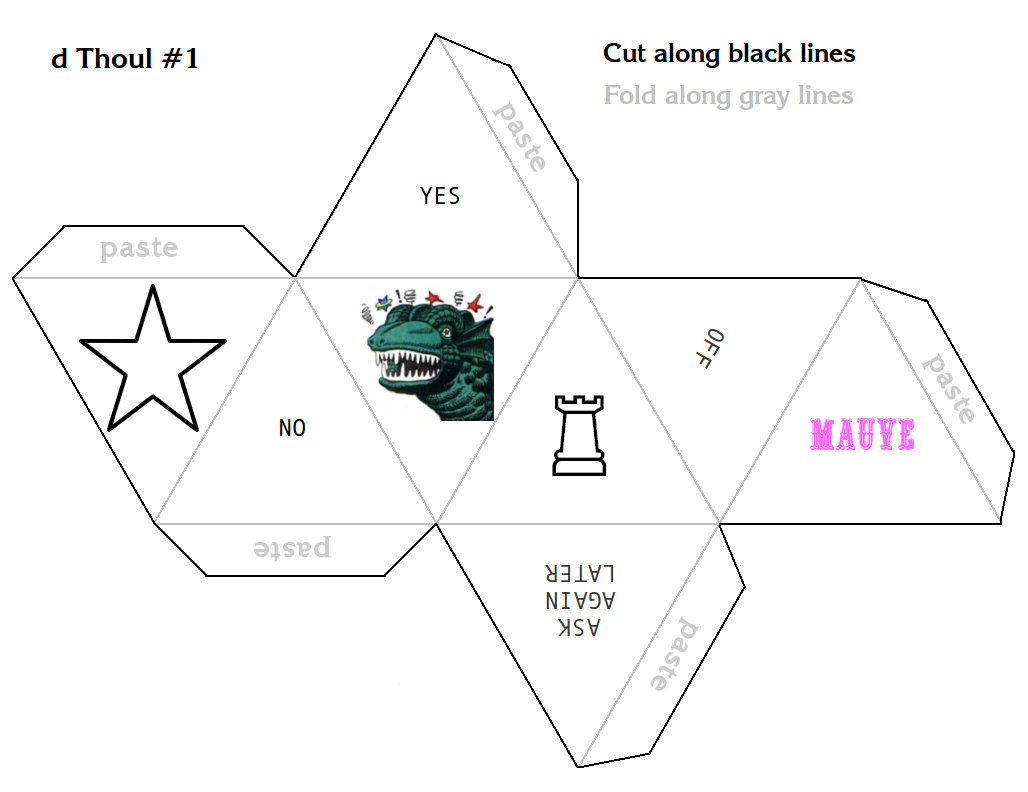
You humble host intended this to commemorate the blog's 100th post; however, due to the interview with Daniel Griego, this is the 101st post.  Regardless, your humble host provides his beloved readers with two 'specialty' dice (some assembly required).  Can there possibly be a use for them?

This image is not intended to foster belief in the occult

Void where prohibited

Thursday, March 15, 2012

Happy Birthday Dave Wesely!


This is really weird — I'm going back to being the king of Holland.
                                                                                                   -- Dave Wesely


Many readers of this blog know that role-playing games have their origin in the wargaming hobby.  Specifically, Dave Wesely is responsible for the wargame ‘mutation’ (so to speak) which wbecame the progenitor of all RPGs.  As such, Dave Arneson considered Wesely to be the inventor of the role-playing game.  Today is Wesely’s birthday, so your humble host deems it fitting that we look at Wesely’s contributions to our hobby.

Back in the day, Arneson’s parents’ basement served as a weekly gathering place for grognards in and around St. Paul, Minnesota (although the term ‘grognard’ may not have been in vogue at the time).*  It was there that Wesely orchestrated a ‘Napoleonic’ scenario about the fictional Prussian town of Braunstein.  Wesely served as an impartial referee; while not innovative, this concept would become central to RPGs.  Of course, in wargames, players control military forces; however, in Braunstein (as the game came to be called), each player adopted an individual role, not necessarily that of a combatant.  Each role had its own goal, not necessarily a military goal.  With a multitude of goals came a plethora of ways players attempted to accomplish those goals and Wesely had not anticipated the variety of activity upon which players had their characters engage.  It was necessary for Wesely to improvise rules in order to accommodate the players’ intent.  Wesely saw the result as a mess and did not consider his effort to be successful.  However, the players wanted more, so Wesely crafted further Braunsteins.

With the new scenarios, he thought that restricting the activities of characters would make for a better, more controlled game.  Alas, the players preferred the freedom of action (along with the 1:1 player-character ratio).  The fourth Braunstein used a stereotypical banana republic as the setting.  In this game, Arneson focused on playing his role as opposed to playing merely the game.  As such, he helped develop the rich potential inherent in a role-playing game.  When Wesely went to serve in the military, Arneson continued the Braunstein tradition and established a setting based on fantasy literature, but that's another story.

Legend has it that Wesely introduced his Minnesota cohorts to the concept of using platonic solids as atypical dice.  The notion of polyhedral dice was certainly not new, but if not for Wesely such dice may not have not become associated with RPGs.

With regard to other accomplishments in gaming, Wesely designed 'Valley Forge' and is co-designer of the underrated 'Source of the Nile.'  He is also credited with the development of several video games from the early ’80s.

If your humble host produced documentaries, he would be all over this dude like white on rice.  If you know anyone who makes documentaries, please clue them in to Dave Wesely.  The man had a profound (if unintentional) effect on the hobby and his insight is invaluable.  Oh, and be sure to ask him about the time he nearly killed Arneson.

*  Speaking of Arneson’s parents’ basement, that place ought to be listed in the National Register of Historic Places. Seriously, just consider the pop culture and sociological impact of role-playing games, even if only computer RPGs.