Showing posts with label Egypt. Show all posts

Sunday, June 27, 2021

Journey to Stonedeep (spoilers)

Art by Ed Lee

The introductory adventure (or “ready-to-run quest”) provided in 1995's Everway Box Set takes up about half of the 64-page Gamemastering Guide.  It is a very good example of what an introductory adventure should be:  it provides options for the gamemaster, explains the likely results of those options, describes probable choices the players may make, and the ramifications of those choices.  In short, 'Journey to Stonedeep' is not a linear narrative to which the players and gamemaster must conform.  However, Jonathan Tweet identifies a best or ideal ending (later called the “ideal climax”).

Given the focus on cards in Everway, it should come as no surprise that 'Journey to Stonedeep' has six 'quest cards' associated with it.  Each quest card has an illustration on one side and relevant information (usually the scores for background characters) on the other.  The illustrations are useful for showing the players what a particular scene or background character looks like.

In terms of background, “a venomous, evil dragon” devastated a realm called Sweetwaters three hundred years ago.  The only gate to the realm of Stonedeep is in Sweetwaters.  Due to the presence of the dragon in Sweetwaters, spherewalkers have not been able to travel to or from Stonedeep.  Recently, “a hero has vanquished the dragon,” and the gate to Stonedeep is accessible once again.  Patrons now recruit the player characters “to use the gate, find out how Stonedeep may have changed in three hundred years, and determine the best way to approach those lost neighbors.”

Once in Sweetwaters, a guide leads the party to the gate to Stonedeep.  This takes seven days.  The guide will wait two weeks for the party to return, after which, “the guide will leave, and eventually someone will sponsor another expedition to Stonedeep.”  The Playing Guide tells us, “Most spherewalks take about a week.”  One week to Stonedeep and one week back already accounts for two weeks, so there's not much time to accomplish the goal of the quest.

Anyway, during the transition from Sweetwaters to Stonedeep, characters with strong Water scores have a vision of the Awakener (shown above).  Of course, the characters don't yet know it's the Awakener, they just see the vision:

You are standing in a field, but you feel ungrounded, and you realize you're having a vision.  A dragon hurdles down out of the the sky, crashes into the ground, and bursts into flame.  Out of the flame walks a man in armor.  He strides forth, stands still, and stares at you.  His eyes glow red.  Suddenly you see that he is standing on a pile of skulls.  “I seek a bride,” he says.  The vision vanishes, and you're standing on solid ground.

Crashing dragon.  Glowing red eyes.  Pile of skulls.  Players are sensitive to clues like these and they might just receive the impression that this is not a nice person.  A sidebar provides some additional information:

The Awakener gets his name from a teaching of Anubis, the god of death.  Anubis teaches that dying is “awakening”:  the virtuous awaken to the light of a glorious afterlife, while the unworthy awaken in darkness.

If or how the player characters learn this is not detailed.

In any event, the party arrives at some ruins in Stonedeep, a realm similar to ancient Egypt.  The party soon encounters a damsel in distress; specifically, a woman named Rarity is at the mercy of two (or more) ghouls.  Presumably, the party rescues Rarity and, also presumably, return her to the town of Underwood.  In this and subsequent scenes she party obtains pertinent information.  A priestess of Isis repelled an invasion 250 years ago and became the ruler of Stonedeep, changing the name of the realm to Bonekeep.  She remains ruler and is known as “the Ghoul Queen.”  We also learn:

The queen rules the land by turning the dead into vile, half-alive servants that do her bidding without question.  The people have grown resigned to her rule.

Additionally, the party gains some information about the Awakener.  His arrival in Bonekeep is imminent.  As indicated in the vision, he is looking for a bride.  The Ghoul Queen has captured a few beautiful women (like Rarity) and intends to present them to the Awakener under the assumption that he's looking for beauty.  She expects the Awakener to provide her with a boon for her efforts.

Should the party confront him once he arrives, they learn that, “By snapping his fingers, the Awakener can bring death to mortal and undead beings.”  Specifically, each snap causes up to twelve beings to lose one point of Earth.  Therefore, the Awakener can destroy a dozen average opponents in three narrative turns.  Also, he is “unkillable” and has a Fire score of 6.  In effect, the party cannot reasonably hope to defeat the Awakener.  If the party prevents the Ghoul Queen from presenting the Awakener with a bride, they “will have to track him down and deal with him somehow to keep Bonekeep from being destroyed.”  So, absent interference from the Ghoul Queen or the party, the Awakener will destroy the realm.  I feel safe in saying this is a bad thing. 

As written, the quest implies that the Ghoul Queen's rule is tyrannical.  There are references to peasants being “angry at the Ghoul Queen,” that hers is an “evil reign,” and “there are crimes she committed.“  Granted, 'Ghoul Queen' is not a term of endearment and she has arranged for the abduction of beautiful women for the purpose of giving one of them to the Awakener.  However, since the arrival of the (possibly ineffective) party was unanticipated, the Ghoul Queen's plan was the only way to prevent the destruction of Bonekeep.  Other than the fact that she takes her subjects “as servants and soldiers when they die,“ there is no evidence presented that she is evil.  Remember, the Ghoul Queen saved the realm from invasion and, as another priestess of Isis explains, “as long as the Ghoul Queen rules, no living soldiers have to shed their blood in battle.“  Also, the ghoul servants are morally incorruptible.  It's been several generations since the Ghoul Queen became ruler and since the “people have grown resigned to her rule,“ one might suppose that the ghouls have become an accepted part of society.  I mean, if creating ghouls is so intolerable, people would cremate their dead or otherwise dispose of corpses to prevent their conversion.

“The cleverest outcome,“ the text relates, “would be for the heroes... to convince the Awakener to choose the Ghoul Queen as his bride.“  (So, Jonathan Tweet's concept of an “ideal climax“ involves a Ghoul Queen.  I'm not judging, just making an observation.)  In terms of storytelling, it makes sense; resolve the quest by using two threats to cancel each other out.  This ending also leads to the sixth quest card.  However, there's no apparent reason for the Awakener to choose the Ghoul Queen as his bride.  Unless the party suggests this option to him, the Awakener will not select the queen.  The “best ending“ develops from a player character essentially saying to the Awakener, “Hey bro, why don't you hook up with the Ghoul Queen?“  Why the Awakener would think this is a good idea is not touched upon.  No explanation is needed.  At the last minute, the player characters “still have a chance to succeed if they can yell to the Awakener and put it in his mind to choose the queen as his bride.“

As indicated earlier, the assumption is that the Awakener is looking for a 'beautiful' bride.  This assumption is incorrect.  With regard to suggesting to the Awakener that he should choose the queen, it would make much more sense if the party could discover some bit of lore about what the Awakener actually wants or why choosing the queen is a good idea.  Maybe the Ghoul Queen's original name was 'Open Eyes' or something and the party can find this out.  Awakener + Open Eyes = perfect match.

Everway characters do not earn experience.  As compensation, for this quest, heroes can get loot from the Ghoul Queen's palace (assuming she departs – one way or another):

Ask each player to invent some item that his or her hero takes from the Ghoul Queen's palace.  They may find precious jewels, items with magical abilities, scrolls bearing magical secrets, and so on.  (You can change or disallow any item that you think would make the game less fun, such as one that would make a hero too powerful.)

Alternately, you can invent an item for each hero, either on the spot or ahead of time.  Invest items that the heroes are likely to enjoy.

Sunday, August 4, 2019

Experience and Significance in Timemaster


As indicated previously, player characters rise in the ranks of the Time Corps as they successfully complete missions.  They can also gain Success Points which can be used “to raise their Basic Ability Scores and skill scores, or to acquire new skills and paranormal talents.”  Contrary to the notion of success, player characters do not necessarily receive Success Points upon successfully completing a mission; they only get Success Points if they don't change history.  Whether or not player characters change history is tied to the notion of “significance.”

Historical figures and events – as well as certain items of Time Corps equipment – have significance ratings reflecting their potential to affect history.  We learn that “each human NPC has a significance rating of 1 to 500.”  For instance, the Guide to the Continuum tells us that Cleopatra has a significance rating of 275.  According to the introductory adventure, Manfred von Richtofen (sic) has a significance rating of 100.  The Paranormal Talent of Significance Sensing “allows characters to sense how important an unknown NPC or event is to history . . . with an accuracy of plus or minus 25 points.”  During the course of an adventure, player characters may make “mistakes” which have a significance rating value.  The premature demise of an important personage would be a mistake with a “cost” equal to the significance rating of said person.  Losing a piece of Time Corps equipment “costs” the significance rating of the item.  (A medical kit has a significance rating of 500, a Time Corps stunner has one of 300.)  Various events in an adventure have “costs” if player characters do not prevent them.  For example, in the first encounter in the introductory adventure, a meddlesome Demorean attempts to steal military plans being delivered to George S. Patton.  If the Demorean succeeds, there is a “cost” of 75 points.

At the end of an adventure, the Continuum Master tallies up the values of the “mistakes” and rolls a d1000.  This is called a “significance check.”  If the result of the check exceeds the “mistakes total,” then the course of history is preserved.  Otherwise, history is altered and the player characters are not awarded Success Points.  In this circumstance, the significance check value is subtracted from the “mistakes total.”  This difference is compared to the adventure's Historical Changes Chart; the greater the difference, the greater the deviance from 'original' history.  Such a deviance is never for the better.  The Historical Changes Chart for the introductory adventure (which takes place in the first World War) describes the following conditions:
Difference 01 – 99:  The ancestor of a Time Corps agent dies, meaning said agent never comes into existence.  “Fortunately, the agent was only a Trainee/5, so only five missions will have to be redone.”
Difference 100 – 199:  The German High Command becomes paranoid about saboteurs and spies.  “The Army arrests hundreds of innocent Germans, and executes them.”
Difference 200 – 299:  An American soldier (who should have died in the war) becomes a financier and the stock market crash occurs in 1927 rather than 1929.  “Herbert Hoover solves the problems of the Depression by 1931; Franklin Roosevelt is not elected President, and American entry into World World II is delayed until 1943.”  Eventually, “Communist China becomes the major world power by 1960.”
Difference 300 – 399:  The Allied Powers become discouraged with tank warfare, causing the war to continue longer than it would have.  Somehow, “this works to the benefit of Soviet Russia, which becomes the major power in Europe by 1940 . . . [and] nuclear war occurs in 1984.”
Difference 400 + :  “The Allies lose badly at Cambrais [sic], but realize the significance of air and rocket power to their defeat.”  World War II begins sooner than it would have.  “Europe is devastated; the United States is badly crippled, and Japan conquers most of Asia.”
If the player characters utterly fail in their mission, “The Allies still win World War I, but the lessons learned at Cambrais [sic] give the Germans a significant technological edge before the beginning of World War II.”  As an eventual result, “The Nazi Third Reich dominates Europe until the Holocaust of 1984, when America and Nazi Europe destroy one another in a nuclear war.”

Assuming that player characters are successful in a mission (as defined in the Time Corps' briefing at the beginning of the adventure) and they do not alter the course of history, they are entitled to Success Points.  We learn that, “Every TIMEMASTER adventure has a significance rating from 1 to 1000.”  (The introductory adventure has a significance rating of 500.)  The “mistakes total” is subtracted from the adventure's significance rating.  The result is the number of Success Points to be equally divided among the player characters.  Success Points may be saved, but can only spent between adventures.

If agents violate Time Corps regulations, they may be demoted and “earn no Success Points until they regain their original status.”  So, if there are five player characters and one has been demoted, is the pool of Success Points divided by four?  Or is it divided by five and the fifth portion is lost?

At the conclusion of a gaming session, the Continuum Master may award up to fifty bonus Success Points “to reward outstanding play.”  The rules explain that, “Outstanding play includes things such as playing the character almost as well as an actor would, coming up with a particularly good plan to solve a problem, risking the character's life for the benefit of the group of characters, and so forth.”

In TIMEMASTER, each skill has three levels:  Specialist, Expert, and Master.  When a character first learns a skill, it is at Specialist level.  A new skill costs 50 points.  Raising a skill from Specialist to Expert costs 100 points; from Expert to Master is 150 points.  While player characters can purchase any number of skills, a given skill may only be raised one level at a time.  For example, a skill may be raised from Specialist to Expert, but that skill cannot be raised to Master until at least one adventure has passed.  Also, player characters receive a new skill upon attaining a new rank in the Corps (i.e., ten grades or successful adventures).

New Paranormal Talents cost 200 points each.  For fifty Success Points, a Basic Ability score may be increased by one, but such scores cannot be increased beyond a value of 80.

Sunday, December 4, 2016

Role Playing Adventure in Ancient Egypt


Two-and-a-half years ago, your humble host briefly addressed Palladium Books' The Valley of the Pharaohs.  Now it is time for a more detailed analysis.  Published in 1983, the rulebook – accompanying several maps and a template character sheet in a boxed set – consists of 48 pages (numbered 3 - 50).

Player Characters in The Valley of the Pharaohs (hereinafter TVotP) have five attributes.  Although the glossary mentions “Will, Intelligence, and Dexterity,” the actual attributes are Strength (“physical power and endurance”), Speed (“fleetness...coordination and nimbleness”), Intellect (“intelligence and mental capacity”), Power (“will and mental strength”), and Persona (“personality, appearance, and charisma”).  Values are determined, in the old school tradition, by rolling 3d6 per attribute.  I never understood why game designers would use a 'normal distribution' paradigm for determining player character attributes.  Just as there are no stories about Conan the Mediocre, I do not indulge in escapism to assume the role of an average person.  I think I would have players add together the attribute values of a character and subtract the total from 100.  This would result in a number of points (perhaps called ka points) which could be allocated for various purposes; for instance, increasing attributes (perhaps 3 points for +1 value, up to a value of 10, and 6 points for +1 thereafter, up to a value of 18).

Each character has a number of hit points equal to Strength × 2.  Should the hit points of character be reduced to zero, “that character collapses and goes into shock; if he/she does not receive care within ten minutes he/she dies.”  When “a character is reduced to negative hit points...he/she dies.”

Anyway, before dice are rolled for attributes, a character's caste is determined by rolling percentile dice.  The are four castes, each of which provides a +1 bonus to a particular attribute:  Nobility (Persona), Clergy (Power), Bureaucracy (Intellect), and Commons (Strength).  In my alternate character generation method, Commons would be a character's default caste, a different caste could be purchased with ka points.  Rather than providing an attribute bonus, a caste's attribute could be purchased up to a value of 19.

TVotP is a skill based system. Each character receives a number of 'caste' skills from a list of ten:  Agriculture, Archery, Combat, Cooking, Gaming, Hunting, Reading, Swimming, Throwing, and Writing.  'Reading' is a mandatory skill for every caste except Commons.  Nobility receive 4 - 6 skills with Archery mandatory, Clergy receive 3 - 6 skills with Writing mandatory, characters of the Bureaucracy caste also receive 3 - 6 skills, and Commons receive 2 - 6 skills with Agriculture mandatory.

There are five possible classes (called occupations in TVotP ).  Choice of occupation is limited by caste.  Nobility can be either Soldiers or Priests, Clergy can be either Priests or Scholars, the Bureaucracy caste is limited to Merchants, Scholars, and Thieves, and characters of the Commons caste have a choice among Soldiers, Merchants, and Thieves.  The only difference among occupations is that each has a list of ten skills distinct from the 'caste' skills. However, some 'occupation' skills apply to more than one occupation.  For instance, Merchants and Thieves both have access to Barter and Evaluation; Priests and Scholars both have access to History, Magick, Music, and Oration.  Each character receives four 'occupation' skills.

The initial score for any skill is based on attribute values.  For example, the initial score for Scouting is Intellect + ½ Speed; the initial score for Chariot Use is Strength + ([Intellect + Speed] / 3).  Perhaps ka points could be used to purchase additional skills and/or increase initial scores.

Character improvement comes in the form of increasing skill scores and acquiring new skills.  If, during a scenario, a character uses a skill (successfully or not), the character can attempt to improve that skill after the scenario concludes.  Percentile dice are rolled and if the skill's current score is exceeded, then the score is increased by 1d6.  Characters can also be trained “by a teacher who has at least a 60 in the skill taught.”  After two game weeks, “one...increase check is allowed.”

In combat, a d20 is rolled to see if an attack is successful.  If the result exceeds the Resistance Factor of the target, then damage is applied.  Armor provides a Resistance Factor.  Scale armor has a Resistance Factor of 14; an unarmored character has a Resistance Factor of 5.  A roll of less than 5 misses the target.  A roll equal to or less than a target's Resistance Factor (but still at least 5) damage is applied to the target's armor.  Combat rolls may be modified depending upon the Speed attribute as well as the scores of “Martial Skills.”  For example, with a Combat skill score of 21, a character has two attacks per round; at 31, +1 to hit; at 41, +1 to parry, etc.  Characters can use 'attacks' to dodge or parry.

Twenty Magick Spells are described and each is assigned a level.  The least powerful spell is Illumination (level 10) and the most powerful is Speak with Gods (level 90).  A character can only learn a spell if his (or her) Magick skill score equals or exceeds the spell's level.  A spell may be learned from a teacher, a tablet, or a scroll.  Regardless, “it takes 1 - 4 weeks of study to commit a spell to memory.”  To successfully cast  a spell, a character must roll (on percentile dice) less than or equal to his (or her) Magick score or the spell's Difficulty, whichever is less.  A spell's Difficulty is roughly inverse to its level; the Difficulty for Illumination is 85 (easy to cast) and for Speak with Gods is 25 (hard to cast).  Spell-casting characters have a number of Magick Points equal to the initial score for the Magick skill (i.e., Power + Intellect).  Each spell has a cost between 1 (e.g., Speak with Animals) and 6 (e.g., Ressurection [sic] ).  An unsuccessful casting still costs 1 Magick Point.

The rulebook spends about a page describing magical amulets.  We are told, “Gamemasters should limit the total number of charms and amulets which may be worn or divided (sic) each each individual charm's power by the total number worn...”  Here are a selection of amulets detailed in TVotP :
Menat:  “If worn or held it will restore 1d6 of hit points lost due to disease or poison and will eliminate all pain.”
Scarab:  “If this amulet is worn, the character receives +5% on any skill proficiency as well as an additional 1d6 of hit points.”
Shen:  “This amulet represents the sun's orbit and eternity...If worn it will give the character an additional five years of life.”  (I assume this refers to natural lifespan, it's not as though a character can be disemboweled and expect to live another five years.)
Tet:  “The wearer of this amulet will receive a 10% bonus against all magic cast on or within a three meter radius of him.”
Utchat:  “This amulet, which was by far the most numerous, represents the eye of Horus...If worn, this amulet has a 20% chance of neutralizing any poison and can restore 1d6 of hit points once per day.”

Sunday, September 14, 2014

Adventures and Random Encounters in Man, Myth & Magic (Spoilers)


Book III of the Man, Myth & Magic set is The Adventures Book, containing a 'basic' adventure, an 'advanced' adventure, advice on being a Lore Master, and some random encounter tables.

The basic adventure is a simple 'infiltrate and destroy' mission.  The advanced adventure does not have a title per se, but consists of four 'linked' episodes.  Each episode is divided into game-time periods called segments.  Surviving a segment allows a character a POWER roll and at least some damage recovery. 

To be blunt, the advanced adventure is a railroad; in fact, the Lore Master's advice (four pages under the modest heading 'How to Become the All-Time Greatest Lore Master of the Known Universe') includes a section titled 'Getting Players Back on the Rails'.  In fairness, Brennan states that players – not the Lore Master – should “control the action” and that Lore Masters should not “break their necks to try and make sure players follow a particular pre-determined sequence.”  In other words, players should be allowed to leave the “rails” but the Lore Master should “get his players back on the real track of the adventure without their suspecting anything is amiss; and without their getting restless or bored.”  To assist the Lore Master with accommodating the players' impromptu peregrinations, the book provides a few “standard” maps.  (At the end of this post I provide scans of the “standard cave complex” map and the “standard underground complex” map.)

The first episode (less than two-and-a-half pages of text) is called The Dragon Loose in Rome.  Essentially, players must develop a strategy to defeat a “dragon” that is practically invulnerable to weapons.  In the second episode, Apollo's Temple, Emperor Caligula summons the player characters to his presence.  Because of their success defeating the “dragon,” he assigns the characters a “special task.”  Caligula wants the characters to learn the secret of Apollo's Temple (i.e., Stonehenge).  The reward is great; however, if they fail, the Legions of Rome will seek them out and bring them back to Rome for an “extremely painful” fate.

The party goes to Britain and, en route to Stonehenge, there are three 'Road Encounters'.  Two of these encounters can provide clues regarding the episode's climax.  At Stonehenge, the party confronts a group of evil druids about to engage in human sacrifice.  Once the druids are defeated and the clues deciphered, the party can perform a ceremony that 'activates' some of the stones.  Different stones – distinguishable by color – generate distinct effects when touched.  Some effects are beneficial, such as healing or “granting the single item each [party] member desires most at that present moment.”  Some effects are bad, such as being disintegrated or sent to hell.  One stone summons a “Ban Sheed.”  What is a Ban Sheed?
This fearsome creature appears in the form of a very tall, white robed and dark haired woman, but is, in fact, the sexless representative of an alien race of beings who once inhabited the Celtic Islands during an era of almost unimaginable antiquity.
It is revealed that the Ban Sheed is the basis of the banshee legend.  Anyway, the party can only progress to the next episode by being sent to hell.  The adventure was designed for six characters; since there are five stones, it is reasonable to expect that someone will touch the 'hell' stone.  However, there are psychic abilities that can provide characters with information about possible future events.  Also, the Ban Sheed can tell the party the effects of a given stone.  Alternately, the Ban Sheed can also destroy Caligula, thereby dispensing with the party's motivation.

Assuming the party goes to hell, they are given a scroll by some old guy in robes and informed that “the fate of your planet now rests squarely in your hands!”  The party returns to Stonehenge after being subject to a poem of fifty-six lines.  The old guy's scroll indicates that the party should go to Hibernia and the next episode, The Witches of Lolag Shlige, assumes that they do so.  It just so happens that, in Hibernia, there is a “prediction” that “a party of strangers” will find and rescue the infant nephew of the king.  The party is supposed to discover that the infant was kidnapped by the titular witches and then go to the House of Lolag Shlige to effect a rescue.  The 'house' is presented in the style of a dungeon; there are two levels and a description of the various rooms.  One of the denizens is a “Pollyrotten” which is “a peculiar breed of paranoid parrot...indigenous to Hibernia in prehistoric times.”  The episode ends in a confrontation with the aforementioned witches.  If the party loses, I guess they die.  If the party wins, the witches cast a spell that transports the party to “an eerie, moonlit shore.”  The only way to leave the location is via a boat piloted by a “robed and hooded boatman.”

In the boat, the characters lose consciousness; when they wake, they find themselves in Egypt and thus begins the fourth episode, The Great Pyramid Revealed.  The party finds a scroll that leads them to a fishmonger who informs them that Caligula “has issued a Death Warrant for members of the party.”  (Given that the characters can reincarnate, this doesn't seem like much of a threat.)  The fishmonger also lets the party know that they must go to the Great Pyramid of Giza because of a dream he had.  The interior of the pyramid (for purposes of the adventure) is displayed in the graphic at the beginning of the post.  Compared to the real thing, it is only slightly embellished.  In Location 10, there is “a rare subterranean plant...that feeds directly on energy.”  The plant will cause a character to become “a shattered, unconscious husk of 6 Life Points.”  The plant can be avoided by edging along the sides of the chamber; however, contact with the side walls “leads to a total sex change by the current segment.”  At the end of the episode, the characters find themselves in Hibernia, but ten years have passed since the second episode.  There are actually five more episodes to this adventure, but they were sold separately.

Random encounter tables are provided only for the regions where the adventures take place:  Roman Britain, Roman Italy, Egypt, and Hibernia.  It would have been nice to have tables for other regions, like Greece or Gaul, but I suppose one can't have everything.  For each region, there is a table for the following terrains:  Open Road, Wilderness, Forest, Village, Town/City, and Underground.  (There is no Forest table for Egypt.)  Using a table requires a percentile roll. The Lore Master has a choice of using the indicated encounter or any of the preceding encounters on the table.  For the sake of example, here is the 'Open Road' table for Italy:


With a roll of '44', a party may encounter a foreign traveller, a merchant, a peasant farmer, or a formation of Legion soldiers.  Note that the first encounter requires a minimum roll of '20'; anything less than that means “the Fates have decided your party encounters nothing at that time.”  The table above is rather tame compared to many of the other tables.  Most tables have a '100' listing with a suitably rare encounter.  For instance, the 'Wilderness' table for Italy allows for a 1% chance of encountering “the god Jupiter.”  Brennan uses this result in an example of how to 'present' encounters to players.
You might present him sitting on a rock throne hurling thunderbolts to wipe out the party, but this, surely, lacks a certain subtlety.  He might equally well be presented as a naked youth with amazing powers, who may even aid the party if they are nice to him...
Other '100' results include a talking bulldog, a giant weasel, Caligula in fancy dress, and “Pharaoh's cousin (so he claims).”  Other, more common, encounters include a funeral procession, up to one-hundred village idiots, a bear, a brass golem, bugs, and a sandstorm.  However, Brennan saves the most colorful encounters for his native Hibernia.  Eight Hibernian encounters are explicitly described as “drunk” and only one encounter is listed as “sober.”  Some examples of Hibernian encounters include:  beautiful colleen (with mother hidden in trees), intelligent shamrock, fake Leprechaun, vampire pig farmer*, two-headed calf, and “Drunk Hibernian Lore Master who fell into his own scenario and couldn't find his way out.”


We are left to ponder which is vampiric – the farmer or the pigs?  Or both?


Sunday, September 7, 2014

Character Classes in Man, Myth & Magic (part IV)

Art by Angus McBride

Some of the character Classes in Man, Myth & Magic have 'negative abilities' in an attempt to balance (I suppose) the powers and talents that the Classes supply.  We have seen a few examples in prior posts; a Hebrew Warrior may “feel compelled to offer food to an opponent” and Leprechauns can disappear from play for a segment at a time.  Here are a few other examples:
  • Visigoth Barbarian:  Once per segment, if given any order by friend or foe, there is an 11% chance the character will obey it “without question.”
  • Philistine Warrior:  “Will attack immediately if his family or heritage is insulted.”
  • Oriental Shaman:  There is a 6% chance per segment that the Shaman will be “unable to fight or use magic or any special ability for two segments” as a result of “mushroom poisoning.”
  • Egyptian Physician:  May never start combat and “will always be hit in the first round of a Combat.”
  • Egyptian Priest:  Once per week, must engage in self-laceration (at least 25 Life Points worth of damage) and fasting.
  • Egyptian Sorcerer:  Upon entering a tomb, there is a 2% chance that the character will refuse to leave voluntarily.

For the Alchemist classes, the prime ability is “Science.”  Alchemists don't believe in magic, so they can't use magic; I suppose, however, they can be affected by magic.  An Egyptian Alchemist can do the same things as an Egyptian Apothecary, except at three times the POWER cost.  This is interesting because the Egyptian Apothecary can craft amulets, charms, talismans, and artifacts – all of which have magical effects.  The description of the Egyptian Alchemist class acknowledges that the character's creations may be magical, but the character may not use them.  Items that an Egyptian Apothecary (and Alchemist) may create include:
  • Seal of Solomon:  The user can command any one demon for the remainder of the segment.  (Yes, Egyptians create the Seal of Solomon.)
  • Rope:  “Is uncuttable and unbreakable.”
  • Hammer:  “Will drive in or pull out nails without an operator.”
  • Box:  A six inch cube that can nonetheless contain a volume of six cubic feet.
  • Negative Sand:  Damage from “magical injury” is reduced by ten points per use.

Egyptian Alchemists can also analyze potions and can attempt to “transmute” one pound of metal to one ounce of another metal (because that's science).  By contrast, Babylonian Alchemists have a 50% chance of identifying compounds and can spend two months to add one point to either SKILL or INTELLIGENCE.  Regardless of nationality, Alchemist characters can do the following things.
  • Identify Non-Magical Machines/Artifacts:  An Alchemist can also “determine how to operate” such devices.
  • Make Corrosive Acid:  Each “dose” costs five points of POWER and consists of water, mercury, and ten Life Points of the Alchemist's blood.
  • Make Fire Bombs:  These bombs consist of “oil, sulphur and salt.”  They “burn with three times the intensity and effect of burning oil” but must be used within six hours of being made.
  • Intensify Poison:  Distilling a batch of poison doubles its effectiveness and increases the duration of its potency by three times.
  • Repair Metal:  An Alchemist can attempt to repair a metal item “using a combination of iron, sulphur, and 10 Life Points of his own blood.”

In the 1375 BC Man, Myth & Magic setting, Charioteer is a 'Special Class' that may be selected in conjunction with a character's 'normal' class.  If the Prime Ability of the 'normal' class is Combat, then it may be assumed that the character is already trained.  For non-combat classes, there is a training cost of 500 - 5,000 Gold Pieces (the 1375 BC setting uses pieces/ounces instead of libra).  However, trained non-combat characters have less ability than combat class Charioteers.

Man, Myth & Magic offers two “special categories,” which are Class “aspects” associated more with the player than the character.  The Sage category is for “know it all” players – the MM&M equivalent of “rules lawyers.”  The Orator is for players who are comfortable making extemporaneous speeches.

With regard to Sages, we are told by Book II:
[T]he Sage is obliged to sell information to to fellow players.  Note that this is an obligation.  Information may no longer be volunteered by a Sage, but only offered for sale...
The cost of information is 25 gold libra per item; however, if the Sage provides the wrong answer, he or she must pay 50 gold libra to the player(s) who asked.
Good Sages are very valuable to a party.  Know-all Sages are a pain.  Either way, the MM&M Sage system keeps them under control.
Lore Masters do not determine who is a Sage; a player must decide if and when to become a Sage.  So, “under control” may not be entirely accurate.  The description of the Sage category implies that they provide answers to rule-based questions.  As a player, I would not be inclined to pay gold for information the Lore Master should provide.  I would be more amenable to the notion of the Sage supplying in-game knowledge to which the players had been exposed previously.  Even then, I think that non-gold POWER would be a more appropriate currency.

By delivering “a spoken two-minute (real time) speech on the prevailing situation,” an Orator “...will so fascinate any number of opponents that the Orator's colleagues may always attack first, irrespective of First Strike Capabilities.”  The result of 1d100 determines the “number of opponents affected.”  (I would have imposed a cost of one POWER per incapacitated opponent.)  The Lore Master must be given “advance notice” of any of such an oration.  To become an Orator, a player must pass an examination in which he or she must “speak fluently, amusingly and without a break for three minutes (real time)” on a topic of the Lore Master's choice.

Sunday, August 24, 2014

Character Classes in Man, Myth & Magic (part III)

Art by Angus McBride

The only Priest class available in the 'original' Man, Myth & Magic setting is Hebrew.  Once per segment, a Hebrew Priest has a 41% chance to “commune with his Deity” thereby obtaining a truthful yes-or-no answer to a question.  Once per adventure, a Hebrew Priest has a chance (based on the character's SKILL) to “work” a miracle.  For purposes of MM&M, a miracle must be expressed as a written statement of no more than twenty-five words and is subject to literal interpretation by the Lore Master.  With a POWER expenditure of only 150 points, a miracle costs less than a Leprechaun's wish.  The class description for the Hebrew Priest explicitly states, “Magical Abilities:  None.”  Regardless, several Hebrew Priest 'spells' are described in the back of MM&M Book II.  The spells are appropriately thematic:  Part Waters, Water from Rock, Manna from Heaven, Fiery Hail, Angel of Death, Pillar of Fire, and Lazarus Lives.  (For the sake of comparison, here are the spells specific to Hebrew Sorcerers:  The Ear of Baalam, Joshua's Tongue, The Eyes of Elija, Walk on Water, The Jug of Gideon, Conjure Cherub, Seeker, Conjure Demon, Sanctuary, and Bridge over Gehenna.)

'Lazarus Lives' is an interesting spell for a game where reincarnation is a primary feature.  At a cost of 30 POWER, the Priest has a 20% chance of restoring life to a character who died that same segment.  If successful, “the Priest loses an amount of POWER Points equal to the restored character's total Life Points.”

In The Egyptian Trilogy 'setting' for MM&M, several other Priest classes are introduced.  (Original MM&M takes place circa AD 41 while The Egyptian Trilogy transpires 1,400 years earlier.)  Specifically, the additional Priest classes are:  Babylonian, Egyptian, Minoan, Philistine, and Sumerian.  With regard to 'magical abilities', the description for Babylonian Priest states, “May not use Spells listed in Grimoire, only Special Character spells for this class.”  Seemingly, this is true of every 'nationality' of Priest, including Hebrew.  The Grimoire consists of thirteen spells “common to all Character Classes having magic as one of their abilities.”  Priests are evidently excluded, as are Apothecaries; some 'magic' classes – like Druid or Harper – don't cast spells per se and others – such as Soothsayer or Astrologer – are 'psychic' rather than magical.  Thus, the classes that have access to the Grimoire are:  Witch-Doctor (African), Leprechaun (Hibernian), Sorcerer (Hebrew and Egyptian), as well as Shaman and Zen Lama (both Oriental).  (It seems that the Zen Lama class has access to the psychic talents as well as the Grimoire spells.)

Only Hebrew Priests are entitled to miracles.  Maybe if the other gods were less stingy with their miracles, their respective religions would have persisted.  Each variety of Priest has its own selection of spells, but instead of invoking miracles, non-Hebrew Priests can craft magic-like items; specifically...
Babylonian:  Can create charms that offset Basic Failure Rate (10 uses)
Egyptian:  Can create a 'Focus' that magic-class characters can use to reduce Basic Failure Rate (10 uses)
Minoan:  With a two week preparation, can enchant a weapon (+1 damage per 25 POWER spent)
Philistine:  Can create an ointment that allows the user to fly
Sumerian:  Can create a personal focus that reduces Basic Failure Rate  (permanent, but costs 50 POWER and takes two weeks)

Instead of being able to commune with their various deities, non-Hebrew Priests have an aptitude with divination – an aptitude shared by Hittite Seers and Sumerian Astrologers.  There are many, many forms of divination; however, MM&M limits itself to nine methods.  In listing the divination types, sometimes the rules use the high falutin' term (e.g., 'hepatoscopy') and sometimes a common descriptor (e.g., 'smoke').  The methods are:  Rhabdomancy (use of divination rods), Incubation (sleeping overnight in a temple), Tarot (a.k.a. Taromancy), Augury (“The study of birds in flight”), Smoke (a.k.a. Capnomancy; +10% chance of success if smoke is narcotic), Dog Howlings (a.k.a. Ololygmancy), Casting Lots (a.k.a. Sortilege), Hepatoscopy (“The study of the liver of an unblemished sacrifice”), and Horoscope.

Aside from Rhabdomancy, which is used “to locate water, oil or a particular type of ore,” and Smoke, which gives “a clue to a future event,” the various divination methods provide a yes/no answer to a question.  For most methods, the question must pertain to the future; however, Incubation allows for “any one question” while with Dog Howlings, the question must regard “another individual.”  Hepatoscopy actually answers six questions and Horoscope, three questions.

The 'Divination Table' shows which classes are capable of performing a given type of divination as well as the POWER cost and Basic Failure Rate modifier.  POWER cost is usually 10 or 15 points, but there are two instances of a 5 point cost and one instance of a 20 point cost.  Modifiers are more often detrimental than beneficial; however, the modifier for Hepatoscopy is beneficial for all classes that can perform it.  An unblemished sacrifice really is the most economical means of gaining knowledge about future events.  The only class that can engage in all forms of divination is the Sumerian Priest.

Wednesday, August 20, 2014

Interview: Stephen Peek

J. Stephen Peek was a game designer for Yaquinto.  He is credited with several board/war games, but more importantly (for purposes of this blog) he was the developer of Man, Myth & Magic and co-developer of The Egyptian Trilogy.  Recently, he was gracious enough to answer a few questions...

Thoul's ParadiseMM&M was Yaquinto's first RPG.  What was the impetus for entering the RPG market?

Stephen Peek:  During this period Role Playing games, (read as Dungeons & Dragons) were rising to dominate the hobby gaming industry.  War games required each player to read and fully understand tedious and long game rules.  Role playing required one player to understand the rules and be the game master.  The rest of the players in the group only had to understand the aspects of their character for the adventure.  Other companies were beginning to compete with Dungeons and we needed a game that allowed us to jump into the market.

TP:  Why did Yaquinto go with MM&M as its first RPG and not some other game/genre (Timeship, for instance)?

SP:  Herbie approached us with Man, Myth and Magic.  We loved the idea that it was rooted in history and ancient mysteries instead of pure fantasy.  Herbie offered us Timeship sometime later.

TP:  You have a “developed by” credit.  In collaborating with Herbie Brennan, how did you influence the game?

SP:  Herbie had created a great game system.  What I tried to do was expand the world in Man, Myth & Magic so that it had a better chance of competing with D&D which had, by that time, an enormous world for gamers.

TP:  The setting for the original Man, Myth & Magic rules was circa AD 41.  The Egyptian Trilogy allowed for campaigns in 1375 BC.  Were there any long range plans to adapt the rules for other times and/or places?  Were there any times and/or places you would have liked to address?

SP:  Eventually Man, Myth & Magic would have allowed players to play in any historical period through the middle ages.  Targets would have been:  The Hollow Earth, Mu, Incas, Maya, a Lost City series and a few others were on the drawing board.

TP:  I doubt you would remember this from thirty years ago, but the nerd in me is compelled to ask.  Page 14 of MM&M Book II states:
Distant Memory is a very important concept in ADVANCED MM&M. It is the key to the ultimate character – a skilled, experienced amalgamation of all classes; and the ONLY character entitled to strive toward the final goal of ADVANCED MM&M.
What was the “final goal”?

SP:  The premise was that once an advanced character died there was a Distant Memory role for his next incarnation.  Only high level characters had a chance of achieving the Distant Memory roll.  If the player did then his next incarnation possessed his own newly created skills plus a percentage of skills from the previous character.

TP:  Several Yaquinto games (including your own Mythology) command respectable sums on E-Bay.  What is the feasibility of reprinting some of these games?

SP:  Zero from me.  Yaquinto was purchased a few years ago by Carte Mundi and I don't think they have an interest in these old games.

Thanks you for your interest.


Wednesday, August 6, 2014

Inspiration: Thel


Today's inspiration comes from the 1985 TV series Otherworld.  The protagonists are the Sterlings, a nuclear family from Southern California – husband Hal, wife June, teen-aged son Trace, teen-age daughter Gina, and pre-adolescent son Smith.  The Sterlings are visiting Egypt in the pilot episode.  On the day of a rare planetary alignment, they hire a guide to take them into the Great Pyramid.  The guide attempts to extort money from them.  Because they refuse, the guide extinguishes his lantern, abandoning the family in darkness near “the Chamber of Ordeal.”  They inadvertently enter into a “mysterious vortex” and arrive in another world (although they do not realize it at first).

The Sterlings spend hours walking through a desert before finding a road.  The first person they meet is Nuveen Kroll, a 'Kommander' (thus spelled) in the Zone Troopers.  Fortunately, Kroll (like everyone else on Thel) speaks a language indistinguishable from English.  Unfortunately, Kroll is an arrogant jerk and attempts to arrest the Sterlings since they are in a 'forbidden zone' and lack identification papers.  A scuffle ensues and Kroll is rendered unconscious.  The Sterlings leave Kroll and take his vehicle and a crystalline phallic symbol of authority.  They soon abandon the vehicle because they don't know how to control it.  Eventually, they find an inhabited area called Sarlax.

Our protagonists assume they will not be treated favorably if they claim to have gone through a vortex and overpowered some kind of authority figure and stole his possessions.  (This is just the sort of thing player characters would do, only they would do it intentionally.)  So, the family doesn't mention their problems to anyone.  In another instance of good fortune, they fall in with a group of 'new' people.  Playing along, they are assigned vocations and a residence.

After living in Sarlax for a couple of days, the family obtains some information.  Sarlax is one of seventy-seven distinct 'provinces' separated by forbidden zones.  Each province is 'different' but they all more-or-less acknowledge the authority of the city/province of Imar.  This is the result of a series of Unification Wars.

Also, throughout Thel, there are obelisks.  (See the image above.)  Legend has it that – long ago – people from other worlds would come to Thel and follow the trail of the obelisks to Imar.  When they returned to their worlds, “they became kings and sorcerers.”

Imar
It turns out that all of the residents of Sarlax are androids, but they have souls.  Androids operate the all-important mines because humans can't tolerate 'Sarlax radiation' for more than a few days.

The family also finds out that the crystal they took from Kroll is a “Class One Access Key.”  It offers “practically unlimited access to power sources, locked doors, information banks, travel...anything.”  As one might expect, Kroll wants it back.  Thus, the Sterlings acquire their very own Inspector Javert/Gerard.  Not only does he pursue the protagonists as a matter of pride, but they have an object he needs to recover.

Thus, the protagonists are subject to what I call a goal/goad motivation.  Their goal (returning home) is to be accomplished by following the 'obelisk trail' to Imar, but there is also the goad of the pursuer.  Theoretically, one can gradually attain a goal or even forgo it altogether; the goad makes this impossible.  If the draw isn't enough, there's the push.  In Otherworld, the fact that the location of the goal happens to be the seat of power of the goad makes things more interesting.

Each week, the Sterlings find themselves in a new province – usually ripe with social allegory.  With Kroll's access key, they are able to establish identities and gain funds.  Any given episode might start with the Sterlings struggling through a forbidden zone or domestically ensconced in a province hardly discernible from a Reagan-era suburb.

The series lasted for only eight episodes.  Some parts were clever, some parts were quirky, and some parts were both.  However similar Thel might seem to Earth, it is a different place.  Frequently, a difference might only be seen or mentioned in passing – taunting the imagination of the viewers.  The ironically named 'Unification Wars' were important, history-shaping events.  The fourth such war occurred hundreds of years ago and included the “Black Mirror Campaign.”  Yet one of the Unification Wars was so recent that Kroll is a veteran.  The differences aren't limited to historical/sociological deviations; the laws of physics don't always conform to 'Earth' reality.  For instance, in “Village of the Motorpigs,” there is a 'photo-comet' that emits light but not heat.


Iconography of the
Church of Artificial Intelligence

Sunday, August 3, 2014

Character Classes in Man, Myth & Magic (part I)

Art by Angus McBride

For random determination of characteristics, many role-playing games use a method that reflects normal distribution; Man, Myth & Magic does not.  As said previously, characteristic scores are determined by rolling percentile dice.  All results are equally common; there is no tendency for a value to be near the middle of a range.  Thus, a player character has the same chance to have an unfortunately low score as an ostensibly 'average' score.  (Even in Rolemaster players:  assign scores as wanted, re-roll anything under 20, and can adjust prime requisites.)  According to Book III, a Tyrannosaurus rex has a 25 Intelligence.  This isn't relative Intelligence, this is Intelligence “on a human scale.”  This means that when generating characters according to the rules, one-out-of-four characters will be no smarter than a dinosaur.

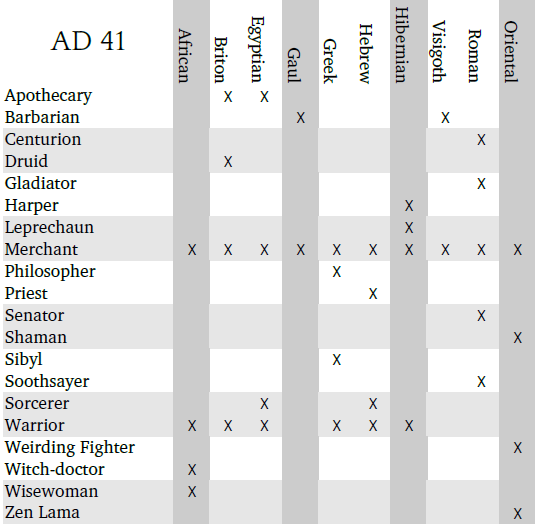
The ten nationalities available for AD 41 era MM&M characters are:  African, Briton, Egyptian, Gaul, Greek, Hebrew, Hibernian, Visigoth, Roman, and Oriental.  For 1375 BC era characters, only the African, Egyptian, and Hebrew nationalities are retained, but the following are added:  Babylonian, Hittite, Minoan, Philistine, and Sumerian.  Each nationality is associated with at least two classes.  As I mentioned before, determination of nationality and class is random.  Nationality may be rerolled only when a previous incarnation of the character was of the rolled nationality.  Class can be rerolled, but the second roll is final.

Here are charts showing the various classes for each nationality.


Each class has a “prime ability” which indicates the use to which the character's SKILL may be applied.  For instance, the Anakim, Barbarian, Centurion, Gladiator, Warrior, Weapon Master, and Weirding Fighter classes all have 'combat' as their prime ability.

All nationalities have a Merchant class (“the most broadly based of all character classes”), the prime ability for which is 'wealth increase'.  This means that the value of the character's treasure is modified based on Skill and Intelligence.  For every twenty points (or fraction thereof) of Skill over fifty, value is increased by 10% (or 15% for Hebrew Merchants); however, for every twenty points (or fraction thereof) of Skill under fifty, value is decreased by 5% (except Hebrew Merchants do not suffer this penalty).  For every twenty points (or fraction thereof) of Intelligence over fifty, value is increased by 5%.  In game terms, the only differences among the Merchant classes of the different nationalities (other than Hebrew) are their permitted weapons and armor.

Most nationalities have a Warrior class.  In addition to their permitted weapons and armor, each nation's Warrior class is made distinctive by special abilities.
African:  In tropical environments, +5 to hit and +10 damage; however, in Arctic conditions, the modifiers are -5 to hit and -10 damage.
Babylonian:  When fighting in a city, +5 to hit.  (technically, -5 THN)
Briton:  “Gains a +5 on damage if body and face are stained blue with woad.”
Egyptian:  In desert environments, +6 to hit and damage.  When using a bow, +5 to hit and damage.
Greek:  Via deception, has a 31% chance of gaining first strike in combat regardless of First Strike Capacity.
Hebrew:  When fighting alongside a Hebrew Priest, +5 to hit and +10 damage.  “On a roll of 85 or better...will feel compelled to offer food to an opponent.”  This means the Hebrew Warrior will not have first strike, regardless of First Strike Capacity.
Hibernian:  When fighting in the rain, +5 to hit and +10 damage; there are no negative modifiers for “fighting in fog or mist.”  Once per segment, Hibernian Warriors can heal their own wounds.  For every one POWER spent, three Life Points are regained.  When taunted, there is a 50% chance that a Hibernian Warrior will attack.
Hittite and Sumerian:  Can fight from a chariot without penalty.
Minoan:  When “fighting at sea or on board a boat,” +5 to hit.  (technically, -5 THN)

Of course, combat classes that aren't Warriors also have distinctions.  Gallic Barbarians receive +10 Courage (not to exceed 100).  Visigoth Barbarians get +10 Courage and Strength; additionally, when at least three are fighting together, they have +5 to hit and +10 damage. Philistine Anakim use a special table for determining hight and weight.  Opponents must succeed with a Courage roll to gain first strike, regardless of First Strike Capacity; however, Anakim may not use magical artifacts.  “Roman Centurions are entitled to hire and lead up to 100 mercenaries.”  A Centurion in combat may spend 10 POWER to make a percentile roll.  With a result of 26 - 60, allies receive +5 to hit and damage for the remainder of the combat; if the result is over 60, the modifier is +10.  Roman Gladiators get +5 to Courage, Skill, Speed, and Strength characteristics.  They never suffer combat penalties but they must fight (at least) once in the Arena between adventures.  The THN of a Hittite Weapon Master can never exceed 45.  Weapon Masters can train other characters how to use weapons they would not normally be allowed to use.  Finally, Oriental Weirding Fighters receive +10 to Speed and Endurance.  Bare hand damage is at +15, “while kicks with his feet strike at +25 damage.”  At a cost of 10 POWER, a Weirding Fighter can paralyze an opponent long enough to attack him twice; this is accomplished by ch'i energy.

The Astrologer, Seer, Soothsayer, Sybil, and Zen Lama classes all have “psychic” as their prime ability.  This means that – by spending POWER – they have access to the following eleven psychic talents.
Body Blow:  Automatically inflict damage on any one human within ten feet of the character; damage equals POWER spent.
Glimpse:  The character gains vague information about a distant or future event.
Hunch:  The character can “determine if a given course of action will prove dangerous or beneficial.”
Illusions:  By means of “mass hypnosis,” 1 - 100 humans see something that doesn't actually exist.  Someone not subject to the illusion can convince someone who is subject that the illusion is not real; however, the subject character must have at least 50 Intelligence.
Mind Reading:  The character can determine the main concern of any one person within twenty feet.
Tulpa Creation:  The character can “create an illusionary human or animal” that will act independently for one segment.  (rabbit hole)
Teleport:  The character can “mentally transport any inanimate object through any non-magical barrier.”
Telepathy:  The character can transmit information (in the form of words) “to any willing subject over any distance.”
Demoralize:  Once per turn, any one character within twenty feet must succeed with a 'courage check' or else flee.
Mirror Image:  The character can create a number of illusionary duplicates.
Empathy:  By handling an object, the character can determine what its owner was feeling when last in contact with the object.

Astrologers have a chance of identifying “the use of any artifact.”  On a clear night, they can study the stars to “predict whether a given course of action will prove harmful or beneficial.”  This is like the 'hunch' talent (above), only without the POWER cost.  Of course, Astrologers can devise horoscopes to obtain the answers to three yes/no questions “regarding the future of certain propositions.”

Hittite Seers must dance until exhausted (losing 20 Life Points) once per week.  They can commune with birds.  Perhaps more importantly, the Seer can engage in “Healing Empathy.”  Essentially, this allows the Seer to restore an injured character's Life Points by transferring his or her own Life Points.

The Soothsayer class has the ability of prophecy.  If used, the Lore Master must provide “a short, obscure rhyming prophecy pertaining to dangerous or unpleasant aspects of the current situation or...the next danger or unpleasantness the party is likely to encounter.”  However, when this ability is used, there is a 6% chance that the character “will lose the prophetic ability for three segments.”  Another ability of this class is a 31% chance of repelling “any chosen character” to a distance of fifty feet.

The Sybil is one of two MM&M classes that require the character to be female.  Each segment, there is a 2% chance that a Sybil will fall into a trance for an unknown length of time.  The Sybil has a 'prophecy' ability like the Soothsayer; however, unlike the Soothsayer, the Sybil's 'prophecy' must be about the current situation.  Also, a Sybil can 'infatuate' any one male at a chance of 41% (or 6% against Leprechauns).

A Zen Lama has +50 Endurance (not to exceed 100) by virtue of lung-gom-pa and has +10 to hit and damage in freezing conditions as a result of “tumo.”  The special ability of this class is “The Glance of Death.”  Once per segment, the character has a 6% chance of causing the instant death of any one opponent by scrambling his/her/its brain waves.

Sunday, July 6, 2014

MacGuffins, Plot Devices & Bric-a-brac

Plate 10 from The Book of Talismans, Amulets and Zodiacal Gems

When 'incarnated', an Advanced Man, Myth & Magic character receives an inheritance.  I suppose only the first incarnation receives an inheritance given that equipment is retained when a character is reincarnated.  However, there is no rule that addresses this and a new inheritance that somehow shows up with each incarnation is no stranger than the MM&M 'reincarnation' process itself.  By rolling percentile dice, the inheritance table “will tell you which of your ancestors remembered you and how much you receive.”

There is a 4% chance that your grandfather has bequeathed to you a:
7 pound piece of fallen star (meteorite); [worth] 300 Lbr.)[sic](If piece is melted into sword it will have a plus 15 to damage).
Whether or not this grandfather is maternal or paternal is not stated.  However, the table lists another grandfather who provides (also at a 4% chance) a silver helmet complete with horns (worth 100 libra) and a ruby (worth 500 libra).  It seems both the maternal and paternal branches are included, but not specified.  One of your aunts might give you “Seven vials of rare spices (150 libra each).”  Your other aunt – perhaps the crazy one – might leave you 200 libra and a leopard skin.  If your father really loves you (1% chance) you will get “10,000 Libra and the Emperor's Seal.”  Otherwise, there's a 4% chance he will give you a suit of legionnaire armor (complete) and 200 libra or (another 4% chance) 500 libra, a broadsword, a dagger, and a Greek helmet.

The 'ancestors' on the inheritance table are related to the character (Older Sister, God Mother, etc.) with the exception of Livia the Poisoner, a non-player character from a couple of the adventures.  (I guess she could be a relative, but the familial tie is not given.)  There is a 4% chance that Livia will leave you:  500 libra, a blowpipe, one hundred darts, and – true to her epithet – a bottle of cobra venom.

Yaquinto's The Egyptian Trilogy was marketed as “A TRIPLE Adventure Module for use with Man, Myth & Magic.”  It is also a 'system expansion' or sourcebook.  The setting of the MM&M rules is AD 41 (or thereabouts), but The Egyptian Trilogy module takes place in 1375 BC.  As such, the book provides nationalities, classes, rules, etc. appropriate for that era, including an inheritance table.  The 'ancestors' include the relatives from the original table (other than godparents), but also includes 'ancestors' such as Ex-Lover, Childhood Friend, Tribal Hetman, Priest, and Hunter.  Your uncle might give you sixty ounces of silver, a bow, a quiver of thirty arrows, and a vial of five applications of curare.  Your other uncle might give you a copper poleaxe, an iron-tipped spear, and a bronze helmet.  There is a 4% possibility that your ex-lover will leave you a leather kilt and a lethal dose of hemlock.  (I wonder if that's supposed to send some kind of message.)

The MM&M inheritance table provides characters with starting equipment and/or money.  The items can also be plot hooks.  What was your uncle doing with an “African Ju-Ju Bone”?  A spool of golden thread is worth 500 libra, but first you need to find someone who will buy it.  Why would “the Hunter” leave you his magical bow and magical charm?  What's the story behind the silver chalice your cousin left you?

In the recently released D&D Basic Rules we see a similar 'plot hook generator' with the 'Trinkets table' (which I find reminiscent of 1E Gamma World's 'Treasure List').  The table takes up two pages, with more than half of the second page blank.  Surely, the Trinkets table is not necessary for the Basic Rules; they could have used those pages for a couple of additional backgrounds or a detailed example of play or an index or more passages from that literary genius R. A. Salvatore.  While not necessary, the Trinkets table does something important – it connects (however faintly) the character with the setting in a unique way.  It shouldn't be the only connection, but it may be the first.  Anything that spurs the imagination is worthwhile.

The Trinkets table “can help stock a room in a dungeon or fill a creature's pockets.”  The problem with this is that some trinkets are more appropriate as contents for a monster's pocket than as possessions of a player character.  Why would a player character walk around with a “rope necklace from which dangles four mummified elf fingers” (Trinket #9) or a “glass jar containing a weird bit of flesh floating in pickling fluid” (Trinket #20)?  Why would you keep a “small idol...that gives you unsettling dreams when you sleep near it” (Trinket #8)?  Some things useful for dungeon room/monster pocket stocking should be in a Dungeon Curios table and not a 'player character possession' Trinket table.

Most of the Trinket table items are unusual, but some are not.  Trinket #41 is a “scrap of cloth from an old banner.”  That's an example of a trophy from the Soldier background; it shouldn't be a “trinket.”  On the other hand, perhaps there should be a separate Trinket table for each background.  (I'm ambivalent about Trinket #29, “A pair of old socks.”)

I notice possible product placement with trinket #46, “A dead sprite inside a clear glass bottle.”  (Get it?  A bottle of Sprite!  Haha!)

Trinket #99 is “A wooden box with a ceramic bottom that holds a living worm with a head on each end of its body.”  I wonder if this is an allusion to one of Sherlock Holmes' “unsolved” cases; namely, “that of Isadora Persano, the well-known journalist and duellist, who was found stark staring mad with a match box in front of him which contained a remarkable worm said to be unknown to science.”  (“The Problem of Thor Bridge”)

Thursday, December 20, 2012

Ghost Towns & Pyramids

Photographer:  Francis Firth (1857; Public Domain)

Nearly a year ago your humble host stated that he would “more thoroughly” examine Gregory L. Kinney's World Action & Adventure role-playing game.  WA&A doesn't warrant the level of analysis that this blog has afforded more interesting games, yet there are a few aspects upon which your humble host shall deign to reflect.  The aspect reserved for today's post is what Kinney refers to as “Explorer's Findings,” discussed in Chapter Eight (titled 'Random Encounters') of the Official Guide.  On page 110, Kinney explains:
Findings of this sort often promote great action and adventure.  An explorer's finding is often hidden from civilization and difficult to find.  Once found, trespass, danger, and treasure are often the active ingredients.
Kinney then provides various tables, some of which your humble host renders for the edification of his cherished readers.  Some scans from the Official Guide are provided; however, some of the tables displayed in this post have been reformatted, altered for esthetic purposes and – when necessary – corrected.  The tables with alternating shaded rows are distinct from Kinney's copyrighted material.

The first table shows the type and frequency of nine types of 'findings' for six 'specific terrains.'


The next table shows “if an explorer's finding can exist in a particular region.  If the result from table 1 does not agree with table 2, then roll again on table 1.”


Basically, the purpose of this second table can be summed up with the following admonitions:  Coniferous and deciduous forests can't have pyramids. Tropical Forests, savannas, and deserts can't have dungeons. Tropical Forests also can't have ghost towns.  The third table shows the possibilities for various “features.”

'Creatures,' 'guards,' and 'treasure' are self-explanatory.  However, if a lost mine has guards, is it really lost?  What about ghost towns with guards?  Anyway, 'peril' refers to the structural integrity of the 'finding,' with six possibilities:  (1) weak floor, (2) weak walls, (3) weak supports/pillars, (4) cliffs or pits, (5) narrow/weak bridge, and (6) entire structure might collapse.

Kinney has this to say about 'riddles' on page 118 of the Official Guide:
Riddles bring about mysterious action.  When a riddle is encountered, the Action Guide makes up a riddle on the spot, unless he has already made some.  The riddle can be a rhyme, pun, play with words, or mixed up statements.  As long as the Action Guide can come up with a clue or hint for the actors' characters, that is all that is required.
Kinney's riddle determination tables:


Kinney's trap tables:


Details for three sizes of lost mines:


Details for three sizes of pyramids:


Details for three sizes of ghost towns:


With regard to 'Points of Interest,' Kinney lists eight varieties:  (1) bridge, (2) church, (3) gallows, (4) mill, (5) mine, (6) river, (7), tower, and (8) well.