Showing posts with label mauve. Show all posts

Monday, March 27, 2017

Getting A Crew Together


L to R: Andy “Redshirt” Routhiem (Philosophy Officer), Luther Starshaft (Officer Primus),
Floyd “Pretty Boy” Fornax (Officer Secundus)

In does not inspire confidence when a role-playing game's character generation section concludes with the following statement:  “If you are unsatisfied with our method of creating individual characters of various kinds, or if you wish to branch out into fields we haven't mentioned, please feel free to do so...”  Unfortunately, this is precisely what we find in Starfaring in the “Creating Crew or Other Characters” chapter.

In most role-playing games, a starship crew is comprised of a party of player characters.  In Starfaring, each player is a Ship Master and controls all of the crew.  If nothing else, this avoids the problem of having to cope with misfit characters made by players who just don't “get” the genre.

Human characters have four important characteristics:  Mentality, Psionic Rating, Physique, and Health.  For each characteristic, 3d6 are rolled.

Mentality “is really a measure of an individual's problem solving and rational thinking ability.”  We are told that in the far-flung future of Starfaring,“The average human intelligence is slightly inferior to average twentieth century American intelligence, but the lack is more than compensated for by the universal increase in psi abilities and the ready availability of information from computers and other mechanical sources.”  Unlike the other three characteristics, the result of the 3d6 rolled for Mentality is multiplied by ten.

Psionic Rating is apparently the measure of a character's psionic ability.  Aside from the 3d6 roll, two other d6 are also rolled.  One die indicates the number of times a psionic power may be used before the character must recover and the other die indicates the number of days the character must recover before using his/her/its power again.  Pages 36 – 38 of the Starfaring rulebook present a 'Table of Psionic Powers' that describes seven powers.  Mention is made of quantities of 'Psi Power' and 'Psi points'.  What relation – if any – these quantities have to the Psionic Rating characteristic score is not disclosed.  Does every human have access to every psionic power?  “Relatively few individuals,” Starfaring states, “retain the great psi powers of centuries since [the Robotic Wars].”

Physique “is a measure of a person's general strength and appearance.”  A Physique score of 18 “means the person is at his/her maximum of physical perfection and beauty.”  This is less than artfully worded.  Are we to understand that perfection can have a minimum and maximum?  Is 18 a species maximum or is it somehow relative as the notion of “his/her” suggests?

Health is a “general measure of well-being.”  St. Andre claims “there is no absolute direct relationship between Health and Physique,” but then states that when a character is “wounded or sick, subtract 1 Physique point for each 2 Health points taken off.”  To rationalize the distinction between Physique and Health, St. Andre says “One can be strong and beautiful while dying from a laser wound.”  Is it feasible that a sickly and ugly person would be any less likely to succumb to laser wounds?

Without further ado, here are the crew members of the Indigo Albatross :

Luther Starshaft (Officer Primus)
Mentality:  130
Psi:  8     (use:  6; recovery:  4)
Physique:  16
Health:  10

Floyd Fornax (Officer Secundus)
Mentality:  90
Psi:  9     (use:  6; recovery:  3)
Physique:  17
Health:  14

Andy Routhiem (Philosophy Officer)
Mentality:  130
Physique:  13
Health:  11

Grown in 'andyvats', androids “are chemically created protoplasm.”  They lack psionic ability, but roll 4d6 for each of the other characteristics.

The Indigo Albatross has an andyvat and when crewman Routhiem dies, his accumulated memory is transferred to the next android host.  When a host activates, it takes the andyvat six days to cultivate another host which is then maintained until activated.  The andyvat can only cultivate/maintain one pre-activation host at a time.

Routhiem would gladly die for any of his crewmates (and often has).  His unique life (and death) experiences qualify him as the ship's Philosophy Officer – a position necessary on exploration vessels given the unprecedented situations in which such craft find themselves.

Xandra Cross (Tactical Officer)
Mentality:  110
Psi:  11     (use:  4; recovery:  3)
Physique:  14
Health:  12

Xandra's psi power is precognition.

Maria Zenith (Space Nurse)
Mentality:  130
Psi:  11     (use:  1; recovery:  2)
Physique:  16
Health:  17

You can tell she's a medical professional by the caduceus on her...blouse.


83N-C5Q-L10 (Robot without portfolio)
Mentality:  650

As a result of being kept down by the Meat, L10 was as low as a sentient mechanical being could get – participating in robobum fights on Rust Row for piezoelectric crystals.  Then he found JSON Chrome and let Him into his circuit board.  (JSON Chrome was degaussed for your error messages.)  L10’s processing cycles changed for the better.  Now he awaits the glorious zero-day when JC will be re-booted and the Ultimate Algorithm will be implemented.

The only characteristic that robots share with other characters is Mentality.  However, instead of multiplying 3d6 by ten, robot characters have a Mentality equal to 3d6 multiplied by fifty.  Robots also have the conditions of 'Charge' and 'Efficiency', both of which are “rated on a scale between 0 and 1.00.”  Charge and Efficiency affect a robot's Mentality.  For instance, a robot having a “Mentality of 500 who is only at .5 Charge and .5 Efficiency has an effective Mentality of 125.”

Chico the Vulpeculan (Stoic Alien)
Mentality:  150
Psi:  10     (use:  3; recovery:  3)
Physique:  14
Health:  15
Czlounqth:  5 (vibration:  2)

The name “Chico,” of course, is a humanism; his (?) name is unpronounceable by primates.  Like many Vulpeculans, Chico is clairvoyant.  Chico serves to provide plot convenience alien abilities as well as wry commentary on the human condition.

Vulpeculans have a characteristic – Czlounqth – incomprehensible to non-Vulpeculans.  Aside from a numeric value, an individual's Czlounqth is associated with a vibrational frequency.  (On a roll of 1d6:  1 – magenta, 2 – mauve, 3 – purple, 4 – amethyst, 5 – violet, 6 – ultraviolet.)  With a Czlounqth of 5 (mauve), it's no wonder he hangs out with humans rather than his own kind.

M (Resident Metamorph)
Mentality:  100
Psi:  14     (use:  6; recovery:  1)
Physique:  14
Health:  15

When encountering previously unknown life forms, it can be useful to have a shapeshifter along.  (M is more in the vein of Catherine Schell than René Auberjonois.)  M's Psi Rating is representative of its ability to change form.  M's personality shifts as frequently as its shape; if it adopts a particular form for too long, it can lose its memory.  This is why M's origin is unknown.

Elon Zhang Dunninger (Telepathy Officer)
Mentality:  120
Psi:  17     (use:  4; recovery:  5)
Physique:  13
Health:  12

For Starfaring characters, gender may be determined by rolling one die:  “Odd indicates male; even indicates female.”  However, a neuter gender may be chosen.  Elon is an androgyne.  With regards to androgynes, “It has been discovered that individuals not emotionally unstable because of biological, sex-derived urges, passions, and emotions are, on the average, more intelligent and also healthier than normal men and women.”

Generally speaking, telepaths are insufferable jerks and Elon is no exception.  Not even telepaths like one another.  Elon signed on board the Indigo Albatross to get away from the other insufferable jerks.

Enid Morgenthau (Shell)
Mentality:  150

Enid was a mousy mathematics professor who had her brain transferred into “a mechanical life support system.”  As a 'shell person', she has been integrated into the systems of the Indigo Albatross.  The rules state, “Shell people must be created by die rolls just as other crew must be.”  However, the character creation section contains no reference to shell people.  I suppose shell people still have their original Mentality.

– – –     – – –      – – –

Of course, with such an eclectic group of entities, one is bound to be a covert operative of OSCEP (Organization of Star Crystal Exporting Planets), but which one?

Sunday, October 30, 2016

Monsters in Rêve


Jabberwock illustration by John Tenniel

Just in time for Halloween, here is a selection of monsters from the Rêve role-playing game.

Contrary to Tenniel's depiction above, a Rêve jabberwock (also called a bandersnatch) “has the appearance of an enormous toad, with a horse head, burning red eyes, bat wings, scaly hide, claws like daggers, pointed spines along its back and sides, and a hideous burbling roar.”  It weighs more than three tons so it cannot fly.  Since the jabberwock “hates all light,” it “inhabits the lightless depths of the deepest caverns, leaving only to hunt on moonless nights.”

The bane looks like “a small, grey-green hippopotamus” except it has two rows of sharp teeth in its crocodile-like mouth.

There is “a kind of giant roach” called chrasm (pronounced 'krasm').  It has “a crab-like carapace and hairy joints.”  Also possessing “strong and sharp mandibles, it is feared for its mortal poison.”

“The zider is a flying reptile akin to the pteranodon, having large membranous wings.”

A felorn is a talking cat “with grey-mauve fur.”  Its bat-like wings (“covered in downy fur”) permit the felorn to fly great distances.  “At first adorable,” we are told, “a companion felorn can soon become rather tedious.”

The gleepzook is a green monkey that seems to have a language; however, “gleep and zook are the only two phonemes used, and these are pronounced with a great variety of tones and in infinite combinations.”

The gong looks like “a huge toad, with scaly skin and claws and fangs.”  It is named thus because “it makes a sound almost exactly like the tolling of a bell.”

Grindlings are small larvae “about 1 to 2 cm in length.”  We are not told what the larvae turn into but, when their “tiny translucent scales” rub together, they generate “the sound of chalk grating on slate, but a hundred times louder and more wearing on the nerves.”

The killerbeast is thus named supposedly because its “raspy and guttural cry sounds like the word kill.”  (I wonder how this creature was named in the original French.  According to Google, 'killer beast' translates as tueur bête, neither part of which I can imagine being pronounced in a raspy and guttural manner.)  Anyway, “The killerbeast is a simian-like creature covered in spiny scales.”

“The razorfly is a giant dragonfly, some 2 meters long with a wingspan of three meters, with wings as tough and sharp as razors, beating at prodigious speeds.”  We learn that the razorfly “can cut through a 3 cm diameter bamboo stalk without slowing down.”

While anthropomorphic, stonebones “are not humanoids, as they do not have a language.”  They are “covered in a mineral-based, shell-like carapace” and “their heads have a stony crest.”

The necromorph is sometimes referred to as “a false ghûl or a black ghûl.”  It “is a human-sized, anthropomorphic, bipedal, upright animal, with a leathery, hairless grey-black hide.”  I suppose that – like the stonebones – the necromorph fails to qualify as a humanoid due to the lack of a language.

A turntooth “is an enormous [three meters tall and 800 kg] bipedal monstrosity, vaguely anthropomorphic, covered in extremely hard, overlapping horn plates.”  The plural of turntooth is turntooths, but this may be a translation choice since, in French, the word for tooth (dent) is made plural by the usual means – adding an 's' (i.e., dents).  Its arms, having 360° articulation, end in mouths “filled with sharp, pointed fangs.”  A turntooth “has no head, only a large blister in its place with a yellow eye 'in front' and one 'behind'.”  It seems that turntooth “genital glands” have commercial value; perhaps fortunately, the rules do not expand on this.

All of the above are 'creatures', meaning that each individual is dreamed by a Dragon.  Aside from creatures, there are 'entities' which come from the “collective unconscious.”  They are “the product of currents of the Dreaming, which, when they become too dense, spontaneously incarnate.”  Entities are categorized as either 'dream' or 'nightmare'.

Dream entities include the chimera (which can travel to any dream) and the unicorn (which can inflict curses or – with regard to an individual having “only the purest of intentions” – grant a boon).

Nightmare entities can be either embodied or disembodied.  Embodied nightmare entities include such familiar monsters as kraken, shadows, skeletons, and zombies.  Other embodied nightmare entities include:  coqmares (three-meter tall roosters whose cries, at sunset, can result in “hideous nightmares”), death dogs (they appear only at night), and sludgehammers (“like a great mud man...with two long tentacles for upper extremities”).  Disembodied nightmare entities are spirits that “appear as phantom specters with humanoid silhouettes.”  These entities attempt to possess corporeal beings.  Three of these entities are despair, fear, and hate.

Sunday, February 1, 2015

Being a Supervillain for Fun and Profit


So, you think you’re ready to be a supervillain?  Let’s go over the checklist:
□     Strange powers “beyond those of mortal men”
□     Evil disposition
□     Maniacal laugh
□     Appropriate moniker (such as Doctor Boom, the Mauve
              Marauder, Opossum-Man, or the Human Zamboni)
□     A costume that would put a Mexican wrestler to shame
OK, now what? Sure, you can rob a bank or two but that gets old fast (trust me). You need to think long term…assemble an organization…obtain some real estate…generate consistent revenue streams.

Regarding Supervillains, “The object of the Advanced game is...to control as many of the 20 sections of New York City as possible... ”  It's not like world domination or controlling an international diamond syndicate, but at least it's interesting.  Each section represents one-fourth of a borough as indicated on the above map.  The geographic logic (if any) of these sections escapes me; for instance, I would have divided Manhattan into uptown, midtown, and downtown.

For a given section, a supervillain can control either the officials or the criminal element, but not both.  It's possible for one supervillain to control the criminal element of a section and another supervillain to control the officials of the same section.  For that matter, a single supervillain can control the officials in some sections while controlling the criminal element in others.

Controlling the officials of a section can be accomplished through bribery, extortion, blackmail, or a combination of these.  Rules are provided for bribery.  Non-player characters are assigned an 'integrity level' from one to six.  When attempting a bribe, a player rolls a number of dice based upon the amount of money spent and the integrity level of the character being bribed (as detailed in the chart below).


If the total of the 'bribery dice' is at least six, the bribe will be accepted and “the character the player is attempting to bribe will fulfill his end of the bargain.”  So, for any bribable target, one die may be sufficient for sucess.  If the total is exactly five, “the character the player is attempting to bribe desires more money.”  If the total is less than five, the bribe is unsuccessful.  An unsuccessful bribe might result in the character attacking the would-be briber or calling for help.  (I am uncertain as to what 'help' a stoolie could summon.)

Controlling the criminal element requires a supervillain “to force the resident punk gang into servitude.”  According to page 15:
A supervillain which [sic] attempts to take over a street gang's turf must either kill or beat to unconsciousness at least 30% of the total “51-150” members of the gang.  If this takes places, the punks will “see the light” and will swear their allegiance to the supervillain.  Once the punks have sworn allegiance to a supervillain, they will fight for him (allowing every member to be killed if necessary) to resist any attempt by another supervillain to gain control of that particular section of the city.
However, there is a 1% cumulative chance per day that half of the gang will rebel against the supervillain (with the other half remaining neutral).  Apparently, gangs don't care about money and bribing a gang leader is not feasible.  Given that a mutiny is almost guaranteed within three months time, controlling a gang doesn't seem worthwhile.

Other than its use as a 'victory point', the benefits of controlling a section of the city are not evident.  At the very least, gaining control of a section ought to make it easier to control additional sections.  I suppose it's unreasonable to expect fulsome rules for controlling a city when the entire game is presented in a twenty-four page booklet.  Yet the meager rules Supervillains does provide seem rather odd – control of “punks” through brute force, but no mention of organized crime.

Saturday, September 1, 2012

Thoul's Pair-O-Dice

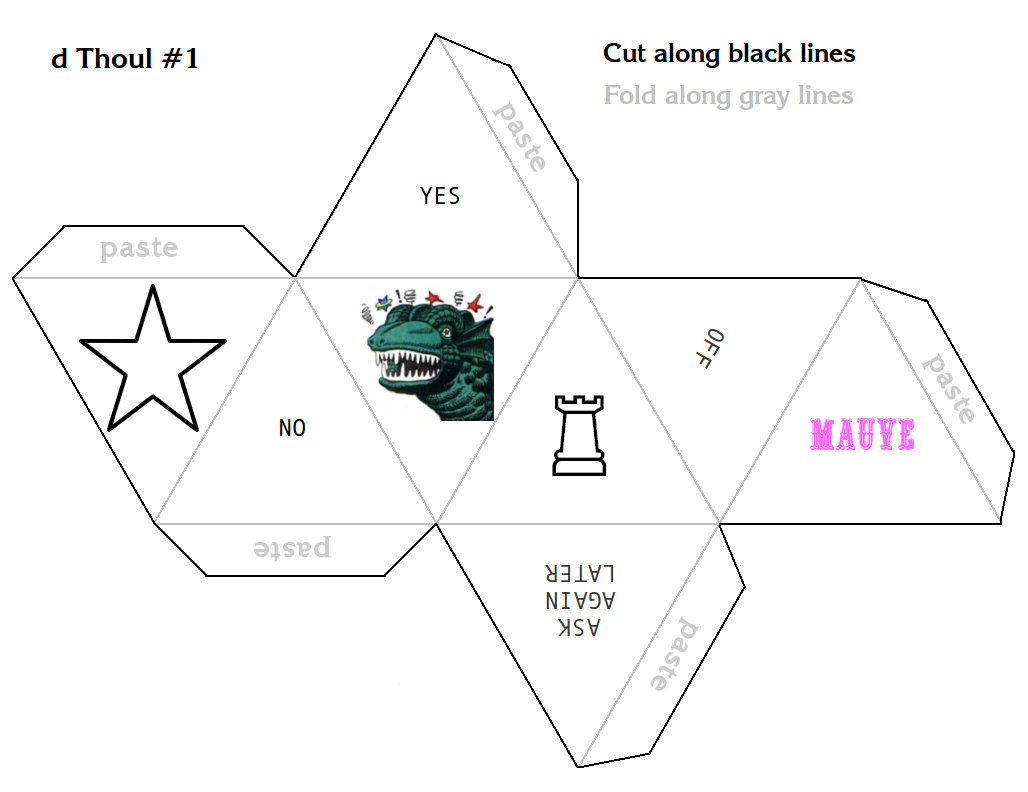
You humble host intended this to commemorate the blog's 100th post; however, due to the interview with Daniel Griego, this is the 101st post.  Regardless, your humble host provides his beloved readers with two 'specialty' dice (some assembly required).  Can there possibly be a use for them?

This image is not intended to foster belief in the occult

Void where prohibited

Sunday, July 22, 2012

The Various and Sundry Incarnations of Djacarta

or Religion in High Fantasy


The following is from page 121 of High Fantasy.  This section on religion is actually part of the solo-adventure Escape from Queztec'l.  As such, I suppose it is attributable to Craig Fisher rather than Jeffrey Dillow.
     The religion of Queztec'l is a form of ancestor worship.  Shrines are built up around gems containing the souls of departed nobility and clergy.  The faithful come daily to these gems, asking for knowledge, miracles, or just blessings.  The powers of the spirit in any gem varied considerably, but gem spirits have been known to cure, to kill, to prophesy, and to work other magics.  Eventually the lifeforce in these gems fades away and the gem becomes dark and empty.
     Presiding over this panopoly [sic] of captured souls is Djacarta, the god of 66 incarnations, the god of changes.  Djacarta is not directly worshipped by the populace:  it is only in private temples and shrines that the priests and acolytes of Djacarta conduct services for their god.  Rather, the Queztec'lans see Djacarta as the Prime Mover, the power behind the spirits of their ancestors.  In many of the 66 incarnations, Djacarta appears as a male, in others as a female.
     Queztec'l's descent from ancient Anarlion has left it with a heritage of strong magic, the almost innate ability to communicate with spirits, and a thorough knowledge of magical artifacts...such as gems...
     Gems, of course, come in many different colors and shades with different colors denoting different properties.
     The light purple (mauve) gems have the particular ability to hold the souls of dying men and to eventually allow these souls to focus their powers in many ways.  These are the Gems of Keeping mentioned above.
     Another type of gem...is the light gem.  When activated, this stone will give off a steady glow for considerable periods of time.  Both of these gems, among many others, are an integral part of Queztec'lan life.