Showing posts with label Craig Fisher. Show all posts

Sunday, July 29, 2012

High Fantasy Setting


On page 119 of High Fantasy, included in the background section of the solo-adventure Escape from Queztec'l, we are treated to a map of a continent.  No credit is given for the map but, as a whole, the solo-adventure is attributed to Craig Fisher.

As we can see, the name of the continent is Lysdexia.  This is doubtless an attempt at humor by switching two letters in dyslexia.  Such humor would not fly in our politically correct day and age, but in the era of the Old School, making fun of the less fortunate was commonplace.

There's not much detail, but it is more than enough for purposes of the solo-adventure.  The aptly named adventure takes place in the city of Queztec'l on the northern coast.  According to page 118:
Once Queztec'l was a regional capital of the Anarlinian Empire but that empire is long, long gone and even the subsequent Queztec'lan Empire is in a state of decay.
Once Queztec'l controlled nearly the complete northern half of the continent.  At the time of this story, however, the area governed by the city is only one-fifth of the size of the former domain.
You are Xenon, from a medium sized barony out on the Long Arm.  Although your lands have not formally been part of Queztec'l for centuries, you are still tied by a common language, religion, and customs.
Should someone want to employ the map for a campaign setting, there is a great deal of space with which to play.  (Just what is the scale anyway?)  Yet there are a variety of landmarks depicted to inspire the imagination.  (By the way, Queztec'l sits at the mouth of the Mezofari River.)

In the southwest quadrant of Lysdexia, there are “the ruins of Anarlion,” apparently the former seat of the great Anarlinian Empire.  The empire ceased to hold sway ages ago, but why would the city be abandoned?  Why would it remain abandoned after so long?  The ruins would seem to occupy a prime piece of real estate at the mouth of a major river and it wouldn't have been built in the first place if the position wasn't advantageous.

Also, why is the Insane City called thus?


Sunday, June 24, 2012

Solo Adventuring in High Fantasy


In the preface to High Fantasy, Jeffrey Dillow states:
This is not a book of rules. The actual rules consist of only a few pages. What this book is, is an accumulation of medieval weapons, spells, and monsters with clear explanations on how to use them in fantasy adventures.
Actually, the page distribution is as follows.


Dillow also uses the preface to point out the 'giant' solo adventure and its suitability for teaching the reader how to play.  Specifically, Dillow says in the introduction to the adventure, it “was designed...to teach beginning players how to work through combat and to give them a basic understanding of how High Fantasy works.”  The adventure, Escape from Queztec'l, was written by Craig Fisher, who also wrote another High Fantasy solitaire adventure, In the Service of Saena Sephar. With Queztec'l, Fisher not only provides a solo adventure and a streamlined version of High Fantasy combat, he also provides some setting background, including a continent map, notes on religion, and creature statistics.  The setting deserves its own post, so I will not dwell further on it here.

Dillow says, “High Fantasy is based on the sound mathematics of the percentile dice.” I don't know why the RPGGeek listing includes “Dice (Primarily d6)” as a game mechanic. Six-sided dice are not mentioned in High Fantasy (at least not in the second edition), doubtless due to their comparatively unsound mathematics.

Anyway, for purposes of playing the solo adventure, the reader controls a character named Xenon.  The picture above suggests that the character's full name is Xenon Swif's'ord and that Xenon could be of either gender based upon the preference of the reader.  For purposes of the adventure, all characters have three attributes:  quickness, offense, and defense.

Essentially, quickness determines initiative.  It also determines movement rate.  It is affected by encumbrance.  For purposes of initiative only, it is also affected by weapon type.

In order for Xenon to hit an adversary in combat, the adversary's defense is subtracted from Xenon's offense; the result is the percentile chance of success.  Assuming Xenon is successful, the combat table is consulted.  The chance of success determines which column to use and another percentile roll determines which row to use.  The combat table provides a number that is subtracted from the adversary's offense and a number that is subtracted from the adversary's defense.  Death occurs if and when defense is reduced to zero.  Combat against Xenon is handled similarly, except that defense damage is divided – as indicated by the combat table – between 'personal' defense and 'armor' defense (if any).

Depending upon the attack, more or less damage may be inflicted.  A 'plus' means moving to a column to the right of the column indicated by the chance of success (more damage) and a 'minus' means moving to the left (less damage).  For instance, a weaponless attack by a human has a -5 damage modification while a Xermoc's claw has a +6 damage modification.

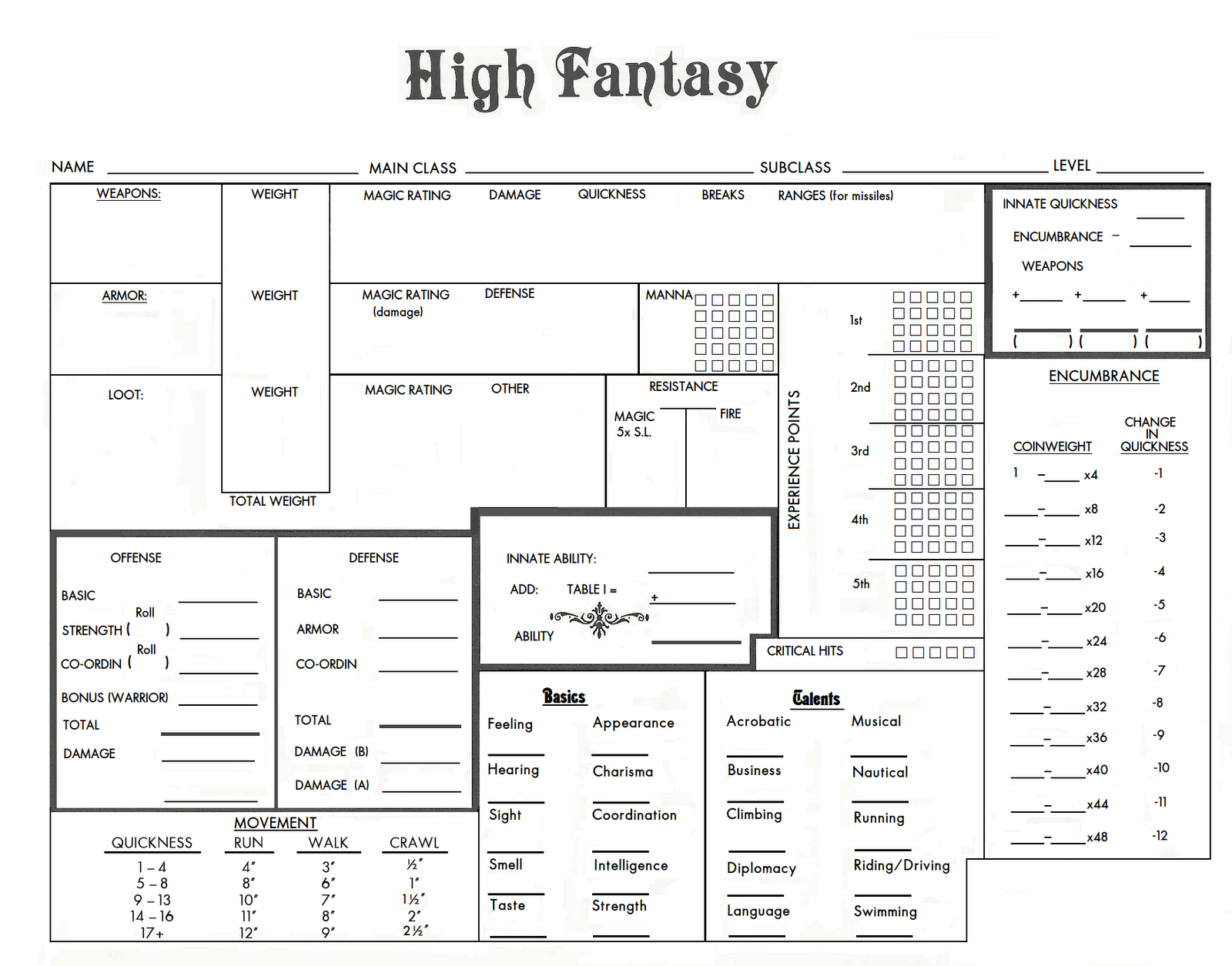
Apparently, “pad[s] of character sheets” as well as percentile dice were available from Fantasy Productions Inc., the company that Dillow created originally to publish High Fantasy. The character sheet graphic in the book is, in effect, a diagram with different sections labeled with numbers associated with the steps a player follows when making a character. For my cherished readers – as well as posterity in general – I have scanned in the so-called character sheet and cleaned it up somewhat, taking out the step labels.  The result appears below.  You can use it as a reference as we continue our exploration of this fine game.