Showing posts with label Wesely. Show all posts

Tuesday, March 10, 2015

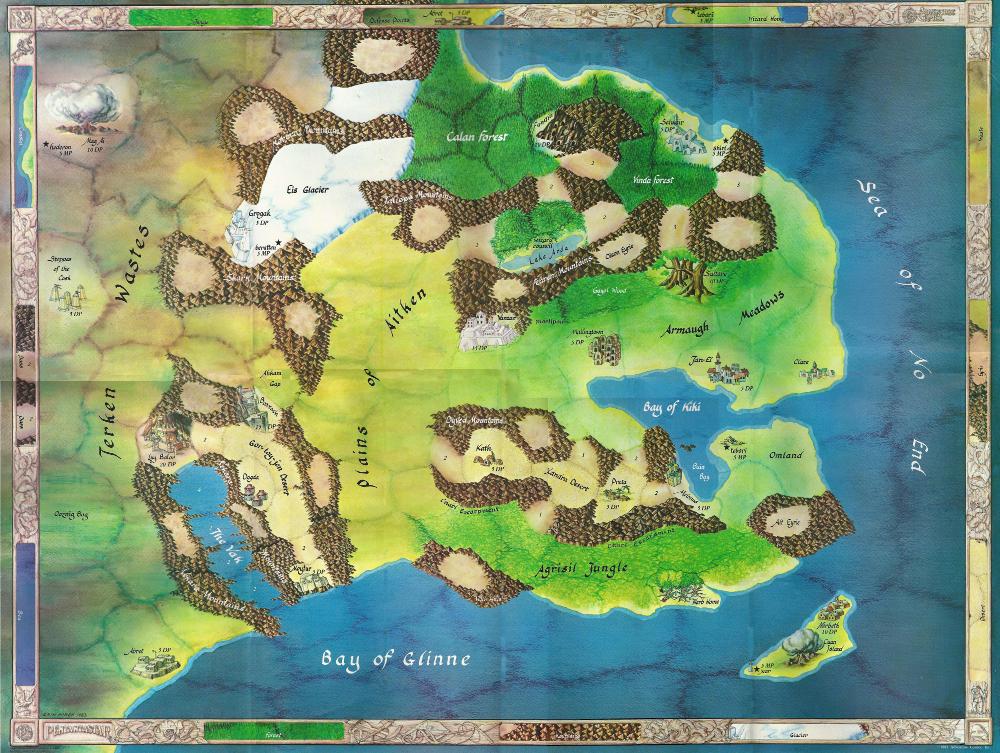
Inspiration: Pentantastar

Map by Erin McKee

In 1983, Dave Arneson's Adventure Games released Pentantastar, “A Fantasy Boardgame of Magic and Strategy.”  It was designed by Dave Megarry (one of the designers of Dungeon!) and his family.  Playtesters included Arneson himself, Richard Snider (Arneson's Adventures in Fantasy collaborator and Powers & Perils designer), Scott Bizar of Fantasy Games Unlimited, and Dave Wesely.

The game is about a conflict between two factions in a fantasy setting.  The factions are not labeled as 'good' or 'evil'.  However, one may infer that the West – ruled by the mysterious Arkhon™ –  is the 'bad' side since it is the aggressor and has trolls.

The game has two aspects:  military and quest.  In the military aspect, counters (called 'pieces') represent armies and other forces.  The combat strength of pieces in conflict are compared.  If the attacker's combined combat strength is equal to or less than the defender's, nothing happens.  If the attacker's strength exceeds the defender's, the defender's pieces retreat or are removed from the game.  There are certain key locations, the East has four and the West has three. A military victory is achieved when one side occupies all key locations of the opposing side.

In the quest aspect, the Eastern operatives (a pair of wizard siblings) vie against the Western operative (a wolf) to collect five 'charms'.  When the charms are assembled, they form the titular Pentantastar™.  A magical victory is achieved when one side brings the Pentantastar to the opposing side's capital.  Each charm activates certain creatures:
  • Liths™ – living rocks
  • Serak™ – “spiked clusters of ice about the size of a man's head and shaped like puffed-out dandelions”
  • Sletta™ – bog creatures
  • Antherb™ – huge vines that are “literally several places at once”
Other strange creatures in the game include:
  • Quila – wyvern-like creatures (I would have called them 'wyverns')
  • Vorts™ – “black, scaly” snakes with lethal poison; they “have heads mantled with a fan of red and silver”
Also present are more traditional fantasy races like elves, dwarves, and giant eagles.

There is a booklet with seven pages of rules and one page with instructions on how to make your very own Pentantastar using paper clips and plastic straws.  There is a separate booklet with seven pages of background fiction and a seven stanza poem/prophecy.

Each side has a deck of cards from which a hand of five cards is drawn every round.  Each card has a military function and a quest function, but only one function can be used when played.  The quest function for each card is represented by a number of 'magic points'.  Every round, both players 'spend' cards for magic points.  The player with more magic points (including those available from certain pieces and from occupying certain spaces) moves the quest operatives.  The military function for a card is either a 'mobilization' (introducing new pieces) or a 'hazard' (inflicting obstacles like storms).  Quest pieces are unaffected by hazards or military actions.

I think I would have designed it so that each charm would not activate special creatures.  Instead, the winner of the magic point bid for the round could cast a spell based upon which charms had been recovered.  For instance, the white charm could prevent some pieces from attacking, the yellow charm could negate a hazard, etc.  Also, I would not have used funky, 'trademarked' creatures; just traditional creatures with which anyone likely to play the game would be familiar.

Anyway, I can easily imagine the questing wizards – Seraphael and Waalibor – and their gypsy friend, Wandelar, as player characters in a campaign against a backdrop of war and intrigue.

Art by Erin McKee

Thursday, March 15, 2012

Happy Birthday Dave Wesely!


This is really weird — I'm going back to being the king of Holland.
                                                                                                   -- Dave Wesely


Many readers of this blog know that role-playing games have their origin in the wargaming hobby.  Specifically, Dave Wesely is responsible for the wargame ‘mutation’ (so to speak) which wbecame the progenitor of all RPGs.  As such, Dave Arneson considered Wesely to be the inventor of the role-playing game.  Today is Wesely’s birthday, so your humble host deems it fitting that we look at Wesely’s contributions to our hobby.

Back in the day, Arneson’s parents’ basement served as a weekly gathering place for grognards in and around St. Paul, Minnesota (although the term ‘grognard’ may not have been in vogue at the time).*  It was there that Wesely orchestrated a ‘Napoleonic’ scenario about the fictional Prussian town of Braunstein.  Wesely served as an impartial referee; while not innovative, this concept would become central to RPGs.  Of course, in wargames, players control military forces; however, in Braunstein (as the game came to be called), each player adopted an individual role, not necessarily that of a combatant.  Each role had its own goal, not necessarily a military goal.  With a multitude of goals came a plethora of ways players attempted to accomplish those goals and Wesely had not anticipated the variety of activity upon which players had their characters engage.  It was necessary for Wesely to improvise rules in order to accommodate the players’ intent.  Wesely saw the result as a mess and did not consider his effort to be successful.  However, the players wanted more, so Wesely crafted further Braunsteins.

With the new scenarios, he thought that restricting the activities of characters would make for a better, more controlled game.  Alas, the players preferred the freedom of action (along with the 1:1 player-character ratio).  The fourth Braunstein used a stereotypical banana republic as the setting.  In this game, Arneson focused on playing his role as opposed to playing merely the game.  As such, he helped develop the rich potential inherent in a role-playing game.  When Wesely went to serve in the military, Arneson continued the Braunstein tradition and established a setting based on fantasy literature, but that's another story.

Legend has it that Wesely introduced his Minnesota cohorts to the concept of using platonic solids as atypical dice.  The notion of polyhedral dice was certainly not new, but if not for Wesely such dice may not have not become associated with RPGs.

With regard to other accomplishments in gaming, Wesely designed 'Valley Forge' and is co-designer of the underrated 'Source of the Nile.'  He is also credited with the development of several video games from the early ’80s.

If your humble host produced documentaries, he would be all over this dude like white on rice.  If you know anyone who makes documentaries, please clue them in to Dave Wesely.  The man had a profound (if unintentional) effect on the hobby and his insight is invaluable.  Oh, and be sure to ask him about the time he nearly killed Arneson.

*  Speaking of Arneson’s parents’ basement, that place ought to be listed in the National Register of Historic Places. Seriously, just consider the pop culture and sociological impact of role-playing games, even if only computer RPGs.