Showing posts with label Hargrave. Show all posts

Sunday, December 27, 2015

The Arduin Adventure Bibliography

Detail from the back cover of Michael Whelan's
Wonderworks: Science Fiction and Fantasy Art

Role-playing game bibliographies (or ‘Appendices N’ as the case may be) tend to list two categories of material:  research works and genre literature.  Depending upon the game, ‘literature’ may be inclusive enough to accommodate motion pictures, television programs, and even music as sources of inspiration.  In addition to including the aforementioned types, Hargrave embraces the aphorism that a picture is worth a thousand words and indicates specific art books in the bibliography for The Arduin Adventure (hereinafter ArdAdv).  Although it makes perfect sense, art books are not commonly acknowledged as RPG inspirations.  Hargrave specifies the following art books:  Alien Landscapes, Beauty and the Beast, Faeries, GiantsSolar WindTomorrow and Beyond, and Wonderworks.  Also, I suppose we can categorize An Atlas of Fantasy as an art book.

Hargrave ends the bibliography with a few items that “have served as wonderful sources of fun and ideas.”  Included among these are Elfquest as well as Marvel Comics (“An unlikely, but valuable source of inspiration”).  If we count art books as sources of inspiration, there is no reason why we should construe comic books as an ‘unlikely’ source.  For whatever reason, Hargrave singles out Marvel Comics.  Surely, if Elfquest makes the grade, Marvel cannot be the exclusive source of inspiration among comic books.  Given Hargrave’s acknowledgement of comics and art books (especially the Achilléos book), I find it strange that Hargrave doesn’t mention Heavy Metal.  The remaining ‘wonderful source of fun and ideas’ is “The entire works of J.R.R. Tolkein.”  Complementing that assertion is the inclusion of The Complete Guide to Middle Earth and A Tolkien Bestiary in the bibliography.

For “expanded insight into what is happening in the fantasy gaming world,” Hargrave lists three periodicals:  Alarums and Excursions, Different Worlds, and Sorcerer’s Apprentice.  Notably absent is Dragon ; it’s good enough to advertize in but not good enough to endorse.

Some role-playing games have bibliographies that reference other RPGs; ArdAdv is not one of those games.  However, Hargrave does mention Chaosium's Authentic Thaumaturgy.  Speaking of Chaosium, the RuneQuest (Second Edition) bibliography lists the first three Arduin books in the ‘Other Fantasy Role-Playing Games’ section.  Additionally, the ArdAdv and Runequest bibliographies have one non-fiction work in common – George Cameron Stone’s A Glossary of the Construction, Decoration and Use of Arms and Armor in All Countries and in All Times, Together with Some Closely Related Subjects.

Along with Authentic Thaumaturgy, the ArdAdv bibliography has a variety of books about magic – from reasonably academic texts like The Complete Illustrated Book Of The Psychic Sciences and The Supernatural to the rather eccentric The Morning of the Magicians.  Hargrave also has The Encyclopedia of Witchcraft & Demonology.  As shown in a prior post, Hargrave prefers to spell magic with a ‘k’; he even alters the spelling when the word ‘magic’ appears in the title of a book.  Therefore we see in the bibliography “The Encyclopedia of Magik & Superstition” (sic) as well as “Magik, White and Black” (sic).

Hargrave carries his interest in Japan over into Arduin.  We find in the bibliography Secrets of the Samurai, Japanese Short Stories, Martial Arts (although the title is generic, the book focuses on Japanese martial arts), and – in another instance of ‘magik’ versus ‘magic’ – “Seven Magik Orders” (sic).  The only other reference to a (real world) culture in the bibliography is in the form of The Phoenicians.

Several books in the ArdAdv bibliography discuss fantasy creatures.  Aside from such books listed above, Hargrave includes An Encyclopedia of Fairies, Mysterious Monsters, and Zoo of the Gods.

The Fantasy Almanac has earned a place in the ArdAdv bibliography.  The remaining ‘reference books’ can be sorted into two types:  mythology (The New Larousse Encyclopedia of Mythology, Men of the Earth) and history (War Through The Ages, Medieval Warfare).

In terms of ‘traditional’ fantasy literature (besides Tolkien), Hargrave gives “Personal thanks” to Robert Asprin, Stephen R. Donaldson, and lastly, C. A. Smith “for his fantastic tales of wonder and glory, but mostly for Zothique, the true progenitor of ARDUIN.”

Sunday, December 20, 2015

Spells in The Arduin Adventure

Art by Stephen Fabian

A common misgiving of the (early) D&D magic system was the 'Vancian' paradigm wherein a magic-user must 'forget' a spell upon casting and then re-memorize the spell before it could be cast again.  (Of course, contrary to the notion of 'forgetting' a spell, a given spell could be 'memorized' more than once.)  Different 'spell point' systems were devised as alternatives to the unsatisfactory Vancian method.  In The Arduin Adventure, Dave Hargrave employs a system of 'mana points' for magic magik spells.  However, in The Arduin Adventure (hereinafter ArdAdv), mana points do not obviate the 'forgetfulness' imposed by the Vancian philosophy, but merely act as an adjunct.

In ArdAdv, there are two types of magik:  Thaumaturgical (cast by Mages) and Priestly (cast, appropriately enough, by Priests).  When a mage memorizes a spell, he (or she) must invest an amount of mana specified in the spell's description.  At any point after the spell is memorized, the mage can cast the spell by speaking a trigger phrase.  All thaumaturgical spells take a combat round to cast.  (Apparently, material components are not required.)  “Once used,” the rules tell us, “mana takes 10 hours to 'recharge' to working level.”  Does this mean that if a mage casts a one mana point spell, he (or she) regains that point ten hours later?  If a mage uses half of her (or his) mana points at once, will all of those points will be available after ten hours?

Priestly spells (sometimes called “rituals”) also have a mana cost, but spells need not be memorized.  Mana is expended when the spell is cast.  Priestly spells take an entire minute to cast:  “This is because priestly magic also requires proper obeisance (kow towing) to the god in question and certain rituals (variable according to the spell).”  Priestly spell listings do not describe the particular rituals to perform, so it is safe to assume that – for game purposes – ritual activity is not distinctive.  Regardless, casting a priestly spell during a combat situation would not seem to be a feasible option.  Presumably, mana expended via priestly spells is 'recharged' in a fashion similar or identical to how mages recover mana.

Mage characters begin with a number a mana points equal to their Intelligence plus five points as a result of training:  “A mage must spend years learning his craft, either as an acolyte with an already established mage or at a 'College of Magik.'”  Priest characters begin with a set amount of fifteen points of mana.  Both types of character gain three additional points of mana for each experience level gained.

Rather than spell level, ArdAdv uses the term “order of power (or OP).”  The highest 'order of power' to which a mage has access is equal to half of the mage's experience level, rounded up.  So, through the second experience level, a mage only has access to 'first order' spells; starting at the third experience level, a mage can use 'second order' spells, etc.  The rules do not comment upon the schedule by which priests access successive orders of power.  One could assume that priestly 'spell progression' uses the same formula that applies to mages.

Each mage has a 'book of power' in which the mage writes his (or her) spells.  For each order of power of the spell, at least three pages are required.  There is no other mention in ArdAdv about pages in mages' books.  It takes a mage an amount of time to memorize a spell equal to thirty minutes for every order of power of the spell.  Memorization time is “reduced by half per (experience level) earned over the (experience level) needed to cast the spell.” 

For both thaumaturgical and priestly spells, ArdAdv presents four orders of power – enough for eight experience levels.  There are 32 thaumaturgical spells and 29 priestly spells.  In general, the ArdAdv spells are reminiscent of their D&D counterparts, but typically with suitable name changes.  For example, instead of “Silence 15' Radius,” ArdAdv has “Sound Wipe”; instead of “Web,” there is “Tangle Trap”; and instead of “Mirror Image,” there is “Multiple Image.”

Aside from spells, priests have spell-like abilities.  They can “Turn Away” undead:
Priests have a 10% chance of success for each 10 HP less than 100 the undead have.  Thus, a priest has a 100% chance versus 10 HP undead but only 10% chance versus 100 HP ones.
Evidently, a priest's experience level does not modify this chance.  Also, “A priest can 'Lay on Hands' to heal those of his faith.”  (To use this ability on a character not of the priest's faith, the priest must succeed with “a 'God Reaction Roll'...to see if the priest's patron deity will allow this to happen.”)  It is quite taxing for a priest to 'Lay on Hands,' but all wounds (other than fatal) will be completely healed.  (This ability is distinct from the healing spells to which priests have access.)

Monday, December 14, 2015

Combat in The Arduin Adventure

Art by Marshall Frantz

Characters in The Arduin Adventure (hereinafter ArdAdv) have a Defense Factor (DF) which “is a numerical rating for the natural (Armor Class) or worn armor a character has.”  Armor Class is defined as “The sum total of a character's ability to actively or passively defend himself.”  Armor Class starts at nine (“Person in normal clothes, with no special protection”) and descends.  However, unlike D&D, ArdAdv AC does not extend into negative numbers.  AC 2 represents “Full plate armor and small shield” or “Half plate and standard shield” or “Scale and Chain mail with tower/kite shield.”  The next AC is not 1, but instead “2+1.”  “Full plate armor and tower/kite shield” is AC 2+2, which is the limit of Armor Class.  However, due to modifiers, Defense Factor extends up to “2+7” (at least according to the Combat Chart).  The rules state, “for each DEX and AGIL point LESS THAN 7 a character has, subtract 1 point from his DF...by the same token, for each DEX and AGIL point MORE THAN 12, ADD 1 point to the DF.”  By 'subtract', I suppose Hargrave means impair and by 'add', I suppose he means improve.  “Targets in flight” add four to their DF; characters benefiting from partial cover get a bonus of two.

Wearing armor imposes a penalty on both Dexterity and Agility.  For instance, “Small shields and cloth armor have a penalty of one each...A set of full plate armor with tower shield has a combined penalty of 8.”  Defense Factor modifiers are determined before armor penalties are applied to Dexterity and Agility; however, movement rate is determined after penalties are applied.  The number of feet a character may move per melee round (six seconds) is determined by the formula:  5 × (Dexterity + Agility).  (Each ten pounds of weight carried reduces movement rate by five feet.)

ArdAdv characters also have an Attack Factor (AF) – “a numerical rating of the kind of weapon or attack used.”  The Combat Chart indexes a column of twenty-five weapon types against a row of Defense Factor values.  Examples of weapon types include Maul, Short Spear, Throwing Knife, and “Non-Weapon.”  If I had created the Combat Chart, the laws of semantics would prevent me from including “Non-Weapon” as a “weapon” type.  Instead of weapon type, I would use attack type and have two “Non-Weapon” categories:  pummel and claw.  Anyway, the intersection of Weapon Type and Defense Factor provides a number (Attack Factor) which is the minimum number required to hit on 1d20.  A character's Strength can modify Attack Factor.

Characters attacking a target from the rear get “a +3 bonus to their AF...”  By this, I suppose Hargrave means characters get a bonus to their attack roll.  Also, a target being attacked from behind loses the “AGIL/DEX and shield bonuses” to Defense Factor; this also applies to “downed” targets.  (I suspect that penalties from Agility and/or Dexterity still apply.)  Attacks from the side provide a +2 bonus and attacking from an elevated position grants a +1 bonus.

When attacking, a roll of twenty indicates a critical hit.  If a roll of 20 was required for a successful hit, then the hit is a normal hit instead of a critical.  Unfortunately, ArdAdv does not make use of Hargrave's Arduin Grimoire critical table; instead we are presented with a 1d10 table with each result representing a different body location.  For instance, a roll of '4' means an arm was hit for three points of damage with a 'side effect' of:  “Major artery cut, bleed to death in D20 combat rounds.”

A roll of '1' when attacking typically indicates a fumble.  Just as ArdAdv lacks the Grimoire critical table, it also lacks the fumble table.  Instead, Hargrave presents a 1d10 junior version with results like “Trip and fall, 1 to 5 melee rounds to get up” and “Hit wrong target FULL DAMAGE.”

Weapons in ArdAdv inflict a fixed amount of damage (e.g., a short sword inflicts five points, a flail inflicts ten).  A high Strength score provides a bonus to inflicted damage, but a low score does does not subtract from damage.  Each weapon type is associated with one or more types of damage:  bruising, crushing, puncture, slashing, stab, and tearing.  How these different types are supposed to affect game play is not explained.

Chapter VI, “How to Have a Melee,” begins with:
A melee consists of two parts:  movement and combat.  First comes movement, each character moving all or part of his allowable movement distance.  Then comes the actual combat.  Both parts are carried out in the order of the fastest (dexterity for combat, or agility for movement) to the slowest.
When opponents have the same Dexterity, the character with the weapon that “has length (or reach) advantage” attacks first.  Chapter XI, “A Glossary of Terms for the Basic Adventurer,” does a good job of describing various weapons and types of armor; however, not all of the weapon descriptions include the length of the weapon.

In his Introduction, Hargrave explains that ArdAdv “has a unique modular learning system that permits the gamer to apply any part of it to another system, or part of another system to itself.”  Gamers are apt to 'mix & match' rules in a blithe fashion without regard to whether the systems at issue “permit” it.  As such, there is nothing unique about the ArdAdv system other than Hargrave's acknowledgement that such customization is to be expected.  In this spirit, Hargrave offers “Optional Advanced Rules” for combat.  Said rules focus on the concept of “Coordination Factor,” which is the average of Agility and Dexterity.  (Why not just have a Coordination attribute instead of Agility and Dexterity?)  Instead of a melee round consisting of movement followed by attack, characters have a number of actions based upon Coordination Factor (CF).  Any given action can be movement or attack at the player's discretion.  Characters with a Coordination Factor less than five have only one action for every two melee rounds.  Otherwise, characters have at least one action per round.

In essence, there is a “CF COUNTDOWN” each melee round.  The character with the highest Coordination Factor acts first.  Other actions take place on subsequent counts.  “For example,” the rules state, “my character’s CF is 15, so I divide that by three, which gives me the number five...I now know that every five counts of the melee/movement round my character can perform an action...Thus at 15,10, and 5.”  A character's movement rate per action equals the rate per melee round divided by the number of actions the character has per round.  Such calculations start to get wonky when characters have less than one action per round.  Although Hargrave admonishes that “the GM as well as players will have to exercise a little common sense,” I think that a minimum of one action per round (instead of one action per two rounds) would offer a more elegant process.

Sunday, November 29, 2015

Monsters in The Arduin Adventure

Art by J. Allen St. John

Chapter VIII of The Arduin Adventure (hereinafter ArdAdv) is titled “Monsters and Other Creatures.”  It contains listings for two dozen 'monster' species (or 'creatures' it would be indecorous to label as 'monsters' but nonetheless could pose a threat to player characters).  Chapter XIII is titled “Additional Overland / Special Encounter Monsters” and has listings for a half-dozen 'monsters' not addressed in Chapter VIII.  (I suppose that – similar to Chapter VIII – the Chapter XIII entities are not necessarily 'monsters', but to suggest that they might otherwise be 'creatures' would be gauche.)  In all seriousness, the only reason to segregate the Chapter VIII beings from the Chapter XIII organisms would seem to be editorial.  The Chapter VIII descriptions are in alphabetical order and Chapter XIII is exactly one page.  I suspect that, when establishing the layout for the book, there was room for an additional page of material, but alphabetically integrating a page worth of listings into Chapter VIII was not feasible (perhaps due to time constraints).

Still, while Chapter VIII begins straightaway with the first listing (“Black Lion”), Chapter XIII starts with the following:
These monsters are given to help your game play and show you some of the wide variety available to the GM.  Each has been chosen especially to 'trigger' your imagination into certain areas, so that you can then 'build' your own creatures.  It's not hard, so read on, then create away!
With regard to creating new monsters, Chapter VIII concludes with the following statement:
The GM is encouraged to 'invent' encounter creatures himself.  Things like Giant Rats, Huge Amoebas, Large Lizards etc.  Simply use the preceding monsters as guidelines or try the hundreds of creatures listed in the ARDUIN TRILOGY.

We also recommend the many, many monsters to be found in ALL THE WORLD'S MONSTERS...
Hargrave encourages the Do-It-Yourself ethic but also manages to put in plugs for two products, one of which is his own.

Here is a sample listing:
Desert Saurigs are tail-less and much less bulky than their aquatic brethren.  They stand 5' to 6' tall and are a pale to dark tan color with yellowish stomachs.  They average 36 HP and have DEX / AGIL of 15 each.  They use round shields and a weapon called a Jhang (which is a broad bladed wooden sword with obsidian “teeth” imbedded in its edges.  Consider it as a broadsword for attack but give it 2 extra points for damage).  Their favorite mode of attack is to leap up and kick with their clawed feet (4 points damage each) hoping to knock their opponent or his shield down.
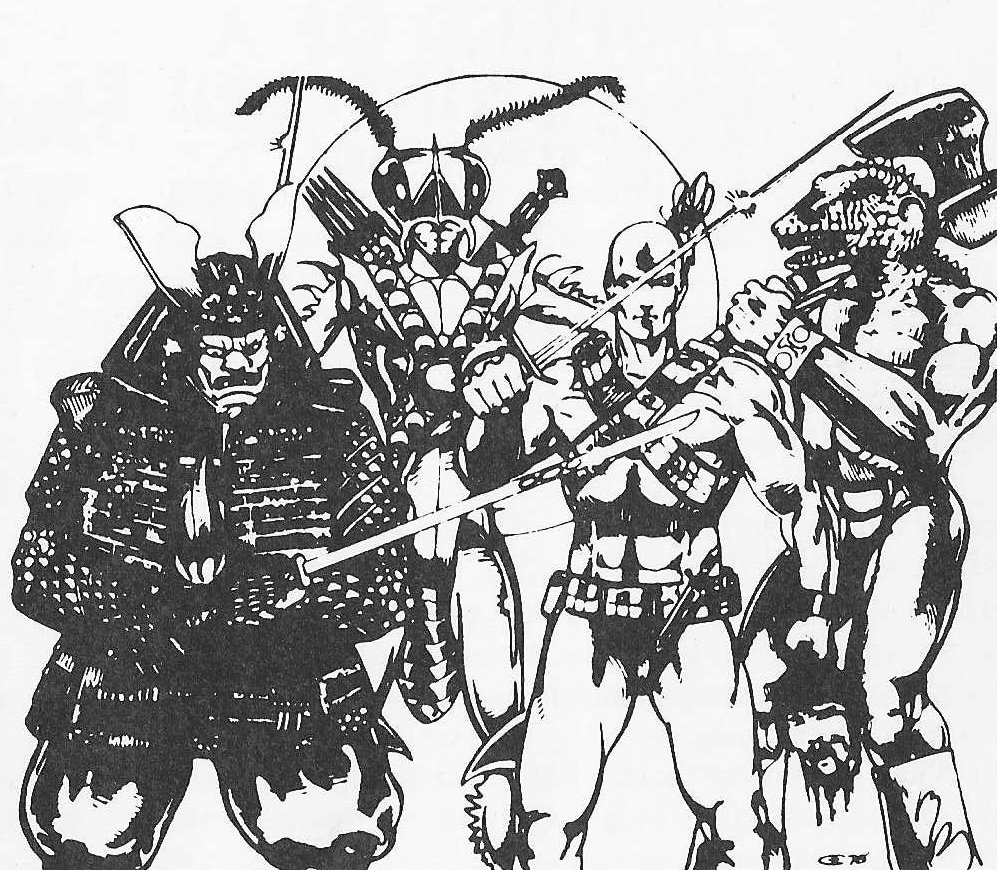
Perhaps the most distinctively Arduin creatures are Phraints – “Bright metallic blue or green, upright man-sized insect warriors.”  Hargrave explains, “They are cold and emotionless warriors with great intelligence who know no fear.”

Hargrave provides some interesting details about monsters of greater familiarity in contrast to standard D&D descriptions.  For instance, he points out that faeries “excel in vexing and pestering dogs and cats (the latter of which has been known to hunt them).”  Cats hunt faeries.  I like that idea.

In our world, a wraithe is a “coarse comb used on a form of warp-dressing or-beaming machine to keep the warp-threads apart.”  However, in Arduin, a wraithe is a wraith.  (I suppose that the 'E' is silent.)  Rather than drain experience levels, Arduin wraithes drain Constitution.  Lost Constitution can be regained at a rate of one point per week of immediate rest; not resting can result in permanent loss.

Giants “are probably the most common of all mythological monsters.”  Additionally, “They are not simply oversized humans, but are entirely different race descended from the Gods and Demi-gods of Old.”  ArdAdv indicates four types of giants but does not provide any specifics about the differences.  The types of giants are:  Desert (or Dune), Forest, Mountain (or Krag), and Sea.  Titans “are sometimes erroneously referred to as 'STORM GIANTS', but are a separate and distinct race.”  They “are wise, but cruel blue-skinned beings...” and they “live only in the far polar reaches or atop the highest mountains.”

Other monster details of interest:  “Usually,” zombies are “found in groups of 13 and 7 only.”  Giant scorpion venom “is fatal to all creatures of less than 51 HP.”  Trolls have “bat-wing like ears.”  Vampire Bats have a “15' wing span.”  Dragons have a number of Hit Points equal to three times their length in feet.

Sunday, November 22, 2015

Player Characters in The Arduin Adventure

Art by Ramon Naylor

The first step in creating a character for The Arduin Adventure is to choose a race.  Hargrave's Arduin offers a plethora of playable races; however, for The Arduin Adventure (hereinafter ArdAdv) he presents only six options.  The limited number of races is appropriate for an introductory game, yet it's still 50% more than the number of races in Basic D&D.  The races available in ArdAdv are:  Human, Amazon, Half Orc, Dwarf, Elf, and Hobbitt (usually – but not always – spelled thus with two 'T's).

Amazons are treated as a race distinct from Humans.  For instance, “...Amazons can see better in the dark than humans...”  In Arduin,
There are three distinct types of Amazon.  The most numerous are the sea going “Gypsy Corsairs” who use light leather armor and cutlasses as well as short bows.  The least numerous are a very dark complexioned and tall jungle-living kind who fight with no armor...The third kind...come from the loose coalition of City States known as “The Motherland.”
Amazon “culture stresses 'the warrior ethic'” so much so that hardly any Amazons “have done anything except become warriors.”  So who carries out the non-warrior functions in Amazon society?  Slaves?  Amazon 'men'?

With regard to Dwarves, there are “'Mountain' or 'Dark Dwarves' and the taller 'Stone Downers' or 'Common Dwarves.'”  The Elf types are High, Wood, and Sea.  Hobbitts “usually come in one of three types: the taller, darker 'Gravellers' – who are usually associated with a Stone Downer settlement, the more common 'Plow Foots' usually found in small farm oriented villages and lastly the small and secretive 'Street Wise' or city Hobbitts.”

After selecting a race, players determine character 'statistics' by rolling 1d20 for each statistic.  (Instead of 1d20, I would have had players use 2d10 so as to achieve a more 'realistic' bell curve.)  For statistics, ArdAdv has the usual six D&D attributes along with Agility and Ego.  Agility is “A character's ability to dodge, duck, move about on his feet, etc.” as opposed to Dexterity, which is “A character's ability to wield a weapon or use his hands.”  Ego “is the character's force of will and arrogance factor.”

Statistics are modified in accordance with the character's race.  Amazons allocate eight points between Constitution and Strength.  Dwarves allocate twelve points among Constitution, Strength, and Ego.  Elves distribute twelve points among Dexterity, Agility, Intelligence, and Charisma.  Half-Orcs allocate six points between Constitution and Strength but must remove a total of four points from Intelligence and Wisdom.  Hobbitts distribute eight points among Agility, Dexterity, and Charisma.  Lastly, Humans either add or subtract points – a 50% chance of either.  They add (or subtract) four points between any two statistics.  For any race, the minimum modification for any applicable statistic is one point.  For instance, an Elf must allocate at least one point to each of Dexterity, Agility, Intelligence, and Charisma.  For all characters, the minimum value for any statistic is 5 (except for Intelligence, which must be at least 10).  Also, the maximum value for statistics is 20.

ArdAdv offers the standard four classes – Warrior, Mage, Priest, and Thief – and also offers Forester.  Apparently, the classes are open to all races and there are no level limits.  Each class also adds one point to at least one statistic.
  • Warrior:  Strength and Constitution
  • Mage:  Intelligence and Ego
  • Priest:  Wisdom
  • Thief:  Dexterity and Agility
  • Forester:  Constitution and Agility
Each class offers certain abilities.  Mages and Priests can both cast spells; in addition, Mages can sense magical magikal things and Priests can sense evil.  (I suppose that good Priests sense evil while evil Priests sense good, but I could be wrong.)  Warriors have a “chance of detecting ambushes and avoiding 'surprise.'”  Thieves can hide “in darkness and shadows” while Foresters have a “chance of following any track or spoor.”

“Finally,” Hargrave explains, “each character is allowed one character quirk or special attribute if it is not too outrageous.”  Hargrave didn't see fit to include the Arduin special ability charts in ArdAdv, but he encourages players to use “imagination to make each character unique and different.”   He also suggests the Arduin Grimoire “for those who have difficulty” in this regard.  The sample character, Jothar, is a Human orphan raised by Elves.  So, he “knows a lot about elves and elven ways (a rare thing for humans).”  Jothar also has +2 with bows.

Sunday, November 15, 2015

An Introduction to the World of Adventure Gaming

Art by Brad “Morno” Schenk

With the exception of 'Inspiration' posts, this blog tends to examine role-playing games that are complete – or at least claim to be complete.  As such, your humble host has elected to focus on Dave Hargrave's The Arduin Adventure rather than his Arduin Trilogy since said trilogy was presented as supplementary material. Having 64 pages, The Arduin Adventure book was sold individually and as part of a boxed set that included character sheets, two sheets of “magikal” item cards, and a die with “a total of twenty (20) sides numbered zero through nine twice each number.”

In the detail of the cover image shown above, we see the subtitle An Introduction to Fantasy Role-Playing/Adventure Gaming and it is in this context that The Arduin Adventure stands out.  The Arduin Adventure (hereinafter ArdAdv) was published in 1980, one year before the release of the Moldvay edition of D&D.  So, the contemporaneous, equivalent product from TSR was the Holmes 'Blue Book'.  According to its preface, the Holmes edition was “aimed solely at introducing the reader to the concepts of fantasy role playing...”  In this regard, ArdAdv compares favorably and could arguably be considered superior.  Essentially, the Holmes edition is a 'starter' set:  “Players who desire to go beyond the basic game are directed to the ADVANCED DUNGEONS & DRAGONS books.”  Hargrave references other Arduin products as options but only as options; he emphasizes that players and Game Masters can rely upon imagination.  While the Holmes edition rules “allow only for the first three levels,” no experience level limits are presented in ArdAdv.

In fact, the experience system in ArdAdv does not involve charts or large numbers.
Each character will gain one experience level (EL) for each five adventures completed (through fourth level). Thereafter it takes 20 adventures to gain each additional EL.
It's certainly not detailed, but it's satisfactory for an introductory system.

For many role-playing games, the rules begin with character generation.  This is not so with The Arduin Adventure ; the first topic after the introduction is an explanation of the Game Master's responsibilities.  Hargrave makes three points:
1.  Know all of the rules you have all agreed upon (and have the rule book(s) handy to settle disputes).
2.  Have not only the desire, but also the time to give the creation of each game’s “script” the attention it needs. It will take a good GM at least one hour to ready a game for play properly (usually the night before).
3.  Have the trust and confidence of all of the players so that they will not argue with his decisions. This confidence can only be earned as the GM demonstrates his integrity and honesty during the games. If the players feel that they are being short-changed by a GM, the play will soon become bogged down in arguments and hurt feelings. So, a GM must always maintain a detached and impartial attitude towards every player and every player’s character no matter what the GM’s personal feelings are. A good GM sees only the game, not those who play within it.
On the following page Hargrave states, “A GM never tries to run the players' game, but only operates as a referee, acting out the parts of the monsters or other things or people the characters meet.”

Later in the rules, Hargrave announces that the Game Master is really “a STORY TELLER!”  Some 'old school' aficionados prefer to distance themselves from the notion of game-as-story.  Here's a quote from Gary Gygax:
The adventure is the thing, not "a story." If you want stories, go read a book, If you want derring-do, play a real RPG and then tell the story of the adventure you barely survived afterwards. The tale is one determined by the players' characters' actions, surely!
Evidently, Mr. Gygax felt that stories are not the focus of “a real RPG.”  My philosophy is that the play of any game is a story – chess, poker, hopscotch – any game.  Gygax uses the terms “the story of the adventure” and “The tale.”  So, obviously, there's a story involved even in “real” role-playing games.  If the adventure is distinct from the story, then the adventure is the medium in which the story forms.  It is probable that Gygax meant two things in his quote:  (1) that the adventure should shape the story and not vice versa and (2) players should not influence the outcome of the adventure except through the actions of their characters.  I am not adverse to either point but, ultimately, a role-playing game generates a story.  How the story manifests is a matter of play style.  In any event, the Game Master is the impetus of the story.  (Hence the Game Master is really “a STORY TELLER!”)  In short, if you're pretending to be an elf in a make-believe world of magic and dragons, you're a participant in a story making process.

Sunday, November 8, 2015

Take a Troll to Lunch


Before engaging upon an exploration of The Arduin Adventure, it is necessary to understand the beginnings of Arduin.

In 1977, prior to the release of the Advanced D&D books, Archive Miniatures published Dave Hargrave's The Arduin Grimoire.  This work was followed by several other volumes and adventures, but those later books are not the subject of this post.  In the “Forward,” Hargrave presented the book as an amateur effort with no intention “to replace or denigrate any other fantasy role playing supplement or game, either professional or amateur.”  There was an unstated presumption that the Grimoire required the Dungeons & Dragons rules as a foundation.  In terms of appearance, the Grimoire was quite amateurish and doubtless was a seminal influence on the ambiance of Encounter Critical.  However, to its credit, the Grimoire featured the early artwork of Erol Otus.

As a supplement, The Arduin Grimoire included new classes, new spells, new magic items, new player character races, new monsters, and an assortment of other new rules.  The advertisement reproduced below appeared in issue #6 of The Dragon (April 1977).  Counting its covers, the Grimoire indeed spanned one hundred pages.  There was something on every page, even if only artwork, but we must indulge “jam-packed” as an article of hyperbole.  In your humble host's salad days, photocopies of the special abilities charts and the critical and fumble tables made the rounds and were accorded “official” status without quite knowing their provenance.  The special abilities charts had titles like “Special Abilities Chart for Thieves, Monks, Ninja, Highwaymen, Corsairs, Assassins, Traders, Slavers, and All of Those with a More or Less "Secret" Nature” and included results such as “+1 to all character attributes but –2 versus all magic (even clerical)” and “Woodsman, +1 dexterity, +3 with all missile weapons, hide like angels.”  The critical table included effects like “Forehead...Gashed, blood in eyes, can't see” and the fumble table had results like “twist ankle...lose first attack, and one half of agility/5 min.”

The Arduin oeuvre is unabashedly 'gonzo'.  One of Hargrave's goals was to provide options and inspiration beyond the standard “Tolkeinian” [sic] paradigm.  In a section of the Grimoire titled “Notes on Player Character Types,” Hargrave lectured readers about limiting themselves to “classical” character tropes:
Never will you hear the complaints of Brownie infantry squad as they whine about that stupid half-ogres cheshire cat that keeps looking at them and licking his chops.  And never is such a lonely word.  Don't be lonely, take a troll to lunch.  The world is a small place but is even smaller still in relationship to the myriad worlds of the entire Alternity (alternate eternities).  Do not be a small player from a small world, embrace the whole Alternity and give the different types a chance.  I think you will find that the world your game is in will become a lot more fun if you do.


Sunday, January 20, 2013

Greystar's Take on Experience and Combat

copyright 1984 by V Autumn, S Scherf, and K Autumn

Chapters III and IV of Scherf and Autumn's The Complete Works of Zorin Greystar - Book One regard 'Experience' and 'Combat.'  Although 'Experience' is the third chapter and appears before the fourth chapter, 'Combat,' page 40 reads “CHAPTER IV - Experience” and page 52 reads “CHAPTER III - Combat.”  Both chapters are 'narrated' by Lord Toran of the Dragonsback Mountains; however, Zorin chimes in occasionally via means of a 'Time Stop' spell (much to Toran's chagrin).

In the Greystar system, player characters start at “zero-th” level.  They have the same hit points as a first level character, but their capabilities are diminished:  they attack and save as 0 level fighters.  “Thief and assassin character types subtract 10% from all ability percentages.”  There is a 50% chance for successful spellcasting; this chance increases by 1% for each experience point gained, up to a maximum of 95%.

Regarding experience, each character class has a 'constant.'  Thieves have the lowest constant at 90 while mages have the highest at 150; this represents the amount of experience a character needs to rise to first level.  This constant is also used in calculating experience necessary to reach higher levels.  A mage needs 450 experience to attain level two, 900 experience to reach level three, 1,500 for level four, etc.

It may not seem that much experience is needed to gain levels, but experience is awarded differently using the Greystar way.  Characters receive one point per level/hit die of a defeated opponent, with up to double that amount depending on the effectiveness of the opponent's “abilities.”  Experience gained via combat is not divided among a party; each participating character receives the full amount.  'Participating' means “endangered by or interacting with the enemy.”  If a defeated opponent has “exceptional abilities” and has level/hit dice exceeds a participating character's level by at least ten, that character receives additional experience.  The amount of additional experience is based, in part, on which “abilities” the opponent possessed.  Experience is also awarded when a character uses class abilities (e.g., spellcasting, thief skills) either “in combat or in a non-repetitive fashion.”  Characters do not receive experience for obtaining treasure.

Speaking of combat, Toran explains that two 20-sided dice should be used when attempting to strike an opponent.  One die is used in the usual way to determine hit or miss; this is called the 'hit die.'  (This could lead to confusion, I would have called it the 'strike die.')  The second die is called the 'luck die.'  If the result of the luck die is '20' and a successful hit is indicated on the hit die, an 'exceptional hit' occurs.  If the result of the luck die is '01' and the hit die indicates a miss, a 'fumble' may occur.  There is a percentage chance equal to the character's level “of turning a fumble into an ordinary miss.”

In the event of a fumble, a d% roll is made on 'Fumble Chart A'; the result indicates the type of fumble and which of seven other fumble charts to consult.  For instance, a result of 56 – 70 states, “Weapon entangled, roll on Chart E.”  Chart E requires fumblers to make a dexterity roll; failure produces results like “knock shield from grasp” or “trip self.”

With a critical an exceptional hit,body placement is determined; the hit could land on the arms, head, legs, or torso.  (There are modifiers for targeting a particular area, but only an exceptional hit grants exceptional effects.)  Each area has its own table which is further divided into sub-areas.  For instance, with 'Arms' the sub-areas are:  arm (general), elbow, forearm, hand, and upper arm.  Most sub-areas have their own table; regardless, the effects are à la Hargrave.  (Yes, “buttock removed” is a possibility:  3-18 damage, unconscious for 1-3 turns, movement slowed to 30% normal rate.)

There are also rules on weapon breakage, which can occur as a fumble result “or if a weapon is struck against a hard object (of armor class 3 or better) with combat force (when an 18 or greater is rolled on the luck die).”  The chance of breaking is expressed as a percentage chance determined by a complex formula (or by consulting the Weapon Breakage Chart).  Whether using chart or formula, it is necessary to know the “weapon substance constant,” which can vary from 0 (stone) to 16 (adamantine steel).  Armor can also be damaged (due to falls, severe blows, etc.) and armor class thus worsened.

copyright 1984 by V Autumn, S Scherf, and K Autumn