 |
Islandia; Abraham Ortelius, circa 1590
|
Here we have a map of Iceland created by Abraham Ortelius in the tail end of the sixteenth century. More information than you could possibly want about this map is available here. Ortelius displays various nautical features – most of them 'sea monsters' – and labels each with a letter of the alphabet, 'A' through 'Q' (excluding 'J'). The reverse of the map provides information regarding each of the entities so labelled. In the descriptions below, italicized text represents a direct quote from Ortelius' material; everything else is my commentary. For terms of measurement, it is assumed that one 'cubit' is equivalent to 18 inches while one 'ell' equals 4 feet.

A. NAHUAL – If any man eat of this fish, he dieth presently. It has a tooth projecting ten-and-a-half feet out from its head. This tooth has the same anti-poison properties as the Unicorn's horn. This monster is 160 feet in length. We know this creature as the narwhal; however, narwhals do not grow to such lengths, their teeth do not possess any unusual properties, and consumption of its flesh is not typically fatal.

A. NAHUAL – If any man eat of this fish, he dieth presently. It has a tooth projecting ten-and-a-half feet out from its head. This tooth has the same anti-poison properties as the Unicorn's horn. This monster is 160 feet in length. We know this creature as the narwhal; however, narwhals do not grow to such lengths, their teeth do not possess any unusual properties, and consumption of its flesh is not typically fatal.

B. ROIDER – This is a fish 520 feet in length, which hath no teeth. The flesh of it is very good meat, wholesome and toothsome. The fatte of it is good against many diseases.

C. BURCHVALUR – This creature hath his head bigger than all the body beside. It hath many very strong teeth, whereof they make Chesmen or Tablemen. It is ninety feet long.
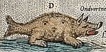
D. HYENA or SEA HOGGE – Ortelius refers us to Olaus Magnus for information. According to Olaus, this monster has “four feet like a Dragons, two eyes on both sides of his Loyns, and a third in his belly inkling toward his navel.”

E. ZIPHIUS (perhaps XIPHIUS, the sword fish) – This is an horrible sea monster, swallowing the blacke seale at one bitte. Rather than the swordfish, science equates this 'monster' with Cuvier's beaked whale.

F. ENGLISH WHALE – It is 120 feet long. It hath no teeth, but the tongue of it is 28 feet in length.

G. HROSHUALUR or SEA-HORSE – It often doth the fishermen great hurt and skare.

H. WHALE – Specifically, the greatest kind of Whales, which seldome sheweth it selfe. When it does appear, it seems more like a small island than a fish. It cannot follow or chase the smaller fishes, by reason of the huge greatnesse and waigth of his body. Nonetheless, it is able to catch fish and sustain itself by a naturall wile and subtilty.

I. SKAUTUHVALUR – This fish is somewhat like a ray or skaite but an infinite deale bigger; it seems like an island when it appears and it overturns ships and boats with its massive fins. It is altogether full of gristles or bones.

K. SEENAUT or SEA-COW – These gray creatures sometimes leave the water and feed on the land as a herd. They are able to live in the water by virtue of a little bagge hanging at their nose. Should this bag break, they live upon the land as other cattle.

L. STEIPEREIDUR – A most gentle and tame kind of whale; which for the defence of the fishermen fighteth against other Whales. It is forbidden by Proclamation that no man may kill or hurt this sort of Whale. It has a length of at least 150 feet.

M. STAUKUL or SPRINGUAL – It is so called of leaping or skipping. It is a very dangerous enemy to seamen and fishers; and greedily seeketh after mans flesh. It has been known to stand all day upright upon its tail for reasons not established.

N. ROSTUNGER or ROSMAR – This creature is somewhat like a sea-calfe. It walks on the sea bottom with its four, short feet. His skinne may scarcely be pearced with any weapon. It sleeps for twelve hours at a time in a curious fashion – hanging by his two long teeth from a rock or cliff. These teeth are at least four feet long, but the length of his whole body is 56 feet. Rostungur is Icelandic for walrus.

O. HUALAMBUR or SPERMACETI PARMACITTY – This is a semiliquid, waxy substance found in the heads of Sperm Whales. It was much sought after by whalers.

P. TREES – These are tree trunks which have been pulled up from Norway by force of winde and violent tempest. After being tossed to and fro and passing through many stormes, they are eventually cast upon the Icelandic shore.

Q. ICE – Great heaps of ice brought hither with the tide from the frozen sea, making a great and terrible noise; some pieces of which oft times are sixty feet. In some places white beares do fitte closely, watching the silly fish which heere about do play...


