Showing posts with label James Bond. Show all posts

Sunday, November 5, 2017

The Ultimate Role-Playing Game . . .

Art by Dave Billman
a game of science, fantasy, science fiction and high adventure that explores the farthest reaches of your imagination!  Splendid adventures take place throughout time, space and other dimensions.
So reads the first portion of copy from the back of the Lords of Creation boxed set.  The first sentence of the Introduction further states, “LORDS OF CREATION is a role-playing game of science fantasy, fantasy, science fiction and high adventure...”  The difference is the mention of 'science fantasy'.  Lawrence Schick, in his 1991 Heroic Worlds, categorizes Lords of Creation as a Science Fantasy game – along with such games as Gamma World and Space: 1889.  The back-of-the-box copy continues:
LORDS OF CREATION allows unlimited voyages via your imagination through time and beyond worldly dimensions.  Journey into magical realms ruled by swords and sorcery . . . battle bizarre aliens and killer robots on mysterious planets in distant galaxies . . . venture into the worlds of mystery, horror and wonder hidden beneath the surface of the present everyday world.  Experience thrilling adventures as you become a valiant and courageous hero!
Lords of Creation, published by Avalon Hill in 1983, was written by Tom Moldvay.  Since this is Moldvay's birthday, it is appropriate to begin our exploration of the game.  Moldvay contributed an essay to Heroic Worlds explaining Lords of Creation.  Not surprisingly, Moldvay and his friends were enthralled by “Original D&D.”  According to Moldvay:
...we had played every twist and variation D&D could offer.  We wanted more.  We experimented with extra rules; we tried to expand to other genres.  After a while it became obvious you can only stretch the D&D rules so far before they snapped.  So I made up a set of rules to suit our needs.
Much like a universal system, Moldvay's rules had to accommodate the possibilities inherent in essentially every role-playing game genre.  Yet Moldvay did not offer Lords of Creation as a universal system; instead, he intended a genre-mixed campaign arc with a definite end game. 
          The idea was to have characters start in a familiar setting – that of our own time and place.  They would begin as “ordinary” people; strange things start to happen to them; they undergo unusual adventures.  Gradually, the characters find that there are realities other than their own.  The characters discover they have innate powers they could once only dream of.  As they gain experience their adventures become more bizarre.  They travel throughout time and to far-flung planets.  They burst the bounds of normal time and space and journey to otherworldly dimensions and universes with unique physical laws.
          The Lords of Creation who give the game its name are extremely powerful individuals who can build whole new worlds and design dimensions with differing physical laws.  Yet all of them were once “normal” people, like the player characters.  If a character survives long enough, he or she becomes one of the Lords of Creation and learns how to build new worlds.
Page 43 of the Rule Book states, “New GMs should first run the adventure included in this game, THE HORN OF ROLAND.”  Unfortunately, The Horn of Roland was sold as an “expansion module” and not included in the Lords of Creation boxed set.  While the Rule Book provides ample advice on creating adventures, Lords of Creation suffers from not providing an introductory adventure to enlighten the Game Master (and players) as to Moldvay's vision and how the characters fit into the super-setting.

The contents of the boxed set included a Rule Book and a Book of Foes – both 64-pages and both with paper covers.  Also included were 1d6, 1d10, and 1d20.  Contemporaneously with selling Lords of Creation, Avalon Hill was also selling James Bond 007.  The soft cover, 160-page James Bond Basic Rules sold at $9.95; the boxed set, which also included character sheets and dice, sold at $12.95.  Although The Horn of Roland has 52 pages and includes play aids in its boxed set, a different introductory adventure could have – and should have – been included with Lords of Creation.  In fact, the Rule Book could have been 48 pages and the campaign material otherwise in the Rule Book included in a 48 page Campaign Book with an introductory adventure.  A 48-page Rule Book, a 48-page Campaign Book, and a 64-page Book of Foes together equal the total page count of the James Bond Basic Rules; Lords of Creation could have been packaged similarly to James Bond 007.

Moldvay also stated in his Heroic Worlds essay, “Sources of inspiration can often reveal more about a game than a long explanation.”  In this regard, Modvay listed the main inspirations for the game:
(1) mythology, legends, and folklore in general;
(2) an unpublished novel [Moldvay] wrote entitled Tom of Bedlam;
(3) the science-fantasy works of Philip José Farmer (the “World of Tiers” and “Riverworld” series) and Roger Zelazny (the “Amber” series, Jack of Shadows, Lord of Light, etc.);
(4) Dr. Who, The Twilight Zone, The Outer Limits, and The Avengers;
(5) science-fiction stories and novels in general, especially the “classic” SF of 1946 to 1959; and
(6) supernatural horror stories, particularly the kind written for the famous Weird Tales magazine.
Sadly, this 'Appendix N' for Lords of Creation was not included with the game.  By the way, why list as inspiration an unpublished novel you wrote?  If you're trying to inform people, listing something that cannot be referenced is pointless.  Was there any external inspiration for the novel that did not also inspire the game?

Also on the back of the box are the following claims:
  • A combat system including 53 different types of weapons ranging from swords and spears to proton beamers and blasters.
  • More than 450 foes to challenge the most daring of role-players.
  • 100 different non-combat skills and 53 combat skills that characters can learn as they gain experience.
  • 60 different powers that characters can gradually gain.
These claims are essentially true.  There are 53 weapon types, each associated with a combat skill.  The Book of Foes details more than 450 foes if we break down the concept of 'foes' so that orc (average), orc (soldier), and orc (leader) count as three foes.  Also among the foes are famous individuals (such as Marco Polo) and deities (such as Freyja).  I am uncertain as to whether Marco Polo can reasonably be categorized as a foe.  Technically, there are twenty non-combat skills, but each skill has five levels and each level confers a different talent.  For instance, the five levels of 'bureaucracy' are:  Record Keeping, Record Tracking, Bribery, Infiltration, and Futuristic/Magical.  (Most skills have a Futuristic/Magical level.)  Finally, there are twelve power categories. Each category has five powers and these powers must be acquired in ascending order.  For instance, the five Sorcerer powers are (from least to most powerful):  True Sight, Fascination, Illusion, Enchanted Sleep, and Animation.

Sunday, June 11, 2017

Taxidermy, Tarot, and Tattoos


Among the various categories detailed in Citybook I:  Butcher, Baker, Candlestick Maker, the vague grouping of 'Personal Services' offers some of the more interesting establishments.  As examples, consider the following three businesses.

– – –     – – –     – – –

The entry for Professor Fyber's Taxidermy and Museum is credited to Steven S. Crompton, to whom we were introduced in the last post.  (The 'museum' section is displayed above.)
The Museum houses a collection of oddities that the Professor has stuffed over the years.  This includes a two-headed unicorn [Wouldn't that mean it has two horns?], a bison with wings [i.e., a 'flying buffalo'], a wolf with eight legs, and other freaks of nature.  One section also contains several heads which once belonged to famous bandits that were executed in the city (the only exceptions to Fyber's no-humans rule)...
Your humble host suspects Fyber's name was inspired by (the abominable) Dr. Phibes of motion picture infamy.  Yet, if so, Liz Danforth did not use Vincent Price as the model for Fyber's illustration.

Art by Liz Danforth
     Professor FyberHuman.  Ht: 6'3".  Wt: 210 lbs.  Age: 58.  Fighting prowess: very good rapier or saber; otherwise average.
     Professor Fyber is a dark, aristocratic man with a thin moustache.  His dress and voice bespeak a highly cultured man with a sense for the finer things in life.  He is a gourmet cook, a lover of good brandy, and very well-read.
     ...Fyber is a charming fellow and fairly formidable.  He is also a taxidermical genius and very popular with the City nobility to whom he provides trophies.  He zealously guards his secret formulas for preserving tissue, and is not above slaying an intruder who tries to steal them.  His major goal in his work is to preserve the semblance of life in as natural a manner as possible...
Of course, Fyber must obtain his specimens somehow.  The player characters may be retained to search out these strange creatures.  “The hunting expeditions can make a simple scenario for players,” Citybook informs us, “and good mileage can be gotten out of any of the Museum exhibits.”  One suggested scenario involves a vast treasure, the secret to which is contained within one of the bandit heads on display.  The player characters “must steal the head and find a way to revivify it in order to get the clue.”

 – – –     – – –     – – –

Thelesha Moonscry is a fortune-teller – or “seeress” – whose presence in Citybook is attributed to Larry DiTillio.  Given Liz Danforth's penchant for basing the appearance of Citybook personalities upon real-world celebrities, I am inclined to believe that Moonscry's depiction is inspired by Jane Seymour in her role as the fortune-telling Solitaire from Live and Let Die.

Art by Liz Danforth
     Thelesha MoonscryHalf-elf.  Ht: 5'9".  Wt: 130 lbs.  Age: 29.  Fighting ability: poor.  Magic ability: average; C5
     Thelesha has very pale skin, and long black hair with silver streaks in it.  Her left eye is sea-blue and her right eye is silvery-gray.  She is very beautiful and somewhat haunted.  Her typical attire is a sky blue robe adorned with a sigil showing silver moons and green oaks.
     Thelesha is not particularly cheerful.  She knows that she is fated to live without love, and uses her gift in memory of her teachers, an all but extinct sect called the MoonRiders.  She sometimes sees her talent as more of a curse than a gift, and may break off a reading if the omens she is scrying become too painful.  She rarely leaves her house and garden, and the MoonRider spirits watch over her there.
“C5” is Citybook code for communication magic.  I would have thought that divination would be part of clairvoyant magic (i.e, “C3”).  Regardless, Moonscry practices the following divinatory arts:  astrology, oneiromancy, pyromancy, hydroscopy, palmistry, cerescopy [sic], and cartomancy.  With regard to cartomancy, the Game Master is encouraged to “use a Tarot deck if you have one, improvising the meaning of the cards to fit the 'prediction' for the character.”  Otherwise, “You may use a regular card deck in this fashion:  Hearts indicate an emotional situation, Diamonds mean money, Spades mean competition, Clubs indicate magic [and] Face cards represent people.”

We are told that “Thelesha is about 90% accurate in all readings.”  As such, Game Masters are advised not to let Thelesha “be misused or over-used by the players.”  As a deterrent, “High prices should sufficiently limit the use of her powers!”  Also, readings need not be precise – “the more esoteric the symbolic answer, the more intriguing it will be to players.”

 – – –     – – –     – – –

Jock and Wilbur Sleaz are twin orcs who were raised by a kindly wizard who taught them how to make tattoos.  “(GM: if your system has no Orcs, or an Orc would not reasonably fit in your city, make Jock and Wilbur very ugly humans.)”  While Wilbur “quite frequently exhibits more of the standard Orcish traits,” we learn that “Jock is a very gentle soul” who gives money “to a local orphanage in order to give a few orphans the benefit of a better upbringing than he received.”  It seems to me that being raised by a kindly wizard who teaches them a trade is not so bad as an upbringing.

Anyway, the brothers employ their skills at a tattoo parlor of which they are the proprietors.  In addition to 'regular' tattoos, Jock (but not Wilbur) learned to create 'magical' tattoos (called “mattoos”).  By concentrating, the wearer of a mattoo can bring the mattoo into existence.
Once a mattoo comes to life, it will follow any command of the wearer (if it's a creature), or be employed in any manner the user wishes.  For each hour it exists, the wearer must pump strength into it, on an ever expanding scale.  The first hour costs 1 point; the second, 2; the third, 4; the fourth, 8; etc. (doubling each time).  Willing a mattoo to life for less than an hour costs 1.  The strength used returns at 1 point per full game turn.  (GM:  adjust to your game system.)
The price of a mattoo “starts at around 1000 gold pieces, rising with the complexity of the mattoo desired.”  Mattoos which are destroyed are no long usable, leave a scar, and cannot be replaced.

Jock himself has the maximum of five mattoos, created by the kindly wizard.  These mattoos are “two small dragons, a full-size flaming sword down his right leg, a waterfall on his chest (which can be used somewhat like a firehose), and a full-size rose on his left arm.”

A special mattoo is described:
Very simply, it is a “duckie”, a cute little representation of a duck.  Jock always recommends it because he likes duckies.  The duckie is like a normal mattoo – except that it always appears as a full-sized duck with full powers of speech, better than human intelligence, and a poisonous bite!  In addition, duckies have the power to deflect spells (set the level according to your game system); if a duckie is within a 5' radius of its wearer, it will partly protect its wearer by absorbing the spell.  Neither Jock nor Wilbur are aware of these powers – Jock just likes duckies!

Sunday, September 4, 2016

Gambling in James Bond 007


Bond (Barry Nelson, left) faces off against Le Chiffre (Peter Lorre, right)
in the first filmed depiction of James Bond
Casinos play an important part in the Bond mythos.  It is often the place where characters first encounter Major Villains and test their mettle, where contacts are made, or where they go to relax and have a good time.
Chapter 7 of the James Bond 007 role-playing game is devoted to “Gambling and Casino Life.”  On page 37, the Gambling skill is described as follows:  “These tasks allow characters to play casino games, but without the players actually needing cards, roulette wheels, and the other paraphernalia of casinos.”  Specifically, casino games are resolved using die rolls – usually, Gambling skill rolls.  The Gambling skill is based on the Perception characteristic; therefore, a character without any skill levels in gambling will use his (or her) Perception for the Primary Chance of a gambling task, but with a -3 Ease Factor modifier.

James Bond 007 does not provide the rules of the actual games, even though “the GM is expected to have a good working knowledge of the actual game in addition to the rules of the role playing version.”

Card games are presented as contests between two characters (or among multiple characters).  The rules recommend the die rolls be refereed by someone whose character is not taking part in the gambling event.  If player characters are gambling against player characters, the GM can be the referee.  In the more frequent circumstance of player characters gambling against non-player characters, the GM must control any non-player character, of course; the task of referee is left to a player without a gambling character.  The point is that – if at all possible – participants make their die rolls in secret from one another.  This means that “the betting is done without foreknowledge of the other players' hands.”

A die roll (i.e., Gambling skill at an Ease Factor of 5) is made for each character participating in a given card game.  This result of this roll represents the hand dealt to the character.  In terms of RPG mechanics, the roll is either a failure or has a Quality Rating of one through four; 'one' being the best possible result.  Even if the roll failed, “The player then has the option to roll a second time (simulating the draw, an extra card, and so on), which may or may not improve the hand.”  (The second roll is also made at an Ease Factor of 5.)  With two rolls, the appropriate table must be consulted, “cross-referencing the new dice result with the first to obtain the final Quality Rating.”

Here is the table for poker:
So, if the Quality Rating of the first result is 4 and the Quality Rating of the second result is 2, the final hand has a Quality Rating of 3.  The character with the best Quality Rating wins.  The rules state that “for a Quality Rating of 4, the hand would have been a pair, two pair, or three of a kind; for a Quality Rating of 3, either a straight or a flush; for a Quality Rating of 2, either a full house or four of a kind; for a Quality Rating of 1, a straight flush; and for a Quality Rating of 1+, a royal flush.”

In the event of a tie, the character with the higher Gambling Skill Level wins.  If tied characters have the same Gambling Skill Level, the character with the higher Fame Point total wins.   If the tie still remains unresolved, “the character with the higher Perception” prevails.  The more 'famous' you are, the more likely ties will resolve in your favor.

Of course, Bond's game is baccarat, specifically chemin de fer.  Here is the chemin de fer table:
A Quality Rating of 1 for the first roll indicates “a natural 8 or 9” with no need for a second roll.  It's impossible to improve a first result Quality Rating of 2, so there's no point in trying.  An ultimate Quality Rating of 2 means “a value of 7 or a three-card 8 or 9.”  A Quality Rating of 3 means “a value of 4, 5, or 6.” Quality Rating 4, “a value of 1, 2, or 3” and Failure, “a value of 0.”

Player Characters are allowed to spend Hero Points to improve Quality Ratings.  Chapter 7 does not disclose how a player should inform the referee that he (or she) is using Hero Points without alerting the players of other gamblers.  Perhaps the player can position an unused die to display the number of Hero Points (if any).

“A Player Character may never cheat,” the rules explain, “unless he has detected another NPC cheating.”  If a character suspects that an NPC is cheating, a Perception roll is made for the suspecting character at an Ease Factor derived from the cheater's Gambling Skill Level.  (For example, a Skill Level of 1 means an Ease Factor of 5 while a Skill Level of 10 imposes an Ease Factor of 2.)  Of course, this assumes there is cheating; if there is no cheating, the result of the Perception roll is irrelevant.  If there is cheating – and the player character detects it – the observing character “may confront [the cheater] with it or cheat back.”  In terms of game mechanics, how is cheating accomplished?  The player (or the GM) simply lies about the Quality Rating of his (or her) rolls.  This is why an indifferent referee is necessary.

In addition to card games, Chapter 7 discusses roulette even though “Roulette is a game that does not often appear in Bond's world; he distains (sic) it because of the lack of skill involved.”  Here is the table for roulette:
Each player chooses one of the listed bets for the spin.  There is a Winning Chance listed with each bet; each character's Skill Level is added to the Winning Chance for his bet, and the GM rolls a D100.  If the result is less than or equal to a character's Winning Chance, the character wins and is paid off at the listed odds.  The odds listed...are for tables with a single-zero (0).  For tables with a double-zero (00), decrease the Winning Chance by one.

Sunday, August 28, 2016

Guest Stars in James Bond 007

George Lazenby (as "J.B.") breaking the fourth wall in
The Return of the Man from U.N.C.L.E.

“How to Be a Successful Gamesmaster,” Chapter 12 of James Bond 007, provides comments on 'guest stars'.  Specifically, on page 96:
Surprise guest stars from the Bond movies are quite entertaining. Having Sheriff J. W. Pepper of Live and Let Die and The Man With the Golden Gun show up unexpectedly can give players a lift. Sometimes a guest appearance by other fictional heroes – Napoleon Solo, John Steed, or Emma Peel, for example – can get a good response.
The game, however, does not provide write-ups for characters not part of the Bond license.  Gamesmasters considering using such guest stars are left to their own devices.  Yet the 'guest star' concept was not original to James Bond 007.  “The Super Spies,” an article featured in Dragon #44 (December, 1980), describes various fictional spies in terms of the Top Secret role-playing game.  The article was written by Allen Hammack, “Developer & editor of Top Secret,” along with Merle Rasmussen, “author of Top Secret.”  Incidentally, the article adopts the conceit that the referenced spies are real:  “Strangely enough, many of these actual secret agents have been publicly revealed in books, movies, and on television, but this does not seem to have hampered their effectiveness.”

Converting from the Hammack/Rasmussen data to James Bond 007 is not without difficulty.  The Top Secret Primary Personal Traits are Physical Strength, Charm, Willpower, Courage, Knowledge, and Coordination while the James Bond 007 characteristics are Strength, Dexterity, Willpower, Perception, and Intelligence.  There is no Top Secret rating that equates to 'perception'.  Also, there is no James Bond 007 characteristic that represents 'charm'; however, all James Bond 007 characters have the Charisma skill.  Comparing the Hammack/Rasmussen James Bond to the James Bond 007 James Bond, I derived the following formulae:
  • STRENGTH = (Physical Strength / 12), round up
  • DEXTERITY = (Coordination / 13)
  • WILLPOWER = ([Willpower + Courage] / 20), round down
  • PERCEPTION = ([Courage + Knowledge] / 20)
  • INTELLIGENCE = (Knowledge / 11), round up
  • % of maximum Charisma Skill Levels = (Charm / 1.6)
Hammack and Rasmussen opted not to include bureau classification (i.e., character class) and level with their descriptions; nor did they include “Areas of Knowledge.”  Other than the differences between the Top Secret and James Bond 007 game systems, representing non-Bond characters in James Bond 007 terms can be problematic.  James Bond 007 was designed to capture the James Bond oeuvre – which it does well – as opposed to being generic in scope.  Because of this, the rules may not be able to adequately accommodate characters from other franchises having differing types of missions and levels of realism.  Page 93 explains:
Bond adventures are exciting, glamorous and sophisticated.  They are not the textbook adventures of John LeCarre, or the complex psychological manipu- lations of a Mission: Impossible, or the gritty double and triple-crosses of Robert Ludlum.  The James Bond 007 Game is not designed to cover all subsets of the spy genre, and you will have to experiment with the rules to make them work in other subgenres.
Given these caveats and without further ado, your humble host presents:


Sunday, August 21, 2016

Experience and Equipment in James Bond 007

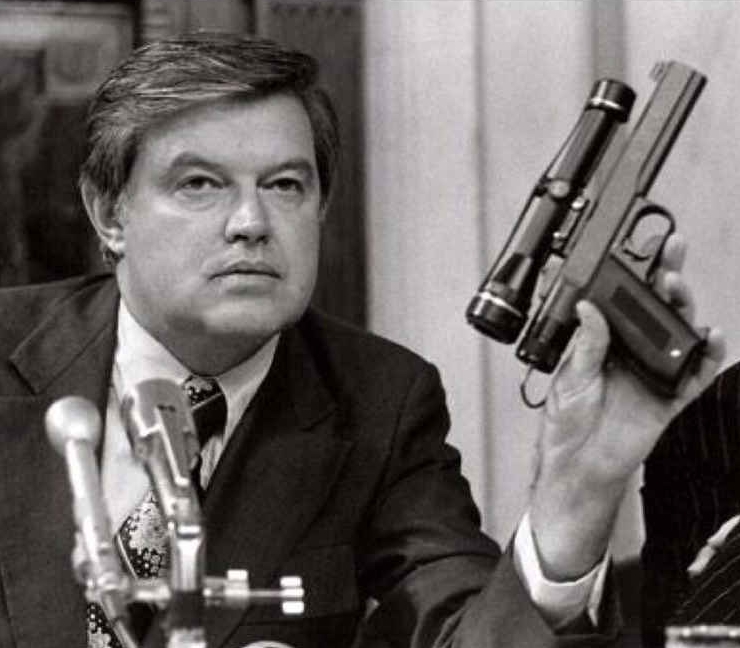
Senator Frank Church brandishes the CIA's dart pistol

At the end of every game session, a James Bond 007 Gamesmaster awards Experience Points to the player characters.  The default amount per character per session is five hundred points.  Characters of players who role-played well receive an award modifier of “up to ×1½.”  Characters of players who role-played poorly are penalized with an award modifier of “down to ×½.”  The rules advise new GMs:  “Until you are experienced as a GM and can tell good role-play from poor, you should not modify Experience Points for role-play.”  Should a mission conclude during a session, the Experience Point award is modified by ×2 if the mission “was a success” or by ×¼ if it “was a failure.”  Characters of “Rookie” rank have a ×¾ award modifier while “00” rank characters have a ×2 modifier.

With regard to character generation, Rookie rank characters are created with three thousand Generation Points, Agent rank characters with six thousand points, and “00” rank characters, nine thousand points.  After generation, the total of a character's characteristic values and skill levels establishes rank.  Although the rules state that a Rookie's combined total of values and skill levels is “Less than 125,” I'm certain that “125 or fewer” is intended.  Agent rank characters have from 126 to 250 total values and skill levels while “00” rank characters have more than 250.

Experience Points can be used to improve a character.  The amount of Experience Points necessary to acquire a new skill is the same as buying skills with Generation Points (i.e., 100).  However, a skill level costs 30 Experience Points as opposed to 20 Generation Points.  When creating a character, the 'Characteristic Value Expenditure Chart' is consulted to determine characteristics' cost in Generation Points.  When improving a characteristic value with Experience Points, the cost of the next value increment equals the new value multiplied by 150.  For example, raising a characteristic from 12 to 13 costs 1,950 Experience Points.

In addition, Experience Points can be used to 'remove' Fame Points.  Characters accrue Fame Points through various means:  killing a person (5 points), killing a Privileged Henchman (10 points), killing a Major Villain (20 points), gaining “00” rank (20 points), for “each distinctive visible scar” (20 points), and for each mission completed – either successfully or unsuccessfully (3 points).  Fame Points measure how easily “enemy organizations” recognize the character and how much information such organizations have about the character.  Aspects such as height, weight, and appearance impose Fame Points to the extent such aspects of a character vary from “normal.”  Each Fame Point removed costs one hundred Experience Points.

Although the rules do not address the possibility, if Experience Points can 'buy back' Fame Points, it seems feasible that Experience Points could be used to buy away Weaknesses.

Finally, “Experience Points may also be used to acquire equipment from Q Branch.”  It is for this reason your humble host feels comfortable with combining experience and equipment in the same post.  “Standard” equipment does not cost Experience Points, neither does equipment assigned to the characters.  With regard to assigning equipment to characters, the rules advise the GM, “you should choose equipment for the characters so that it will relate in some way to the mission.”  That advice is immediately followed by the statement, “It may even act as a clue for the sharp-minded.”  This is an interesting reference to meta- gaming.

Experience is spent only for equipment that a character specifically requests from Q Branch.  However, before a character can obtain special equipment, he or she “will have to make a successful Persuasion attempt on Q first.”  Multiple characters can pool their experience points for purposes of obtaining equipment.  A “personal item” of equipment costs 200 Experience Points.  A large item (such as a vehicle) costs 500 points.  A “modified” large item costs 700 points, plus 50 points per modification.  Thus, an Aston Martin with an ejection seat and a smoke screen would be 800 points.  Equipment acquired with Experience Points must be returned (if it still exists) at the conclusion of the mission, so it doesn't count as a career investment.

Victory Games produced a Q Manual supplement for the James Bond 007 game, detailing various items from the movie series as well as original items.  The Basic Game includes descriptions of real world weapons and vehicles, as well as “mundane” equipment such as scuba gear, night-vision goggles, and silencers.  Some movie items (like the cigarette rocket from You Only Live Twice and the attaché case from From Russia With Love) are also described in the Basic Game.  Yet, like Mark Twain said, “Truth is stranger than fiction.”

In 1975, several CIA officials testified before the United States Senate Select Committee to Study Governmental Operations with Respect to Intelligence Activities.  (Someone must have been paid by the word.)  As a result, some items of CIA 'equipment' became publicly known.  In a vault with “a stock of various materials and delivery systems accumulated over the years, including...lethal materials, incapacitants, narcotics, hallucinogenic drugs, irritants and riot control agents, herbicides, animal control materials, and many common chemicals” the CIA – in contravention of Presidential order – maintained 11 grams of shellfish toxin and 8 grams of cobra venom.  Eleven grams of shellfish toxin (“a little less than half an ounce”) doesn't seem like much, but it's an amount “sufficient to kill at least 14,000 people.”

A method of delivering a dose of shellfish toxin to a target is the dart pistol shown above.  According to CIA director William Colby:
The round thing at the top is obviously the sight, the rest of it is what is practically a normal .45, although it is a special.  However, it works by electricity.  There is a battery in the handle, and it fires a small dart.
According to Time magazine, “the dart is so tiny – the width of a human hair and a quarter of an inch long – as to be almost indetectable, and the poison leaves no trace in a victim's body.”  Further testimony established that the dart pistol functions “Almost silently” and has a range of “about 100 yards.”  As Senator Church observed, “As a murder instrument, that is about as efficient as you can get...”  Of course, shellfish toxin is only one of many substances that the pistol's darts could employ.

Additionally, the committee was made aware of other items of 'equipment' including “a fountain pen dart launcher and an engine head bolt designed to release a substance when heated, appeared to be peculiarly suited for clandestine use…”

Among the substances in the possession of the CIA, there was evidently “an agent that...was designed to induce tuberculosis.”  Regarding this substance, Senator Walter Huddleston queried Colby.
HUDDLESTON:  Is that correct?
COLBY:  Yes. There is that capability.
HUDDLESTON:  What application would be made of that particular agent?
COLBY:  It is obviously to induce tuberculosis in a subject that you want to induce it in.
HUDDLESTON:  For what purpose?
COLBY:  We know of no application ever being done with it, but the idea of giving someone this particular disease is obviously the thought process behind this.
A Senate investigation or a budding comedic routine? Remember, 'Intelligence' is the CIA's middle name.

Sunday, August 14, 2016

Adventuring in James Bond 007

Roger Moore in Rio de Janeiro
©Associated Press
Chapter 14 of the James Bond 007 role-playing game provides a Non-Player Character Encounter System:
This system allows you to create a random encounter whenever you feel the need to do so.  This encounter may occur when the players are unable to catch on to the main plot of the adventure, when the mission is proceeding smoothly but you feel the need to spice it up with a chance meeting, or when you want the characters to have an encounter that is typical of the Bond movies.
The basis of the system is a set of two Area Encounter Tables based upon the physical location of the player characters.  The 'Hot' table is used when the PCs “are in a location directly related to a mission” while the 'Cold' table is consulted when the PCs “have wandered astray.”  However, some of the listed encounters transpire in particular locations.  Each table is presented as a grid of thirty-six possible encounter types.  (Some encounter types are duplicated within a table and some exist on both tables.)  Two six-sided dice are rolled to determine an encounter; the first die indicates the column and the second die indicates the row.  Of course, “If the encounter you generate does not match the adventure or interferes with it, ignore it and roll a new one.”

Descriptions of the encounters take up about four pages of the rule book.  About half of the encounters relate to the “caricature types” from Chapter 13.  Examples of other encounters include 'Tourists', 'Newspaper', 'Dead Body', and 'Questioning'.  Some encounter types have a sub-table in their descriptions, requiring another D6 roll – possibly with a modifier as listed in the main table.  For instance, double fives on the 'Hot' table is “Beautiful Foil (+3),” meaning 1D6+3 on the Beautiful Foil sub-table.  Number 5 on this sub-table reads as follows:
Encountered in a casino, restaurant or fancy night spot, this Foil is very fond of the good life and also has connections that can lead to a Shady Contact or a Technician (the choice is up to the character).  The Foil will display a growing fondness toward the character, hoping to continue the liaison.
The resolution of some encounters is dependant as to whether or not the character spends a Hero Point.  After determining the encounter – but before revealing it – the GM asks the player if he or she spends a point.  If the player spends a Hero Point and the encounter type is 'Intuition', “the character gains a valuable insight into the mission as if from thin air.”  Without spending a Hero Point, the 'Intuition' encounter amounts to nothing.

Roll 1:2 on the 'Cold' Encounter Table is 'James Bond'.  If Bond is on the mission, then another encounter is determined.  Otherwise, the character(s) encounter(s) 007 himself.  Fortunately, Chapter 16 of the rules is all about 'James Bond as a Non-Player Character'.  Although Bond is an encounter on the 'Cold' table, Chapter 16 encourages the GM to have the PCs “encounter Bond while they are on a mission” generally.  “Bond will always recognize the Player Characters,” the rules state, “even if they are in disguise.”  Similarly, “the Player Characters will always recognize him.”  What is Bond doing?  Well, he's going somewhere.  A Destination Table is thoughtfully provided.  Most commonly, Bond is en route to “deliver a secret message to NATO headquarters in Belgium.”  Other possibilities have him going:  “To Italy to help their secret service,” “To see Lazar in Macao about some ammunition,” or “On a date with Moneypenny.”  Naturally, “players should not be encouraged to think that Bond will help them on their current mission” and “they should never feel that they are simply Bond's foils, but must be made to feel they are essential in their own right.”  If the players are having a tough time of it, Bond “may be used as a means of giving the characters some information” and he “may also give the characters some small item from Q...to help them.”  If the player characters fail utterly, and such failure “has caused events to lead to the annihilation of life as we know it, thes yes,” the rules permit, “Bond will show up and somehow...prevent the conflagration.”

Given that “one of the highlights of a Bond adventure is the plethora of exotic locations he visits,” Chapter 19 of James Bond 007 is devoted to Thrilling Cities.  (A 1985 supplement, Thrilling Locations, expands greatly on this concept.)  The chapter includes “capsule descriptions of some of the centers of intrigue of the world,” namely:  Hong Kong, London, Nassau, Paris, Rio de Janiero (sic), and Tokyo.  In honor of the current Olympic Games, presented below is the description of Rio – current as of a third of a century ago.  


Sunday, August 7, 2016

Hero Points in James Bond 007


The 'Glossary of Terms' in the James Bond 007 rules defines Hero Points as:
Points which may be used by a player to alter the Quality Rating of a dice result in any manner he chooses.  The use of Hero Points allows failure to become success, and certain death to become only a graze.
Although only two pages, the rulebook devotes a chapter to Hero Points, clarifying their use.  As indicated in a previous post, a task can have five possible outcomes, failure and four Quality Ratings of success.  The spectrum of possibilities can be represented thusly:

QR1 (excellent) – QR2 (very good) – QR3 (good) – QR4 (acceptable) – failure

Immediately after the dice are rolled and the result determined, a player may alter the result by one step per Hero Point spent.  The example of play includes the scene in Goldfinger where Bond is strapped to a table and threatened by a laser.  (In the example of play, the movie scene is described on the left column of a page while the right column shows the conversation between the GM and Bond's player as they play through the scene.)  Bond's player has Bond attempt to Persuade Goldfinger to keep him alive.  The player barely succeeds with his roll and the GM states it will take three Hero Points to obtain a result wherein Goldfinger is convinced (i.e., changing a Quality Rating of 4 to a Quality Rating of 1).  We see that Hero Points can cause an unlikely (yet possible) result that nonetheless accurately represents the source material.

Robert Kern, credited as “Game Development and James Bond Savant,” wrote in Heroes (Vol. 1, No. 6), “The hardest part is visualizing the varying degrees of success.”  Kern encourages developing the habit of “telling the player the possible outcomes ahead of time” (i.e., before the player rolls).  According to the rules, “You can also spend Hero Points to change the Quality Rating of a dice roll performed by the GM for any task directed against your character.”  Also, “If the GM is rolling the dice to resolve any hidden task (whether for your character or an NPC), your Hero Points can be used to improve that result as well.”  By definition, players cannot be aware of the possible outcomes of a “hidden task.”  In such a situation, a player would be spending Hero Points blindly; it is possible to waste one or more Hero Points if the hidden result turned out to be Quality Rating 1 – the best possible result.  Also, Hero Points can only be used to “improve” the result of a hidden task.

The GM permitting, “you can spend Hero Points to affect the environment in your character's favor.”  Such alterations should be reasonable in scope; spending Hero Points to, for instance, “change a snowstorm into balmy weather” should not be permitted.

“Fellow Secret Agents working on the same side as the Player Characters” are also entitled to Hero Points.  Besides Hero Points, there are Survival Points, which are defined by the 'Glossary of Terms' as “Points given to Masterminds and Privileged Henchmen...which negate the Hero Points used against them by Player Characters.”  This definition does not correspond to how Survival Points are explained in the Hero Points chapter.  In that chapter, we are told, “NPCs use their Survival Points to alter Quality Ratings of any tasks directed at them, never to alter the Quality Rating of any dice roll for them.”

So how does a player character acquire Hero Points?  This is a good question.  “The rate at which you award Hero Points will affect the tenor of your campaign,” the rules tell us.  With too few Hero Points, the campaign will not accurately represent the Bond milieu ; with too many, player characters “will be able to pull off some amazing feats with regularity.”  The rules say that the process described for awarding Hero Points “is admittedly rather conservative.”  In short, every time a character rolls a Quality Rating 1 result (except combat rolls) he or she gains a Hero Point.  This means that more-skilled characters will have more Hero Points since they can more easily obtain Quality Rating 1 results.  “This is to be expected,” according to the rules.  It also means characters earn Hero Points – which can be construed as 'luck' – by making lucky rolls.  In essence, the lucky get luckier – a disparity with which I am not entirely comfortable.  Additionally, a player may be tempted to engage upon numerous, useless tasks in order to cultivate Hero Points.  Such activity (“for example, trying a Seduction attempt with every female in a gambling establishment”) should be “penalized,” the rules state.  The penalty, however, is denying “the player any Hero Points.”

Other methods of awarding Hero Points are expanded upon by Neil Randall, one of two people credited with Systems Development for the James Bond 007 game, in an article in Heroes (Vol. 1, No. 2).  Fortunately, Heroes editor William E. Peschel interrupts this article to inform readers, “This is okay.”  It's always nice when someone who had nothing to do with creating the game validates a statement by one of the Systems Developers.  Anyway, Randall indicates that, in the games he runs, “players don't roll the dice very often.”  Therefore, he allows “Hero Points for all Quality Rating 1 results, whether they occur in Combat, Chases, Characteristic rolls, Skill rolls, or Ability rolls.”  Randall includes “Characteristic rolls” even though he recognizes that “characteristic rolls don't use the Quality Rating system.”  Randall also suggests the possibility of assigning Hero Points as a reward for good role playing:
Say, for instance, the character rushes into a burning building to rescue the lovely young lady trapped inside.  Award a Hero Point or two.  Award a Hero Point for helping a fellow agent beyond the call of duty, especially if it does not impede the mission.  Award a Hero Point for figuring out a very difficult clue...
Should rescuing a homely young lady garner more or less Hero Points?  Randall notes that rewards for good role-playing officially come in the form of additional Experience Points; however, “there is no nicer feeling for the player than to be rewarded instantly for an action which is directly the result of playing within the Bond genre.”

Sunday, July 31, 2016

Chases in James Bond 007

Art by Dan Spiegle

The James Bond 007 rules treat chases in an abstract manner:  “...these rules are played out without worrying about environments and terrains (such as city streets, countryside, mountains and the like) to complicate play.”  The GM is exhorted:
Since all the action in a chase will take place solely in the players' imaginations, you must be prepared at all times to have detailed descriptions of what is taking place.  If there is something the player wishes to try that is not specifically covered...you can use the James Bond movies as guidelines for resolving the action.
Chases require characters to use one or more skills:
Boating – “under or on top of water in a vehicle”
Diving – “underwater without a vehicle”
Driving – “driving any land vehicle”
Evasion – “on foot”
Piloting – “in the air”
Riding – “using a horse or other animal”
It is possible that different participants in the same chase will use different skills:  “For example, in the famous helicopter chase sequence in From Russia With Love, Bond uses his Evasion skill since he is on foot, while the helicopter pilot uses Piloting.”

The relative distance between participants in a chase can be indicated in terms of the following ranges:  Close, Medium, Long, Distant, and various degrees of Extreme.  At the beginning of a chase, the GM determines the range – perhaps randomly.  (Chases cannot begin with an Extreme range between participants.)

Like combat, chases transpire in a sequence of Action Rounds.  Each Action Round has eight steps which are resolved in order.  In the first step, the range between the participants is determined.  As stated above, the GM determines the range in the initial Action Round.  In subsequent rounds, maneuvers from the prior round will affect the distance.

In the second step, beginning with the players, each side in the chase “bids” for the opportunity to choose when to act.  Much like Name That Tune, “Bidding starts at Ease Factor 7, and the bid moves down.”  Bidding alternates among the participants.  The final bid values represent the Ease Factor with which the bidder will attempt the maneuver roll.  The GM bids for NPCs as a group; they perform the same maneuver, but the GM rolls for each NPC individually.  In the third step, the winner of the bidding contest “declares which side goes first.”

The rules describe five maneuvers:  Pursue/Flee, Force, Quick Turn, Double Back, and TrickPursue/Flee can be used to decrease/increase the distance between participants; the change in range is inverse to the Quality Rating of the result (e.g., a Quality Rating of 1 indicates 4 range steps and a Quality Rating of 4 represents 1 range step).  Pursue/Flee cannot be performed when “a character's maximum speed is less than his rival's cruising speed.”  When participants are in Close range with regard to one another, a Force maneuver may be attempted.  When a Force is successful, “the side being forced makes a Safety roll to avoid a mishap...”  (When characters are on foot, a successful Force attempt means the characters “are now engaged in Hand-to-Hand Combat.”  When a character being chased is at Long or Extreme range, he or she may attempt a Quick Turn.  If the successful, the pursuer attempts a Perception roll.  Failure means the chase is over; success means “the pursuer has anticipated the maneuver, and the range is now Close.”  When a character being chased is at Close or Medium range, he or she may attempt to Double Back.  If successful, pursuers may immediately attempt a Force or may Double Back themselves.  Regardless of the maneuver, if the pursuers fail, the distance becomes Extreme.  Trick is a catch-all maneuver including “virtually everything else a character might attempt during a chase – jumping a wide ditch, tilting the car onto two wheels, skiing at top speed through a dense thicket, grabbing someone else's parachute off him in mid-fall, etc.”  Also, “Another way to use the Trick maneuver is to interpose obstacles which the characters must overcome to continue the chase.”  Situations such as “rain” and “night” can modify Ease Factors for chase-related rolls.

Each maneuver has a “Safety Ease Factor.”  If a character fails a maneuver attempt, then he or she must roll against the appropriate Safety Ease Factor to avoid a mishap.  In the event of a mishap, the vehicle suffers damage – as do any characters therein.  The amount of damage is found on the Mishap Damage Chart, which indexes the failed maneuver against the Ease Factor that the character bid.  Thus, when bidding, the value of the opportunity to act first must be weighed against the possibility of failing one's maneuver and – if failed – the amount of damage caused by a mishap.

We are told that if the GM has not determined chase-related Primary Chances for NPCs at the onset of a chase, the applicable Primary Chance can be determined by rolling 3D6 (adding 5 if the player characters are of “Agent” rank or adding 10 if they are of “00” rank).

Anyway, in the fourth step in a chase Action Round, “the side going first declares which maneuver will be attempted.”  In the fifth step, that “maneuver is resolved” and if “...successful, the results are applied immediately...”  In the sixth step, “The first side can...fire any weapons it has.”  In the seventh step, “The side going second” announces the maneuver it wants to attempt and said maneuver is resolved.  Finally, in the eighth step, “The second side can...fire its weapons.”  Chase Action Rounds proceed one after another – “The GM will decide when the chase is completed.”

Naturally, James Bond 007 describes a variety of vehicles in game terms.  Vehicles have their own attributes.  Some of these attributes include Cruising Speed, Maximum Speed, Range, and Cost.  There are other attributes.  Performance Modifier is the number “applied to the Ease Factor when attempting maneuvers and...the Safety Check.”  Values range from 0 to +2.  Redline represents “the lowest Ease Factor that may be bid by the operator without incurring an automatic mishap roll; if the operator bids lower than the Redline, he must automatically make a mishap roll at the end of the Action Round in addition to any other mishap roll.”  Values range from 2 to 6.  Force Rating refers to “the vehicle's overall mass.”  A vehicle adds its Force Rating to the Ease Factor of Force maneuvers it attempts, but subtracts its Force Rating from attempts to Force it.

Sunday, July 17, 2016

Combat in James Bond 007

Art by James Talbot

Combat in the James Bond 007 role-playing game transpires in a series of rounds each consisting of a Declaration part and an Action part.  During the Declaration part, players declare what their characters will do in the Action part.  The Gamesmaster, of course, announces what non-player characters will do.  Declarations occur in order of ascending Speed ratings of the participating characters.  Characters with greater Speed are at an advantage since they can react to the Declarations of lower Speed characters.  Speed is based on the characteristics of Dexterity and Perception; it ranges from zero (the lowest) to three (the highest).  The rules state that “ties are resolved by rolling a D6 until the tie is broken (lowest roll wins).”  Once established, “the order of Declaration...is retained throughout the entire battle.”

During the Action part of a round, activity is resolved in order of descending Speed rating (i.e., “in reverse order of the Declaration”).  An Action Round lasts “approximately 3 to 5 seconds” of game time.  Once an action is declared, the character must attempt that action at the appropriate time unless intervening circumstances prevent the action from occurring.  The only way a declared action can be modified is when a character attempts to fire a weapon at a player character who has not yet fired his or her weapon during the round.  In such an instance, the player character “may be able to 'draw' to see who gets to shoot first.”  In a “draw,” each character involved has his or her Speed added to the result of 1D6 (with a possible modifier as a result of the weapon used); the character with the higher result shoots first.

During a round, a character can attempt a number of attacks equal to his or her Speed rating.  Characters with a Speed of zero can attempt an attack every other round.  When using a firearm, a character may be limited to the weapon's 'shots per round' attribute.  For example, James Bond has a Speed of 3; however, a Walther PPK is listed as having 2 shots per round.  So, Bond could only fire twice with this weapon.

The Fire Combat skill is used for “any weapon which looses a projectile at the target.”  The Hand-to-Hand Combat skill is used for “fists, swords, knives, or any weapon that is not a projectile weapon.”  Attempts to hit a target using either skill are made at an Ease Factor of 5.  Examples of modifications for Fire Combat include the Performance Rating of the weapon, range to the target, and the amount of cover the target may have.  For Hand-to- Hand Combat, the target's Speed rating acts as a negative Ease Factor modifier.  A kick has a -1 Ease Factor Modifier, but increases Damage Class by 1.  A “Specific Blow” may be attempted at a -2 Ease Modifier.  Different types of Specific Blows include:  disarm, trip, rise (“Your character uses this option to get back on his feet if he has been tripped”), restrain, release (“Your character uses this option to break a Restrain”), and knockout.  'Knockout' requires an additional -2 Ease Modifier and, if the attack is successful, the target can only remain conscious by succeeding with a Willpower roll at an Ease Factor equal to twice the attack's Quality Rating. 

Damage is rated in terms of Damage Class which ranges from 'A' to 'L'.  Depending on Strength, characters can have a Hand-to-Hand Damage Class of up to 'C'.  A knife increases H-t-H DC by 1 while a sword increases H-t-H DC by 2.  A heavy Spear gun has a Damage Class of 'G' and a Beretta has a Damage Class of 'E'.

Damage Class is indexed against the Quality Rating of a successful attack to determine which of six Wound Levels applies to the target.
ST = Stun.  The target must succeed with an Ease Factor 8 roll or be unable to perform any actions for 1D6 rounds.  The roll is Willpower for Fire Combat; Strength for Hand-to-Hand Combat.
LW = Light Wound.  The target cannot perform any activity until he or she succeeds with an Ease Factor 7 Willpower roll.  Until the wound is healed the character suffers a -1 Ease Factor on every task.
MW = Medium Wound.  As a Light Wound except the Willpower roll is at Ease Factor 5 and there is a -2 Ease Factor on every task until healed.
HW = Heavy Wound.  As a Light or Medium Wound except the Willpower roll is at Ease Factor 3 and there is a -3 Ease Factor on every task until healed.
IN = Incapacitated.  The target falls unconscious for 1D6 hours and thereafter suffers a Heavy Wound.
KL = Killed.  The target “is removed from play.”
Player Characters can reduce the result of an NPC's combat roll Quality Rating (not inflicted Wound Level) by one for every Hero Point spent.  Presumably this applies only when the spending player character is the target, but this is not expressly stated in the rules.

Characters with a Strength of at least 14 can attempt to “Shake Off” Hand-to-Hand damage not caused by “a stabbing point or a cutting edge.”  With a successful Ease Factor 5 Strength roll, the wound result is lowered by two levels.

“When a character who is already wounded receives another wound, his Wound Level is increased” according to the Wound Accumulation Chart.  Wounds are healed at a rate of one Wound Level per week.  Hospitalization allows a character to heal up to two Wound Levels at a rate of one Wound Level per three days.  A successful First Aid roll in the field can reduce a character's Wound Level by one.  Such an attempt “may be made only once for any wounded character.”

Characters who receive a Medium (or more severe) Wound “from Fire Combat or from a knife or sword in Hand-to-Hand Combat...may receive a permanent, recognizable scar.”  The location of such a scar may be determined by using the Scar Location Chart, shown below.  Each distinctive, visible scar adds twenty points to the character's total Fame Points.  The more Fame Points a character has, the more recognizable he or she becomes.  For secret agents, this is not a boon.


Sunday, July 10, 2016

Bond Villains (and Others)


Dr Nikola – likely inspiration for Blofeld
Art by Stanley Wood

Don't get me wrong, Ernst Stavro Blofeld is like the big brother I never had, but my favorite Bond villain is Auric Goldfinger – the cinematic version, of course, not the weirdo from the novel.  Yet the book provides some insight into his character.  According to Bond's thoughts, “...Goldfinger was an artist – a scientist in crime as great in his field as Cellini or Einstein in theirs.”  Earlier in the novel, Goldfinger contemplates what will result from his raid on Fort Knox:
And then will come the applause, the applause for the the greatest extra-legal coup of all time.  And Mr Bond, the world will rock with that applause for centuries.
For all his wealth, Goldfinger realizes that he can't take it with him. Ultimately, Goldfinger wants to be remembered; this is his motive.  As he states in the film:
Man has climbed Mount Everest, gone to the bottom of the ocean.  He's fired rockets at the Moon, split the atom, achieved miracles in every field of human endeavor...except crime!
He's cruel; he's crazy; he's a control freak.  Additionally, he has a plan that Bond concedes is “inspired” and “brilliant.”  More than greed, Goldfinger is driven by the desire to win – even if he has to cheat or murder thousands of innocents.  This leads to his downfall.  After the plan fails, a rational person might flee to some exotic corner of the world and live in low-key luxury.  Goldfinger, on the other hand, has to confront Bond, the man who bested him.  Thus, Goldfinger dies.

Also, four words not associated with Blofeld:  Pussy Galore's Flying Circus.

Blofeld, incidentally, is not described in the James Bond 007 role-playing game.  The game was published when ownership of Blofeld and SPECTRE was contested by Kevin McClory.  Therefore the game describes an analogous organization – TAROT (Technological Accession, Revenge, and Organized Terrorism).  Characters in the film series associated with SPECTRE (for example, Tetsuro Osato from You Only Live Twice ) are instead associated with TAROT.  Instead of Blofeld, we have Karl Ferenc Skorpios, who is depicted with a greyhound, not a cat.  We are told, “...Skorpios organized and Built TAROT, supposedly influenced by the old deck his mother handed down to him.”  (Skorpios was born “to gypsy parents who performed in travelling carnival shows.”)  TAROT has several subsections, “Each subsection and its leader are identified by a card from the tarot deck.”  These are:
  • Terrorism – The Tower (Leader:  Achmal Al Korba)
  • Blackmail – The Hanged Man (Leader:  Giovanni Di Fortelli)
  • Assassination – Death (Leader:  Marcel Dupre)
  • Kidnapping – Judgment (Leader:  Boris Deminovitch)
  • Robbery – Wheel of Fortune (Leader:  Lady Victoria Lynn Richmond)
  • Military Action & Operations – The Chariot (Leader:  Major Nicholas Burke)
  • Intelligence – The Hierophant (Leader:  Nsei Mbenga)
  • Research & Development – The Magician (Leader:  Dr. Isa Nakahara)
The rules provide information regarding 'Personalizing Major Villains'.  Such villains should have the following traits:
  • They “consider themselves to be so far beyond the average person that their desires and plans are always more important.”
  • They have an “incredible capacity to respect their enemies.”
  • They “are connoisseurs and men of exceptional taste.”
  • They “prefer the complicated over the simple, especially when it comes to eliminating their adversaries.”
“In a Bond adventure,” the rules state, “the villain will always want to know how much the characters know, will always want to relate to them his life history and explain the full scope of the plan, and will then seek to do away with them in some creative way.”

Chapter 13 of James Bond 007 is titled 'How to Use Non-Player Characters'.  It describes various “caricature types” and provides a method for quickly generating these NPCs.  For a given type – like 'Technicians' – two tables are provided, each requiring a 2D6 roll.  The first table has eleven (i.e., 2 – 12) arrays of characteristic values.  The second has eleven groups of skills (with listed skill levels).  A roll on the first table, combined with a roll on the second, provides 121 distinct characteristic array / skill group combinations.  (Of course, since the probability distribution is not flat, some combinations are more likely than others.)  Just as there are three Player Character ranks (Rookie / Agent / “00”), there are corresponding ranks for opposing NPCs (Hood / Criminal / Mastermind).  A choice of rank may modify the characteristic values and skill levels.  For instance, the default rank for 'Civilians' is Criminal/Agent; a Hood/Rookie Civilian would subtract three from each characteristic and skill while a Mastermind/“00” Civilian would instead add three.

Here are some quickly generated Non-Player Characters:

Major Villain

Privileged Henchman

Beautiful Foil

Fellow Secret Agent

Shady Contact

Sunday, July 3, 2016

Hooking Up With Pussy Galore

Honor Blackman as the titular Pussy Galore

As I have said previously, “A role-playing game based on a given intellectual property ought to be able to emulate situations from the source material.”  Since James Bond is famous for his womanizing, it is no surprise that the James Bond 007 role-playing game provides rules for “attempting to form an intimate romantic relationship with a Non-Player Character.”

One of the skills available to James Bond 007 characters is Seduction.  As explained in last week's post, a skill is based on one or two characteristics.  Seduction is unique in that it is derived from another skill as well as a characteristic.  The Primary Chance 'formula' for the Seduction skill is:

[ ( Charisma Skill Levels + Willpower ) / 2 ] + Skill Levels

Every player character has the Charisma skill at no cost and thus has one skill level automatically.  Charisma regards “making good impressions upon the Non-Player Characters your character encounters and convincing them that he is a great human being and deserving of their respect, love and admiration.”  Like Seduction, Charisma is based on the Willpower characteristic.  Willpower is defined on page 18 as:
The character's mental ability to control his bodily reactions to such things as pain, abuse, attacks (whether verbal or physical) and stress.  It is also a general measure of discipline.
James Bond's Willpower value is 13 and he has a total of 15 Skill Levels in Charisma.  (This is the maximum number of Charisma Skill Levels he can have – two more than his Willpower.)  Bond has 14 Skill Levels in Seduction, giving him a Primary Chance of 28.  ([(15 + 13) / 2] + 14)

The “How to Interact with Non-Player Characters” chapter of James Bond 007 explains that Seduction “is used to establish a close, romantic relationship with an NPC of the opposite sex with the intent of changing the NPC's reaction towards the character.”  Also, “The relationship will probably develop to include some kind of physical encounter.”  Nowadays, “of the opposite sex” would be replaced with a phrase along the lines of “sexually predisposed to the PC's gender.”  It's not as if Fleming excluded characters of alternative sexuality from his works; of course, his attitudes in this regard were not exactly enlightened.  Fleming stated that Pussy Galore's lesbianism was a “psycho-pathological malady” and she “only needed the right man to come along...”  Although a flawed character, Bond is nonetheless the quintessential white male power fantasy.  No woman can resist him – not for long.

There five stages in a Seduction attempt:
  1.  The Look (Ease Factor 10)
  2.  Opening Line (Ease Factor 9)
  3.  Witty Conversation (Ease Factor 8)
  4.  Beginning Intimacies (Ease Factor 5)
  5.  When and Where? (Ease Factor 4)
Despite names like “Opening Line” and “Witty Conversation,” each stage is effectively a die roll.  Specifically, each stage requires the seducer to succeed with a Seduction roll at the listed Ease Factor.  The Ease Factor lowers as the stages progress – meaning the rolls become more difficult.  The Ease Factors can be modified for a number of reasons.  If the seducer previously impressed the character to be seduced with the Connoisseur Ability, the seducer receives a +1 Ease Factor.  “If the NPC is male and the Player Character is female,” there is a +2 Ease Factor.  If the person to be seduced “has a Weakness for Members of the Opposite Sex,” there is a +2 Ease Factor.  There is a –2 Ease Factor when a seducer attempts to seduce someone who has “successfully resisted“ his or her prior attempt.  As might be expected, a seducer's appearance affects the Seduction roll.  For example, a “Normal” character has a –1 Ease Factor while a “Striking” character (Bond's appearance 'level') has a +2 Ease Factor.

An NPC can attempt to resist a Seduction attempt at any stage “by making a Willpower roll at an Ease Factor equal to the Quality Rating [of the Seduction roll].”  Even if a Player Character fails a Seduction roll, the NPC must succeed with a Willpower roll at an Ease Factor of 10 in order to resist.  Player Characters can automatically resist Seduction attempts and NPCs successful in resisting can “pretend to have the Seduction continue.”

Anyway, according to the Goldfinger Adventure Module:
Galore should be played as a frigid woman.  She distrusts all men and, therefore, Seduction attempts against her will be very difficult (a –2 Ease Factor modifier) and will probably require the expenditure of Hero Points.  Because of her innate distrust of men, she gets a +3 Ease Factor modifier on her Willpower roll to resist being seduced.
Bond's first stage Seduction attempt has an Ease Factor of 10.  This represents a base Ease Factor of 10, with –2 on account of Galore's modifier, but +2 for Bond's Striking appearance.  With Bond's Primary Chance of 28, an Ease Factor of 10 means a Success Chance of 280.  For the final stage of the Seduction, Bond's Success Chance is 112.  Because of Bond's high Success Chances, he can fail only with a roll of 100.  What differs with the various stages are the rolls necessary for the different Quality Rating results.  On the first stage, Bond can achieve a “Good” result with a roll of 57 – 98; on the last stage, he can obtain the same result with a roll of 25 – 60.

Galore's Willpower value is 8.  So, depending upon the Quality Rating of Bond's  successful Seduction roll at any stage, Galore has a 32%, 40%, 48%, or 56% chance to resist.  (A woman of equivalent Willpower, but without Galore's modifiers, would have an 8%, 16%, 24%, or 32% chance to resist.)  Successfully resisting at any stage would require Bond to start the Seduction sequence again, beginning at the first stage.  The –2 Ease Factor for a repeated attempt would apply.

The 'consummation' of Bond's seduction of Galore is immediately preceded by violence.  Assaulting a woman is hardly heroic and I would not condone such behavior in the real world.  Fortunately, Bond is fictional and we need not countenance his actions as we consider them.  Bond's opportunities to succeed in his mission dwindled.  His 'conversion' of Galore was necessary in order to save the day, protect thousands of innocent lives, and prevent economic chaos in the Western world.  What would you do to accomplish the same?

Sunday, June 26, 2016

Characters in James Bond 007


One can play James Bond in the James Bond 007 role-playing game, but Bond would overshadow everyone else, of course, in games with multiple player characters.  Provision is therefore made to create original characters using a point allocation method.  There are three 'ranks' of characters:  Rookie (with 3,000 Generation Points), Agent (with 6,000 Generation Points), and “00” (with 9,000 Generation Points).  When players need to spend a thousand or more points to create a character, perhaps a game designer should consider reducing costs by an order of magnitude.

There are five characteristics:  Strength, Dexterity, Willpower, Perception, and Intelligence.  Player characters start with a value of 5 in each characteristic since it “is the minimum an agent of M.I.6 should have if he is to have a decent chance of surviving in the field.”  Generation Point costs are listed up to a characteristic value of 15 (although Jaws has a Strength of 18).

Several items of information are derived directly from characteristics.  Speed (“how fast your character's reflexes are”) is figured by looking up the sum of Perception and Dexterity on the Speed Chart.  Speed ranges from zero to three.  From Strength is derived Hand-to-Hand Combat Damage Class (A, B, or C) and Carrying Value (in pounds).  Running/Swimming Value (“how many consecutive minutes [a character] can spend running or swimming at full speed before becoming exhausted”) and Stamina (“how many consecutive hours your character may stay awake without feeling exhausted”) are both derived from Willpower.  One might think that physical conditioning would influence endurance, but such is not the case in the world of James Bond (at least in the interpretation of Victory Games).

A player must spend Generation Points for his or her character's Physical Aspects:  Height, Weight, and Appearance.  For males, Height can be anywhere between 5'2" and 6'6" and Weight can range from 120 lbs to 260 lbs.  For females, the ranges are 4'10" to 6'2" and 95 to 205 pounds.  In terms of cost, 'average' values are most expensive and 'extreme' values are least expensive.  For example, it would cost 400 Generation Points for a male character to be 5'10" and 181 pounds.  It would cost only 60 points for a male character to be 6'6" and 250 pounds.  Weight must be selected in relation to Height (i.e., “you must select a weight for your character that is within two lines of those same point values”).  There is a spectrum of six Appearance values:  Plain, Normal, Good Looking, Attractive, Striking, and Sensational.  (James Bond is 'Striking'.)  'Normal' is the most expensive at 200 points and 'Sensational' is the least at 30 points.

The rule book describes twenty-four skills (but player characters are not permitted to acquire the Torture skill).  “A skill is based on one or two characteristics,” the rules state, “the value of which is then added to the Skill Level to determine the Primary Chance for that skill.”  For example, the formula for the Riding skill is the average of Perception and Willpower.  Each skill costs 100 points; this gives a Skill Level of one.  (Player Characters automatically have Charisma and Driving.)  Each additional Skill Level has a cost of twenty points.  The number of Skill Levels a character may have for a given skill cannot exceed two more than the higher Characteristic used in the skill's formula.  In no case can a character have more than fifteen Skill Levels in any given skill.  Since “Bond has never had serious trouble communicating” during his adventures, languages are not deemed important by the rules.  Optionally, however, each language can be treated as a separate skill. 

Other than skills, characters can have Abilities, “which are equivalent to skills and are played like them, except they cannot be raised in level and always have the same Primary Chance (20).”  Any member of an intelligence-gathering organization – including every player character – automatically has the following Abilities:  Connoisseur, First Aid, and Photography.  (Incidentally, these are the only Abilities described.)  Naturally, 'Connoisseur' represents an important part of the James Bond oeuvre, but should it be considered standard training for secret agents?  Even so, should James Bond's Connoisseur affinity be no different than that of anybody else?  I think not.

As an optional rule, characters can have experience in a career prior to becoming a spy.  The starting age for such a character is 27 plus the number of years spent in a profession (to a maximum of six years).  The character gains twenty Generation Points per year spent in a profession; these points may only be spent on skills associated with the profession.  For instance, the Scientist profession offers Electronics, Science, and Riding.  Also, a character gains a 'Field of Experience' for every year he or she spends in a profession.  Unlike skills and abilities, for Fields of Experience, “a character either knows the information required or how to perform the task, or he does not.”  Fields of Experience available to the Thief profession, for instance, include:  Fine Arts, Jewelry, Law, Mechanical Engineering, and Rare Collectables.  There are also 'General' Fields of Experience, some of which include:  Wargaming, Economics/ Business, Tennis, and Snow Skiing.

Another optional rule grants Generation Points to characters with one or more weaknesses.  “In addition to the depth of personality which weaknesses add to individual characters,” the rules state, “they will also help you create situations to exploit a specific weakness.”  Bond, for instance, has the 'Attraction to Members of the Opposite Sex' weakness.  About which, according to the rules:
If the person afflicted were not a secret agent, he would simply be considered healthy; however, agents are supposed to be immune to emotional attachments.  100 Generation Points.  Causes distraction.
Some other weaknesses include:  Fear of Snakes (75 points), Dependence on Drugs (125 points), Sadism (only NPCs may have this weakness) (100 points), and Greed (100 points).

* * *


BART FARGO

WILL RETURN IN

WARNING!!  BIO-HAZARD