Showing posts with label Tom Moldvay. Show all posts

Sunday, April 21, 2019

Assault on Starship Omicron (spoilers)

Art by Jeff Easley

In Heroic Worlds, Lawrence Schick declared, “There is no SFAC2.”  However, the Star Frontiers Referee's Screen is commonly considered to be the second Star Frontiers accessory.  In fairness to Schick, SFAC1 (Star Frontiers Official Character Record Sheets) and SFAC3 (Zebulon's Guide to Frontier Space) are clearly labeled as such; the code SFAC2 appears nowhere on the Referee's Screen product.

As is common, the screen itself is a tri-fold sheet of thick card stock.  As is also common, the screen displays a combination of art and charts/tables.  For the Star Frontiers Referee's Screen, the art is limited to the Jeff Easley cover – a portion of which is depicted above.  The cover helpfully informs, “This package includes a durable referee's screen with all charts needed to play STAR FRONTIERS™ adventures.”  This product pre-dates Zebulon's Guide to Frontier Space, so the rule changes introduced in that book are not addressed.  Otherwise, the information presented is fulsome.  Does the chart display “all charts needed” for play?  Well, not all tables from the rules are available but, technically, few tables are actually necessary to play the game.

As a game master, I have little use for screens.  I certainly understand their utility, but I would rather not have a barrier between me and the players.  As a player, I can benefit from information on the screen only if I'm sitting next to it; even then I would only be able to see one panel.  As a player, I prefer mood-setting art on a screen rather than charts and tables.  Obviously, the point of the charts and tables is to limit delays during the course of play.  Most information on a screen relates to combat since combat is the stage of play where delays are least tolerable.  The Star Frontiers screen includes the Skills Cost Table and the Robotic Design Cost Table; this sort of information is only needed during the game's downtime.  The following items are absent from the screen:  the Vehicle Control Table, the Rate of Fire Table, the Punching Table, details about structural damage, Grenade Bounce Diagrams, and the Avoidance Roll Table.  Any of these items presented on a screen would better serve a referee rather than “downtime” information.

In the Old School era, when Gamemaster's Screens were sold separately from a boxed set, they were commonly bundled with a small adventure.  The Star Frontiers Referee's Screen is no exception.  The cover continues to tell us about the product:
It also includes a mini-module, ASSAULT ON STARSHIP OMICRON, that can be used as a re-playable game.  The players must defend the starship from an attack by hostile aliens.
The concepts of “assault” and “attack” successfully convey the notion of hostility; referring to the aliens as “hostile” is somewhat superfluous.

The 'mini-module' was written by Old School stalwarts Mark Acres and Tom Moldvay.  Two distinct scenarios are provided:  “Sathar Attack” and “Rogue Robots.”  When the cover refers to the mini-module as a “re-playable game,” it is not an error.  In the 'How To Use This Module' section, we are informed:
Each scenario has been designed so that it can be used by a referee as part of a continuing campaign, or played and replayed on its own as a game.  Eight pre-rolled characters are provided.  When the scenarios are being replayed as a game, the pre-rolled characters should be used.  There should always be eight player characters at the beginning of each scenario; if there are fewer than eight players, some players should play more than one character.
In fact, using the mini-module as part of a campaign may not be desirable.  The referee is warned:
The combat in these scenarios is intense and deadly.  Players should not use their campaign characters unless the skills and equipment of the characters are equivalent to those of the characters included in the module.
Among the eight pre-generated characters, there are a pair of characters from each of the four player character races.  Each pair includes a male and female except for the Dralasites – their gender phase is not specified.  Generally speaking, the pre-generated characters are formidable.  The average number of skill levels among them is 8.375.  One of the characters possesses a Stamina of 85 and another has a Stamina of 75.  Write-ups for the pre-rolled characters take up one of the mini-module's eight pages.

'Assault on Starship Omicron' introduces a new alien species, the Zuraqqor.  They “are a race of intelligent, bipedal insects.”  We learn that the “Zuraqqor are technological experts” and they are allied with the diabolical Sathar.  Unfortunately, the module contains no illustration of a Zuraqqor.  The 'Alien Life Form Update File' for the Zuraqqor is a little more than one-half page.  A portion of the file is presented below for the reader's delectation.


The mini-module makes use of the Starship Bridge Area map from the Star Frontiers boxed set.  One of the booklet's pages is a Starship Upper Deck map meant to be used in conjunction with the Starship Bridge Area map; the hatches of both maps line up with each other.  (“An individual who opens a hatch on one map can move directly into the corresponding airlock on the other map.”)

According to the Introduction:
The starship Omicron, the pride of the Pan Galactic Corporation, disappeared years ago on its first voyage.  Recently the ship was found drifting in space, the passengers and crew killed by a strange and virulent disease.  The ship was decontaminated, refueled, and made ready for operations.  The PGC has hired eight adventurers to “babysit” the Omicron on her voyage back to a Corporation starport.  The ship is being navigated by her computers and robots and this promises to be an easy mission for the “babysitting” team.
Two pages are devoted to rules specific to the module (such as movement, life support, and ship locations).

In the “Sathar Attack” scenario, an invasion force boards the Omicron.  The force consists of “10 Sathar, eight Zuraqqor, two quickdeaths, and one cybodragon.”  The player characters are not alerted to this incursion until the Sathar open the “outer hull hatch.”  Evidently the Omicron has no escort and the Sathar can avoid the ship's sensors (assuming it has any).  As an option for the scenario, “a small sample of the disease spores...[are]...stored in the Medical Lab.”  Should combat occur in the Medical Lab, “there is an 80% chance that the vial containing the disease spores will be broken...”

In the “Rogue Robots” scenario, “the Zuraqqor have infiltrated a rogue robot onto the starship Omicron” somehow.  “The rogue robot has secretly reprogrammed all the other robots,” but not necessarily successfully.  Different types of robots have different percentage chances of genuinely being in the rogue robot's thrall.  The objective of the player characters is to determine which robot is the rogue and destroy it.

Sunday, October 7, 2018

The Volturnus Trilogy (part I) (spoilers)

 
Venus (Source: NASA/JPL/USGS)

The introductory adventure module included with the Star Frontiers boxed set was Crash on Volturnus, having a designation of “SF 0.”  The adventure continued with two additional modules – Volturnus, Planet of Mystery (SF 1) and Starspawn of Volturnus (SF 2) – sold separately.  All three modules are credited to Mark Acres and Tom Moldvay.

According to the Player Character Background Report in the first module:
          The Zebulon star system was first investigated 20 years ago by an unmanned exploration probe launched by Truane's Star.  This probe indicated that Volturnus was the only inhabitable planet in the Zebulon system.  It also indicated that great mineral wealth might exist on the planet in the form of molybdenum, tungsten, gold, and other heavy metals.  Truane's Star soon made a legal claim to the ownership of Volturnus, and completed exploration of a star route to the Zebulon system one year ago.
          The first manned expedition to Volturnus from Truane's Star was launched nine months ago.  The four member team of specialists was instructed to set up an outpost, gather data on the possible colonization and mining of Volturnus, and report back.
          After passing into the star system, the starship carrying the specialists was never heard from again...
          Truane's Star has found itself short of personnel and funds due to colonial troubles and associated police action on Cygnus Omicrom IX recently.  They have hired you, a team of unknown adventurers, to mount a relief expedition to Volturnus.  Your mission is to explore Volturnus, gathering as much information as possible about mineral deposits, life on the planet, and other items of interest to future colonists.  You are also to find and rescue the members of the original exploratory mission if possible.
          The government has provided you with a minimal amount of equipment, and transportation to Volturnus aboard the starliner Serena Dawn.  After dropping you on Volturnus, the Serena Dawn will return in three months to transport you (and, with luck, the original exploration team) back to Truane's Star.
Although the player characters would not realistically know this, game statistics for the members of the original expedition are provided.  Intended only for referees, the Star Frontiers™ System Brief for Zebulon indicates that Volturnus is named “after the Greek god of the southwest wind.”  This is interesting in that Earth is not part of the Star Frontiers setting.  Perhaps we are supposed to adopt a belief in Hodgkin's Law of Parallel Planetary Development.  (Also, one of the locations on Volturnus is Crystal Stonehenge; described as “resembling Stonehenge on Terra...”)

While on the Serena Dawn, weapons and power packs belonging to the player characters are secured in the ship's weapons locker.  Heavy gear has been placed in the cargo hold; player characters are allowed to retain only “non-weapon tool kits.”  Anyway, when the ship enters the Zebulon system, pirates hijack the Serena Dawn.  At least the module refers to the hijackers as pirates.  I assume that pirates are interested in capturing and/or looting vessels; these pirates don't seem to have studied the job description.  They wind up destroying the Serena Dawn and, although they post guards at the cargo bays, they don't actually seem to take anything.

Additionally, I wonder why pirates would establish a base in the Zebulon system which is five light years away from the nearest system with any sort of starship traffic.  The second module establishes that the “pirates” oversee an illicit mining operation on Volturnus.  (It also establishes that the pirates work for the “Star Devil.”)  I can understand destroying the Serena Dawn to keep the mining operation from being discovered, but it isn't piracy.  Dragon #98 (June 1985) has an article which presents an “unofficial” background for Volturnus, providing a plausible explanation for the pirates as well as the identity of the Star Devil.

The player characters don't learn about the hijacking via the alarm system or an intercom announcement.  Instead, they “hear the sound of scuffling outside [their] cabin.”  There are five random encounters which take place in order.  They are random in regard to when they take place.  On each turn, there is a 10% chance of the next sequential encounter occurring.  The fifth encounter is actually an event:  “The ship begins to vibrate badly.”  The is the cue to evacuate the ship.  Meanwhile, the player characters have some amount of agency and move about the area of the ship represented on the Starship Bridge Area Map.  (The bridge, incidentally, is in two separate sections.)  One possible course of action is for the player characters to go to the cargo bays.  Aside from their equipment, player characters can find things like a “Holographic fireworks projector,” “Yazirian punching bags,” “Packets of dehydrated food,” etc.  Some of these items could be of use to enterprising players.  However, why a ship transporting an exploratory expedition would have cargo like “Large machine gears” and “High fashion Human dresses” is not apparent.

Eventually, it is assumed that the player characters will board a lifeboat and venture to Volturnus.  Unfortunately, as indicated in the module's title, the player characters crash on the surface of the planet.  With the lifeboat on fire, “The characters have enough time to remove the survival packs...but no other equipment can be removed.”  On the other side of the Starship Bridge Area Map, there is a colorful planetary map of Volturnus representing an area “about the size of the state of Colorado.”  The lifeboat crashes in a desert in the southwest quadrant of the map.
          A dashed line circles the lifeboat crashsite.  This is the movement limit for CRASH ON VOLTURNUS.  It is important the characters do not pass this line, especially if you plan to play the sequel to CRASH ON VOLTURNUS.  If the characters reach this line, turn immediately to planned encounter 3 (the Ul-Mor).  In addition, if the characters begin to die of thirst or starve, turn immediately to planned encounter 3.
The Ul-Mor resemble octopuses.  In addition to eight limbs (each ending “in five small tentacles useful for grasping and manipulation”)...
          The Ul-Mor also have a ninth limb, a tentacle about 30 centimeters long.  This tentacle is an extension of the spinal cord.  The end contains a hard cartilage point encasing a series of nerve endings.  The Ul-Mor can insert the tip of this tentacle into the fatty tissue surrounding the spinal cord of other creatures, achieving a nerve link which allows them to communicate directly with the creature's mind.  The Ul-Mor use this tentacle so effectively they can achieve a direct mind-link with any being.
Before meeting the Ul-Mor, there are various encounters the player characters can have in the desert, both random and planned.  The five random encounters are:  (1) Burrower Snake, (2) Sand Storm, (3) Funnel Worm, (4) Sand Shark, and (5) Lopers.  Often used by Ul-Mor as mounts, lopers “are two-legged reptiles the size of horses.”  The “Lopers” encounter is what I call a “bear cub” moment.  In D&D module B3, Palace of the Silver Princess, the adventurers can come across a bear cub that “appears to have been abandoned by its mother.”  Player characters can choose to adopt the cub – a type of role-playing opportunity not typically afforded in a dungeon crawl.  In the “Lopers” encounter, the Volturnus castaways find “a dead female loper that has just given birth to two babies.”  Adopting the baby lopers can result in a pay-off when the player characters eventually meet the Ul-Mor – “if the characters have the baby lopers with them, the tallest Ul-Mor will ceremoniously drop his weapons and raise four of his tentacles.”  I suppose this is a good thing.

It behooves the player characters to cultivate the good will of the Ul-Mor; the rest of the module depends upon it.  The Ul-Mor can provide food and water to the player characters only if they agree to join the Ul-Mor tribe.  Assuming they agree, the Ul-Mor will lead the characters to the Place of the True Warriors where the initiation ritual can occur.  Evidently, the safest route to this place is through the Forbidden Caverns.  In the caverns, the characters become separated from the Ul-Mor and must make their way through the science fiction equivalent of a dungeon.  This is the most detailed portion of the module.

The actual initiation (and culmination of the module) is called the Ritual of the Quickdeath wherein the player characters must fight the eponymous quickdeath, “a tiger-sized creature covered with some sort of reflective armor.”  It is “the ultimate land carnivore” and has the capability to “fling a poisonous dart” from its tail.  According to the Alien Creatures Update File, “The Sathar used an advanced form of DNA manipulation to create these hideous beasts from a common type of housecat found throughout the universe.”


Sunday, March 18, 2018

Omegakron (spoilers)

A post-apocalyptic Mod Squad

Art by Dave Billman


Have you ever wanted to use the history of your home town as the basis of a rollicking RPG adventure?  Neither have I.  Yet Tom Moldvay, not being me or you, took the idea and ran with it until he couldn't run any further.  Had Moldvay come from Chicago or San Antonio, this probably would not merit mention; however, he hailed from the Buckeye State... specifically Akron.  Lacking the élan of Cincinnati or the gravitas of Cleveland or even the je ne sais quoi of Toledo, Akron might not be the most marketable of Ohio's cities.  Maybe it was home town pride, maybe it came about because of a dare; regardless, the third (and last) of the Lords of Creation adventures features the (former) Rubber Capital of the World.  Toss in a dead abolitionist and – in Moldvay's estimation – you have suitable components for a commercially successful role-playing romp.

“Omegakron” refers to the greater Akron area two centuries after a world war using nuclear, chemical, and biological weapons.  The result is a combination of science and savagery populated by intelligent animals, street gangs, mutants, cyborgs, and androids.  The player characters can arrive at this future setting via the dimensional gate from the conclusion of The Yeti Sanction, but “the Game Master can choose any means he wishes...”  On page 3 we read, “The simplest method is to have the characters mysteriously appear in the city.”  The setting of Omegakron was “an obscure probability branch diverted from the main time-flow.”  Instead of leading to the Imperial Terra setting, the main-time flow 'now' leads to Omegakron due to a temporal shift.  “The characters entrance into Omegakron was a way of nature seeking to restore the proper time-flow.”  Of course, the player characters don't realize this at the start of the adventure; they just “mysteriously appear.”  However, before arriving, the player characters “see a vision of Prometheus” and receive a 31-line poetic message.  “Even if the characters have never before seen Prometheus, they will recognize him as friendly.”  Naturally, the “cryptic message...holds the key to the success of the adventure.”  The adventure consists of several missions.  “Each time the characters succeed at one of their ten missions, the old town bell will mysteriously ring.”

Omegakron is dedicated to three TSR alumni:  Mark Acres, Jim Ward, and Steve Sullivan.  Given the time travel aspects of Omegakron, Acres makes sense due to his association with TIMEMASTER.  Given the gonzo post-apocalyptic nature of Omegakron, Ward makes sense due to his association with Gamma World.

Various factions exist in the Omegakron area, some of which are races of intelligent, mutated animals.  There are anthropomorphic raccoons who ride semi-intelligent buffalo, anthropomorphic woodchucks who ride semi-intelligent wolves, and anthropomorphic squirrels who ride mutant rhinoceri.  Although not anthropomorphic, there are also intelligent tigers and bears.

Player's Aid #1 is “A Short History of Akron,” a pamphlet with eight pulse-pounding pages of canal building and rubber litigation.  This pamphlet “contains clues woven into the manuscript which will help the characters solve most of the mysteries in the vision of Prometheus.”  The player characters are meant to find this pamphlet early in the adventure; however, the location of the pamphlet is considered sacred to the intelligent animals.  When the intelligent animals catch the player characters violating their shrine, they give the characters three options.  The first option is to fight against a hundred animal warriors and undoubtedly die.  The second option is to submit to a trial in which “one character chosen at random will be killed.”  The third option is to endure an ordeal that will allow the characters to become tribal members, thereby absolving them of their trespass.

The ordeal consists of running along a path to the Cuyahoga River while avoiding booby-traps and fending off animal warriors.  In game terms, the ordeal “has been designed abstractly.”  This means the characters will have 41 - 60 chances for encounters in the course of the ordeal.  For each chance, 1d10 is rolled; a result of '1' indicates an encounter and a table is then consulted.  So, 1d10 is rolled up to sixty times.  The adventure even acknowledges that “it can become boring for the players to watch the GM roll dice.”  Why not just have 4 - 6 encounters?

One of the factions in Omegakron is Novos Akros.  It has a high level of technology, including longevity treatments and “a small intergalactic spaceport.”  Novos Akros has a small 'Manager' class that exerts Orwellian control over the 'Worker' class.
A 12-hour work day is still common in Novos Akros.  Education stops at age 12, when the youths join the labor pool. Workers are kept hopelessly in debt. Any rebellious attitude is immediately crushed.  Offenders are kept in a state of drugged obedience.
To maintain the sophisticated technology of Novos Akros, there are “about 1500 technicians on loan from Old Akron,” a democratically ruled faction established at the University of Akron.  Old Akron has a level of technology roughly equal to the late twentieth century.  For reasons not explained, Old Akron helps a tyrannical regime maintain a technology superior to that which Old Akron enjoys.

The Akros Rangers are the police force for Novos Akros.  Rangers are recruited from personnel not native to Novos Akros.  The player characters are enticed into Novos Akros so they can be drafted into the Rangers.
While drafting the characters might appear to be an underhanded trick at the time, it is actually a way of helping them succeed in their ultimate mission.  As Akros Rangers, they can go anywhere in Omegakron with reasonable safety.  Even the street gangs and intelligent animals hesitate to attack Akros Rangers...
Noted radical John Brown was once a resident of Akron.  This association is all Moldvay needs to bring John Brown's ghost into the adventure.  We learn from Moldvay's pamphlet that “John Brown was one of the world's foremost experts in appraising wool.”  However, he was financially ruined when people refused to buy his overpriced wool.  (If people don't pay the price you set, can you really be considered an expert at appraisal?)

Anyway, the player characters encounter the ghost of John Brown who wants to liberate the “wage slaves” of Novos Akros.  (“For the adventure to work best, it is suggested that the GM make sure the characters join the Akros Rangers before meeting John Brown.”)  The player characters can successfully foment a worker revolt in Novos Akros only if they steal a copy of the Bill of Rights from Old Akron.

By completing all of their missions, the player characters “opened the way” for the Time Adjustors, “a mysterious group of individuals who strive to maximize the time flow.”  (Maximizing the time flow entails the preservation of the branches of time “which lead to the most successful of all possible futures.”)  The Time Adjustors explain to the player characters about such concepts as time flow, temporal shift, and probability branches.  The Temporal Adjustors can recruit the player characters to seek out the reason for the temporal shift that redirected the main time flow toward Omegakron.  This would have lead to the fourth, unpublished Lords of Creation adventure, The Towers of Ilium.  Moldvay claims “the GM should be free to use his impression of the Time Adjustors” and thus provides little detail about them.

Art by Dave Billman

Sunday, March 11, 2018

The Book of Foes

Art by Dave Billman

Included in the Lords of Creation boxed set was The Book of Foes with 64 pages (including covers).  According to the book, 'foe' is a term of convenience for “any being who is not a character.”  This broad term includes animals, gods, extraterrestrial species, folklore races, legendary beings, historical persons, mythological monsters, and figments of Tom Moldvay's imagination.  Beings tied at having the least experience value are baboons, cobras, (average) goblins, (average) mandragoras, and wolves.  An entity named Romerac Elerion has the largest experience value.
Romerac Elerion (rom'-er-ac el-er'-e-on) seldom appears twice looking the same.  His favorite guises are a pot-bellied, balding man with a beard; a 7 foot tall gray-eyed blond man with a jagged lightning scar criss-crossing his body; a brown-haired, blue-eyed minstrel; a tawny-colored Feline; a dwarvish jester dressed in multi-colored rags; a small gray cat; and a 200 foot long Dragon.  Romerac is whimsical, but once his fancy is caught he follows the whimsey to the end with rock-hard purpose.  He has all skills and powers.
Experience value being “the maximum number of experience points the characters could receive for surviving a determined attack by that particular foe.”  Los has the next to greatest experience value while the number three position is occupied by Wayland who...
...looks like an ordinary human man but he is actually one of the most powerful Lords of Creation.  Wayland is the master technician.  He can build almost anything.  He specializes in fantastic creations and has built many of the powerful objects in the world.  He also takes contracts for constructing special “pocket universes”.  Wayland has all powers and skills.  He sometimes goes by the name of Welland or Wayland Smith.
One of the settings described in the Lords of Creation rule book is the Elder Lands, featuring fantasy versions of various cultures of the Bronze Age (more or less).  This allows Moldvay to include in The Book of Foes game stats for gods who didn't make the cut for Deities & Demigods.  Among these are the gods of the Scythian pantheon.
Moldvay's interpretation of mythology is not necessarily traditional.  Outside of the Elder Lands, for instance, Moldvay describes the Einherjar as “the most valiant Viking warriors raised from the dead (as biomechanical constructs)...”

Art by Dave Billman
The first two entries in The Book of Foes – Abiku and Acephali – often work in tandem with Kinnara for reasons not expressly stated.  Abiku are described as “three foot tall humanoids with gray mottled skin, long claws, and fangs.”
Acephali (ak-e-fal'-e) are six foot tall creatures with brown, barrel-shaped bodies.  They have three legs arranged like a tripod and two long tentacles instead of arms.  They have three eyes spaced out around their bodies for all-around vision.  Acephali can teleport through space, time, and other dimensions.  Wrapped in their tentacles, Acephali can carry six small individuals, three human-sized individuals, or one large individual.
Kinnara are described as “thin, 5 foot tall humanoids with oversized heads.”  They are telekinetic.

Art by Dave Billman
Psyschokillers (cue Talking Heads) are...
...clones of psychotic killers with a genetic disposition toward murder.  They are raised in an environment designed to foster paranoia then surgically altered to be more efficient killers.  Ownership of a Psychokiller is highly illegal.  A Psychokiller is an arch-assassin, never stopping until its victim is dead.  Psychokillers have the powers of Plasteel Body, Exoskeleton, Backup Metabolism, Physical Control and Energy Control.
It's “highly illegal” to own Psychokillers?  When you outlaw Psychokillers, only outlaws will have Psychokillers.  Is it only slightly illegal to make them?  How do Psychokillers feel about being owned?

Art by Dave Billman
Scavenger Wheels are animals that have a 4 foot wide, spherical body covered with tentacles between two 6 foot tall, wheel-like appendages.  They hunt by rolling over the ground (usually wind blown, though they can move laboriously to a hill top, using their tentacles, then rol down when they sight prey).  As they roll over prey, they scoop it into their mouths using their tentacles.
Art by Dave Billman
According to page 61, “Vorian Death Maggots are winged serpent-like creatures 10 feet long.”  The never-published fifth Lords of Creation adventure was to be titled Voria.  Doubtless, these venomous foes would have played some part.

Sunday, February 11, 2018

The Yeti Sanction, part I (spoilers)

Art by Dave Billman

Enjoyment of fiction sometimes requires suspension of disbelief.  Such suspension is also needed when participating in a role-playing game.  However, different genres can tolerate suspension to a greater or lesser extent.  The genres of mystery and espionage, dependent upon logic and plausibility, are not well suited for suspension of disbelief.  The first Lords of Creation adventure, The Horn of Roland, includes a mystery scenario.  Although I questioned the appropriateness of the scenario as an introductory adventure, the mystery was competently crafted.  The second Lords of Creation adventure, The Yeti Sanction, begins with an espionage scenario.  Unfortunately, this scenario is so implausible, it makes any given Saturday morning cartoon plot look sophisticated in comparison.  Lords of Creation can accommodate mystery and espionage, but the potential of the game is so vast it seems a shame to present an unsatisfactory espionage scenario instead of any of numerous possible opportunities.

The Yeti Sanction “was designed for characters who have just finished” The Horn of Roland, but the completion of Roland is not a prerequisite for Yeti.  In fact, the continuity between the two adventures is practically non-existent.  Yeti, however, requires characters of a higher power profile than RolandThe Yeti Sanction (1984) was designed by Ian Guistino and Tom Moldvay.  Since Moldvay is listed second, it would seem that Guistino did more of the work.  Other than some magazine contributions in the 21st century, Yeti is Guistino's only published RPG effort.

Like Roland, Yeti encompasses six scenarios.  The first scenario begins with the player characters being contacted by an Air Force colonel; however, when “he is sure that no one else can hear, he will reveal to the characters that he is actually a member of the CIA...”  The colonel “has been sent to escort the characters to Washington.”  I think we can all appreciate how annoying it is when someone from the CIA wants to escort us to Washington.  The colonel establishes his bona fides by presenting an ID card.  Also, “Any characters with the Espionage skill will know that CIA agents have a recognition code which is changed each week.”  It is also somehow known that, “This week the code is wearing a piece of silver jewelry shaped like a lion, with imitation ruby eyes.”  The colonel “is wearing such a tie pin.”  This is important later when...oh, wait, it isn't important.  If the characters call the CIA to confirm the colonel's credentials, the GM should “give them a 10 XP bonus for intelligent play.”  Ten experience points is more XP than a character can earn by beating up a grizzly bear or an orc leader.

It is assumed that the player characters will accompany the colonel to Washington.  Instead of taking them to Langley, the colonel brings them to a facility underneath the Pentagon.  A CIA official named Commander Williams addresses the player characters via television screen.   Williams explains that the Secretary of State has been kidnapped and, as a result, the commander is “empowered” to recruit the player characters “to help during the crisis.”  Williams claims, “Every one of you has been recommended to me.”  The adventure background claims the characters are asked “on the basis of the job they did in New Bristol” (assuming they completed The Horn of Roland adventure).  Williams gives the characters the opportunity to back out; however, “The GM should encourage the the characters [sic] to accept since there is no adventure otherwise).”  Assuming the characters accept the offer, they become “Force J” and are briefed by Williams:
     ...Up until three years ago, Dr. Markov was Chief of the Asian Division for the Russian KGB.  Then one day he suddenly disappeared.  Unconfirmed rumors placed him somewhere in Siberia at a secret base.  We believe that he received special training in terrorist tactics while at the base.  About a year go Markov surfaced in Tibet.  He is currently leader of an international terrorist organi-zation named YETI.  As far as we can determine, YETI stands for Young Everest Terrorist International.  They have an isolated base somewhere in the Himalayan Mountains.
     In the past year, YETI has established an international reputation for kidnappings and assassinations on a grand scale.  While not as well known yet as some other international terrorist groups, their actions over the last year make YETI one possible suspect in the kidnapping of Secretary Jackson.  Other agents are checking out different leads.  Your mission is to find out whether or not YETI was involved in the secretary of state.  If so, rescue Secretary Jackson and capture or kill Anton Markov.
Additionally, Williams explains that the characters' “contact in the field is Sally Anderson at the United Travel Agency.”  Anderson “has already done some preliminary work on the case and...will handle all preparations for your trip to the Himalayas.”  Williams directs his secretary, Helen Robbins, to take the characters to the “Armaments section” so that they may be issued their equipment.  Williams concludes the briefing by alerting the characters, “There may be a leak in the agency” and only five people know about Force J:  the colonel, Williams, Anderson, Robbins, and George Fox, “the head of the Armaments section.”

I would have handled the recruitment of the player characters in a different manner.  Rather than have the Secretary of State kidnapped from his home, I would have him kidnapped from a conference held at a hotel.  They player characters would also be at the hotel and they would fall victim to the incapacitating gas used by YETI.  The characters recover from the gas with the aid of the CIA.  After checking the characters' backgrounds, the agency offers the 'Force J' opportunity.  In this way, the player characters would have a sense of obligation to the CIA and a motive for going after YETI.

Just over six pages near the beginning have listings for spy equipment, rules for car chases, and forty-eight car descriptions.  The only foreign vehicle that isn't a luxury model is a Volkswagen Rabbit.  Anyway, “The Game Master has two methods of giving the characters their special equipment.”  The GM can either provide the characters with the suggested equipment or let them outfit themselves with a budget (“$50,000 for two cars, and $15,000 for other equipment”).  If you bog down the adventure by letting the players go on a shopping spree, you're doing it wrong.  Just give them the suggested equipment and entertain any reasonable requests.  Honestly, time is too precious – both in real life and in the game.


Once the characters get their equipment, they go to United Travel Agency to see Sally Anderson.  There are two indicators that something isn't right:  'Sally' doesn't respond with the proper recognition phrase and there is “a muffled yell from behind the back door.”  The real Sally Anderson is being kidnapped.  Specifically, she is being forced into a station wagon in the back alley.  The station wagon has the name 'Yak Exports Unlimited' displayed on the sides.  A car chase ensues...probably.

Included in The Yeti Sanction box are some player aids:  equipment lists, car descriptions, charts pertaining to the car chase rules, and a map of Washington, DC.  The Lords of Creation car chase rules are not as abstract as those for other games.  The chase follows a specific route through Washington and there is a table that indicates what happens on each game turn (including what 'driving check' rolls are required).  The adventure acknowledges that – instead of pursuing the station wagon – the characters can just find the address of Yak Exports Unlimited by looking in the phone book.

At the Yak Exports Unlimited warehouse, the player characters find out about the YETI plan:  “Dr. Anton Markov hopes to start a nuclear war by setting off [atomic] bombs in Washington and Moscow after first kidnapping important officials from each country.”  A disassembled atomic bomb is present at the warehouse and “Included with the bomb is a copy of Markov's orders.”  If your plan is to start a nuclear war, destroying Moscow and Washington ought to do the trick; kidnapping officials would seem to be an unnecessary effort (unless that's the easiest way for a GM to involve the player characters).  The player characters have captured the Washington bomb, but the Moscow bomb plays no part in the adventure.

Also at the warehouse, the player characters come across a bad guy burning some papers.  An unburned fragment relates information about a Russian mole in the CIA, including the mole's date of birth.  The reasons why this document would even exist, why it would it be written in English, and why the bad guy would have this document on his person are not elaborated upon.  (Spymaster pro tip:  If you really must write down your mole infiltration plans, don't mention the mole's identity.)  Additionally, “On a pad next to the telephone is a message which reads:  'Tell Katrina about Force J; also call Marie at house'.”

The characters are awarded 50 XP if they can determine who the mole is.  Only five people know about Force J.  Of the five, only two did not know Sally Anderson's recognition phrase – George Fox and the colonel.  Fox is too old given the mole's date of birth; hence, the colonel is the traitor.  Of course, this logic assumes that the mole would have supplied YETI with the recognition phrase if he or she knew it.  Absent is the possibility that the actual mole would implicate someone else in order to avoid detection.  “Of course,” the adventure states, “deducing who the mole is, and proving it, are two different things.”  Also, “The GM should remind the characters [sic] that they do not have any actual proof.”  Via the phone company, the player characters can determine “that a number of calls have been made from Yak Exports Unlimited to a number which originates from an apartment on 20th Street...”  At said apartment, the player characters find “the complete dossier on the mole...[including] pictures, fingerprints and a list of...subversive activities.”  So, there's the proof.  Fortunately, Markov kept a bunch of identifying information about his infiltration agent so that his enemies could acquire it when needed.  Actually, the mole subplot doesn't affect the rest of the adventure, it didn't even need to be included.

Sunday, January 28, 2018

Role-Playing the William Blake Way

William Blake          Jerusalem, Plate 25 (detail)          1804-20

Part 8 of Lords of Creation features the Lands of Wonder – “six unusual settings where adventures may take place.”  One of these settings, The Land of Ulro, “is a science fantasy world inspired by the mystical poetry of William Blake...”  This is an interesting choice, but not inexplicable given that Philip José Farmer's “World of Tiers” series was specifically cited by Moldvay as an inspiration for Lords of Creation and Blake was an inspiration for Farmer's series.

“Science fantasy” is one of the seven setting types Moldvay describes in Part 7 of the Rule Book.  “Anything and everything goes in a science fantasy setting,” Moldvay informs us.  Additionally, “science fantasy settings are the easiest to work with since anything mentioned in the rules can be used.”  Science fantasy foes include (but are not limited to):  GIANT ANIMALS, Le Comte de Saint-Germain, Kuan Yin, FELINES, SILKIES, and Väinämöinen.

The physical form of Ulro is that of a huge hollow sphere.  The inhabited area of Ulro is on the inside shell of the sphere.  The sphere is filled with Udan Adan, that is, with outer space complete with stars and a sun which makes a daily journey through Udan Adan.  Paradoxically, Udan Adan really is outer space.  By travelling into it one can travel to the outside of the sphere into normal space.  Similarly, one can be travelling in normal space and find oneself in Udan Adan in Ulro without even noticing the transition.

Among the points of interest in Ulro:
Tree of Mystery – “A huge tree that bears every known fruit in addition to some strange, unknown fruits that appear nowhere else.”
Drantham Road – “A road made of silver that runs from the Tree of Mystery to Golgonooza...”
Stone of Night – “A giant black, square stone which weeps tears of blood when major battles are in progress anywhere on Ulro.”
City States of Enitharmon – “Seven cities located in the middle of fertile cropland.  The cities are all ruled by matriarchies.”

Golgonooza is a city of superscience and supermagic.

Moldvay tells us that “Golgonooza exists in four dimensions instead of three” and that “One implication [of this] is that the city travels in time.”  Also, “the city exists simultaneously in four spots at the same time.”

With regard to the Lands of Wonder settings, Moldvay states, “There is no reason why the GM cannot exercise imagination to fill in the details...”  One could argue that such an exercise is not optional.  This is especially true of Ulro, since we are not aware of what sort of adventures Moldvay intended for this setting.  “Though sometimes difficult reading,” he explains, “for inspiration the GM may want to study the poetry of William Blake...”  Absent this study, “anything can happen.”
There are many individuals mentioned in the mystical poetry of William Blake.  For reasons of limited space, only six were described in THE BOOK OF FOES under THE FAMILY OF LOS (Los, Enitharmon, Orc, Rintrah, Palamabron, and Vala).  Other sons of Los and Enitharmon include:  Theotormon, Bromion, Antamon, Sotha, Manathra-Vorcyon, Ozoth, Ohana, Har, Gon, Mydon, Ellayol, Ochim, Natho, and Harhath.  The daughters of Los and Enitharmon include:  Ocalythron, Elynittria, Oothon, Leutha, Elythiria, Enanto, Hevah, Thiralatha, and Ethinthus.
According to the description of the Family of Los in The Book of Foes, they “do not call themselves 'gods and goddesses'...Their power has passed beyond such pettiness.”  Each member of the Family of Los has every power of each class.  (This necessarily includes 'cyborg'.)  The least powerful member of the family detailed in The Book of Foes, Palamabron, “is the founder of abstract law and often appears in priestly robes, wearing a horned head piece.”  Compared to Palamabron, Zeus and Odin are a couple of lightweights.  Granted, Zeus and Odin both have every power class (including 'cyborg'), but Zeus is only worth 6,600 experience points and Odin, 4,350.  Palamabron is worth a hefty 8,500 experience points.

Sunday, January 14, 2018

Fencing in Lords of Creation

Art by Dave Sutherland

The third issue of Avalon Hill's Heroes magazine proclaims on the cover:
Special 12-page Pull Out Game:
Musketeers,
Swashbucklers
& Crimson Pirates
The word “game” implies that it is a complete game.  However, the first page of the twelve page section has the subtitle, “Dueling Rules For Lords Of Creation™.”  So, the “game” is a merely a supplement to the Lords of Creation combat rules.

For purposes of dueling, a Lords of Creation GAME TURN consists of six segments.  In each segment, each duelist performs a maneuver.  Before each GAME TURN, duelists purchase the maneuvers they intend to use.  (The maneuvers selected for a given turn comprise the duelist's maneuver pool.)  Each manuever costs a number of 'segment points'.  (I have no idea why they weren’t called maneuver points.)

Each GAME TURN, a duelist has a number of segment points equal to the sum of his or her INITIATIVE ROLL and the product of his or her number of attacks and the appropriate skill level.  To put it another way:

(1d10 + Initiative Bonus) + (skill × # of attacks) = segment points

If the duelist is using two weapons (such as a dagger and rapier), the average of the two skills is used.  Anyway, six maneuvers are selected, purchased, and written down in secret.  Maneuvers can be performed in any order.  Any given maneuver in the maneuver pool can be performed once (unless the duelist purchased the maneuver more than once).  A duelist with two attacks per turn need only select five maneuvers in advance; a sixth maneuver can be purchased and performed on any segment.  Similarly, a duelist with three attacks per turn need only select four maneuvers in advance.

For a given segment, one duelist announces which attack maneuver he or she performs and the other duelist (if able) responds with an appropriate maneuver.  The duelist with the higher initiative on the first turn has advantage and the option of being the attacker on the first segment.  Depending on which maneuvers the duelists perform in a given segment, advantage can be transferred back-and-forth between the duelists.  On the second and later turns, the duelist who has advantage on the first segment is determined by the maneuvers performed on the last segment of the previous turn.  Initiative is rolled, but only to determine respective amounts of segment points.

There are dozens of maneuvers and each is categorized as either an attack, a defense, a 'gaining the advantage', or a counter attack.  Combat rolls are not made during a duel.  An attack is automatically successful unless the defending duelist can perform a maneuver that works against that specific attack.  A defense maneuver cancels an attack but does not transfer advantage.  A 'gaining the advantage' maneuver cancels an attack and (appropriately) transfers advantage.  A counter attack maneuver cancels an attack, transfers advantage, and launches an attack which the other duelist must attempt to cancel with his or her next maneuver.

Each attack maneuver has an associated defense maneuver, a 'gaining the advantage' maneuver, and a counter attack maneuver.  For example, against a 'thrust' attack, the defense maneuver is 'parry', the 'gaining the advantage' maneuver is 'circular parry', and the counter attack maneuver is 'riposte'.  Also, a 'dodge' maneuver can be used as a defense against most attacks and an 'inquartata' maneuver can be used as 'gaining the advantage' against most attacks.  A duelist targeted by a thrust is hit and suffers damage unless he or she performs a parry, circular parry, riposte, dodge, or inquartata.

Not only are there dozens of maneuvers, but when any maneuver (except, presumably, dodge or inquartata) is purchased, a target (body) area must be selected for that maneuver.  The nine target areas are:  head, chest, abdomen, left arm, right arm, left leg, right leg, left foot, and right foot.  So, against a 'thrust (left leg)' attack, possible response maneuvers are parry (left leg), circular parry (left leg), riposte (left leg), dodge, or inquartata.

The maneuvers a duelist can perform are limited by the 'position' the duelist and his (or her) opponent occupy.  'Position' refers to the distance between characters in a duel.  There are four positions.  Position A is the closest two duelists can be (and still be in a duel).  It is too close for swordplay; the only permitted attacks are punch, kick, and dagger thrust.  Position D is the furthest two duelists can be.  In this position, “The only kind of attack possible is a running attack which automatically carries the duelist closer to his opponent, or a thrown dagger.”  Position B seems to be the default position and offers the most maneuvers.

After purchasing six (or five or four) maneuvers for a given turn, any remaining segment points are 'reserve points'.  Duelists who only needed to acquire four or five maneuvers in advance can use reserve points to purchase their additional maneuvers.  One reserve point can be used to advance or retreat by one position.  One reserve point can be used to alter a maneuver's target area to an “adjacent” area.  (The illustration above shows 'transition areas' that can be used in changing target areas.  For instance, changing from left arm to left leg costs two points.)  Lastly, reserve points can be used to 'delay' a response maneuver so that it can be used against attacks from positions C and D.

Once per combat, a character can perform a Foul Trick, an attack against which there is no normal defense.  The target of a foul trick can spend two reserve points to attempt a Luck roll; if successful, the target takes no damage.  A duelist with a sufficiently high skill has a Secret Attack, which is like an 'honorable' foul trick except the Luck roll attempt costs three reserve points.  Foul tricks and secret attacks can only be used three times (each) by any given character.  Moldvay explains:
In a swashbuckling campaign, any duelist who uses either a foul trick or secret attack a total of three times (each) loses the ability to use that special attack.  In the one case, the duelist gets the reputation as a knave or a blackguard and everyone is thereafter on guard against foul tricks.  In the other case, the secret attack is no longer secret and is, hence, useless.
With the introduction of 'hit locations' to Lords of Creation combat, different effects manifest with different target areas.  Luck rolls can ameliorate these effects.  For instance, hits to the chest cause double damage; with a successful Luck roll, damage is not doubled.  Damage to an arm is halved; unless a Luck roll is successful, an attack to a weapon arm causes the weapon to be dropped.

If a duelist faces more than one opponent at a time, “the single duelist splits his segment points any way he wishes and fights each combat as simultaneous single combats.”

Moldvay offers the following comments:
          I tried to keep the dueling rules from becoming cumbersome.  Emphasis was placed on rapier combat.  The Game Master can alter the dueling rules for other circumstances if he wants.  He could interpose dueling with regular combat.  Thus, opposing musketeers might fire their muskets at duelists; or a pirate might fire a brace of pistols before a duel began.  The GM might add other weapons to the duel.  Pikes (long spears) and a variety of pole arms were common in the Swashbuckling Era.  A Pike would mainly be a thrusting weapon while a pole arm could both thrust and slash.  The Swashbuckling Era also saw strange variations of “weapons” such as rapier and cloak, rapier and bar stool, or rapier and lantern.  If the GM wanted to duplicate ship boarding actions, he could throw in the use of crude black powder grenades or even cannon fire.

Sunday, December 24, 2017

Powers in Lords of Creation

Art by Dave Billman

In Lords of Creation, there are twelve power sets, each with a hierarchy of five more-or-less related powers.  Sometimes, Moldvay refers to these sets as 'classes'.  However, he also uses the term 'class' in reference to how these sets are grouped.  There are three power groups (or types):  Magical, Psychic, and Futuristic.  These types “help show what type of setting is most appropriate for the various powers.”  According to the Setting Index optional rule, “each of the three types of powers would be categorized one of three ways” in any given setting.  Either a power type works in the setting, “that type of power has only a 50% chance to work in the setting, or that type of power will not work in the setting.”  For example, Moldvay posits a GM could decide that for a 20th century setting:  a 50% Psychic Index, a 50% Technology Index, and a “no” Magic Index.  (Apparently, 'Technology' equates to 'Futuristic'.)  “These three simple classifications,” Moldvay informs us, “give 27 different possible combinations for setting classifications.”

The dozen power sets, along with their associated powers, are listed below, grouped according to type:

MAGICAL
  • Adept (Remove Magic, Magic Armor, Magic Weapon, Magic Prison, Shape Shift)
  • Invoker (Elemental Shaping, Invoke Elementals, Possession, Elemental Body, Dimension Walking)
  • Sorcerer (True Sight, Fascination, Illusion, Enchanted Sleep, Animation)
  • Wizard (Animal Control, Necromancy, Fly, Curse, Storm)

PSYCHIC
  • Clairvoyant (Clairvoyance, Cure, Psychometry, Precognition, Photon Ray)
  • Mentat (Hypnosis, Persuasion, Altered Features, Metamorphosis, Mass to Energy)
  • Poltergeist (Sound Control, Telekinesis, Apportation, Gravity Field, Teleportation)
  • Telepath (Mind Block, ESP, Telepathy, Neural Overload, Forced Rapport)

FUTURISTIC
  • Cyborg (Recycling Implant, Weapon Implant, Plasteel Body, Exoskeleton, Back-up Metabolism)
  • Magneto (Electrosensing, Electrosleep, Energy Field, EM Tuning, Energy Beam)
  • Projector (Sensual Chaos, Invisibility, Fear, Hallucination, Automaton)
  • Somatron (Physical Control, Dermal Armor, Regeneration, Energy Absorption, Shock Control)

Player characters do not begin with any of these powers, but when they gain powers, “they must always choose the powers in order within a category.”  As an example, Moldvay informs us that a “character could not choose the Magneto power of Energy Field until he or she already had both the Magneto powers of Electrosensing and Electrosleep.”  Non-player characters are not bound by these restrictions.  For instance, the write-up of Circe in The Book of Foes indicates she has the Wizard powers of Animal Control and Storm, but none of the intermediate Wizard powers.  Incidentally, Hercules has most of the Somatron powers even though they are Futuristic.

Unfortunately, Moldvay does not disclose exactly how player characters may obtain these powers.  In the Lords of Creation Introduction, we are told:
As the characters continue to gain experience, they will gain special powers.  When a character qualifies for a special power, the player should read PART 6 – POWERS to decide what power their character chooses.
This suggests that acquiring powers is dependant upon gaining experience.  It also suggests that players select the powers they want their characters to have.  Page 29 specifically states, “When characters choose powers, they can choose freely from any category except Cyborg.”  Cyborg powers can only be obtained in a futuristic setting hospital and the “character will also be charged a fee for the surgery...”

A study of the published adventure The Horn of Roland does little to educate the prospective GM as to how player characters should gain powers.  In one encounter ancillary to the plot, a single character makes a Luck Roll:
If successful, the individual gains the power of Clairvoyance.  If unsuccessful, the character's mental ability is immediately reduced to 2.
In another ancillary encounter, it is possible for a single character – after winning a series of combats – to gain “the power of True Sight.”  Neither of these circumstances involves a character choosing freely (or even the character being aware that a power may be gained as a result of the circumstance).  As such, they do not seem to conform to how Moldvay intimates characters gain powers.  Although Moldvay wrote several articles about Lords of Creation in the periodical Heroes, in none of them does he touch upon power acquisition.  This seems to be an oversight of a vital aspect of the game.

Art by Dave Billman

Sunday, December 17, 2017

Saga of the Starnomads (Part II)

Art by Dave Billman

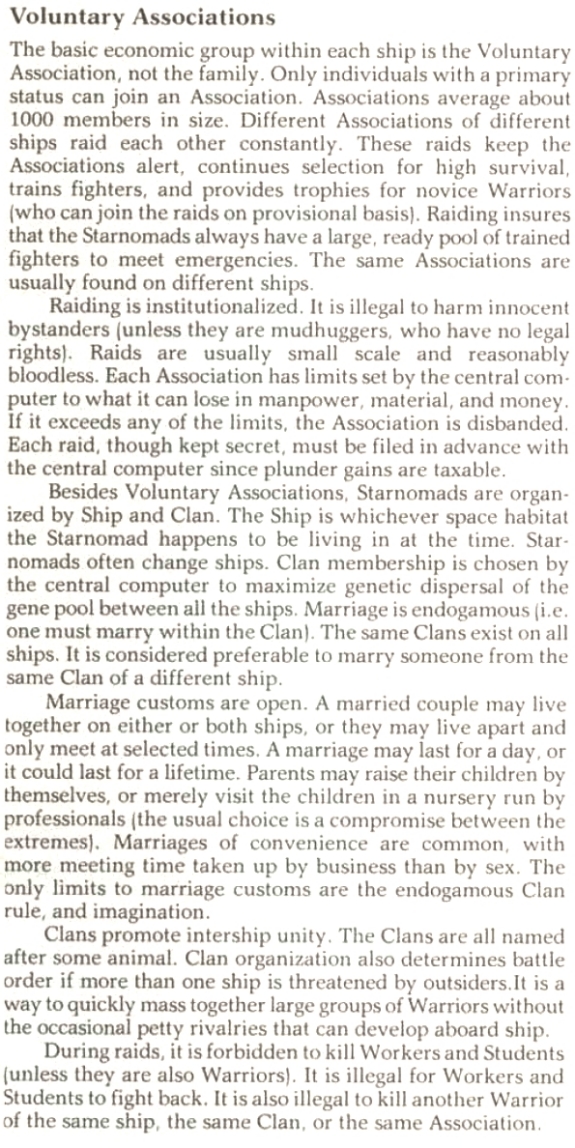
In this post, we continue our presentation of Tom Molday's historical background of the Starnomads.  We learn that “Mudhuggers have no honor” and that, regarding mudhuggers, “Promises need not be kept...”  Yet,“trade is so important the Starnomads” and “Starnomads make excellent traders.”  It seems incongruous that a people seen as “merciless, treacherous barbarians” can manage to be “excellent traders.”  Additionally, we learn that Starnomad “habitats are entirely self-sufficient.”  So, why should Starnomads sully their superior hands by trading with debased mudhuggers or by raiding disgusting mudhugger settlements?

How superior are Starnomads to mere human mudhuggers?  Moldvay establishes elsewhere in the adventure that – when creating a Starnomad character – “a player rolls 2d10 plus 2d6 for each of the five Basic Ability Scores (instead of just 2d10).”

“Mudhuggers have no honor,” we are told.  However, a Starnomad ship will “formally adopt an individual who gains its hospitality.”  This is not a rare occurrence – “New blood is constantly being added to the Starnomads.”  As such, there must be honor to be found among some mudhuggers.

In last week's post, it was established that, “In the Starnomad mythos, they are building toward an ultimate new species that will have about as much in common with Homo Sapiens as Homo Sapiens have in common with the tree shrews...”  Yet in the sections reproduced below, we learn that, “There are even a few [Starnomad] ships composed entirely of alien races.”

Speaking of alien species, illustrated above is a 'Feline', which seems to be slightly larger than the example human shown.  The Rule Book states, “Felines are a bipedal cat like species of intelligent, space-faring carnivores.”  They are among the “traditional enemies” of the Starnomads, but were previously allied with them.  For nearly every humanoid race listed in The Book of Foes, statistics are provided for an average specimen, a soldier specimen, a hero specimen, and a noteworthy individual.  The noteworthy Feline individual, Grymalkin, has magic powers.  Also, Feline heroes are capable of having magic powers.  This is strange in that the Starnomad Setting Index specifies that “Magic does not work...”


Sunday, December 10, 2017

Saga of the Starnomads (Part I)

Art by Dave Billman

In Lords of Creation, Tom Moldvay offers seven settings.  One of these, Imperial Terra, is a space opera venue.  “Because of a series of man-made catastrophes,” states the description, “details of entire centuries of history have been lost, so it is impossible to date the Empire using 20th century time references.”  (Corvus Andromeda comes from Imperial Terra.)  The Rule Book has one-and-a-half pages dedicated to the details of Imperial Terra.  About one-quarter of a page is devoted to describing the Starnomads.  According to The Book of Foes, “A Starnomad is a member of a wandering futuristic culture that practices genetic selection of the fittest.”

Evidently, Moldvay put a great deal of thought into the Starnomads.  I think they're elitist jerks, but I'm just a mudhugger. To the premier issue of Heroes, Avalon Hill's magazine, Tom Moldvay contributed a Lords of Creation adventure, “Survival Run of the Starnomads.”  (However, the adventure refers to itself as “The STARNOMAD SURVIVAL MAZE.”)  In the 'Designer's Note' for the adventure, Moldvay explains, “In the summer of 1979, I designed a game system entitled 'Starnomads' for the amusement of my friends and myself.”  He further explains that the game system “was the grandfather of LORDS OF CREATION®.”

Along with the adventure, Moldvay provides an 'Historical Background' for the Starnomads, some of which is duplicative of the material in the Imperial Terra setting description.  The first part of this background follows.


Sunday, December 3, 2017

The Horn of Roland (spoilers)

Art by Dave Billman

As mentioned in a previous post, Tom Moldvay intended that The Horn of Roland be included in the Lords of Creation boxed set as an introductory adventure.  For whatever reason, The Horn of Roland was published as a separate item.  I examined Roland to see if it addressed perceived gaps in the Lords of Creation rules; alas, it did not.  Regardless, Roland offers a glimpse of how Moldvay intended Lords of Creation to be played.

In most role-playing games, player characters are part of the setting from the start.  In Lords of Creation, Moldvay stated that player characters “begin as 'ordinary' people; strange things start to happen to them; they undergo unusual adventures.”  They are introduced to parallel worlds, alternate dimensions, and pocket universes; they gain extraordinary abilities.  In short, the player characters transition from the mundane world to the “region of super-natural wonder” (to use Joseph Campbell's phrase).

The Horn of Roland is actually a sequence of six related scenarios – a short term campaign, in effect.  The first scenario is intended as a starting point for “newly-created” Lords of Creation characters.  It is a murder mystery.  Of course, there's nothing wrong with a murder mystery in the right context.  However, the cover of Lords of Creation depicts a man and a woman emerging from a portal connecting a fantasy realm to a science fiction realm.  The man has shuriken attached to his boots and the woman is zapping a dragon.  Maybe this seems like an interesting play experience or maybe it doesn't.  In any event, it sets expectations and these expectations do not include a murder mystery.  The mystery is described as “fairly complex” and the GM is encouraged “to force [the characters] to investigate all possibilities...”  (There are seven separate and detailed red herrings.)  A GM can effectively run the mystery thanks to the manner in which Roland presents it; however, the players (who may well have expected to fight robots and dragons) must cope with a convoluted mystery.  I mean, they didn't sign up to play Agatha Christie's Biddies & Belgians.  (That's a thing, right?)

The player characters are attending a gaming convention “in the fictitious town of New Bristol...”  The convention is hosted by the New Bristol Arms, owned by Tom Morgan (evidently an author avatar).  A businessman residing in the penthouse of the New Bristol Arms is murdered, but the police consider the death to be a suicide.  Morgan hires the player characters to investigate (with the consent of the police chief).  I think that Moldvay may have originally intended the mystery to take place in the thirties.  There's an NPC detective whose appearance is based on Humphrey Bogart.  There's an NPC gangster whose appearance is based on James Cagney.  There are German and Japanese agents vying for stolen technology.  Most tellingly, there is an elevator operator.  Moldvay even offers a special trivia quiz that “isn't part of the adventure and in no way affects the experience earned by the characters.”  (Question[s] #1:  Who wrote The Mousetrap?  What novelette is the play based on?  Name two other mystery plays by the same person.)


The players are given some hand-outs, such as the above map.  Unfortunately, there are complications.  On the map, #47, #74, and #95 each appear twice.  Locations #48, #75, #84, and #90 are absent.  (The duplicates of #47 and #74 might account for the missing #48 and #75, respectively.)  Finally, the key lists 101 locations, but the map includes location #102.  I think Moldvay wanted New Bristol to serve as a continuing base of operations for the player characters and a place to acquire equipment.  A venue less expansive than a town may have been more suitable for starting characters; a university, perhaps.

Anyway, during the course of the investigation, the player characters are plagued by a Phantom.  The players are not informed about the reasons for the antagonism of the Phantom until the last scenario.

The murder was committed by a local heiress possessed by the spirit of a witch.  (The victim was descended from the judge who sentenced the witch to death three hundred years ago.)  The mysterious “Cult of the Serpent” was responsible for summoning the witch's spirit and supplying a living vessel for it.  While investigating the seven red herrings, the player characters interact with a long list of townspeople, none of whom are associated with the cult.  If some of the NPCs were cult members, it would have provided players another means to get at the truth.

A non-player character tells the player characters where to go for the climax of the scenario and they get the privilege of watching said NPC conduct the denouement.  Not only must the player characters plod through a complex mystery, but they also get sidelined by an NPC at the end.  Well, the player characters see their Phantom board a “Ghostly Galleon.”  The aforementioned NPC offers them $100,000 to pursue the Phantom (even though he has no reason to do so – nothing suggests he was even aware of the Phantom prior to the end of the adventure).  The heiress, freed from possession, offers her 70-foot yacht.  This leads into the second scenario.  What if the player characters aren't interested in pursuing the Phantom?
     If the characters don't chase the Ghostly Galleon, there is no further adventure...Do your best to let the characters give chase voluntarily.  But if all else fails, the characters are surrounded by a bright yellow light...Each character will have a vision of his enivitable [sic] death at the hand of allies of the Phantom.  Every character who fails to make a Luck Roll feels an uncomfortable urge to chase the Ghostly Galleon.
Please have your tickets ready for the conductor.  Choo-choo!  (Also, how are player characters supposed to know who “allies of the Phantom” are in their visions?  Does the Phantom stand around gleefully rubbing his hands?  Does he give his ally a high five?)

As they pursue the Ghostly Galleon, the player characters have various encounters.  Eventually, in the Bermuda Triangle, “they sail through a swirling tunnel of light” into another dimension.  Then things start to get a little weird.  At night, the yacht is pursued by the Wild Hunt.  The players have no idea why.  Furthermore:
     The characters have to realize, as soon as possible, that they can't harm the hunter.  He is simply too powerful considering the characters' current level of experience.  The characters stand no chance in battle.  Their only hope is to flee as fast as possible.  If they don't flee quickly, the hunter has time to attack, and possibly kill, one or two characters chosen at random before the sun rises and he returns to the clouds.
Fortunately, the player characters meet up with the Flying Dutchman.  He gives them a statuette that keeps the Wild Hunt away, but it is only effective for a week.  The only permanent protection from the Wild Hunt is the eponymous Horn of Roland.  The Dutchman has recently seen it in a bone tower, on a nearby island.  The bone tower is the subject of the third scenario.

Moldvay contributed to The Isle of Dread and the island in The Horn of Roland is what would result if The Isle of Dread met Land of the Lost and they dropped acid.  Yes, there are dinosaurs.  Also on the island are relics of The First Ones, “a strange, unknown race that once inhabited the island.”

The player characters go to the bone tower and fight a wide variety of foes.  They also come across a couple of prisoners, one of whom is Cyrano de Bergerac.  Moldvay must have been a fan of the French duelist; not only was Cyrano featured in Moldvay's The Future King, he warrants a one-page appendix in The Horn of Roland.  Moldvay also modified a ballad from the play Cyrano de Bergerac for Cyrano to recite while he – not the player characters – defeats one of the bone tower guardians.

Even after obtaining the Horn of Roland that acts as permanent Wild Hunt repellent, the player characters have other adventures on the island.  Cyrano, on the other hand, leaves for the moon.  “The same method of travel won't work for the characters,” Moldvay informs us, “unless you want to create a short side trip adventure to the moon, returning the characters to the island after the side trip is over.”  Seriously, going to the moon with Cyrano de Bergerac should BE the adventure.  Aside from Cyrano's own work, inspiration for what might happen on the moon could be gleaned from:  Burroughs' The Moon Maid, Wells' The First Men in the Moon, Baron Munchausen, Kepler's Somnium, Lucian's True History, and The Great Moon Hoax of 1835.  There's even a trip to the moon in Orlando furioso.  (Perhaps the object of the quest should have been Astolfo's horn rather than Roland's.)

On the island, robots have “enslaved” humans.  This is automatically assumed to be a bad thing.  A revolt against the robots is the subject of the fifth scenario.  In order to successfully revolt, the humans need to be armed.  In the fourth scenario, the player characters gather the necessary weapons from the “Caves of Doom.”  Although they don't realize it, the player characters are required to obtain a magic sword – Lightbringer – from a “Bloodstone Cube” in the Caves of Doom.
     If the characters don't voluntarily travel to area D20, then touch the Bloodstone Cube, they feel an unexplained, irrestible [sic] urge to do so.  Give the players every chance to take their characters to D20 and touch the cube.  But if the characters try to leave the Caves of Doom without acquiring Lightbringer, they find it impossible to leave.  No matter which way they go, the path seems to wind around back to the entrance to D20.
The final scenario begins when – after the revolt – Phantoms attempt to steal the horn.  (Remember the Phantom from the first scenario?)  “In the struggle,” the scenario reads, “one of the Phantoms accidently loses a map that gives directions to the stronghold of the Phantoms.”  One might think that the Phantoms intentionally dropped the map to lead the player characters into a trap.  I mean, the Phantoms don't need a map; they can teleport and – even if they couldn't – they still manage to get back to the stronghold without the map.  Yet the map was lost accidentally and thus accurately indicates how to get to bad guy headquarters.

At the Shadow Stronghold, the player characters finally learn why they have been drawn into these scenarios.  The basis of The Horn of Roland is the animosity between the mythological Erebus and Prometheus.  Erebus has Prometheus chained in the Shadow Stronghold.  “Erebus, Lord of Shadows,” we read, “for reasons known only to himself, has decided that the characters are his enemies.”  Actually, although the players never learn this, Erebus wants to destroy all persons who have the potential to become Lords of Creation (such as the player characters).  So, Erebus sent the Phantom(s) and (I guess) the Wild Hunt against the party.  Prometheus “has been helping the characters secretly throughout the adventure.”  The Lightbringer sword is the only thing that can break Prometheus' chains.  Once the player characters free Prometheus, Erebus appears and the two fight.  The player characters get to watch.  The scenario reads, “Prometheus asks the characters to keep out of the battle...”  Erebus necessarily loses.  I would have designed the adventure so that the party fights a group of Erebus' followers while Prometheus and Erebus fight on a different dimensional plane.  Also, what happens in the conflict of mortals would affect what happens in the conflict of immortals.  Then again, I'm used to dealing with players who actually like to have their characters engage in meaningful activity.

The Horn of Roland has aspects of a railroad and forces player characters into inactivity during what should be the most exciting parts of the adventure.  It also has a 'big picture' of which the players remain ignorant until the very end.  Players don't need to see the 'big picture' from the start of the adventure, but enough of it should be presented so that the players have an idea about what is going on and they can interact with the adventure appropriately.  For instance, if the players knew there was an extremely helpful magic sword in the Caves of Doom, then the characters would likely not need to be compelled to find it.  Moldvay has no problem with a mentor NPC giving directions to the player characters (e.g., the Flying Dutchman).  He also has no problem with player characters receiving “visions.”  Why not clue the PCs into the fact they are acting for the benefit of Prometheus (or an unnamed powerful being) who will help help them against their (mutual) enemies? 

* * *     * * *     * * *