Showing posts with label FASA. Show all posts

Sunday, February 2, 2020

In the battle between good and evil, this one counts!

Art by Jim Holloway

In the '80s, FASA produced several games based on licensed properties and did so with reasonable success (other than that one).  FASA hoped to obtain the license to produce games based on the Star Wars property; however, the license went to West End Games.  This left FASA with the basis of a space battle combat system but unable to publish that system for the intended setting.  As such, FASA came up with an original setting.  The 'Renegade Legion' background is essentially the Roman Empire in space.  While Star Wars features a rebel alliance against an evil galactic empire, Renegade Legion has an alliance of humans and aliens (the Commonwealth) against an evil galactic empire (the Terran Overlord Government).  As a result of these opposing forces, we get the rather lackluster tagline, “In the battle between good and evil, this one counts!”

The first Renegade Legion product was 1987's Interceptor, a space ship war game.  FASA produced other war games for the franchise.  In 1990, FASA published Legionnaire, a role-playing game based in the Renegade Legion setting and compatible with the prior games.  Is 1990 too recent to be considered 'old school'?  It's thirty years old, but it's just recent enough for it not to be cataloged in Lawrence Schick's Heroic Worlds.  Cherished readers with a strong opinion one way or the other are invited to comment.  Regardless, Legionnaire certainly has some 'old school' connections.

Legionnaire was designed by Tunnels & Trolls stalwarts Michael A. Stackpole and James “Bear” Peters.  It is therefore not surprising there are similarities between the two games.  Legionnaire characters have eight Primary Attributes:  Agility, Charisma, Constitution, Dexterity, Intelligence, Luck, Speed, and Strength.  There are few differences from the Prime Attributes of the contemporaneous T&T rules.  Legionnaire separates T&T Dexterity into Dexterity (aptitude with “fine motor skills”) and Agility (aptitude with “gross motor skills”).  Legionnaire also has Speed, an attribute which T&T would adopt in later editions.

The “basic value” for each Primary Attribute is determined by adding the results of 2d10.  Alternately, a player may allocate 88 points among the eight Primary Attributes.  Using the allocation method, “No attribute can have a value below 5 or above 17.”

After Primary Attribute values are determined, players select skills for their characters.  The Legionnaire skill system approximates that which Stackpole developed for T&T.  Each character has a number of skill points equal to his or her Intelligence value plus three.  Each skill requires a minimum Intelligence value; as examples, Gambling requires at least 4 Intelligence, Cryptography requires at least 15.  Some skills also require minimum values with other attributes.  For instance, Escape Artist requires a minimum value of 13 in each of Intelligence, Agility, and Dexterity.
It costs 1 skill point to purchase a skill at level 1.  Extra skill levels can be purchased at a cost, in skill points, equal to the sum of the levels up to and including that level.  i.e., level 2 costs 2 more points, for a total of 3 points.  Level 3 costs 6 points (1 + 2 + 3), 3 points more than level 2.  Level 8 costs 8 points more than level 7, or a total of 36 points.
The basic mechanic for Legionnaire is to roll a number of dice and compare the total result to a specified number.  Exceeding said number indicates failure.  The specified number is either a character's attribute (for saving rolls) or an appropriate skill level added to an appropriate attribute (for skill checks).  Difficulty is expressed by the number of dice to be rolled.  Minimum difficulty is 1d10; extreme difficulty is “6D10 or more.”

Every two skill points represents a year of time which is added to a character's base age of 17.  However, we learn that, “A good background story for a character can be rewarded by granting the character a skill or two for free.”  Such a reward “should be limited to two skill points worth of skills.”

Legionnaire offers 'career packages' from which characters can obtain a number of reasonably related skills at a discount.  For instance, the career package for a marine officer provides twelve skills for only nine points.  Only four years are added to the character's age (as opposed to six).  However, career packages require minimum attribute values.  The marine officer package requires a value of ten in each of Intelligence, Dexterity, and Agility.  The career packages in Legionnaire are limited to military or intelligence.  However, characters are not required to take a career package.  Also, rules are provided for creating original career packages.

In the next post, we will continue our exploration of the Legionnaire character generation system.

Sunday, November 18, 2018

A Space Odyssey (spoilers)


It's 1984.  You know what would be great?  Connecting Star Frontiers to a popular science fiction franchise.  This would bring attention to the game and drive its future success.  Let's see...FASA has the rights to Star Trek and The Last Starfighter.  The third film in the Star Wars trilogy was released in '83, so public interest will probably wane...  Perhaps it would be best to get in on the ground floor of an upcoming film and ride its coat tails.  How about Dune ?  It's set to be a merchandising bonanza.  Also, Herbert's series is specifically listed as suggested reading on the inside back cover of the Star Frontiers rules.  But wait... MGM is releasing a sequel to 2001.  Never mind that it's not really space opera.  Never mind that many of the game's target demographic had yet to be born when the original film was released.  Kubrick's cinematic masterpiece is timeless; surely it can be easily adapted into an engaging role playing experience.

Such may as well have been the thought processes of one or more persons at TSR.  Regardless, we have been gifted with 2001 A Space Odyssey – “A Special Star Frontiers® Adventure Module.”  The task of writing this special module fell to Frank Mentzer.

The module is presented in four chapters, roughly analogous to the segments of the film:  Dawn of Man, Lunar Excursion, Jupiter Mission, and Through the Star Gate.  The Introduction provides an overview of the module's narrative:
At critical points in Mankind's history, an alien device, a monolith, appears and provides a key to the future.  Through this adventure, the player characters are present each time a monolith appears.  In each case, whether or not Mankind successfully enters the future offered by the monolith depends on how the player characters react and how much they learn about themselves and their universe.
Obviously, the standard game setting is not used.  “If you put this adventure in your STAR FRONTIERS® game, place it back in time before humans contact the other races.”  However, the adventure can be modified for the other intelligent races of Star Frontiers.
For example, in a dralasite version of chapter one, the monolith might teach cooperation to primitive, independent dralasites.  In a Yazirian version, the monolith might instigate the custom of life-enemies.
We are informed, “This special STAR FRONTIERS® module requires both ALPHA DAWN and KNIGHT HAWKS box sets.”  In reality, the Knight Hawks set is only needed for the Piloting skill and to provide an assortment of counters.  “All spaceflight in this adventure takes place in chapters 2 – 4,” the Introduction states, “Those chapters explain when and how to handle the necessary spaceflight.”

North is to the right
In chapter one, player characters control man-apes in the African wilderness of four million years ago.  Each has the same ability scores.  Events occur in three phases:  Survival (2 game days), Changes (2 game days), and Conquest (3 – 5 game days).  During the Survival phase, the man-apes cope with carnivores and an enemy tribe while trying to obtain sufficient food and water for survival.  A day without water reduces Stamina by 1d10; a day without food reduces Stamina by 1d5.  In the Changes phase, the monolith appears.  On the second day, “each PC man-ape visiting the monolith gains one skill” determined on the Skill Chart (at left).  Man-apes can learn skills from one another.  Player characters achieve the goal of the Conquest phase “when (1) they have slain a carnivore, and (2) the enemy tribe has surrendered.”

Chapter two takes place in 1994 and we learn, “The mega-corporations (which will eventually evolve into Pan Galactic, of the normal STAR FRONTIERS® game setting) dominate the quality of life.”  Players create original characters that reside “on Station One, the largest of three orbital cities floating above the Earth.”  Unlike the usual character generation procedure, a player may allocate a total of twelve Skill Levels among up to five skills (“with a maximum of 5 in any one Skill”).  The Computer and Technician skills are required and “at least 2 of [the skills] must be from the character's PSA.”  Each player then distributes forty additional points among the character's abilities.  “Finally, each player should secretly choose a nationality:  American, Russian, Chinese, or Other.”  Players are informed, “there has been a standing reward of 1,000 CR for anyone able to produce an item created by an extra-terrestrial life form.”


The player characters are recruited by American authorities to locate a presumed extraterrestrial artifact on the moon.  There are nineteen magnetic anomalies on the Lunar map, one of which is randomly determined to be caused by the artifact.  (Although the module refers to squares on the Lunar map, the map itself displays hexes.)  Time is of the essence since the Chinese will arrive in sixty hours to perform their own explorations.  One player character is secretly approached by a Russian agent and another by a Chinese agent.  Respectively, the agents offer 50 credits “to openly claim [the anomaly] in the name of his country, instead of the U.S.A.”  Whether or not the characters accept this generous offer, several NPCs will be working for the Russians or Chinese.  Player characters – either individually or in teams – explore the various anomalies using provided equipment.  “After the large anomaly is pinpointed, all characters involved in the search are detained,” we learn, “The characters never learn the reason for the secrecy...”  Outside the presence of the player characters, “a group of experts and technicians excavate around [the monolith].”  Then the monolith “emits a series of five electronic shrieks.”  One wonders what the players could learn about themselves and their universe via this chapter.

The third chapter takes place on board the USS Discovery and each player controls one of the crew members from the film (Dave Bowman and Frank Poole).  If there are more than two players, one or more of the hibernating astronauts should be used (Kaminski, Hunter and Whitehead – I don't know where Whitehead came from, in the film it was Kimball).  Any additional characters should not be created randomly; we are instructed, “Design the characters to be useful.”

Two new skills are described:  Astronomy (“a new STAR FRONTIERS® technological skill”) and System Navigation (“a new spaceship skill for use with this module only”).  According to Knight Hawks, the Piloting skill can only be acquired by characters with six levels of Technician and two levels of Computer.  Yet this requirement is overlooked in 2001, William Hunter has Piloting 1 but only Technician 3.

As in the film, the HAL 9000 computer works to eliminate the crew and we are advised, “Play HAL very cleverly.”  The module supplies examples of what HAL can do against the characters.  Before HAL attacks, player characters can use a Psycho-Pathology subskill to have HAL “remain calm for another 1 – 6 hours.”  Ultimately, the player characters will have to disconnect HAL.  Afterwards, player characters will need to handle the shipboard tasks manually.  To this end, ship operations and equipment repair are described in thrilling detail.  There are five paragraphs explaining how doors work.  Eventually, the characters watch a briefing tape relating that a monolith was found in the crater Tycho (or “Substitute the name of the crater in which the monolith was found in your game”) thirteen months previously (even though chapter two took place in 1994 and the Discovery was launched on May 14, 2002).  At the conclusion of chapter three, the player characters encounter a giant monolith.  They have the choice of investigating the monolith (and proceeding to chapter four) or staying with the ship (and ending the adventure).

Most of the fourth chapter consists of the referee reading about a page of boxed text.  One of the passages is:
You are above a world of incredible size – much larger than Earth.  But there must be no atmosphere; all the surface details are clear, to the remote and flat horizon.  The surface is marked in huge patterns, probably miles across, of squares, triangles, polygons...and in them, here and there, gaping black shafts, much like the chasm from which you just emerged.
The sky is disturbing.  There are no stars, nor even the blackness of space, but only a milky whiteness.  But no; there are tiny black dots, here and there, scattered across the sky.  They seem oddly familiar – and then you realize that it looks like a photographic negative of the Milky Way.
Eventually, the characters arrive “in a place nearly identical to a hotel suite in the United States of America.”  The referee is instructed to provide “map E, the Hotel Suite Layout, to the players.”  Sadly, no such map is included with the module.  “The entire hotel suite is a creation of the mind of an alien being, created to reassure, but not deceive, the characters.”  Upon falling asleep, each character has a dream wherein he encounters “an alien being – a flickering flame of light, about 7 feet tall.”  Via an undescribed means of communication, the alien presents a range of five options:
  1. The character may return to the Dawn of Man, and help to teach the man-apes the basics of survival.
  2. The character may return to Earth's Moon, in the year 2015, to be rescued.
  3. The character may immediately return to the Discovery, to await rescue, but with no memory of the passage of the Star Gate.
  4. The character may become a higher form of life, an energy being, with no use or concern for material form.
  5. The character may go to an alien planet where another race faces a critical juncture, much live the Dawn of Man the crossroads of knowledge or extinction and help that race along the path to survival.
The module ends with another section of boxed text, the last line of which is:
And now it comes, and it is time to go; to take the final step on this greatest of all journeys; onward, to complete your Space Odyssey.
If you choose to lose your memory, can it really be a journey?

Sunday, August 12, 2018

High Times on Hathor III (spoilers)

Art by Steve Crompton

In 1983, Fantasy Games Unlimited published Casino Galactica for use with Space Opera.  It is credited to “STEVEN B. TODD of Gnome Mountain Workshops.”  The title page explains that “Todd is in the process of forming a new publishing company called Gnome Mountain Workshops for the purpose of publishing Space Opera support material under license.”  Originally, Casino Galactica was supposed to be a Gnome Mountain Workshops publication; however, with regard to Todd, “the idea of having [FGU] publish one of his adventures to make the public aware of his style prompted Steve to change the nature of this submission to allow [FGU] to publish it.”  The reader is told to “Watch for other products by Steve from his own Gnome Mountain Workshops in the future.”  Alas, Casino Galactica is Todd's only RPG credit and no output from Gnome Mountain Workshops was forthcoming.

The Introduction refers to Casino Galactica as a “campaign pack” and “an adventure background” as opposed to “an adventure per se.”  The cover makes the claim:  “Adventure Setting & Scenarios.”  However it wants to refer to itself, Casino Galatica has twenty pages.  The Introduction is on page two and only one-quarter of a page of text appears on the last page.  Considering this – and given the amount of white space present on the other pages – Casino Galactica provides eighteen pages of material.  About six of pages consist of maps and the keys thereto.

'Casino Galactica' is the collective name for a posh resort situated in “the mountainous outback of Arcturus [IV].”  It was established “only a half-dozen years ago by an off-worlder named Cosmo Filroy, who had a lot of money and off-world financial backing.”  Filroy's “background is sketchy” and “he is involved in all sorts of legal and semi-legal activities.”

Approximately five pages – a significant portion of the book – are devoted to describing non-player characters associated with the casino.  Some are detailed fulsomely with an illustration, characteristics, skill ratings, and one or more paragraphs of information.  Some personalities are only supplied with characteristics and skill ratings.  Some entities are merely named; for instance, the security personnel encounter table lists eighteen people whose distinguishing features are left to the StarMaster.
Remember that all duties are by weekly rotation.  Do not put Mary Pale on garage beat one day and at Detention check the next, and someplace else the day after.  Be logical.
An 'act list for the lounge' is provided, indicating such worthies as Johnny Asteroid (comedian) and Tara McClendon (stripper).  Also described – in detail – are notable guests, such as Professor Fielding Price (depicted below), “the leading researcher in the field of temporal physics.”

Naturally, the casino offers gambling opportunities, including sports betting.  Grav-Ball, a game published by FASA the previous year, “is all the rage.”  Casino Galactica encourages the reader to purchase a copy of the game noting, “Besides being useful in this packet, it's a fun game, and simple.”  The local franchise, the Arcturus Blue Scourge, is party owned by Cosmo Filroy.  The team's schedule for the season (with the odds for each game) is listed on page 14.  The StarMaster is advised:
To give the season more flavor, throw in some sports flashes about the other teams, and how well they are doing.  Give the players something to think about, but don't try to steal them blind. Be very careful not to mislead them too much. Remember, they would, in reality, have stats and past histories on hand to check.  They would not be as much in the dark as they're going to be in the game.
Also at the casino is an experimental machine called the Subliminal Imagery Device that “introduces fantasy-oriented images into the mind of the sleeping subject, and makes he or she believe that they are experiencing some fantastic adventure or quest, in a pre-created world, but one which is influenced by the subject's own subconscious images.”  The cost of using the device is one thousand credits per day, “though a one month package is available for CR 25,000.”  How the subjects receive sustenance is not explained.  While the machine “is 99% safe...there have been no fatalities, but one person refused to come back to this world, the other was so real.”  The experimental nature of the S.I.D. is not disclosed to the public.  We read that:
The device has several pre-programmed adventure worlds, all fantasy oriented.  For playing out these 'adventures' use of any of several of the excellent FRP's available on the market is recommended.
So, you can role-play a character who is role-playing in turn – using a different game's rules.

The resort offers various other recreational pursuits, including skiing, shopping, hunting (local as well as imported animals), and two golf courses:  “a traditional Terran golf course and another more 'alien' built on the edge of a deep chasm.”  The alien course “is the utmost in challenges, and utilizes robotic caddies and air-sled carts.”  We are assured that, “So far the only casualties have been balls.”

The section of the book dedicated to scenarios is about 1⅓ pages, including illustrations.  However, the scenario descriptions build upon the background provided in the NPC details, especially with regard to how the NPCs relate to one another.  There are five scenarios presented and six Other Ideas.  (“Just expand on them a little, and presto! Adventures.”)

Birkett H. Crandall, the casino manager, “is a typical gangland hoodlum type.”  His illicit activities extend to “gunrunning, drug manufacture and marketing, corporate spying - even slavery.”  Crandall is involved with “drug growing and smuggling activities” on the planet Hathor III.  In one scenario, Paul LaClerc, assistant manager of the club and undercover IPA detective, hires the player characters “to bring back photographic evidence” of Crandall's felonious deeds on that planet.  Another scenario has Crandall blackmailing the United Federation of Planets with evidence that it was responsible for a political assassination.  The Bureau of State Security hires the PCs to retrieve the disk with this evidence.  In yet another scenario, the player characters work for Crandall to obtain “some experimental drugs that were confiscated by the authorities.” 

Jeff Bezos...in space!
Art by Steve Crompton

Sunday, May 11, 2014

Skills in Tunnels & Trolls

Art by Victoria Poyser

In a 1982 issue of Sorcerer's Apprentice, an article appeared, “Skills in Tunnels & Trolls,” written by Michael Stackpole.  More than twenty years later, it was incorporated into the 5.5 edition of Tunnels & Trolls.  In Stackpole's system, each character has a number of 'skill points' equal to his or her Intelligence (IQ).  Each skill costs one point (or more) and each skill has a minimum IQ necessary to learn the skill.

This system owes much to Metagaming's The Fantasy Trip, specifically In The Labyrinth (1980).  The 'skill point purchase' system in TFT is essentially the same except the term “talent” is used rather than “skill.”  Stackpole employs his system in Mercenaries, Spies and Private Eyes (1983) as well as FASA's Legionnaire (1990), co-designed with T&T alumnus Jim “Bear” Peters.

In his article, Stackpole describes only eleven skills as well as two types of “open” skills (open in the sense that they have no IQ minimum).  The first open skill is 'Special Interest' which includes
...almost anything that might be learned by a character doing personal study.  The only areas that cannot be covered...are areas covered specifically by another skill.
The other open skill is 'Occupational Skill', each of which represents “one year of an intensive training course in one form of employment.”  The other eleven skills, sorted by IQ minimum, are:
  • IQ 6 – Bludgeon, Climbing, Swimming
  • IQ 8 – Begging, Pickpocket, Treasure Evaluation
  • IQ 10 – Trapping, Trap Disarm
  • IQ 12 – First Aid
  • IQ 13 – Navigation, Plant Lore (These cost 2 points each.)
Of course, Stackpole did not intend this listing to be comprehensive, merely “a small sampling.”  According to Stackpole, “You can flesh T&T characters out with appropriate skills from other games.” (i.e., Mercenaries, Spies and Private Eyes and Monsters! Monsters! ).  This sort of brevity is acceptable in a magazine article, but when presented in a rules compilation, a more thorough listing ought to be supplied.

Skills have “levels” and these levels are added to an appropriate attribute for the purpose of making saving rolls.  For instance, 'Trap Disarm' would be added to IQ when attempting to identify a trap, added to Dexterity in disarming the trap, or added to Luck to lessen the effects of a sprung trap.  Upon acquiring a skill, it is 'level one'.  A skill's level increases only with experience, but a skill's experience is distinct from a character's experience.  Every attempt to use a skill – successful or not – earns fifty experience points for that skill.  The amount of experience points needed for a skill to gain a level is the same as for a character to gain a level; a skill advances to second level upon amassing one thousand experience points (or twenty attempts).  Tracking character experience is one thing, but tracking experience separately for each skill is a tedious exercise.

Regardless of the consideration of separate experience, this kind of skill system may not be suitable for Tunnels & Trolls.  In Mercenaries, Spies and Private Eyes it works because there are no character types, all characters are on an equal footing.  T&T has character types that define a character's abilities and pre-game background.  Imposing a skill purchase system as well seems stilted.  Stackpole notes that, “For balance, each level of T&T magic spells cost two skill points.”  Does that apply to both rogues and magic-users?  Does this mean that, upon gaining an experience level, a magic-user can only have access to spells of that level if she has spare skill points or if she opted to increase her intelligence? I'm not opposed to skill systems, but Stackpole's solution is not ideal for Tunnels & Trolls.

Sunday, August 4, 2013

Snake Mountain


The Masters of the Universe Role Playing Game allows for only one adventure.  This tends to support the notion that the game is a board game rather than a genuine role playing game.  The 'adventure' consists of the player characters looting Snake Mountain in an effort to retrieve the 'Crown Jewels of Eternia.'  The denizens of Snake Mountain are adverse to this and conflict is thus engendered.  Players can assume the roles of He-Man, Teela, Orko, Ram-Man, Man-at-Arms, or...Fisto.  Stratos makes a cameo appearance in the rules, but he is not a playable character.

The game includes a map (or board) “representing the catacombs of Snake Mountain.”  A slightly modified image is provided below for your edification.  Take a few minutes to stock it for your own purposes or avail yourself of the encounter tables.

Snake Mountain according to the good people at FASA circa 1985
The game comes with ten treasure “markers,” one of which represents the Crown Jewels.  They are randomly distributed – face down – upon the blue stars.  The object of the 'adventure' is to locate the Crown Jewels and remove them from the environs of Snake Mountain.  If an encounter occurs in a given room, the adversary (either character or monster) starts on the red star of that room.  If there are several adversaries, are they stacked on the same square?  The rules are silent.  Why are there red stars in rooms where there is no chance of an encounter?  Again, the rules are silent.

Here is a directory; location names have been changed for entertainment purposes only.


When player characters cross the Bridge (location 52), they are attacked by the weapon in the Armament Room (location 49); it is the equivalent of a rifle.

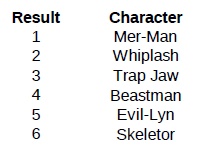
There are four encounter tables:  standard, special, character, and monster.  For each of the tables, 1d6 is used with a possible modifier according to a particular location.  For instance, in location 47, the result of 1d6 would be added to four and the result checked on the standard encounter table.

Standard Encounter Table

Special Encounter Table

Character Encounter Table

Monster Encounter Table

The monsters on the 'monster encounter table' are inventions of the game designers and are not associated with MOTU continuity.  Also, how these monsters are depicted in the rulebook differs from how they appear on the cardboard 'playing pieces' included with the game.

GORMAN

PLAMYDON

ZUVA - REX

Sunday, July 21, 2013

When Is a Role Playing Game Not a Role Playing Game?

Image from BoardGameGeek

An established RPG publisher with a proven capability for adapting licensed properties obtains the RPG rights for a popular toy-line/TV cartoon.  What could possibly go wrong?

...

I can only speculate as to the reasons, but with The Masters of the Universe Role Playing Game (hereinafter MOTU RPG) published by FASA in 1985, I can emphatically state that things went wrong; very, very wrong.  The person ultimately responsible for allowing the game to be sold in its final form ought to be removed from gene pool and forced to plant saplings for the rest of his life in partial atonement for all of the trees killed for this thing's manufacture.  Toilet paper would have been a far more worthwhile product for all of that wood pulp.

But hey, I can't complain!  I can squeeze a few a posts out of this atrocity!

The cherished reader will kindly note that the MOTU RPG link above goes to BoardGameGeek and not RPGGeek.  The worthies associated with those sites have deemed this product to be a board game, not a role playing game.  Their logic is valid; MOTU RPG has no rules for character generation and allows for only one playable scenario.  Nonetheless, I will treat it as a role playing game because that is how the game identifies itself.  Of course, even as a board game, this thing is a travesty...a travesty of a mockery of a sham of a mockery of a travesty of two mockeries of a sham.

Here's what I think happened.  It's only supposition, but it's the only version of events that permits me to believe that human beings – while fallible – are not inherently evil and the universe is not a cold, dismal place of unceasing despair.  Anyway, FASA gets the rights to publish a Masters of the Universe RPG, but it needs to be introductory – and therefore simple – because the age requirement will be “8 and up.”  A full-fledged RPG suitable for 8-year-olds is a tall order, but they had the idea of putting out a simple game, one the kids can grasp, then follow up by publishing an 'advanced' version that addresses everything a 'real' RPG needs to address.  Hey, it worked for other RPGs.  I think they then had trouble making the game simple enough and – with deadlines and whatnot – a less than ideal set of rules was inflicted upon purchasers of the game.

Included with the box was a card with the title “OOPS!”  It read:
We goofed on the magic spells. When you read over the Character Record Cards, you will find that there are spells listed that do not appear on the Magic Spells Table. These spells are for an advanced version of the Masters Of the Universe Game and are not used in this game.

The Masters Of The Universe Advanced Role-Playing Game should be released in the fall of 1986. To make sure you are informed of the release of this game, just fill out the form below and send it to us. You will receive a catalog of FASA products now, and when the advanced game is ready, a letter informing you it is available.
Not surprisingly, the “advanced version” never saw the light of day, and the world is left with a sad mess of rules for MOTU RPG.  Compounding matters was that the rulebook is presented in a comic book format illustrated by the professionals at First Comics.  Now, in and of itself, game-rules-as-comic-book is a good idea, or at least can be.  However, making layout alterations to accommodate eleventh hour rule changes is difficult enough normally, but when when the layout is a comic book page, a last minute rule change is downright impractical.  It is thus that we are left with the likes of the following:

...My Friend Player...
I guess the rules for 'illusion dust' were too complicated, so they used a panel to indicate that one of the game tokens is extraneous.

Alas, some transgressions are unforgivable.  Please, PLEASE, just say no to ALL CAPS.

WTF? ...should be maded?
I guess the Gods of Eternia removed the proofreader.
YES, MUCH OF THE TEXT OUTSIDE OF THE ILLUSTRATED PAGES IS IN CAPITAL LETTERS EXCLUSIVELY.  MAYBE IT WOULD NOT BE SO BAD IF THERE WERE OCCASIONAL PARAGRAPH BREAKS, BUT THEN AGAIN, MAYBE NOT.  THIS GIVES ME A HEADACHE.

Use a question mark when you say that son.
In the comic book, the Sorceress summons 'the player' and He-Man explains the rules (such as they are).  'The player' is meant to be a reader identification character representing the target demographic.  Apparently, the target demographic is extremely androgynous youth.

Can this kid be any more effete?
Seriously, what were they trying to accomplish?  Did they use an epicene cipher so as not to alienate girls who might want to play a He-Man and the Masters of the Universe game?  Really?  All they managed to do was alienate people who don't wear eye-liner, or they would have if the game was worth a damn.