Showing posts with label Erol Otus. Show all posts

Sunday, January 24, 2016

Skills in Alma Mater

Art by Erol Otus

Characters in the high school simulation game Alma Mater have skills; otherwise, this would be a very short post.  There are thirty-one available skills.  Depending on Character Class, each character starts with three or four specified skills plus an extra skill of the player's choice.  Exceptions are the 'Average' Class, who receive any three skills, and Losers, who do not start with an extra skill.  These initial skills are generally oriented towards a given Class's specialty in obtaining Success points.  The initial Class skills are as follows:
Brain:  Homework, Memory, Studying
Cheerleader:  Charisma, Dancing, Friends, Leadership
Criminal:  Illegal Economics, Lockpicking, Lying, Smuggling
Jock:  Friends, Leadership, Sports
Tough:  Dirty Fighting, Driving, Drinking OR Drug Use, Intimidation
Loser:  Crudeness, Isolation, Pity
Note that Brains receive one less skill than many of the other Classes.  Really, I doubt that an additional skill for Brains would have unbalanced the game.

All skills of a beginning character start at level one.  Skills that a character learns after the onset of play start at level zero.  Every character may attempt to learn a new skill at the start of every game year after the first.  Also, a character may attempt to learn the Driving skill after completing a Driver Education course.  Learning a skill requires a successful Learning Drive roll.  No character may have more than eight skills.  If a character does not possess a given skill, he or she can still attempt that skill at level zero.

Depending upon the skill, the maximum level is four, five, or six.  Characters attain higher levels in a skill by acquiring skill points.  Typically, a skill point is earned by a successful use of a skill.  The rate at which different levels are attained varies by skill.  For example, the First Aid skill has the following progression:  level 1 (2 points), level 2 (6 points), level 3 (12 points), and level 4 (20 points).  The progression for the Music skill is:  level 1 (3 points), level 2 (9 points), level 3 (18 points), level 4 (30 points), level 5 (45 points), and level 6 (63 points).  (Each level of Music allows a character to play a different instrument or sing.)

Here are a few Alma Mater skills:
Brewing:  This skill is used “to produce alcohol privately, by using a still.”
Coolness:  With this skill, a character “exhibits little fear, and is able to remain 'cool' in most situations.”
Crudeness:  This skills provides “the ability to say or do particularly disgusting things.”
Drug Use:  With this skill, a character may “increase or reduce the effects of drugs upon himself.”
Homemade Drugs:  This skill provides a character with “the ability to combine chemicals and grow plants to produce various drugs.”
Illegal Economics:  “This skill allows a character to buy and sell illegal items, usually at a good profit.”
Isolation:  “Isolation is the ability to isolate oneself from others and go unnoticed when wanted.”
Pity:  This skill “modifies the reaction of others to characters by +1 per level if a negative reaction is rolled first, or when characters have been hurt or embarrassed.”  This skill does not affect Toughs “because they do not have feelings.”
Smuggling:  With this skill, characters can hide “objects on their person or in items they carry.”

Interestingly, there are no skills regarding computer use even though a certain non-player character is noted for his computer shenanigans (“...he was expelled from school for using his computer to divert school funds into his bank account”).

Teachers have an assortment of optional skills.  “Teachers should not be given more than a few optional skills,” according to the rules, “with permanent skill levels (maximum Level 4).”  Six optional skills are described:
Cheat Catching:  This skill reduces the chance a character can successfully perform the Cheating/Plagiarism skill.
Detect Lies:  This skill reduces the chance a character can successfully lie in the presence of the teacher.  ('Lying' is one of the skills available to characters as indicated in the list of Criminal skills above.)
Fear:  This skill “allows a teacher to intimidate his students, forcing them to behave and do their work.”
Killer Tests:  This skill increases the Subject Difficulty of a test “due to obscure, complicated, or irrelevant questions.”
Killer Examinations:  Every two levels of this skill increases the Subject Difficulty of an examination.  “Generally examinations count more toward the final grade,” the description informs, “so the overall effect of this skill is worse than Killer Tests.”
Omnipotent Classroom:  This skill gives a teacher a chance to perceive “any activity in the classroom which is not directly concerned with the subject matter of the class (eg. paper airplanes, talking).”

Sunday, January 17, 2016

Characters in Alma Mater

Art by Erol Otus

Characters in Alma Mater have seven attributes:  Strength, Coordination, Appearance, Intelligence, Learning Drive, Willpower, and Courage. Strength, Coordination, and Intelligence are common enough to be self-explanatory to gamers, but the others may need some clarification, at least within the context of the game.  Learning Drive “is a character's attitude toward school and his ability to learn.”  Although Intelligence will “influence grades,” Learning Drive “is used to determine grades.”  Learning Drive is also used to see if a character can learn new skills.  Courage represents “bravery and intestinal fortitude” while Willpower is a character's “ability to withstand temptation or pain.”  Appearance is defined as “a person's physical looks” and helps to influence some interesting things, as we shall see below. 

Attributes are determined by rolling 1d10 for each value.  Since player characters are assumed to be high school freshmen, these results are appropriate for characters “aged 13-15.”  As characters age (or for younger characters), the attribute values for Strength, Willpower, Appearance, and Courage are modified.  For characters younger than thirteen, each of these attributes is reduced by one.  At 17, characters gain +1 Willpower and Courage.  Strength and Appearance both increase by one when a character turns 18.  At age 16, Strength for males is increased by one; for females, Appearance is increased by one instead.

Characters have a property of Constitution beyond the seven attributes.
Constitution represents the general Health and fitness of the character.  It determines how fast a character can run and how much damage a character can take before losing consciousness or dying.
Constitution equals the sum of Strength and Willpower.

Like other role-playing games, characters in Alma Mater are mainly defined by their Character Class.  In a game about high school, 'class' is a less than ideal word for the concept; perhaps 'type' would have served better.  The game provides the following 'Classes':  Brain, Cheerleader, Criminal, Jock, Tough, and Loser.  Additionally, there is an 'Average' Class to accommodate characters that don't meet the requirements of one of the more colorful options.  Alas, Alma Mater was published too early to address sportos, motorheads, geeks, sluts, bloods, wastoids, dweebies, and dickheads.  Maybe they could be subclasses?

Only females can be Cheerleaders and only males can be Jocks; all other Classes are open to both genders.  Brains require elevated Intelligence, Learning Drive, and Willpower.  Cheerleaders need a Coordination of at least six and an Appearance of at least eight.  Characters of the Criminal Class need greater than average scores in Coordination, Intelligence, and Courage.  Jocks need Strength, Coordination, and Appearance.  Being a Tough requires a Strength score of at least seven and a Courage score of at least six; however, Toughs may neither have an Intelligence greater than five nor a Learning Drive in excess of four.  For Losers, the maximum value for each of the seven attributes is four.

Speaking of Losers, the description for that Class tells us, “The worst thing about a Loser is that he thinks he's at least equal to or better than everybody else.”  Does this mean that Alma Mater is the first role-playing game to account for the Dunning-Kruger effect?

Characters also have a Social Level.  Technically, it is not an 'attribute' but it might as well be.  It is determined by checking the result of 1d10 against the character's Class on a certain table.  However, instead of making Social Level dependent on Class, it could have been used as a Class pre-requisite just as easily (if not more so).  In any event, Social Level “is an important factor in determining allowance and Parent's Reaction.”  Starting money for characters is determined by the following formula:

$5 × Social Level × (Appearance + Intelligence)

Weekly allowance equals 1% of starting money.  Do stupid and ugly kids get less of an allowance?  Maybe Dunning and Kruger can tackle this one next.

Characters of the Criminal and Average Classes can be of any Social Level.  Cheerleaders and Jocks can span the range of 'middle' to 'upper middle' Social Levels.  Brains must have a Social Level of at least 'middle' while Toughs and Losers have cannot have a Social Level greater than 'middle'.  So, the 'poorer' Social Levels are the province of Averages, Criminals, Toughs, and Losers.  Interpret that as you will.

It is possible for an Alma Mater character to have one or more “problems.”  The rules define a problem as “a defect in the character, either physical or mental.”  For characters with an Appearance score of at least five, one roll is made; if the result is greater than the Appearance score, the character has a problem.  (Even characters with an Appearance of ten have a 10% chance of having a problem.)  Characters with an Appearance score of less than five also roll; however, they may have to roll multiple times and, as a result, be afflicted with multiple problems.  Characters with a low Appearance score must roll for a problem a number of times equal to five minus the Appearance score.  The rules  explicitly state, “ugly characters have a greater chance of having problems.”  To add insult to injury, some problems cause a reduction in Appearance.

Table 6 lists an array of 'problems,' some of which are:  Respiratory, Skin, and Weight (over or under).  The most commonly encountered problem is Vision with the next most common being Dental.  However, as indicated above, problems can be “mental.”  Therefore, “a person's physical looks” establishes a character's chance of having a mental problem.  'Unusual Practice' and 'Phobia' are among the problems included in the table.  (Page 6 informs us that acrophobia is “Fear of being at high places” yet page 38 indicates that acrophobia is “the fear of spiders.”)  “An unusual practice may be determined by the SchoolMaster,” the rules state.  A relatively benign example is “dying one's hair an unnatural color,” but the SchoolMaster may consult Table 8.  Said table indicates 'practices' such as Paranoia, Sadist, and Compulsive Habit (examples of Compulsive Habits are:  “chain smoking, light drinking, mild drug use, and sugar junkie”).  However, the table also includes such 'practices' as Asexual, Bisexual, and Homosexual.  Coming to terms with one's 'non-normative' sexuality can be problematic (especially in high school).  Yet the 'problem' is not the practice, but rather the social reaction (and concern regarding that reaction).  I do not think the authors of the game had an enlightened disposition in this regard.  Aside from the insinuation that people who don't have good “physical looks” are more prone to be gay (and otherwise have 'problems'), Alma Mater 's only homosexual non-player character happens to be a Loser.

Sunday, January 10, 2016

The High School Role-Playing Game


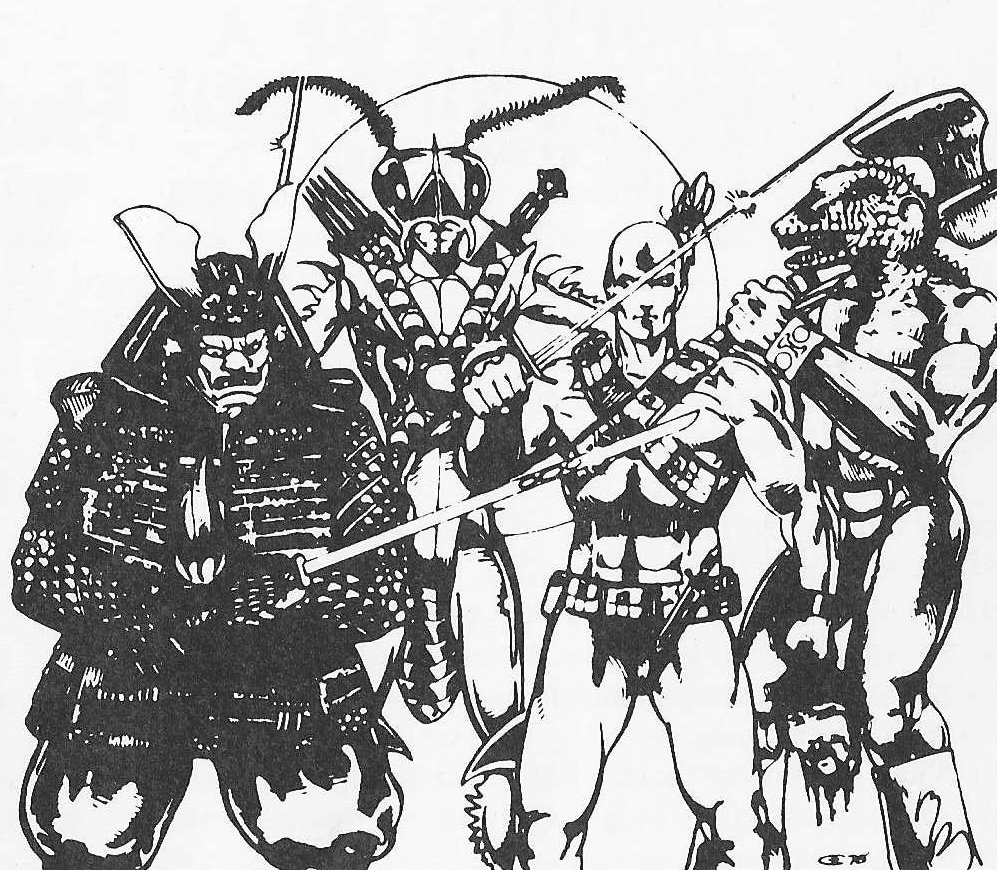
Escapism is a primary attraction of role-playing games; however, Alma Mater bucks that trend, offering as a setting which is neither a fantastic realm of elves and dragons nor a far-flung star empire.  Instead, the game takes place “in North American high schools.”  'North American' is a key term; the game was developed and published in Canada.  The authors, Steve Davis and Andrew Warden, have no other gaming credits.  The publisher, Oracle Games, has no other gaming credits.  One of the illustrators, Owen Oulten, has no other gaming credit, but Erol Otus is the other listed artist.  Otus' art is distinctive and is especially creepy when depicting 'real world' scenes such as those in Alma Mater.  In fact, according to Lawrence Schick in his Heroic Worlds, Otus' art was “in such poor taste that the game was actually banned at GenCon!”  The authors, cognizant of the explicit nature of the art, urge that readers “not be shocked by the illustrations” and reminds of the back cover warning, “this is a game which deals with a mature subject area.”

Schick categorizes Alma Mater as a 'humor' system.  While it is certainly a difficult game to categorize, 'humor' may not be entirely appropriate.  Schick states, “Humor games tend to have loose systems,” yet Alma Mater 's system is rather detailed.  In the opinion of the authors, “The game is generally meant to be realistic, balanced with fun and excitement.”  Additionally, “We have tried to devise a game that simulates the modern high school student...”

The authors comment on their inspirations in the Acknowledgements:
In the creation of this game we used many sources of information.  We would like to thank movies like American Grafitti (sic), Animal House, Grease, Meatballs, and Prom Night as well as the television show The White Shadow, not to mention all of the students in North American schools who raised enough hell to make this game what it is.
The first printing of Alma Mater was in 1982, meaning that it predates the various John Hughes teen flicks.  Also, it was released a little too early to be influenced by Fast Times at Ridgemont High, the Porky's franchise, or the Square Pegs television series.  If the game failed to develop a following among the RPG community, it wasn't due to a paucity of genre-related media.

“The object of the game,” the Introduction tells us, “is to attain as much Social, Academic, and General Success as possible by playing a character through four years of high school.”  Unlike most games, there is a winner in Alma Mater :  “the character with the highest score is the winner.”

Page 42 has the following admonition:  “IMPORTANT:  Do not forget to roll for encounters for every class period or once every five minutes outside of the classroom...in addition to the encounters described in the day plan.”  The implication is that game time should be played out in considerable detail.  Playing four years worth of that level of detail is a formidable prospect.  Page 35 states that...
...the game demands a great deal of creativity on the parts of the players and the SchoolMaster.  If neither uses his imagination to enliven the situations, the game will quickly become like real school – DULL!
Note that the official title of the Game Master is “SchoolMaster.”

Success, of course, is measured by the standards of teen-agers and is quantified (as one might expect) in terms of 'points'.  Social Success is the same thing as popularity.  It can be accumulated by:  throwing parties, being invited to parties, gaining positions (“such as a club president or student representative”), participating in sports, winning sports awards, dancing, gaining a friend or lover, helping others, and being intoxicated.  Flirting, dating, and seduction grant points when successful, but cost points when unsuccessful.  Points are lost by being humiliated, being raped, perpetrating rape, becoming pregnant, causing pregnancy, and killing people.  The winner of a fight gets points while the loser (aptly enough) loses points.  Regardless of who wins or loses, the person who started the fight loses points and the other character gains points.  Also regardless of who wins or loses a fight, the more popular opponent gains points while the other loses points.  Characters only gain (or lose) Social Success if the causative circumstances are “publicly known.”

Academic Success is gained through grades and academic awards.

General Success is defined as “success that is neither social or academic.”  Given the definition, it seems appropriately named; however, General Success is earned only through illegal gains (“such as selling drugs”), stealing, and vandalism.  Furthermore, except for two character classes, General Success is subtracted from Social Success, meaning there is a net gain of zero points.

“Although Alma Mater was written with a modern American high school in mind,” the rules comment on variants:  different areas (“including countries – imagine Alma Mater in the U.S.S.R.”), different periods (“the 50's are a good example, but the '60s and '70s are also possible”), and different institutions (“private, elementary, or even university”).  The game designers do not recommend mixing Alma Mater “with other role-playing games” in terms of an entire campaign, but they make allowances for a one-time event (“it can be done, but it's gross!”).

Sunday, November 8, 2015

Take a Troll to Lunch


Before engaging upon an exploration of The Arduin Adventure, it is necessary to understand the beginnings of Arduin.

In 1977, prior to the release of the Advanced D&D books, Archive Miniatures published Dave Hargrave's The Arduin Grimoire.  This work was followed by several other volumes and adventures, but those later books are not the subject of this post.  In the “Forward,” Hargrave presented the book as an amateur effort with no intention “to replace or denigrate any other fantasy role playing supplement or game, either professional or amateur.”  There was an unstated presumption that the Grimoire required the Dungeons & Dragons rules as a foundation.  In terms of appearance, the Grimoire was quite amateurish and doubtless was a seminal influence on the ambiance of Encounter Critical.  However, to its credit, the Grimoire featured the early artwork of Erol Otus.

As a supplement, The Arduin Grimoire included new classes, new spells, new magic items, new player character races, new monsters, and an assortment of other new rules.  The advertisement reproduced below appeared in issue #6 of The Dragon (April 1977).  Counting its covers, the Grimoire indeed spanned one hundred pages.  There was something on every page, even if only artwork, but we must indulge “jam-packed” as an article of hyperbole.  In your humble host's salad days, photocopies of the special abilities charts and the critical and fumble tables made the rounds and were accorded “official” status without quite knowing their provenance.  The special abilities charts had titles like “Special Abilities Chart for Thieves, Monks, Ninja, Highwaymen, Corsairs, Assassins, Traders, Slavers, and All of Those with a More or Less "Secret" Nature” and included results such as “+1 to all character attributes but –2 versus all magic (even clerical)” and “Woodsman, +1 dexterity, +3 with all missile weapons, hide like angels.”  The critical table included effects like “Forehead...Gashed, blood in eyes, can't see” and the fumble table had results like “twist ankle...lose first attack, and one half of agility/5 min.”

The Arduin oeuvre is unabashedly 'gonzo'.  One of Hargrave's goals was to provide options and inspiration beyond the standard “Tolkeinian” [sic] paradigm.  In a section of the Grimoire titled “Notes on Player Character Types,” Hargrave lectured readers about limiting themselves to “classical” character tropes:
Never will you hear the complaints of Brownie infantry squad as they whine about that stupid half-ogres cheshire cat that keeps looking at them and licking his chops.  And never is such a lonely word.  Don't be lonely, take a troll to lunch.  The world is a small place but is even smaller still in relationship to the myriad worlds of the entire Alternity (alternate eternities).  Do not be a small player from a small world, embrace the whole Alternity and give the different types a chance.  I think you will find that the world your game is in will become a lot more fun if you do.