Sunday, September 9, 2012

Spells in High Fantasy


Within lies the ancient tombs and writing of our most worshipped predecessors.  Between the leather covers of this most ancient reading is the sum total of all the old scrolls and the power of our kind.  Meant for a wizards [sic] eyes only...
Thus begins 'The Spell Book' section starting on page 66 of Jeffery C. Dillow's High Fantasy role-playing game.  I suspect “tomes” was intended rather than “tombs,” but there's nothing I can do about it.

In High Fantasy, there are fifty spells; however, as I explained previously, when a wizard gains skill levels, spells can have improved effects.  Each of the five planes has ten spells, as listed below.  Before a wizard can use spells of a given plane, he must have all spells from all lesser planes.  Beginning wizards start the game with 3 - 6 first plane spells of their choice.

Here is a listing of the entire corpus of High Fantasy spells.


Plane 1: Binding, Paralysis, Create a Familiar, Temperature, Light, Interference Shield, Sleep, Wall, Detect, Negate

Plane 2: Control, Shield, Fly, Voice, Fear, Portal, Transmutate, Telekinesis, Language, Food

Plane 3: Catastrophies, Strike, Electric, Shadows, ESP, Communication, Maxi/Mini, Reverse, Sound, Strength

Plane 4: Summon, Return, Animate, Illusion, Invisibility, Change Shape, Symbols, Body Control, Passage, Aetherial

Plane 5: Hand, Exhaust Aether, Book, Time, Restore Magic, Curse, Undead, Duplicate, Possession/Exorcism, Clone

Spells in bold are “memorizable.”  If a spell is not memorizable, it “must be read from a book.”  How spell memorization affects game play is not readily apparent from the rules.  Nothing in the combat section suggests that casting a memorized spell is different from casting a non-memorized spell.  Neither the example of combat (pages 50 - 52) nor the example of play (pages 99 - 102) are instructive.  An 'advanced rule' only serves to confuse matters.

High Fantasy presents a constructive way for each character class to channel wealth accumulated via adventuring; this is the advanced rule called “Investments.”  Wizards can assemble a research library by purchasing “units consisting of old books, parchments, and symbols, etc.”  Each 'unit' occupies a 2' by 2' area and has a cost of one hundred silver tams.  With such a library, a wizard can reproduce spell pages, discern the abilities of magic items, and obtain additional manna.  Additionally, according to page 107, a wizard...
...will be able to locate shorthand memory tricks and substitute phrases that will enable him to shorten and therefore memorize additional spells.  There is a limit of two more spells to memorize per plane.  For every unit there is a 1% chance of memorization.  He may try to memorize 2 spells per 10 units and the same spell only once per 10 units.
The phrases “memorize additional spells” and “a limit of two more spells...per plane” suggest this process is not necessary for spells that are 'normally memorizable.'

Anyway, all spells in High Fantasy may be cast up to a distance of one hundred feet and (except for instantaneous effects) have a duration of five minutes for every skill level of the caster.
The 'Light' spell...
allows the caster to create light and absorb it...At third plane a caster may cast invisible light.  This is a light that allows anyone within the area to see as if daylight.  To anyone located on the outside of the area it seems to be dark.
Starting at third plane, a wizard can use a 'Sleep' spell to “cause the victim to dream of whatever the Wizard desires.”

A 'Catastrophies' spell permits the caster to create a whirlwind, wave or tremor.  The 'Maxi/Mini' spell increases or decreases another of the caster's spells by 50%; the spell may also be delayed for up to one day.

Aside from controlling “unconscious bodily functions,” the 'Body Control' spell “allows the caster to adjust personal body weight to float lightly down through air or to become just light enough to walk on water.”

With the 'Clone' spell, a wizard can “grow a duplicate of a humanoid creature from a piece of skin” provided that the original humanoid is dead, but the skin cannot be more than a month old.  The clone will have all of the memories of the original, “but possess only those skills the humanoid had minus two planes.”

Wednesday, September 5, 2012

Edge of the Empire (Beta)


2012 © Lucasfilm Ltd., I guess


At Gen Con – just after his disappointing D&D Next playtest – your humble host attended Fantasy Flight Games' 2012 'In-Flight Report' presented by FFG Publisher, Christian Petersen.  As many of you know, at that time Petersen announced that FFG will produce not one, but three Star Wars® roleplaying games.  The beta version of the first, Edge of the Empire (hereinafter EotE-B), was simultaneously released as “a limited edition, 224-page softcover rulebook.”  In this case, 'limited edition' means a print run of 5,000 copies.  Your humble host is given to understand that FFG has sold out of this product; but it had a cover price of $29.95.  Anyway, everyone attending the announcement received a complementary copy.  Thus, your humble host came to be in possession of this tome.

There is a capable review on RPG Geek and this dude looks like he might post a lot about the game.  There also seems to be more forum chatter about it than there are womp-rats in Beggar's Canyon.  So why are we discussing this on Thoul's Paradise?  The blog description says, “old school role-playing games” and EotE-B is certainly not old school.  Nonetheless, your humble host is compelled to express his views on the game in his endearing, idiomatic fashion.  It is as if a great cosmic force has selected him for this purpose; it is his...destiny.  In any event, Thoul's Paradise is not forsaking the old school; weekly posts delving into old school games will continue unabated.

EotE-B uses “special dice” in a dice pool mechanic evidently related to that used for FFG's iteration of Warhammer.*  This is not surprising, given the same publisher and Jay/Jason Little, EotE-B's primary designer, was also on WFRP's design team.  Doubtless, FFG will sell physical dice at some point in the future, but for now FFG is selling a dice app.  A dice app?  Such a thing offends your humble host's 'old school' sensibilities.  Fortunately, there is an alternative – putting stickers on blank dice.  EotE-B comes with a sheet of stickers, but you can make your own if you download an image of the sticker sheet from the EotE-B support page.  (Character sheets are also available for download.)  The fruit of your humble host's labor appears below.

A protocol droid provides scale

The dice seen in the photograph are 16 mm.  The d6's and d12's have a white base color; the d8's are ivory in an attempt to affect an organic synergy.  One sheet provides stickers for the fourteen dice appearing here:
  • Two d6 Boost dice (light blue)
  • Two d6 Setback dice (black)
  • Three d8 Difficulty dice (purple)
  • Three d8 Ability dice (green)
  • Two d12 Proficiency dice (yellow)
  • One d12 Challenge die (red)
  • One d12 Force die (white)
Ability, Proficiency, and Boost dice are 'positive' dice while Setback, Challenge, and Difficulty dice are 'negative.'  Positive dice have success symbols and negative dice have failure symbols.  To determine if a 'check' or task is successful, a 'dice pool' is composed and the dice are rolled.  In essence, if there are more success symbols than failure symbols among the results, the check is successful.

For the sake of example, let us say that a character wants “to make the Kessel run in less than twelve parsecs.”  There are three basic factors that are used to determine which and how many dice to use in the dice pool:  characteristic, training, and difficulty.  For our hypothetical Kessel run task, we will adopt the presumption that the appropriate skill is 'Astrogation' which is associated with the 'Intellect' characteristic.  Let us further say that the character's Intellect is two (average) and Astrogation is three.  The larger of the two numbers tells us how many Ability dice to roll and the smaller number tells use how many of these dice are upgraded to Proficiency dice.  We start with three Ability dice and two are upgraded.  If the Kessel run is 'hard' in terms of difficulty, three Difficulty dice are added to the pool.  As of now, the dice pool consists of one Ability die, two Proficiency dice, and three Difficulty dice.

Advantages can be represented by adding Boost dice to the pool and complications can be represented by adding Setback dice to the pool.  For instance, if our example character was using a ship that had “special modifications,” one or two Boost dice might be added to the pool.

There are symbols other than Success and Failure on the dice.  An 'Advantage' symbol “indicates an opportunity for a positive consequence or side effect, regardless of the task's success or failure.”  A 'Threat' symbol is just the opposite; in fact, Advantages and Threats cancel out one another.  Advantages and Threats “do not directly impact success or failure, only the result's magnitude or potential side effects.”  Triggering a Critical Hit is one example of how an Advantage might be applied.

There is one 'Triumph' symbol on the Proficiency die.  If rolled, it represents a Success as well as opportunity “to activate...potent effects” that would otherwise require several Advantage symbols or that are above and beyond what Advantage symbols can accomplish.  The negative dice version of the 'Triumph' symbol is the 'Despair' symbol.  It appears once on the Challenge die; it has the effect of a Failure symbol and it “can be used to trigger potent negative effects” such as having a weapon jam.


*  It is possible to use “normal dice” and consult a table, but this is less than practical.  EotE-B also employs “regular” d10's for percentile-like rolls.

Sunday, September 2, 2012

Character Advancement and Spellcasting in High Fantasy


In High Fantasy, player characters gain experience points through their actions. With enough experience points, player characters advance in terms of “skill level.” Each skill level attained increases a character's effectiveness. This process is rather standard for many 'old school' role-playing games. However, beyond this point, High Fantasy begins to exhibit some differences.

Five experience points separate one skill level from the next, regardless of character class. From first level to second level – five experience points are needed; from fourteenth level to fifteenth level – five experience points, etc. According to page 41, an experience point is earned “when a player's character's ability leads to the destruction, subdual, capture or control of an opponent with a skill level equal to or higher than that of the player [character].”* The rules go on to say that a character “need only aid in conquering an opponent” to earn an experience point; that way, all party members participating in the defeat of a suitably powerful opponent get an experience point. Because of how High Fantasy handles experience, players are spared the burden of recording thousands – or millions – of experience points as their characters advance and the amount of experience required to attain the next level is easily ascertained. In fact, experience is recorded via a group of checkboxes on the character sheet.

A key point of the experience system is that it specifies a “player's character's ability.” This does not mean 'ability' in the general sense; it refers to the function of the character's class. To earn experience points, a wizard must use spells to overcome an opponent, a warrior must use weapons, etc. It is also possible to gain an experience point when a character employs “his [or her] subclass in a very useful way.” Following up on this remark, the last sentence in the 'Advancement' section explains such an award is appropriate “when the player [sic] has a less than 5% chance and accomplishes his task.” Apparently, gaining experience via a subclass necessitates a very useful task that has a very low chance of success.
In High Fantasy, a set of four skill levels constitutes a “plane.” Page 41 explains that...
When a player [sic] advances into another plane not only does he receive the common skill level advantages but he also receives additional bonuses...For example wizards may use more spells, warriors receive another specialty weapon, alchemist [sic] get a new gun and animal masters train animals faster.
There are five 'planes' of spells. So, a wizard can cast spells from a plane equal to or less than the wizard's own plane (assuming the spell is in the wizard's book).  As might be expected, spells of a given plane are more powerful than spells from lesser planes; however, as a wizard “progresses from plane to plane [the wizard] will learn more effective uses” for known spells of lesser planes.  For example, let us examine the 'wall' spell of the first plane.  A 'first plane' wizard (1st - 4th level) casting 'wall' creates “a smokey wall to obscure vision.” Yippee.  Cast at 'second plane' (5th - 8th level), the spell generates an illusion of a wall.  At 'third plane' (9th - 12th level), the effect becomes substantial – “a stone wall 6" thick.”  At 'fourth plane' (13th - 16th level), a magic-hindering iron wall comes into being.  Finally, at 'fifth plane' (17th level and above), the wizard can create an invisible wall of “annihilation” that inflicts two boatloads of damage upon anything “entering it.”

In High Fantasy, magic is defined as the reshaping of reality.  Wizards do this via spells, which are powered by “a natural resource called aether.”  Wizards “conduct” aether in units called “manna.”  This is the basis of the spell point system in High Fantasy.  Any given spell costs a number of manna equal to the plane at which the spell is cast.  So, even though it is the 'same' spell, a 'smoke wall' would cost one manna regardless of the wizard's level, an 'annihilation wall' would cost five manna.

The amount of manna a wizard has is based solely on level.  Players are directed to consult the 'Skill Level Table' on page 116 to determine the amount of manna available to wizards of a given level.  Essentially, up through tenth level, available manna equals the wizard's level plus two.  After tenth level, manna equals level plus three.**

In order to cast a spell successfully, a wizard must (1) have hand and voice free, (2) not be involved in melee, and (3) “roll...equal to or less than his innate ability score.”  Manna is still expended when a roll is failed.  Wizards recover manna at a rate of one point per twenty-four hours.

Although aether is ubiquitous “in the environment of the game,”  there are areas of greater or lesser concentration.  Nexus points have a greater concentration of aether; because of this, wizards gain a bonus to their (spellcasting) ability rolls.  Also, the effects of a spell might spontaneously 'improve' to the next plane.  Black nexus points are areas of lesser concentration of aether; wizards suffer a penalty to their ability rolls at such places.


*  The Creature Table on pages 97-99 dutifully assigns a skill level to each creature. Xermocs, however, are not listed on the Creature Table; they are described as part of the rouge's gallery for the solitaire adventure and no skill level is listed.

**  Perhaps to avoid the number thirteen?

Saturday, September 1, 2012

Thoul's Pair-O-Dice

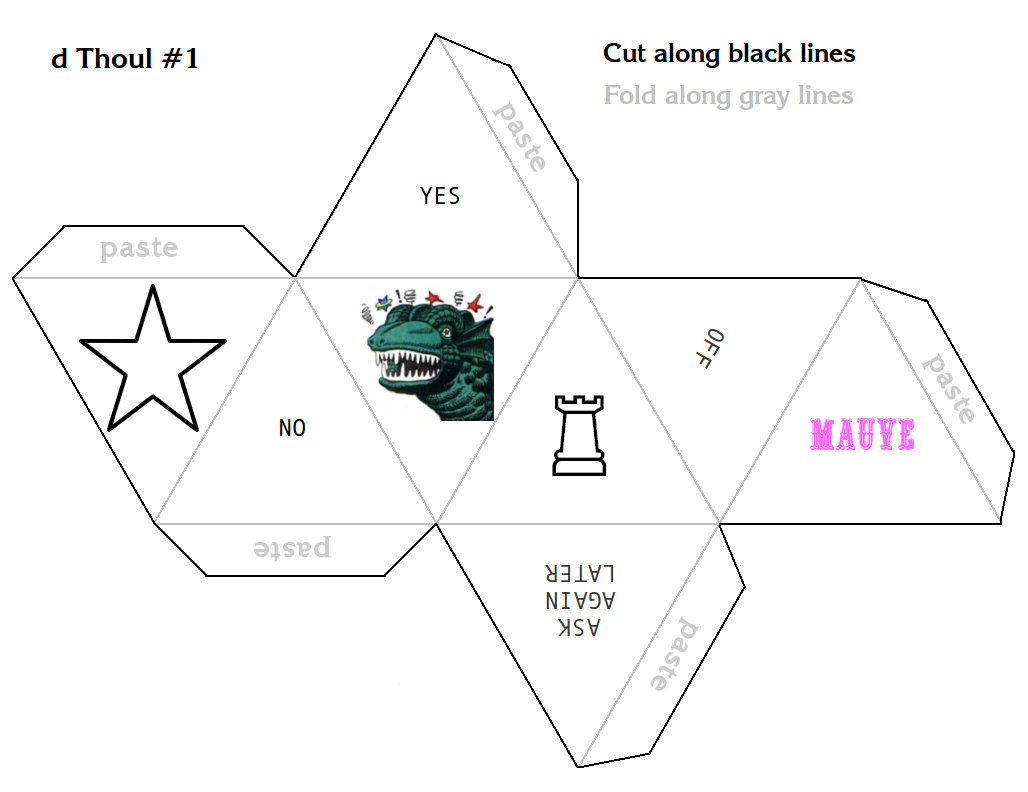
You humble host intended this to commemorate the blog's 100th post; however, due to the interview with Daniel Griego, this is the 101st post.  Regardless, your humble host provides his beloved readers with two 'specialty' dice (some assembly required).  Can there possibly be a use for them?

This image is not intended to foster belief in the occult

Void where prohibited