Sunday, August 4, 2013

Snake Mountain


The Masters of the Universe Role Playing Game allows for only one adventure.  This tends to support the notion that the game is a board game rather than a genuine role playing game.  The 'adventure' consists of the player characters looting Snake Mountain in an effort to retrieve the 'Crown Jewels of Eternia.'  The denizens of Snake Mountain are adverse to this and conflict is thus engendered.  Players can assume the roles of He-Man, Teela, Orko, Ram-Man, Man-at-Arms, or...Fisto.  Stratos makes a cameo appearance in the rules, but he is not a playable character.

The game includes a map (or board) “representing the catacombs of Snake Mountain.”  A slightly modified image is provided below for your edification.  Take a few minutes to stock it for your own purposes or avail yourself of the encounter tables.

Snake Mountain according to the good people at FASA circa 1985
The game comes with ten treasure “markers,” one of which represents the Crown Jewels.  They are randomly distributed – face down – upon the blue stars.  The object of the 'adventure' is to locate the Crown Jewels and remove them from the environs of Snake Mountain.  If an encounter occurs in a given room, the adversary (either character or monster) starts on the red star of that room.  If there are several adversaries, are they stacked on the same square?  The rules are silent.  Why are there red stars in rooms where there is no chance of an encounter?  Again, the rules are silent.

Here is a directory; location names have been changed for entertainment purposes only.


When player characters cross the Bridge (location 52), they are attacked by the weapon in the Armament Room (location 49); it is the equivalent of a rifle.

There are four encounter tables:  standard, special, character, and monster.  For each of the tables, 1d6 is used with a possible modifier according to a particular location.  For instance, in location 47, the result of 1d6 would be added to four and the result checked on the standard encounter table.

Standard Encounter Table

Special Encounter Table

Character Encounter Table

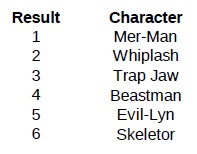
Monster Encounter Table

The monsters on the 'monster encounter table' are inventions of the game designers and are not associated with MOTU continuity.  Also, how these monsters are depicted in the rulebook differs from how they appear on the cardboard 'playing pieces' included with the game.

GORMAN

PLAMYDON

ZUVA - REX

Sunday, July 28, 2013

From Here To Eternia

Masters of the Universe Preview, 1982, Artist: Curt Swan and/or Dave Hunt

When most people think about the He-Man mythos (assuming they think about it at all) they recollect the 1983 Filmation series, but the Masters of the Universe had a history before the series – one with significant differences from what would become 'official' canon.

When He-Man was just an action figure, mini-comics accompanied MOTU merchandise.  Although called mini-comics, the early ones were more like mini-story books, with a single graphic covering most of each page and a few lines of text beneath.  Regardless, the point was to provide the basis of play – a narrative stage that established a fictional environment, the identities of the characters, and the ways in which they interacted.  Alfredo Alcala was the artist for the first series of mini-comics and Don Glut was the author.  Glut is a man with a variety of talents and interests.  Listing his many creations is beyond the scope of this post; however, as an example of his inventiveness, allow me to say he is the person responsible for Tragg and the Sky Gods (among other Gold Key titles).

“They will add to your strength, use them wisely...”
In the mini-comics, He-Man hails from a primitive tribe.  Having “jungle-bred strength,” he leaves his tribe because “Evil forces exist on our planet Eternia.”  It turns out that Eternia is a post-apocalyptic world.  After He-Man rescues “the Sorceress,” she provides him with vehicles and devices (and boots it seems) that “were made centuries before the Great Wars by Eternia's scientists.”  Notice in the illustration above that the Sorceress has green skin and is adorned with serpent-motif accessories – symbolic of knowledge.  The snake costume would become associated with Teela.  At the time Glut wrote these stories, no female characters were planned for the toyline; when Teela and the Sorceress were included, they were represented by the same figure.  As a result, the distinction between the characters was less than clear.  Teela was considered to be a “warrior-goddess.”

Note the golden unicorn fighting Skeletor
Below we see Skeletor's origin according to Glut and Alcala.
“...magic fires, created by ancient scientists and sorcerers...”
The notion of two 'magic swords' that join together to create an artifact of great power is very reminiscent of Filmation's earlier Blackstar series.

In 1982, still prior to the Filmation series, DC Comics published actual MOTU comic books.  These were written by Paul Kupperberg  who (along with Jan Duursema) created Arion, Lord of Atlantis prior to scripting the MOTU comics.  At the time, Arion was your humble host's favorite title.  Alas, it was Kupperberg who implemented the idea of Prince Adam as He-Man's “secret identity.”  Keep in mind that Kupperberg's version of Adam had incredible strength.

So, He-Man is a blond, incredibly strong dude with a Dutch boy hairstyle and Prince Adam is a blond, incredibly strong dude with a Dutch boy hairstyle.  You would think that people would be suspicious.  Oh wait, Prince Adam has a cowardly green-and-yellow tiger who talks while He-Man has a courageous green-and-yellow tiger who talks.  Yeah, I guess that's enough to throw off anybody.  Another thing I dislike about Kupperberg's Eternia is the technological disparity between the aristocracy and the peasants.  To my knowledge, Skeletor never capitalized on this.

In late 1982, Mattel approached Michael Halperin to write a 'bible' for the Filmation series.  Halperin came up with the good idea of Adam/He-Man's mother being an astronaut from Earth, but not all of Halperin's ideas became canon.  In Halperin's story, Evil-Lyn, Beast Man, and Tri-Klops were originally 'normal' Earth humans (and Beast Man's name was Biff – no lie).

If there was any one thing that ruined MOTU for me, it was Orko.  I appreciate the 'need' for a comic relief character, but why Orko?  I'd rather have Gwildor.  For that matter, a dozen Trobbits would be preferable to Orko.  It is Halperin we have to thank for Orko; however, in Halperin's bible he's called “Gorpo,” which is a more fitting name I think.

Halperin seems to have been familiar with D&D.
Where else would he get 'quasit' from?  Halperin also includes dwarves, trolls, gnolls, manticores, wyverns, basilisks, and giant centipedes in his bible.  In the following passage, we are told that Beast Man can supposedly control orcs.

Orcs (or at least creatures called orcs) appear in one of the later mini-comics.

“Orcs” in masks.  Can you tell they're evil?

Skeletor doesn't use this ability often enough in my opinion.
Skeletor, “Dark Lord,” channels Darth Vader

Sunday, July 21, 2013

When Is a Role Playing Game Not a Role Playing Game?

Image from BoardGameGeek

An established RPG publisher with a proven capability for adapting licensed properties obtains the RPG rights for a popular toy-line/TV cartoon.  What could possibly go wrong?

...

I can only speculate as to the reasons, but with The Masters of the Universe Role Playing Game (hereinafter MOTU RPG) published by FASA in 1985, I can emphatically state that things went wrong; very, very wrong.  The person ultimately responsible for allowing the game to be sold in its final form ought to be removed from gene pool and forced to plant saplings for the rest of his life in partial atonement for all of the trees killed for this thing's manufacture.  Toilet paper would have been a far more worthwhile product for all of that wood pulp.

But hey, I can't complain!  I can squeeze a few a posts out of this atrocity!

The cherished reader will kindly note that the MOTU RPG link above goes to BoardGameGeek and not RPGGeek.  The worthies associated with those sites have deemed this product to be a board game, not a role playing game.  Their logic is valid; MOTU RPG has no rules for character generation and allows for only one playable scenario.  Nonetheless, I will treat it as a role playing game because that is how the game identifies itself.  Of course, even as a board game, this thing is a travesty...a travesty of a mockery of a sham of a mockery of a travesty of two mockeries of a sham.

Here's what I think happened.  It's only supposition, but it's the only version of events that permits me to believe that human beings – while fallible – are not inherently evil and the universe is not a cold, dismal place of unceasing despair.  Anyway, FASA gets the rights to publish a Masters of the Universe RPG, but it needs to be introductory – and therefore simple – because the age requirement will be “8 and up.”  A full-fledged RPG suitable for 8-year-olds is a tall order, but they had the idea of putting out a simple game, one the kids can grasp, then follow up by publishing an 'advanced' version that addresses everything a 'real' RPG needs to address.  Hey, it worked for other RPGs.  I think they then had trouble making the game simple enough and – with deadlines and whatnot – a less than ideal set of rules was inflicted upon purchasers of the game.

Included with the box was a card with the title “OOPS!”  It read:
We goofed on the magic spells. When you read over the Character Record Cards, you will find that there are spells listed that do not appear on the Magic Spells Table. These spells are for an advanced version of the Masters Of the Universe Game and are not used in this game.

The Masters Of The Universe Advanced Role-Playing Game should be released in the fall of 1986. To make sure you are informed of the release of this game, just fill out the form below and send it to us. You will receive a catalog of FASA products now, and when the advanced game is ready, a letter informing you it is available.
Not surprisingly, the “advanced version” never saw the light of day, and the world is left with a sad mess of rules for MOTU RPG.  Compounding matters was that the rulebook is presented in a comic book format illustrated by the professionals at First Comics.  Now, in and of itself, game-rules-as-comic-book is a good idea, or at least can be.  However, making layout alterations to accommodate eleventh hour rule changes is difficult enough normally, but when when the layout is a comic book page, a last minute rule change is downright impractical.  It is thus that we are left with the likes of the following:

...My Friend Player...
I guess the rules for 'illusion dust' were too complicated, so they used a panel to indicate that one of the game tokens is extraneous.

Alas, some transgressions are unforgivable.  Please, PLEASE, just say no to ALL CAPS.

WTF? ...should be maded?
I guess the Gods of Eternia removed the proofreader.
YES, MUCH OF THE TEXT OUTSIDE OF THE ILLUSTRATED PAGES IS IN CAPITAL LETTERS EXCLUSIVELY.  MAYBE IT WOULD NOT BE SO BAD IF THERE WERE OCCASIONAL PARAGRAPH BREAKS, BUT THEN AGAIN, MAYBE NOT.  THIS GIVES ME A HEADACHE.

Use a question mark when you say that son.
In the comic book, the Sorceress summons 'the player' and He-Man explains the rules (such as they are).  'The player' is meant to be a reader identification character representing the target demographic.  Apparently, the target demographic is extremely androgynous youth.

Can this kid be any more effete?
Seriously, what were they trying to accomplish?  Did they use an epicene cipher so as not to alienate girls who might want to play a He-Man and the Masters of the Universe game?  Really?  All they managed to do was alienate people who don't wear eye-liner, or they would have if the game was worth a damn.

Sunday, July 14, 2013

Super Rules for Superhero 2044


L to R:  Spy Smasher, Bulletman, (the genuine) Captain Marvel, Minute-Man, Mr. Scarlet     
Image from the cover of America's Greatest Comics #1 (public domain)

In the sixth issue of Different Worlds (Dec 79/Jan 80) appeared an article written by the inestimable Brian Wagner, “Super Rules for Superhero:  44.”  According to Wagner:
As enjoyable and interesting game it is, it's not without its rough spots.  The basic systems of the game work well but there are parts which need to be elaborated upon or outright changed.
These “rough spots” did not permit Superhero 2044 to enjoy a decided popularity, much less maintain a significant market presence after other games in the genre – more polished games – were published.

In the article, Wagner addresses what he considers to be the shortcomings of the game.

First, he provides supplementary details about some of the organizations with which player characters may choose to associate.  (Discussed, to some extent, in an earlier post.)
Köln Institute:  It was your humble host's supposition that Superhero 2044 creator Don Saxman included the Institute as a background option – a way for player characters to obtain services provided by the alumni organization at the cost of a tithe and by following a code of ethics.  Wagner supplies information on enrolling in the Institute during play.  A complete program lasts two years and the cost and commitment are substantial; 20,000 Psuedodollars and two six-hour blocks five days per week, respectively.  In addition to the alumni benefits, graduates increase many of their requisite scores by 1d4.
The Hunters Club (called the Hunter Club in the rulebook):  Wagner indicates that the weekly allowance mentioned in the rules is 80 Psuedodollars.
Science Police:  Again, your humble host thinks that Saxman intended this entity more as a plot device rather than an organization to which player characters would want to belong, especially as Science Police operatives “are psychoconditioned to remain loyal.”  Yikes!  Still, Wagner presents details for the benefit of characters who choose to be operatives.  Training is similar to that provided by the Köln Institute and an operative's weekly salary starts at 600 Psuedodollars.  Also, when on missions, operatives are subject to “dangerous encounters” (i.e., deathtraps).
Uniquex:  Wagner states that this organization will purchase “germ plasm of proven merit” from Uniques.  The price paid can be 100 - 3,500 Psuedodollars depending on a modified die roll.  It is possible that Uniques with “common” abilities may not have their germ plasm accepted at all.  Regardless, each Unique can only submit germ plasm once; there's no returning to the well.

With regard to combat, Wagner recommends the use of hit locations for direct physical attacks as well as projectile attacks.  He also supplies a 1d20 hit location chart as opposed to the 1d10 description in the rules;  percentages remail the same, but a separate roll is not needed for determining right or left limb.  He also recommends 1d20 rather than 3d6 be used for hit determination.

In terms of damage, Wagner recommends a variable range of damage through the use of dice rather than applying “flat blocks of damage” as specified in the rules.  Although the rulebook discusses recovery from injuries, Wagner addresses the monetary costs associated with hospitals.  Aside from room costs, Wagner explains medical expenses as a function of Psuedodollar “Cost Per Vigor Point Repaired.” For instance, medical expenses for a limb injury are less than that of a head injury when both locations have lost the same amount of Vigor.

Wagner also provides “The Quick Deathtrap Resolver.”  The rule book presents an example of a deathtrap, but does not provide any advice on devising them.  Wagner accurately states that his method “reduces it all down to an unromantic die roll,” but at least it is a method and, as he also says, “it is quick.”  In a game  like Superhero 2044, one needn't apologize for an unromantic die roll.  Anyway, Wagner suggests a 'saving throw' where a requisite value is multiplied by 0.75 and that is the number or less needed on a roll of 1d20.  To determine which requisite must be used to escape a given deathtrap, 1d12 is rolled.  More than one requisite may be indicated; if so, the values are averaged for saving throw purposes.