Thursday, September 12, 2013

Inspiration: Curiosities of the Icelandic Sea


Islandia; Abraham Ortelius, circa 1590

Here we have a map of Iceland created by Abraham Ortelius in the tail end of the sixteenth century.  More information than you could possibly want about this map is available here.  Ortelius displays various nautical features – most of them 'sea monsters' – and labels each with a letter of the alphabet, 'A' through 'Q' (excluding 'J').  The reverse of the map provides information regarding each of the entities so labelled.  In the descriptions below, italicized text represents a direct quote from Ortelius' material; everything else is my commentary.  For terms of measurement, it is assumed that one 'cubit' is equivalent to 18 inches while one 'ell' equals 4 feet.


A. NAHUALIf any man eat of this fish, he dieth presently.  It has a tooth projecting ten-and-a-half feet out from its head.  This tooth has the same anti-poison properties as the Unicorn's horn.  This monster is 160 feet in length.  We know this creature as the narwhal; however, narwhals do not grow to such lengths, their teeth do not possess any unusual properties, and consumption of its flesh is not typically fatal.


B. ROIDER – This is a fish 520 feet in length, which hath no teeth.  The flesh of it is very good meat, wholesome and toothsome.  The fatte of it is good against many diseases.


C. BURCHVALUR – This creature hath his head bigger than all the body beside.  It hath many very strong teeth, whereof they make Chesmen or Tablemen.  It is ninety feet long.
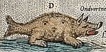


D. HYENA or SEA HOGGE – Ortelius refers us to Olaus Magnus for information.  According to Olaus, this monster has “four feet like a Dragons, two eyes on both sides of his Loyns, and a third in his belly inkling toward his navel.”


E. ZIPHIUS (perhaps XIPHIUS, the sword fish) – This is an horrible sea monster, swallowing the blacke seale at one bitte.  Rather than the swordfish, science equates this 'monster' with Cuvier's beaked whale.


F. ENGLISH WHALE – It is 120 feet long.  It hath no teeth, but the tongue of it is 28 feet in length.


G. HROSHUALUR or SEA-HORSEIt often doth the fishermen great hurt and skare.


H. WHALE – Specifically, the greatest kind of Whales, which seldome sheweth it selfe.  When it does appear, it seems more like a small island than a fish. It cannot follow or chase the smaller fishes, by reason of the huge greatnesse and waigth of his body.  Nonetheless, it is able to catch fish and sustain itself by a naturall wile and subtilty.


I. SKAUTUHVALUR – This fish is somewhat like a ray or skaite but an infinite deale bigger; it seems like an island when it appears and it overturns ships and boats with its massive fins.  It is altogether full of gristles or bones.


K. SEENAUT or SEA-COW – These gray creatures sometimes leave the water and feed on the land as a herd.  They are able to live in the water by virtue of a little bagge hanging at their nose.  Should this bag break, they live upon the land as other cattle.


L. STEIPEREIDURA most gentle and tame kind of whale; which for the defence of the fishermen fighteth against other Whales.  It is forbidden by Proclamation that no man may kill or hurt this sort of Whale.  It has a length of at least 150 feet.


M. STAUKUL or SPRINGUALIt is so called of leaping or skipping.  It is a very dangerous enemy to seamen and fishers; and greedily seeketh after mans flesh.  It has been known to stand all day upright upon its tail for reasons not established.


N. ROSTUNGER or ROSMAR – This creature is somewhat like a sea-calfe.  It walks on the sea bottom with its four, short feet. His skinne may scarcely be pearced with any weapon.  It sleeps for twelve hours at a time in a curious fashion – hanging by his two long teeth from a rock or cliff.  These teeth are at least four feet long, but the length of his whole body is 56 feet.  Rostungur is Icelandic for walrus.


O. HUALAMBUR or SPERMACETI PARMACITTY – This is a semiliquid, waxy substance found in the heads of Sperm Whales.  It was much sought after by whalers.


P. TREES – These are tree trunks which have been pulled up from Norway by force of winde and violent tempest.  After being tossed to and fro and passing through many stormes, they are eventually cast upon the Icelandic shore.


Q. ICE – Great heaps of ice brought hither with the tide from the frozen sea, making a great and terrible noise; some pieces of which oft times are sixty feet.  In some places white beares do fitte closely, watching the silly fish which heere about do play...

Sunday, September 8, 2013

Wizards' Realm


In his Heroic Worlds book, Lawrence Schick has this to say about Wizards' Realm:
Fantasy system with a simplified, back-to-basics approach. Character creation employs a class-and-level system; classes include wizards, spellcasters, knights, and anti-paladins. The combat system is quite simple. Includes maps, a sample town, and an introductory scenario.
Schick also has this to say:
Fantasy system heavily inspired by D&D and set in a saccharin fantasy world where the worst you can say about the monsters is that they're naughty. The main city is such a terrible place, it's called “Mousehole.” The rulebook is printed sideways in a barely legible “script” typeface.
Both descriptions pertain to Wizards' Realm; however, the latter appears as the entry for a different game – Wizards' World – which immediately follows the listing for Wizards' Realm.  Perhaps Schick inadvertently switched the descriptions?  Well, no.  While Wizards' World has an introductory scenario (of a sort), it lacks maps and a sample town.  Also, the combat system for Wizards' World is no simpler than that for D&D.  So, we have two different descriptions for Wizards' Realm and none for Wizards' World.  (By the way, Wizards' World is available for purchase from Lulu.)

Schick makes no claims to perfection, but this Wizards' Realm/Wizards' World error highlights the problem of relying upon the information he presents in Heroic Worlds.  The first description is an even-handed and accurate representation of the game while the second description is laced with derision.  In which other entries does the opinion of “grumpy” Schick prevail over that of “professional” Schick?  What other entries are actually descriptions of completely different games?

Aside from being mean, the second description is wrong on several points.

The remark “heavily inspired by D&D” is one of disdain.  Yes, with regard to Wizards' Realm, the remark is true, just as it is true for many fantasy games from that era (especially from small publishers).  Wizards' Realm isn't any more derivative of D&D than other games of its class.

Rather than calling the Wizards' Realm setting “a saccharine fantasy world,” I would say “an intentionally nondescript fantasy world.”  Like any proper role-playing game, Wizards' Realm provides the GM and players with “latitude in shaping the world...”  The meager background that is provided is rather bland with a 'Tolkien vanilla' aftertaste.  Admittedly, the presentation of the game is sometimes 'cutesy.'  For example, two of the sections of the book are “Monsters 'n' Critters” and “Coin o' th' Realm.”  I'm not a fan of the 'cutesy' presentation, but I don't think it causes the setting to become “a saccharine fantasy world.”

I honestly don't know how Schick developed the notion that “the worst thing you can say about the monsters is that they're naughty.”  Here is a passage from page 9:
     Since a show of weakness is considered a sign of cowardice, bogeys often fight with an animal fury, and will choose to die on one's own sword rather than be taken a prisoner.  The lone bogey-man is then a most dangerous foe, for he will fight to the death over the smallest conflict.  Such beastial [sic] rages have given rise to the erroneous rumors of cannibalism and other outrages ascribed to their kind.
The above paragraph does not convey “naughty” to me.

The sample town (not “The main city”) provided with the game is named Mousehole, “pronounced `muz'l´ -- only an out-of-towner says `mouse-hole!´”  Of course, nothing prevents the GM from changing the name if so desired.  Sometimes, real-world place names are silly, so I would be disinclined to change it.  Besides, there has to be a reason it's called Mousehole; that reason could easily become the basis of an adventure.

Although the cover of Wizards' Realm is displayed in a 'portrait' orientation (see image above), the internal pages are presented in a 'landscape' orientation (or “sideways” as Schick has it).  The 'typeface' might best be described as no-frills, sans serif electric typewriter circa 1981.  It is most certainly not “script” and legibility is not an issue.  That being said, marginalia appears throughout the book in the form of “Realm elvish” – a substitution cipher of 'elvish' symbols.  This is certainly illegible in that it uses a non-standard alphabet – even the book refers to it as “gibberish” – but this is merely occasional marginalia, not the main body of the text.

Wizards' Realm was published in 1981 by 'Mystic Swamp' and written by Cheryl W. Duval, Niels Erickson, William G. Murphy, and Clifford Polite.  Alas, Schick neglects to list Ms. Duval as a creator in the Heroic Worlds entry, even though Wizards' Realm credits her for “original concept” in addition to writing.  If Schick is to be believed, a second, 'ring-binder' edition was released in 1983.  I suppose that's a 'binder with rings' as opposed to 'in the darkness bind them.'

Wednesday, September 4, 2013

What is your Action Guide Style?


In Gregory L. Kinney's World Action and Adventure role playing game, 'Action Guide' is the equivalent of Game Master.  In the Official Guide, Kinney discusses the various Action Guide 'styles' or archetypes.  They include The Technician, The Executive, The Director, The Delegator, The Developer, and The Dictator.  Now – if it were me – I would have used 'The Decider' instead of The Executive and 'The Designer' instead of The Technician because alliteration makes everything better.  Also, I probably would have used 'The Definer' instead of The Dictator because it sounds nicer.  Rather than re-word Kinney's descriptions, I present his own words.


Sunday, September 1, 2013

It's 2013, Do You Know Where Your Cyberpunk Is?

or

The Future Ain't What It Used To Be (Part II)

Johnny Silverhand

In 1988, R. Talsorian Games published Cyberpunk, “The Roleplaying Game of the Dark Future.”  What is meant by “Dark Future” is the near future with rampant social decay and technology.  How near?  How about twenty-five years, a quarter of a century?  That ought to be long enough to posit credibly a cyberpunk dystopia.  Of course, that means the “Dark Future” is now.  Although many might consider the present to be 'dark,' it's certainly not cyberpunk dark.  While it's still 2013, it may be entertaining to take a look back at a look forward to now.

Cyberpunk was designed primarily by Maximum Mike Pondsmith, a storied game designer who was inducted into the Origins Awards Hall of Fame in 2006.  He remains involved with the latest iteration – Cyberpunk 2077.  The first edition of Cyberpunk has come to be known as Cyberpunk 2013, in reference to the date of the setting.  Only two years after 1988, the second edition was published.  Not mush had changed, but the date of the setting had become 2020.  Apparently, thirty years – rather than twenty-five – was a more appropriate distance in time for the setting.

Welcome to Night City is the 38 page sourcebook included with the initial game.  It is this book – having the subtitle A Sourcebook for 2013 – that provided the inspiration (and material) for this post.  Pondsmith intended for Referees to use their own cities as the location for their adventures and Night City was presented to demonstrate “the feel, not the substance” of a Cyberpunk setting.  Realizing that not all Referees would live in a big city, the book provides a map of a Night City that could be used as a substitute for the urban challenged.  With a nod to one of the founders of the cyberpunk genre, the Night City map shows the W. Gibson Memorial Freeway, even though the reports of Gibson's death seem to have been greatly exaggerated.

Here are some highlights from the past two-and-a-half decades:
1990Fall of South Africa.  There is little or no communication from Southern Africa for the next four years, although terrible atrocities and genocidal wars are reported.  (Fortunately, the end of Apartheid was not so violent.)
1991 Gorborev regime purges last of old Soviet hardliners.  (Well, the year is right, but everything Soviet was purged.)
1992 – ...the Euromarket, is formed...A common currency unit, the Eurodollar, is also established... (Well, the eurozone wasn't established until '99 and the euro didn't enter circulation until '02.)
1996Lawyer Purge:  irate citizen (sic) lynch hundreds of crimal (sic) defense attorneys.  (Good times.)
1997Mideast Meltdown.  Tensions in the Middle East escalate to nuclear exchange.  Iran, Iraq, Lybia, Chad and the Arab Emirates reduced to radioactive slag.  World oil supply reduced by half.
2000 – Wasting Plague hits the U.S., Europe, killing hundreds of thousands.
2004 First Corporate War
2007Second Corporate War
2008An orbital war begins between “Euros” and the “Yanks”, until Luna Colony massdriver drops a rock on Colorado Springs.
Communication technology has improved dramatically since 1988.  Let's see what the sourcebook says.  “A [postage] stamp in 2013 costs 75¢.”  (Yay!  We're saving 29 cents!)  Check out this thing called a “Fax”:
This is the letterwriting mode of the future...You may type your letter in using the keyboard provided, have it scanned from your own laser disk, or use the built in scanner to “read” any typed letter.  The faxed copy is then transmitted by wire to a local post office in your destination area, where it is automatically typed off, inserted into an envelope, and delivered by letter carrier to the mailbox.
Golly!  Newspapers now make use of fax technology; they are printed for customers directly from 'newsboxes' for 1¢ per page.

Cell phones have a convenient size, but memory-autodial can be expensive!

By the way, today Rachael Tyroll filed with Arasaka Security Corporation her report on the 'Iron Sights' Booster gang that Arasaka bankrolls (for now).  (Rachael Tyroll / Rachael Tyrell – get it?)
I guess Rachael doesn't have spell-check

Another example of “let's change a letter so they won't sue us:”
"Balron"