Sunday, August 16, 2015

My Amazing High Fantasy Adventure (Part 1 of 2)

My Amazing High Fantasy Adventure
by


I will be releasing two new books this month from the world of High Fantasy. But before I talk about those books, I would like to give you a few highlights about my most amazing adventure with the role-playing game, High Fantasy. I hope you will find most of this story interesting and very familiar to your own RPG experience. One thing that I have noticed since writing the game in 1974; however, is that "trolls" sure have gotten a lot bigger since then.

My adventure begins in 1974 at Indiana University and then continues today in New Jersey where I have spent most of my life. You see, I am a Hoosier at heart wrapped in the attitude of a Jersey Boy.

Like most of you, I picked up the first publication of Dungeons and Dragons and tried to play it. I found it to be a beautiful concept, but very flawed and nearly unplayable. Now we are talking about the original edition. Slow down "trolls", this is not meant to be disparaging of the well thought out and fun game Advanced Dungeons and Dragons that came later.

In high school, I played every board game available. I also created games, including a world social event game that was taught in my high school as a social studies elective. So, when I picked up the first edition of D&D, it seemed unfair and out of balance. In game theory there needs to be a balance and a fairness for the players. One of the things I saw early on was that the Wizard character was more powerful and not equal in gaming terms with the other characters. Weapons were not historically accurate in their abilities, ranges, etc. Again, these were flaws I noticed among others and as we all know, were fixed in later editions.

I wrote my own set of rules at Indiana and played and tested them with friends at the school's gaming clubs. I had no intention of ever publishing.

After graduating college, two of my closest friends and avid High Fantasy players passed away suddenly in a boating accident. My wife and I took the game to the local copy business and printed up 100 copies with a beautiful orange cover where I drew the artwork. There are two amazing facts in that last sentence; one, I never drew anything in my life until then and the cover looks like it; and two, my wife was one of the earliest RPG female game players. So there non-believers. There were actually good looking women playing RPG right from the beginning.

We took our game around to conventions where we set up a large gaming table filled with handmade castles. We had complete working models of all of the adventures that were published later. We took the money made from sales and reinvested to print more booklets. We started to get noticed. We started to have lines waiting at our booth to play the game.

I think we got up to about 1,000 copies sold when we got our first big break. An Indianapolis company called Twinn K saw us and wanted to diversify their chain of products. Who was Twinn K you ask? Twinn K was the largest distributer of racing tires and accessories in the world. I guess I should also mention I am talking about "slot cars". As slot cars were vanishing, they needed to diversify. Most importantly, through the kindness of the owner we went from selling products locally to suddenly being distributed to every hobby store in America over night! We ditched my hand drawings, went to black and white, and then quickly moved to glorious full color.

Now we were selling! Now we could take those adventure stories we had been playing and publish those, also in glorious color. (Fortress Ellendar and Moorguard)

If you stayed with this story so far hang on because it is about to take off.

Reston Publishing noticed we were selling about 5,000 copies with each printing and offered to take over our publishing. Who is Reston Publishing you ask? Reston Publishing is Prentice Hall. At that time and maybe still today, Prentice Hall was one of the biggest publishing houses in the world. We had no choice but to leave the very good and kind folks at Twinn K and move our publishing. With Reston Publishing in charge, we went from every Hobby Store in America to every Book Store the next day.

That is about the time D&D, who was now being distributed by Random House, took notice. Arneson had left TSR and was suing his co-authors company. This was tough. Random House distribution did not like Prentice Hall distributers and there was a lot of discussion with Book Stores about where and how our books should be displayed compared to AD&D.

Are you still with me? Now the adventure becomes fantastic. At this point in my life my wife and I are still in Indianapolis. We were now making a meager living publishing and expanding our line of books. From my original hand drawn cover we were now starting to commission Jim Steranko for cover art. He did our "Wizards and Warriors" cover and posters. He also did a second commission, but it was stolen from the offices of Reston right before "Goldchester" was published. That is a fantastic story onto itself. I will tell it later.

So a guild of wizards noticed my books in the bookstores. These wizards lived in New Jersey and worked for the David Sarnoff Research Center in Princeton. Wait a minute. I am mixing up my gaming terms with real life. These wizards were actually referred to as "Fellows" and research scientists in real life. What is the David Sarnoff Research Center you ask? It was the premier "think tank" in America for consumer electronics owned by the RCA Corporation.

Why were these wizards...I mean scientists interested in me? Well, if you look through the old reviews of my line of books, I almost always get high praise for my adventures. One of these adventures in particular, "Murder in Irliss," had caught their eye. This is a play-your-own adventure. Unlike other adventures, it is very complex in its making. Even more important than that, I had written another adventure called "Circle of Truth" that was about to be published. It is incredibly complex in its structure. I did not know it at the time, but one of the scientists told me I based the structure of the book on "State Event Processing" whatever that is supposed to mean. All I know is that I wrote it and it was perfect for "Interactive Movie" making. And interactive movies and advancing digital media is what all the wizards were interested in at that time.

My wife and I moved our little family to the Princeton area and went to work on advance uses of interactive media. So what happened? Why did I disappear for thirty years? Why am I releasing a new book now?

It has been over thirty years and I did not even know anyone remembered my books until my grown children found blogs and references on the internet. If there really is any interest I will publish the answers in part two of this blog. I promise I won't wait another thirty years to answer your questions.

In the meantime, dare to start a new adventure by checking out our website at www.highfantasybooks.com and remember to like us on Facebook www.facebook.com/highfantasybooks. Our new books are set to be released on August 25th and will be available on Amazon.

Wednesday, August 12, 2015

The Realm of Dungeons & Dragons


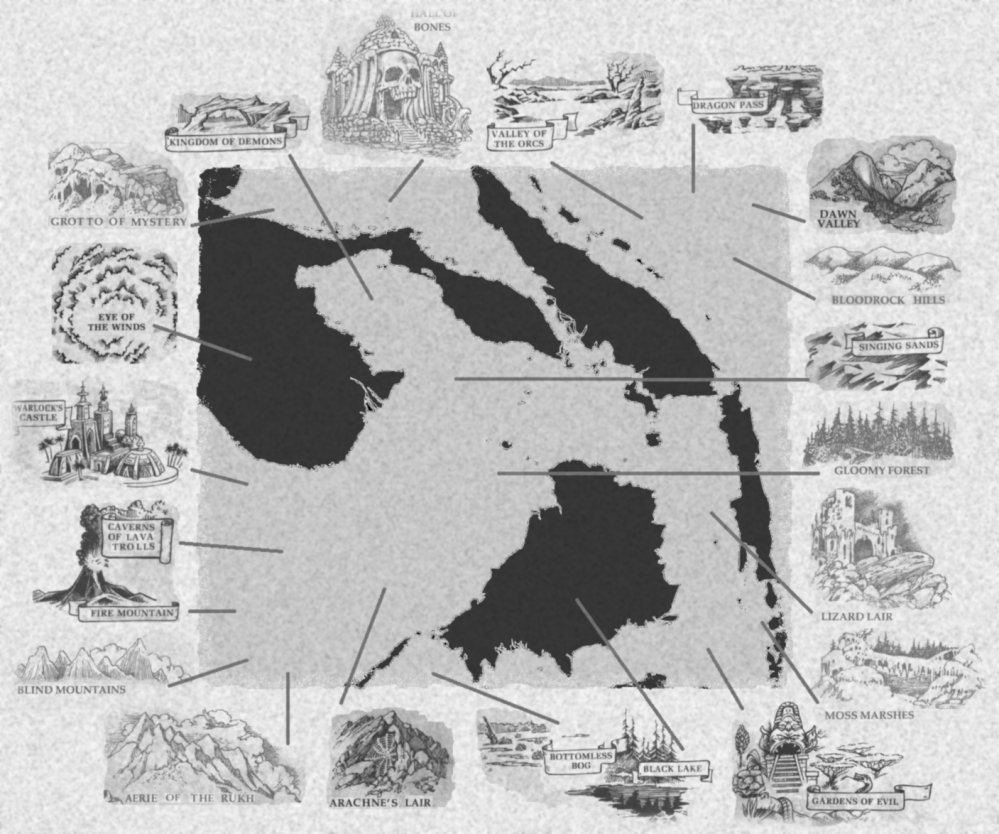
Not surprisingly, the Dungeons & Dragons television series from the Eighties prompted various merchandizing efforts.  Among the affiliated products are two sticker books released in the United Kingdom.  Aside from the requisite stickers and scenic pages upon which the stickers could be posed, each book has a simplistic choose-your-own-adventure type narrative that employs the imagery of the stickers.  There are also maps...or things that purport to be maps.  The word “map” appears in the lower, right-hand corner of each example, but it looks self-conscious, as though uncertain if it really ought to be there.  Actually, each example is an array of illustrations of locations; some of the locations are mentioned in the adventures.  While perhaps not altogether accurate, “map” nonetheless possesses the dual advantages of brevity and convenience.

In the first adventure, from 1985...
Kelek, who is an evil sorcerer, has stolen THE FORCE!  THE FORCE is a strange power held in a star-shaped crystal.  It is the magic which makes this world possible by separating it from the other world which you know outside.
Anyway, Kelek “has broken the crystal into several pieces and hidden them.”  The objective is to recover the pieces.  When the stickers representing the pieces are properly arranged on the map, each “points to a letter in one of the names on the map – and they spell out a message!”  Through this means, the reader/player successfully completes the adventure.

In the second adventure, from 1987, the naughty Kelek has “stolen and hidden” the Spirit King's “magic armour and sword.”  The objective is to recover these items.  The sticker representing the Spirit King's mail shirt is to be placed on the map as is evident below.


The 'maps', as presented, may not be especially useful for a role-playing game setting.  However, the illustrations could easily be incorporated into a more traditional map graphic.  For a crude example, I have taken a map of Indonesia, shifted it around, and 'reversed' land and sea.  I have used the illustrations to create a border around the map, with lines pointing to their precise positions.  Borneo has become “Black Lake,” so I expect the scale to be somewhat less than that associated with Indonesia.


Sunday, August 9, 2015

Magic in DragonRaid


As mentioned previously, DragonRaid did not find much favor in the Christian community, despite the fact that game's primary intent is to promote Christian growth.  Opposition to the game was seemingly due to the inclusion of “magic.”  The sentiments of anti-D&D spokesperson Sharon Sipos were presented in a 1986 newspaper article:
Sharon Sipos, a Chesterfield County housewife and mother of two who has spoken out against the game on about 30 radio and television programs throughout the nation, believes D&D is not merely a game, but an "alternate lifestyle." Mrs. Sipos said she is engaged in "a spiritual battle," led by the Lord.

She is opposed not only to Dungeons & Dragons, but to all fantasy role-playing games, including a "Christian" version of D&D called Dragon Raid. She said Scripture is used as magic in that game, which she believes is associated with the occult.
Unfortunately, since we don't have exact quotes from Mrs. Sipos; we must assume that the article's author accurately conveyed Sipos' meaning.  Alas, the “spiritual battle” faltered as D&D encroached upon popular culture during the past three decades.  Role-playing games are no more of an “alternate lifestyle” than golf and Christianity is not incompatible with D&D.  I noticed that the Christian Gamer's Guild had a booth at Gen Con this year.  (Maybe it's a regular thing, but this is the first year I noticed it.)

That “magic...is associated with the occult” may not be an astounding revelation, but it exemplifies Sipos' logic.  The occult is bad and magic is associated with the occult; therefore, magic is necessarily bad.  This is akin to saying:  arson is bad and fire is associated with arson; therefore, fire is necessarily bad.  If magic in a Christian RPG is bad, then what is an appropriate level of tolerance?  Harry Potter?  Stage magicians?  Fairy tales?

Sipos was correct when she said that DragonRaid uses Scripture as magic.  Players can recite bible passages which cause effects such as  starting a fire or temporarily increasing a character's attribute.  For instance, Ecclesiastes 11:1 (i.e., “Cast your bread upon the waters...”) gives a character “enough food for one day.”  To be clear, this is not “real life” magic.  In a flyer/letter included with the boxed game, DragonRaid creator Dick Wulf wrote:
It's good to memorize Scripture.  You never know when you'll need to recall God's truth.  Though scripture always works powerfully, it does not work magically in real life.  In DragonRaid, however, Bible passages sometimes have mysterious effects in order to create a fun incentive for memorizing scripture.  This means when your character says a verse or passage from the Bible by memory, the OverLord provides help.  It is in no way meant to encourage the study or practice of magic.  Using magic in any way, for any purpose, is absolutely forbidden (see Deuteronomy 18:10-12).
(The peculiar use of bold type is just as it appears in the original.)  These 'magic' verses are called WordRunes.  They each have a difficulty level, a requisite attribute minimum, and restrictions on when they may be used.  Difficulty level based upon the number of words in the passage.  WordRunes of difficulty level one have less than twenty words; higher difficulty WordRunes have more.  Each character has a 'Sword of the Spirit' rating that indicates the highest difficulty level of WordRune that the character can utilize.  However, as the character's Sword of the Spirit rating increases, WordRunes of lower difficulty levels are no longer available.  A character “may not use a WordRune more than three levels below his Sword of the Spirit rating.”

In addition to creating a magical effect, a successful recitation of a WordRune provides the character with “maturity units,” a form of experience points.  Typically, Sword of the Spirit and the requisite attribute each get one maturity unit.  Once twenty maturity units are collected, the applicable rating or attribute increases by one step.  Maturity units can also be earned by completing adventures; however, characters can also lose maturity units by “being caught in a dark creature sin enchantment” or “by being disobedient to the OverLord.”

All DragonRaid players are expected to use WordRunes.  Of course, the main purpose of the WordRune mechanic is to help the players become better Christians by memorizing Bible verses (thereby, one supposes, understanding them and applying them to real life situations).  Yet this is a mechanic where the character benefits from the player's effort – not due to role-playing or rolling dice or even spending narration points (or whatever).  Imagine employing this mechanic as the standard means of spellcasting in some other role-playing game.  The Bible need not be used, but the text should be appropriately atmospheric.  (I would consider using the works of William Blake – spiritual without being oppressively religious.)  Any character would be capable of magic, but only if (and to the extent) the player worked to memorize and recite the material.

Sunday, July 26, 2015

Civil Rights in Trollworld


In the recently released Deluxe Tunnels & Trolls, Section 7 (“The Hostile Opposition”) offers the following statement:
          In fantasy role-playing games, as in all storytelling of heroic derring-do, the good guys battle the bad guys. The forces of order verses (sic) the forces of chaos. If you want to invoke the shade of Joseph Campbell, it’s because solar heroes must slay the evils lurking in darkness to restore light to the world. It is the quintessential Us versus Them...
          For better or worse, 21st Century relativism complicates this simple equation. Monster rights have become civil rights in the Empire of Khazan, and Trollworld harbors many sentient beings who don’t consider themselves monsters...They may, in fact, consider the armies of the “good kindred” to be the monstrous ones when they come rampaging through their territory and looting their dungeon homes.
(See Eric Goldberg's essay, “A Hole in the Ground,” for a similarly 'teratocentric' viewpoint.)  The “good kindred” (also known as the humanoid kindred) consist of T&T 's standard array of player character races:  humans, elves, dwarves, fairies, leprechauns, and hobbs.  However, T&T has never been adverse to 'monsters as player characters'; there are even published adventures intended exclusively for 'monster' characters.  For the 'non-good' kindred, T&T uses the term illkin.  (I would have gone with fellkin.)  The entirety of Section 7 is only three pages;  Section 13 (“Other Playable Kindreds”) provides 23 pages of details about the other sentient races of Trollworld.

The “illkin” are divided into three categories:  familiar, less common (or “scarier”), and extraordinary (or “terrifying”).  For familiar illkin, “Charisma ratings emphasize personality first...,” while for extraordinary illkin, “Charisma ratings reflect implied threat of force...”  Regarding the in-between category, 'less common' illkin, “Charisma ratings immediately favor neither personality nor force, but fear or disgust can be triggered very easily.”  Among the ranks of the familiar illkin, there are centaurs, gnomes, selkies, vampires, et al.  The less common illkin include (but are not limited to) harpies, 'flesh' trolls, minotaurs, and policani (like a centaur, but think 'dog' instead of 'horse').  In the extraordinary illkin category, we find gargoyles, demons, ghouls, 'true' trolls, et al.

Section 13 includes at least one paragraph of information on each of the illkin.  Among various interesting tidbits, we learn that gnomes have a “rather bipolar mix of clever wackiness and entrenched bitterness.”  Also, their collaborations with dwarves “inflate gnomish perseptions (sic) of themselves as one of the unsung greats...”  Rapscallions – “disreputable hobbs...notable but for their scraggly hair and squinty dark eyes,” were known in prior editions as “Black Hobbits.”  Kobolds are “natural shapeshifters, but their choice of forms is limited to small animals like cats, dogs, foxes, and small children.”  Also, kobolds “can briefly project their consciousness into small fires...and both speak and listen.”

Finally, in Section 14, we are given a discourse on Trollworld languages.  We are told:
Many character types are mentioned here that do not appear in the playable list of non-human kindreds.  These sections were originally generated at completely different times.  Because both lists are optional elaborations, we did not try to reconcile the two lists for this book.
Well, the authors can't claim they were pressed for time.

Included in this section is a language chart designed for a d100.  Given that one of the game's  design goals was not to require 'non-standard' dice, this represents a complete betrayal of everything Tunnels & Trolls stands for.  In the fifth edition, Ken St. Andre wrote, “I've tried to keep only 6-sided dice in use in T&T, but multi-sided dice are becoming more available, and I feel their use in this table is somewhat justified.”  In the deluxe edition, no 'justification' is offered.  Just how hard would it have been to create an equivalent table for six-siders?  Not hard at all.  In fact, below is a 'd6-ified' version of the dT&T table.


The dT&T language table has some differences from earlier versions.  Instead of “Orcish,” we have the more politically correct “Uurrk” (also called Uurrkish).  Whereas balrogs (now known as “balrukhs”) and dragons once had distinct languages, they now both speak “flame-tongue.”  Similarly, goblins and gremlins had separate languages; now there is merely “Gobble.”  Leprechauns used to speak the same language as gremlins; apparently, they now speak an Elven dialect.

'The Low Tongues' previously had separate listings on the language chart; now they are grouped as 'animal languages'.  Cats and dogs had different languages; now they share “blood speech.”  Once they had separate languages, but now pigs and pachyderms share “herdspeak.”  “These are not really language names,” dT&T assures us, “but simply descriptions covering a wide variety of noises and body movements made by such animals when they are communicating.”

Although it does warrant a paragraph on page 204, “Wizard Speech” is not listed on the dT&T language table.  Fifth edition T&T – where Wizard Speech is listed on the language table – provides the following definition:
Wizard Speech, despite its name, is not known to all wizards.  As a natural linguistic ability it is so rare that less than 1% of the population of the world knows it.  There is a 13th level spell, however, which can unlock the ability to use Wizard Speech in any sentient being.
(In dT&T, the spell is 10th level.)